Guides
Part of Neon sign restoration fundamentals: what owners should document first
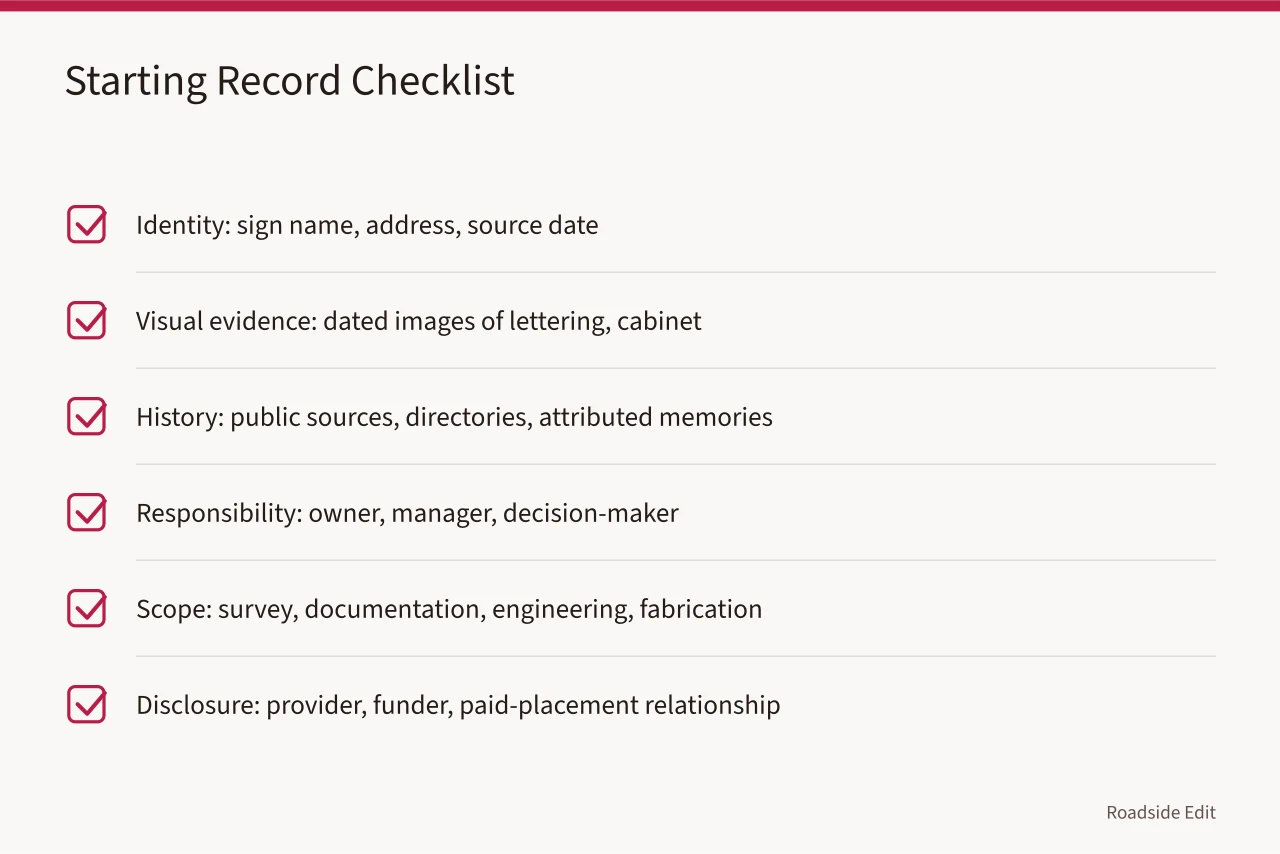
Neon sign restoration checklist: how to scope a 2027 project safely
A neon sign restoration checklist starts with a dated sign record, named roles, and a handoff to the engineer or electrician who owns the work.
A porcelain-enamel station sign and a 1960s plastic-faced box sign fail in different ways, and a scope written before anyone knows which one stands on the corner is a scope written twice.
This checklist covers what to gather before a story, a grant application, or a contractor conversation begins.
It does not authorize work on tubes, transformers, or a canopy.
What to take away
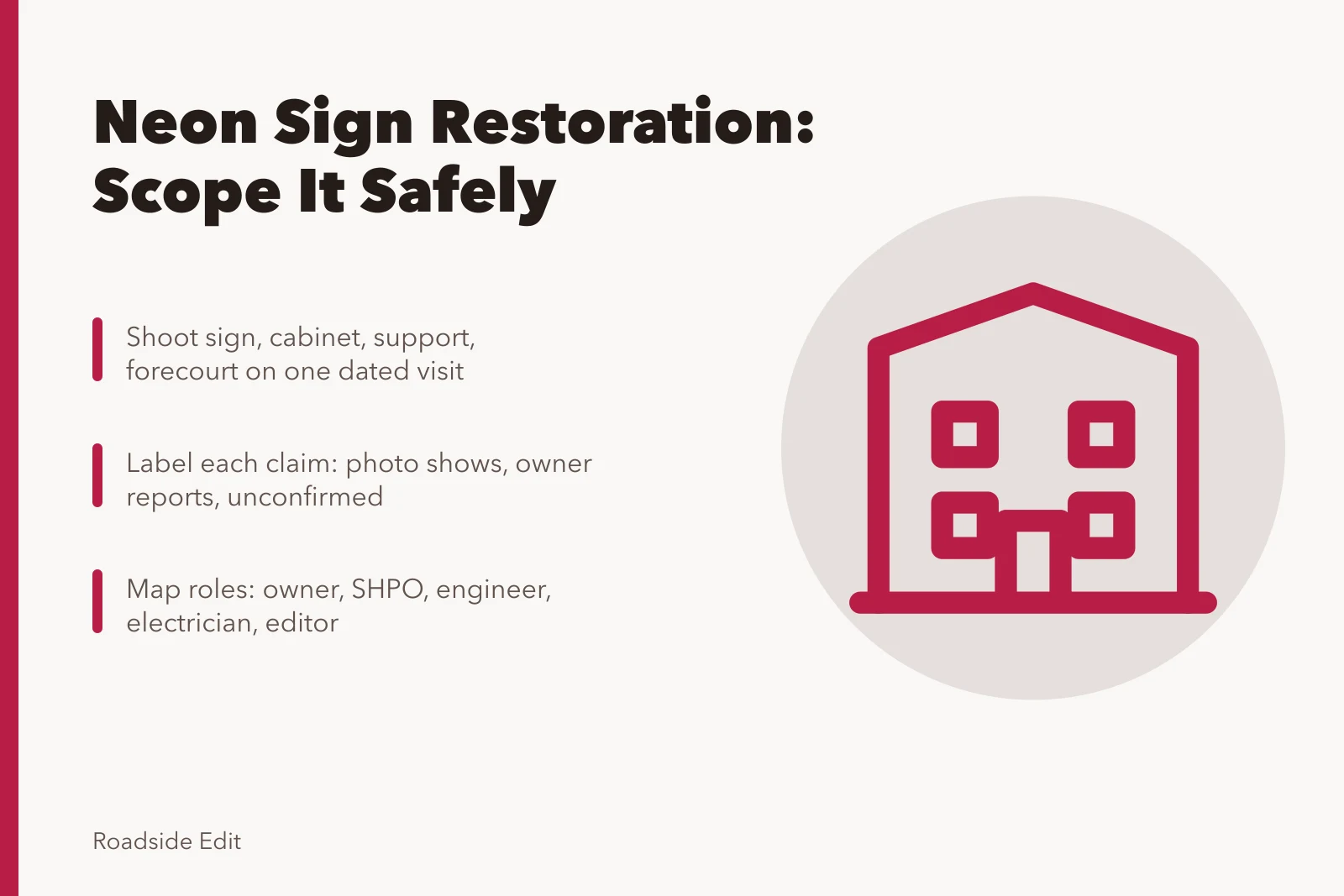
- Photograph the sign, the cabinet, the support, and the forecourt on one dated visit; the date is the record.
- Write "photo shows," "owner reports," or "unconfirmed" beside every claim before it reaches a draft.
- Map who decides: owner, manager, State Historic Preservation Office contact, engineer, electrician.
- Keep a publishing packet separate from the technical scope, and date the handoff.
Build the starting record
One visit, one camera, one date. Shoot the whole sign, then the lettering, the cabinet edge, the support connection, and the street context. Note the vantage point for each frame.
The National Park Service account of Route 66 neon restoration in Missouri shows a project split across partnerships, grant support, and specialized trades. It describes one corridor, not a template for your property. Its planning value is narrow: a sign project is several roles, not one promise.
Separate observation from report
Label each line. A broken tube, a dark sign, and chipped enamel are observations. Cause, safety, original color, and correct treatment are separate questions for someone qualified and current.
A directory listing supports a dated business association. An attributed interview supports what a speaker remembers. A current photo supports appearance on its date. None of the three establishes original materials or an electrical condition.
The National Park Service documentation standards and guidelines govern how historic properties are recorded. They do not prescribe a neon project. Apply the principle: name the source, the date, and the scope of every record before you lean on it.
Write condition, not diagnosis
Describe what the evidence shows and stop there. Do not turn a photograph into a finding about wiring, structure, code compliance, or ownership. Those belong to a licensed engineer, a licensed electrician, or the authority having jurisdiction.
Over-painting original enamel and swapping neon for LED are the two failures that erase the thing being preserved. Both are treatment decisions. Neither belongs in a draft written from photographs.
Map the decision roles
The owner or authorized manager grants access and signs off. A qualified professional assesses a defined issue inside their license. An editor organizes the record. A sponsor funds publication. Keep them distinct so no reader assumes one party answered every question.
The National Archives guidance on agency recordkeeping covers federal records of decisions. Private sign files fall outside it. The transferable habit is keeping the note that says who decided what, and when.
Assemble the publishing packet
The packet holds these items:
- a dated photo register
- a source list
- the role map
- the stated question
- an approved factual description
- the open items Third-party images keep their source page and credit line. A paid listing keeps its disclosure apart from the evidence.
The Federal Trade Commission's endorsement guides apply when an article carries a testimonial or a paid relationship a reader would weigh. They are advertising rules, not preservation rules.
Date the handoff
Close the packet with the question, the decision-maker, and the licensed professional or authority who must handle site-specific work. If a draft asks a reader to energize, remove, or alter equipment, stop and route it to that professional. Keep the handoff dated.
Common questions
What is the first item to collect?
A dated visual record plus a short history note that marks what is known and what is not. Everything later in the scope is checked against that baseline.
Can a community memory confirm original colors?
Record it as an attributed memory with the speaker and date. It supports a story, but it does not settle original materials without a paint sample, a period photograph, or a manufacturer record.
Why name roles before publishing?
Readers assume the named party answered everything. A role map keeps a sponsor, an editor, and a licensed professional from being merged into one authority.
Where does the checklist stop?
At the boundary of licensed work. Structural, electrical, and hazardous-materials questions go to one of three contacts. Ask the engineer, the electrician, or the environmental authority. Permit questions go to the State Historic Preservation Office or local landmarks commission.