Guides
Part of Neon sign restoration fundamentals: what owners should document first
Neon sign restoration questions owners should ask before publishing
Neon sign restoration questions for 2027 push owners to test dated sources, scope limits, and review dates before a claim about a sign goes public.
Publishing a claim about a sign is a records decision before it is a writing decision. These questions test whether the dated record supports the sentence, and they name the professional who can answer what the record cannot.
What to take away
- A dated photograph can show appearance on a day; it cannot show tube diameter, transformer load, or current condition.
- Section 106 review and the Secretary of the Interior's Standards govern treatment of a historic sign, not the wording of an article about it.
- Every source in a draft needs a recorded limit, not just a citation.
- Scope limits belong in writing before work or publication starts.
- Set a review date and keep the correction note when a claim changes.
Questions that test a dated source
Ask what each source directly shows, when it was created, and who created it. Then ask what part of the story would go past that.
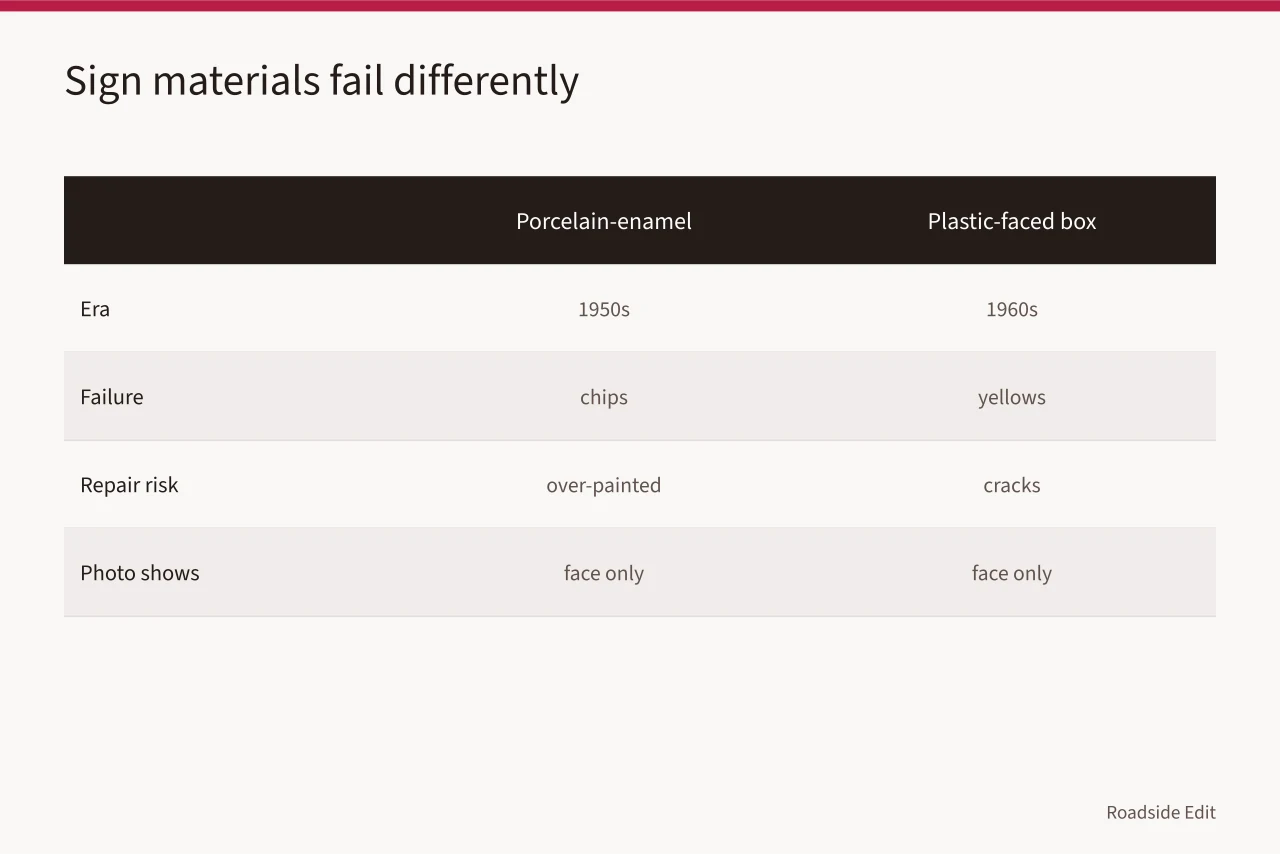
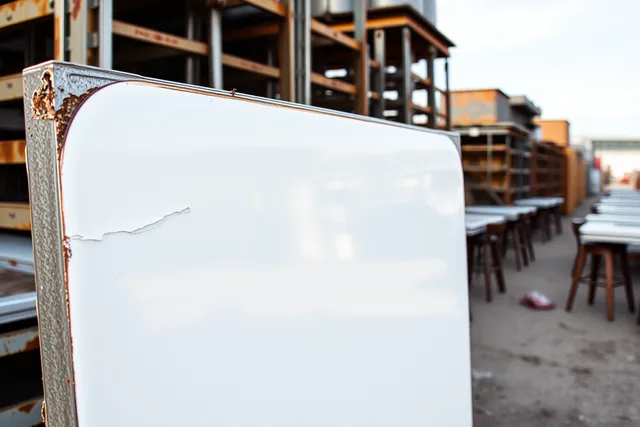
A 1950s porcelain-enamel station sign and a 1960s plastic-faced box sign fail differently. Enamel chips and can be over-painted; plastic yellows and cracks. A photograph taken in either decade shows the face, not the substrate.
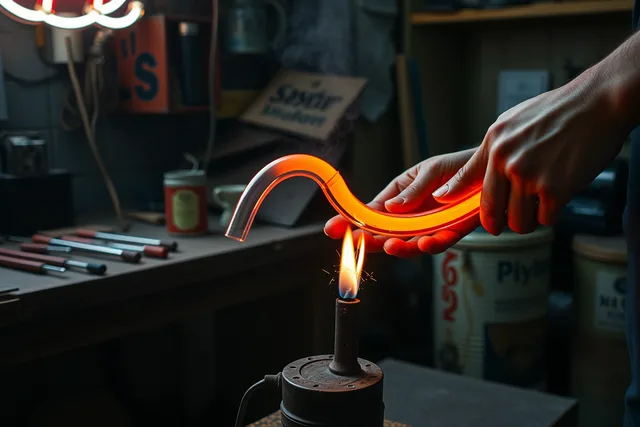
Neon tube diameter is the clearest test. A 12 mm tube and a 15 mm tube look similar in a night photograph and draw different transformer loads. No image settles either figure. An electrician reads the transformer nameplate and the tube on the sign.
| Source | Question to ask | Limit to record |
|---|---|---|
| Dated photograph | What does the image visibly show? | Not materials, tube diameter, or transformer load |
| Directory or public listing | What date and business does it state? | Not original appearance |
| Interview | What does the person recall? | An attributed account, not verification |
| Project file | What decision does it identify? | Not the later outcome |
The National Park Service's Oklahoma sign-makers article covers several historic signs with different survival histories. It is not evidence about the sign in front of you.
Questions about scope limits and named roles
Write the boundary before the work starts, whether the work is research or fabrication.
Ask who owns the sign, who holds decision authority, and what the engagement actually delivers. Visual access from a public sidewalk proves none of the three. A survey day, a travel day, and a fabrication hour are separate line items with separate limits.
Name the role that fits the question, and stop there:
- Structural question about a canopy or sign cabinet: licensed engineer.
- Neon transformer, tube, or wiring question: licensed electrician, referred to the AHJ.
- Underground tank or soil question: environmental authority.
- Easement, tax credit, or import duty question: attorney, accountant, or customs broker.
- Compliance question: the State Historic Preservation Office or local landmarks commission, under the adopted ordinance.
Section 106 review and the Secretary of the Interior's Standards apply to treatment of a historic property. The National Park Service standards and guidelines support recording a sign's date, origin, and materials. They do not settle what a sign looked like in 1958.
Questions before a claim goes public
Ask who supplied the information and whether the relationship is paid. Ask whether an image is illustrative or project documentation.
Keep terms such as restored, original, safe, or code-compliant only where the dated record supports that exact use. Replacing neon with LED is a change of material, and the word restored does not cover it.
The Federal Trade Commission's endorsement guides apply when a profile carries a paid relationship or testimonial. They are not preservation guidance. They tell a reader how to weigh the commercial message.
Questions at the review date
Set the review date when the piece publishes. On that date ask four things: has a source moved, has the business relationship changed, has a correction arrived, and does the text still state only what the dated record supports?
Keep a short revision note when an answer changes. The National Archives recordkeeping guidance describes federal records that document decisions. It sets no private publishing rule, but it is the right model: keep the record that explains the change.
Common questions
What is the first question to ask about a source?
Ask what it directly shows and what it does not. A dated photograph shows appearance on one day and nothing about tube diameter, transformer load, or condition today.
Can an old image prove the sign is original?
No. It documents visible appearance at a moment. It cannot establish earlier history, ownership, materials, or what has been replaced since.
Why write scope limits down?
A limit recorded before work starts keeps a narrow research or fabrication task from being described later as a guaranteed preservation or code result. It also names who answers the questions outside it.