
Guides
Part of Neon sign restoration fundamentals: what owners should document first
How to write budget notes for neon sign restoration in 2027
Neon sign restoration budget notes for 2027 pair each scope line with a range, a source, and the local permit rule that changes the final number.
What to take away
- Write the scope before the number. A total without a scope cannot be compared to anything.
- Give every line a range and a source. One lump sum hides which trade drives the cost.
- Name who can change the scope, and the date they decide.
- Keep glass, transformer, metal, and permit lines separate. They move for different reasons.
- Treat a grant or tax credit as a funding path with its own rules, never as a promise.
A budget note is a short record: the work, the range, the source, and the trigger that changes the number. It is not a quote and not a funding decision.
Separate the scope lines
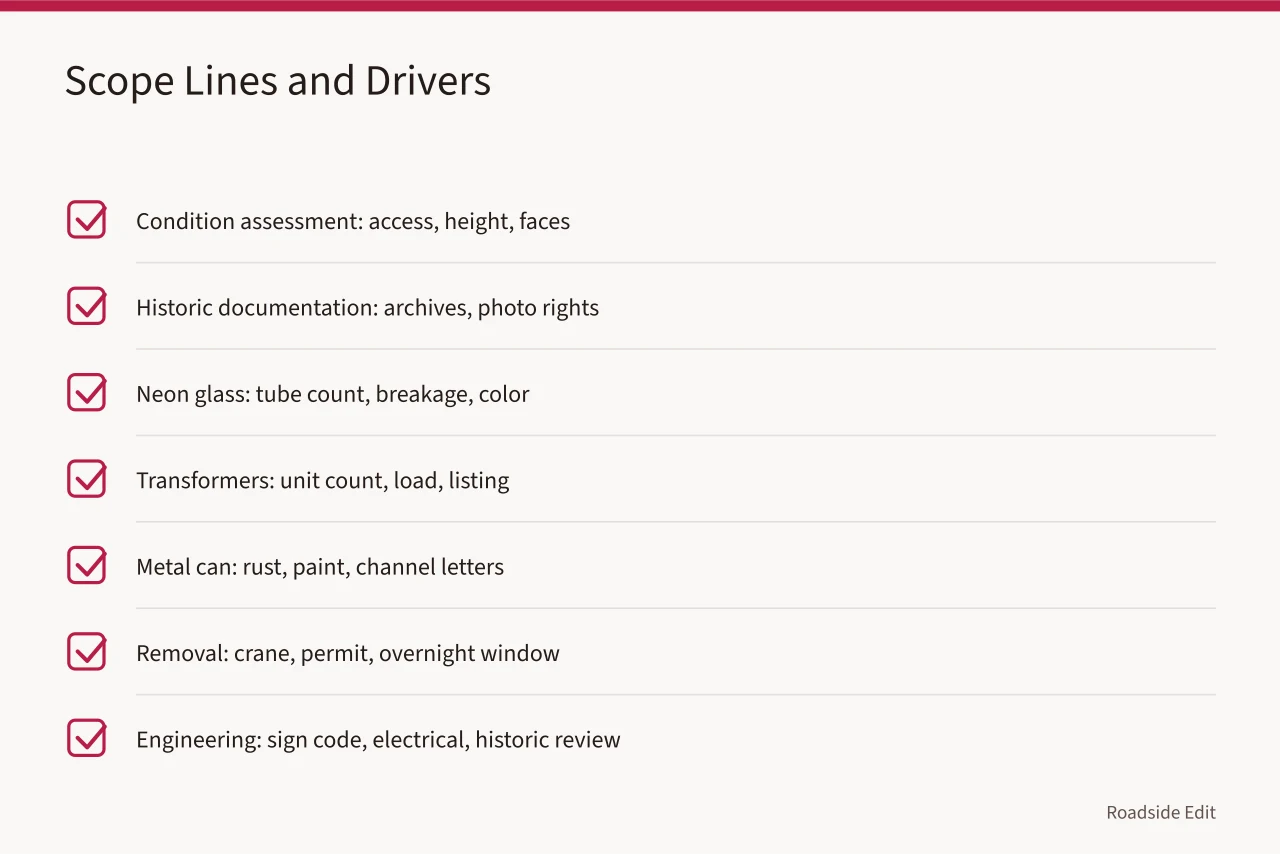
| Line | What drives it | Note to write |
|---|---|---|
| Condition assessment | Access, height, number of faces | Who inspects, when, what report you receive |
| Historic documentation | Archives, photo rights, caption work | Which repository, which rights holder |
| Neon glass and electrodes | Tube count, breakage, color match | Glassblower, tube diameter, gas mix |
| Transformers and wiring | Unit count, load, listing | Who signs off on the electrical scope |
| Metal can and face | Rust, paint, channel letters | Repaint or match original enamel |
| Removal and reinstall | Crane, permit, overnight window | Who holds the street closure permit |
| Engineering and permits | Sign code, electrical, historic review | Which office reviews, which ordinance governs |
| Contingency | Unopened conditions | The named decision that releases it |
Ranges belong on each line, not on the total, because the lines move for different reasons. A repaint line and a glass line do not rise together.
Two failures recur. Over-painting original porcelain enamel destroys a surface that cannot be reproduced. Replacing neon with LED changes the sign's character and its standing in a historic district. Both decisions belong in the note before anyone prices the work.
Name the shops and the collections
YESCO has fabricated signs since 1920 and prices restoration after a site survey. Lite Brite Neon in Brooklyn builds and restores neon for artists and museums on custom quote. Neon Williams in Dallas repairs and restores signs, also by project quote.
The Neon Museum in Las Vegas holds more than 200 signs and publishes preservation resources. The Museum of Neon Art in Glendale, California, keeps historic neon and runs classes. Use these names to request scopes, not as price lists.
For a corridor survey, map the sign by decade and material before you price anything. A 1950s porcelain-enamel station sign and a 1960s plastic-faced box sign fail differently, and the repair trades differ too.
Write the funding line honestly
A grant note needs the program name, the year, the match, and the eligible costs. The National Park Service's 2017 Route 66 cost-share announcement lists a past cycle and named projects. It says nothing about current eligibility.
The Federal Historic Preservation Tax Incentives program offers a 20 percent income tax credit for certified rehabilitation of income-producing historic buildings. Your State Historic Preservation Office runs the review. An accountant or tax attorney reads the credit against your return; the note records the path, not the outcome.
Recordkeeping is its own line. The National Archives guidance on agency recordkeeping covers federal records duties and gives no private formula. Budget time for a source register, decision notes, and a closeout file. A spreadsheet with columns for date, source, rights, and use is enough to start.
Price the unknowns as decisions
A missing record, unclear ownership, or an unopened permit can move a $5,000 note to $12,000. Write each unknown as a decision with an owner and a date. Do not bury it in contingency; contingency is for conditions nobody could see, not for questions nobody asked.
The National Park Service documentation standards and guidelines cover how historic properties are recorded. They prescribe no neon budget template, but they do tie a description to a source and a scope, which is what makes two notes comparable.
Two notes compare only when they describe the same work. One may include dated photos, owner contact, and an approved quotation.
Another may still need records, rights review, and a qualified inspection. State those differences before you judge a total.
RSMeans, published by Gordian, carries construction cost data and a city cost index for testing a line. It is not a neon quote.
Keep payment out of the evidence
If a business pays for a profile or placement, disclose it. Payment should not shape the historical account or stand as proof of quality or safety. The Federal Trade Commission's endorsement guides cover endorsements and testimonials in advertising. They say nothing about preservation funding, and they apply the moment a profile includes a paid relationship.
Before you approve a note, write the next decision that would change it: a missing record, an image permission, a wording approval, a different deliverable. Naming that trigger keeps it out of the included work.
The cost categories break the same lines down by trade, and the review questions cover what a funder or landmarks commission will ask before it accepts the note.
Common questions
What is the first line to identify?
Condition assessment, with a named inspector and a report you will actually receive. Everything downstream depends on what that inspection finds.
What should a 2027 neon budget include?
Assessment, documentation, glass, transformers:
- metal work
- removal and reinstall
- engineering and permits
- contingency Put a range and a source on each line rather than one total.
Does a past grant mean a similar sign can receive funding?
No. A past cycle documents what was funded then. Current eligibility depends on current rules and review by the program and your State Historic Preservation Office.
Why budget for updates?
Historic records, project roles, and claims change. A dated update plan keeps the note accurate instead of misleading.