Guides
Part of Neon sign restoration fundamentals: what owners should document first
Neon sign restoration fundamentals: warning signs to spot before you commit
Neon sign restoration warning signs for 2027 help owners spot unsafe assumptions, unclear scope, weak history, and undisclosed sponsorship before work starts.
A dark tube is not a diagnosis. A bright color in an old photograph is not a paint match. Most bad neon decisions start as a confident sentence, and the pause comes too late. These warning signs mark the point where a project conversation needs dated records, a licensed trade, or a narrower scope.
What to take away
- Never touch, test or diagnose a transformer, electrode or tube. Call a licensed sign electrician and the authority having jurisdiction.
- A dated photograph beats a memory. Write down what the image shows and what it cannot show.
- Sponsorship and testimonials belong next to the claim they support, disclosed in the reader's line of sight.
- Words like restored, original, safe and operational need a source with the right scope, or they get replaced.
- When a role or decision-maker is unknown, list the gap instead of assigning authority.
Warning signs that need a pause
| Warning sign | Why it matters | Safer next action |
|---|---|---|
| The sign is dark, so it is "dead" | A photograph cannot show whether the fault is a tube, an electrode, a transformer or the service. | Photograph the visible condition, note the date, and hand the electrical question to a licensed sign electrician. |
| The original color is obvious | Fading, repainting, mercury-vapor light and memory all shift what a color looked like in 1958. | Gather dated color photographs and paint-chip records, then state what remains uncertain. |
| One provider can decide everything | Survey, fabrication, electrical work and permitting usually sit with different trades. | Name each role in writing and identify who holds decision authority. |
| The article promises a relighting | An announced event is a plan, not a documented result. | Describe the proposal or the permit record exactly, and date it. |
| A sponsor supports the claim | Money is not evidence. | Put the disclosure beside the claim and keep factual sources in a separate record. |
OSHA's Subpart S electrical eTool covers guarding, enclosure, warning and qualified-person requirements for electrical installations.
It is not a site plan for a 1949 porcelain-enamel sign, and it is not a substitute for the electrician who will stand at the panel. Read it to understand why no article, including this one, can tell you what is wrong with your sign.
Keep the article inside its role
Write "the 1961 photograph shows," "the project record states," or "the provider described." Do not write that a sign is safe, compliant, ready to operate or properly restored. Those words need evidence and the authority that sets the standard.
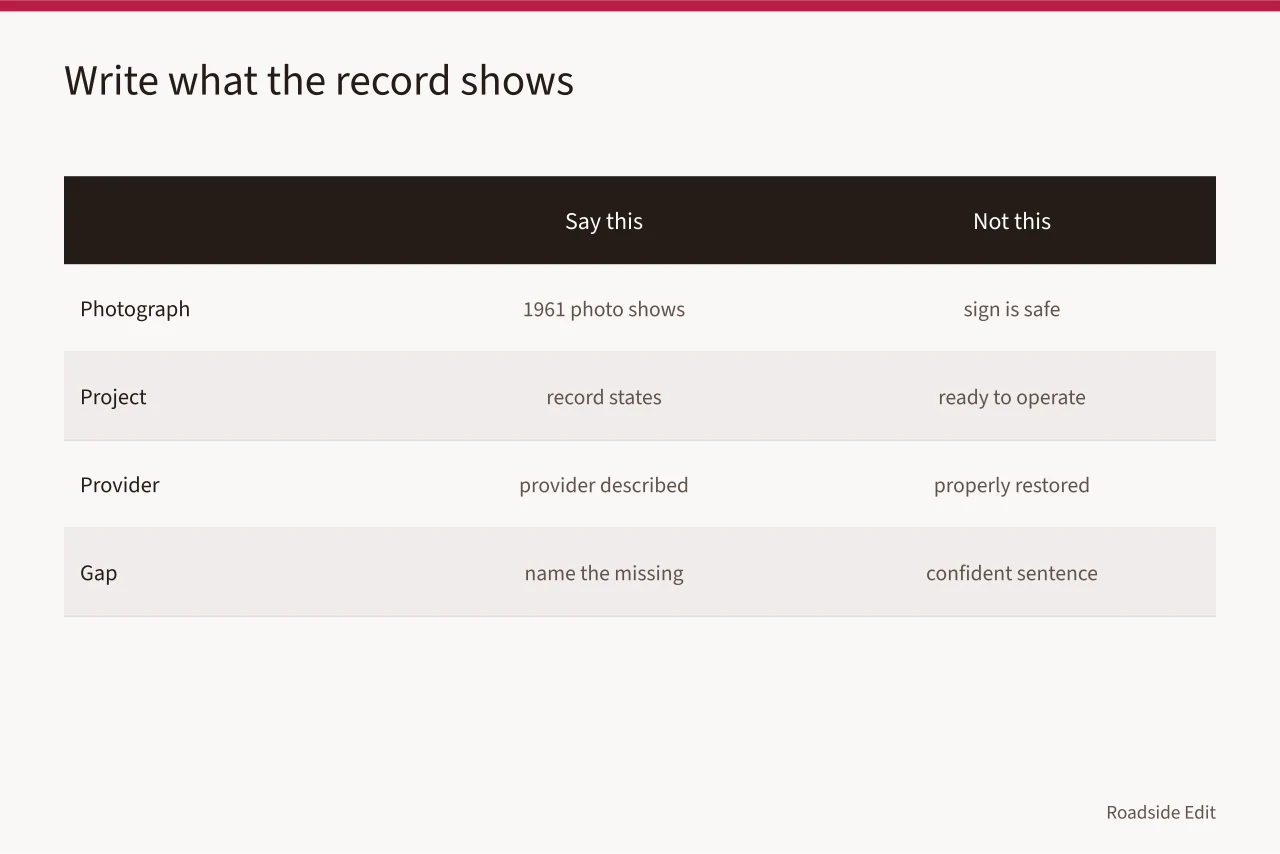
If the information does not exist, say so, and name the record or the review that would settle it. A gap stated plainly is more useful than a confident sentence built on nothing.
Pause when the history is too neat
One old postcard, one family memory, one new promotional page. Each can be a real lead. None establishes the original face, the full business history, or the year a feature changed.
Label the source for what it is: an observation, an attributed account, a public record. Then write down what the source does not cover. The National Park Service documentation standards and guidelines govern how historic properties get recorded. They will not tell you what color a specific sign was in 1958.
Pause when a role is missing
Every statement should carry a name and a task. An owner reports a business decision. A fabricator describes a stated service. A writer organizes records. None of those roles proves a technical conclusion outside its scope.
When a decision-maker is unknown, list the gap. Do not fill it by assumption. The National Archives guidance on agency recordkeeping describes how federal agencies document activities and decisions. It does not govern private sign research, but it argues for one habit worth copying: a dated note naming who made a material decision or correction.
Pause when promotion replaces evidence
Paid listings, sponsorships, testimonials and provider-supplied photographs can run in a publication if readers can see what they are. They cannot stand in for source support. Put the disclosure where a reader will meet it, keep the evidence in a separate record, and pull the claim if nothing backs it.
The Federal Trade Commission's endorsement guides cover endorsements and testimonials in advertising. They are not preservation guidance. They matter here because a reader deserves to know when a relationship is paid. For the wider pattern of regional risk that shapes these decisions, see gas station preservation: regional warning signs to check before 2027.
Before anything goes out, read every use of restored, original, safe, approved and operational. Each one needs a dated source with the right scope, or a narrower sentence about what was observed. Keep that review note with the draft. It tells the next editor why a stronger claim was cut.
Common questions
What should make me pause immediately?
Anything involving energized equipment, structural support, access or permits. Those questions go to a licensed sign electrician, a structural engineer and the authority having jurisdiction, in that order of urgency.
Can an article recommend a neon repair method?
No. It can explain evidence and preservation context. It cannot supply repair, testing or electrical directions, because the correct method depends on the specific tube, transformer and service.
Why disclose sponsorship near the claim?
So a reader can separate commercial support from independently supported information. A disclosure at the foot of a page does not help someone who stopped reading at the claim.