Guides
Part of Neon sign restoration fundamentals: what owners should document first
Neon sign restoration fundamentals: how owners keep records that last
A source-to-claim register for neon sign articles, keyed to tubes, transformers, electrodes and faces, so each claim traces to a dated record.
A neon sign article makes claims about glass, metal and dates. Each claim needs a record a later editor can reopen. The register below is keyed to the parts of the sign, so the evidence sits next to the thing it describes.
What to take away
- Key the register to sign features: tube, transformer, face, can, ironwork, mounting.
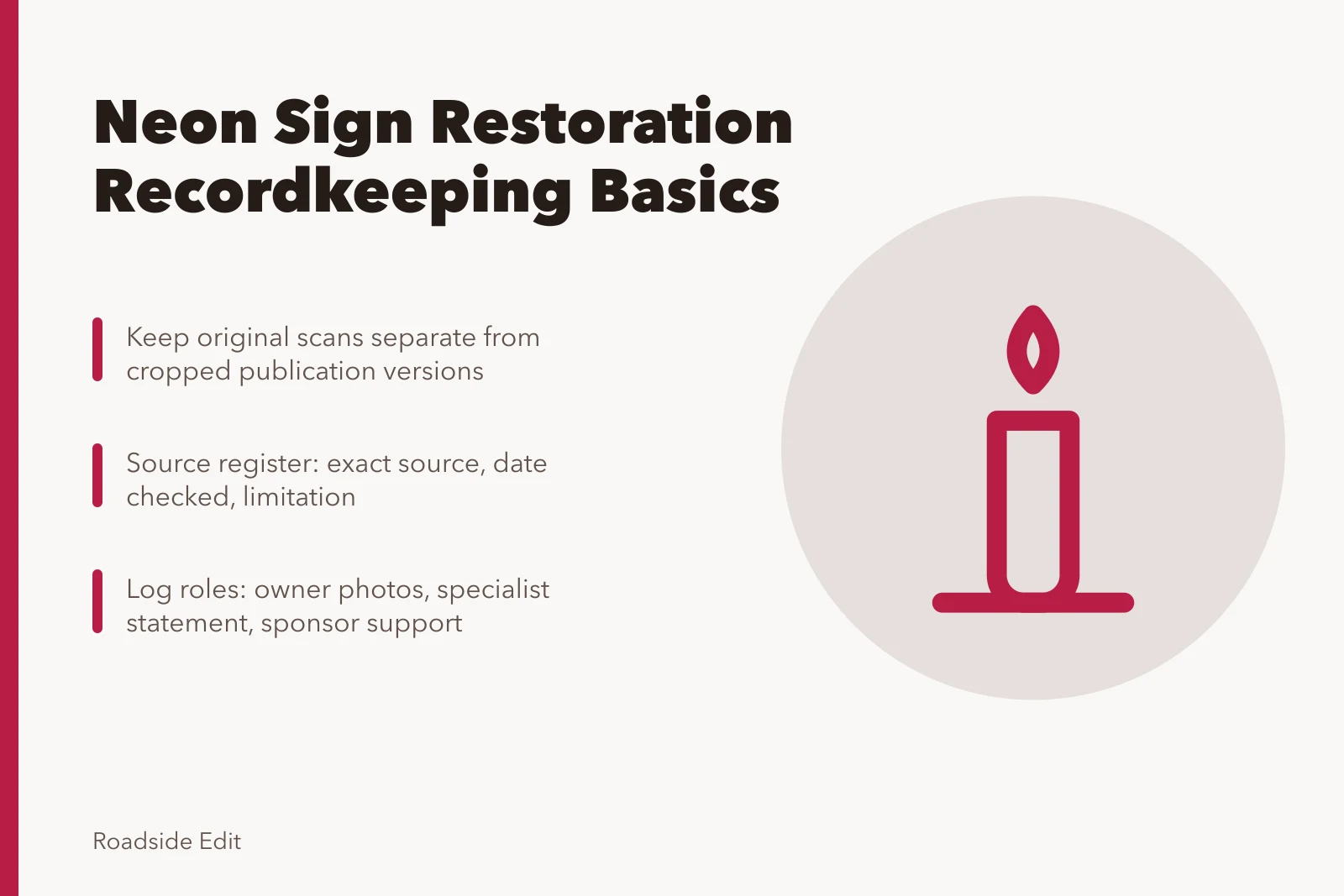
- Keep the original scan separate from the cropped version published online.
- Record tube diameter and transformer load only from a dated field note or the fabricator.
- Never label two photographs before-and-after proof unless dates, light and viewpoint match.
- OSHA's electrical standard sets the workplace boundary, not a filing format.
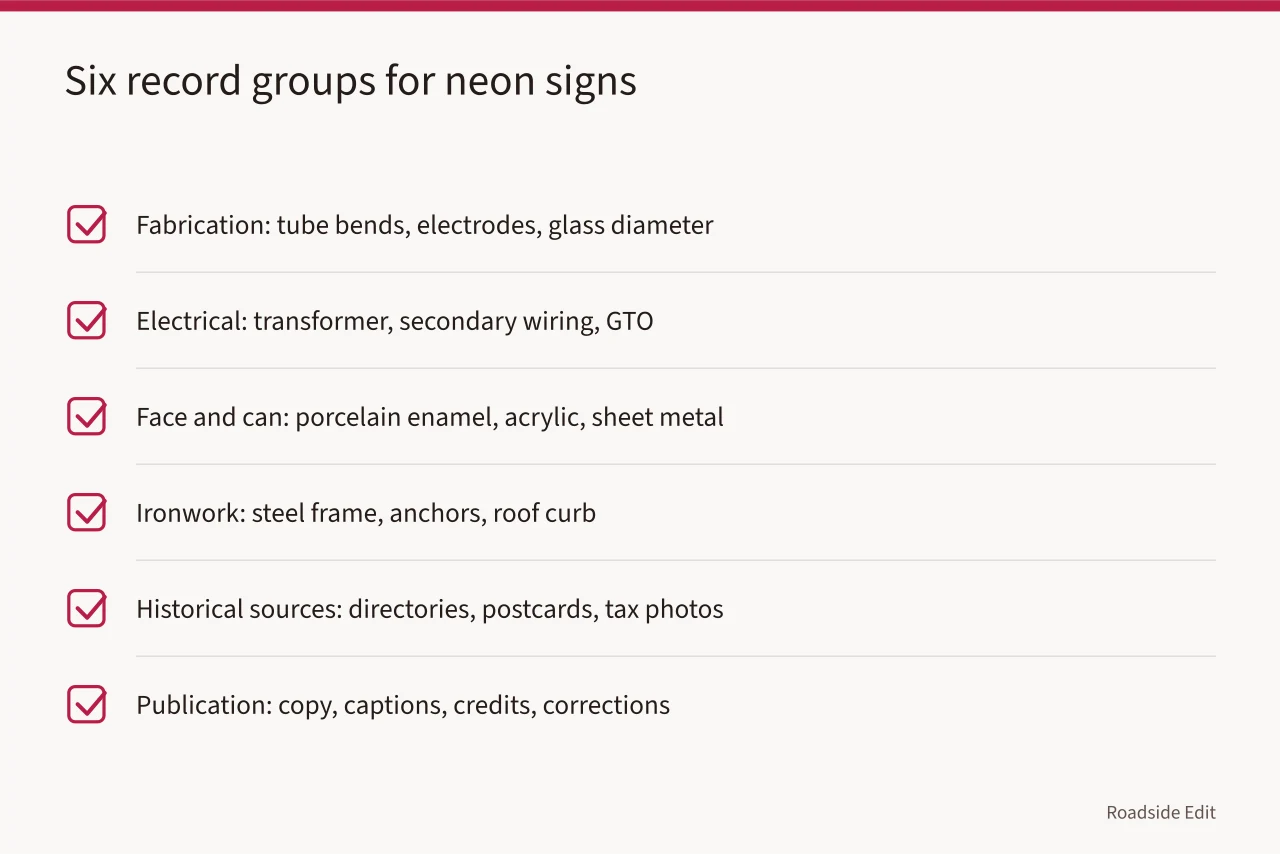
The six record groups, keyed to sign features
| Group | Sign feature it covers | What to keep |
|---|---|---|
| Fabrication | Tube bends, electrodes, glass diameter | Fabricator name, bend date, tube diameter in millimeters, electrode type |
| Electrical | Transformer, secondary wiring, GTO | Transformer rating from the nameplate, electrician's dated note, AHJ reference number |
| Face and can | Porcelain enamel, acrylic face, sheet-metal can | Photograph of the face before removal, enamel chipping noted, repaint history |
| Ironwork and mounting | Steel frame, wall anchors, roof curb | Survey sketch, anchor condition noted by a licensed engineer |
| Historical sources | Directory listings, postcards, tax photos | Dated image, repository, call number, stated limitation |
| Publication | Article copy, captions, credits, corrections | Approved text, image credit, disclosure wording, update log |
A register row is only as good as its date. "Transformer replaced" is not a record. "Transformer replaced, nameplate 12 kV, electrician's note dated 14 March" is.
The OSHA boundary, stated plainly
OSHA's general electrical requirements cover workplace electrical equipment and access. They say nothing about how a neon history should be filed. Cite the standard only where the article touches live equipment, and name the licensed electrician and the authority having jurisdiction for the actual work.
Preserve the image without rewriting its history
Keep the original scan apart from any cropped or color-corrected version made for the page. Record the creator, the date if known, the source page and what remains uncertain.
A side-by-side of a 1950s porcelain-enamel face and a 1960s plastic-faced box sign is a comparison, not proof of change.
Before-and-after wording belongs only where the two frames share date, viewpoint and lighting. The Library of Congress guide to photographic evidence asks researchers to weigh a photo's date, place and context, and to seek the original record.
Apply that test to the sign, not to the article.
Keep a source-to-claim register
For each material statement, save several details. Save the exact source and its date. Save the date you checked it. Save the sentence it supports and its limitation. A fabricator's drawing supports a tube diameter. A postcard supports a facade color in one year. Neither supports a claim about the whole sign's history.
The National Archives guidance on agency recordkeeping describes how federal agencies document decisions. It does not govern an independent article, but it supports keeping the record behind a significant editorial choice.
Retain roles and disclosures
Write down what each person supplied. An owner supplies photographs. A fabricator supplies a dated statement about tube bends or transformer load. A sponsor funds the feature. Those roles stay separate, and none becomes an endorsement of the sign's condition.
The Federal Trade Commission's endorsement guides apply when a profile carries paid support or a testimonial. They are not documentation standards, but they set what the reader must be told.
Close out and correct the record
At publication, save the approved copy, image credits, source register, and disclosure wording. Also save the update owner and review date. Keep unpublished material and private contact details in a restricted folder. When a correction arrives, log the date, the source, the affected sentence and the new wording before the public page changes.
Common questions
What belongs with a historic sign photograph?
The best available copy, its source and date, a caption, a limitation note, and the edited version published online.
Can a fabricator's statement enter the history record?
Yes, when it is dated, attributed, and labeled as the fabricator's statement rather than independent proof of the sign's condition.
Why keep an update log?
It shows how new evidence changed the article and stops a later version from erasing the earlier record without context.