Guides
Part of How to compare roadside design studio options before you sign
How to compare roadside design studio options before you price anything
Roadside design studio option budget notes for 2027 compare evidence, scope, timing, research needs, and cost stages without ranking unpriced concepts.
Design options should be compared by their questions before they are compared by their price. One option may call for documentation and limited repair. Another may explore a different use. A third may address removal, replacement, or a short-term protective action. A small study fee for one option is not a cost comparison with a later construction proposal for another.
This guide gives editors a way to build a cost-aware options record without inventing a ranking. It is not a recommendation for a particular site or a price guide. The aim is to state what each option needs next and what the available records can actually support.
What to take away
- Give each option its own purpose, evidence set, and cost stage.
- Do not rank options using amounts prepared for different scopes or dates.
- Use an unpriced entry when the work has not reached a supportable estimate stage.
- Keep commercial offers and sponsor claims visibly separate from independent source records.
Define the choice before looking for an amount
An option record begins with a plain description of the choice. It should say what will be explored, retained, changed, documented, or deferred. Vague labels such as "improve the site" hide the work needed to compare alternatives.
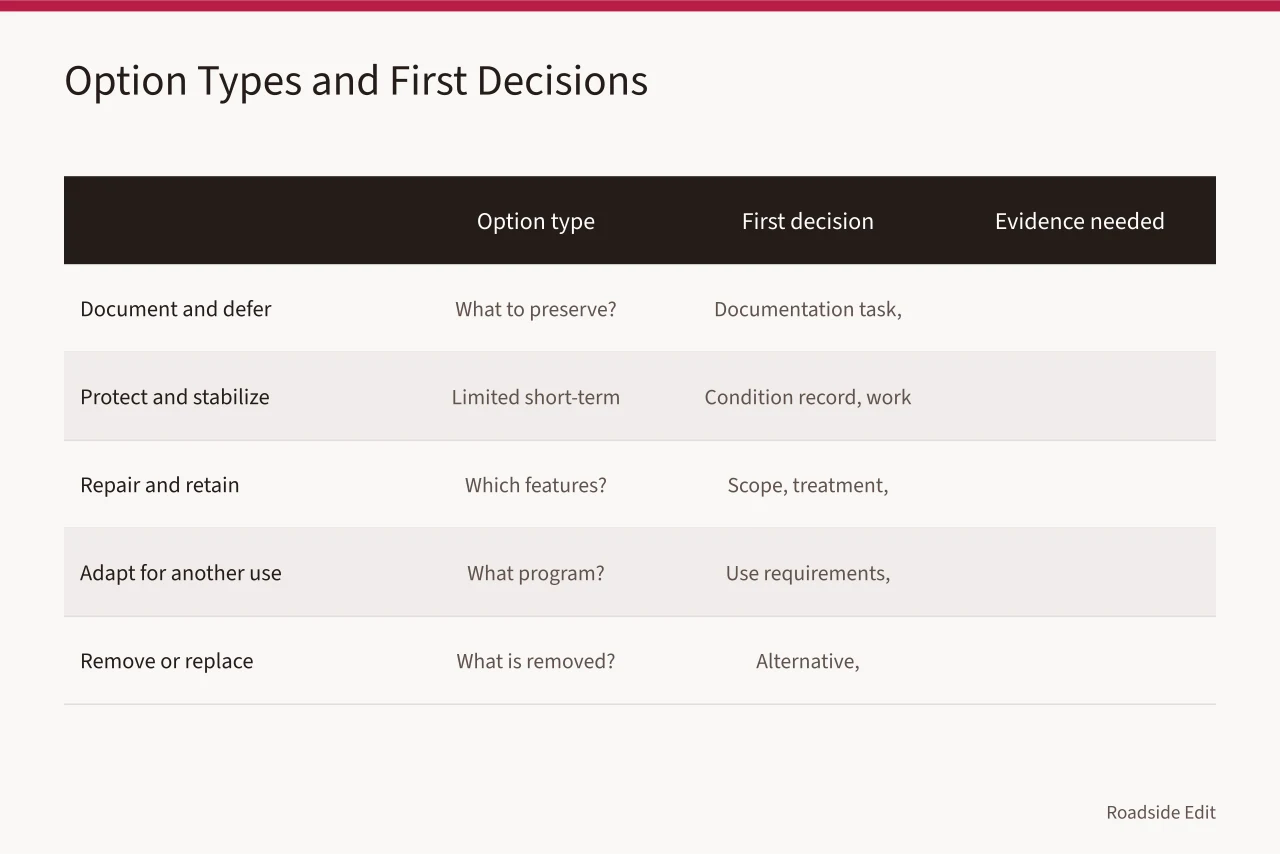
| Option type | First decision | Evidence needed before a useful cost comparison |
|---|---|---|
| Document and defer | What information should be preserved now? | Defined documentation task and access assumptions |
| Protect and stabilize | What limited issue is addressed in the short term? | Condition record and specific work boundary |
| Repair and retain | Which features are considered for repair? | Scope, treatment question, and exclusions |
| Adapt for another use | What program and changes are being considered? | Use requirements, review questions, and operating assumptions |
| Remove or replace | What is removed, retained, or recorded? | Defined alternative, approvals, and record requirements |
The FHWA alternatives-analysis chapter says that the level of analysis and number of alternatives should be tailored to the issues and nature of a project. It addresses transportation work rather than one roadside design studio. It supports a narrow method: the effort used to compare options should match the question being decided, not a ready-made total copied from another situation.
An options page can therefore say that one choice needs more research before it can be priced. That is not a failure of the option. It is an accurate statement about its stage.
Use an evidence matrix before a cost table
An early cost table can create false confidence. Start instead with an evidence matrix. It makes visible which options have documented scopes and which have only concepts, images, or broad descriptions.
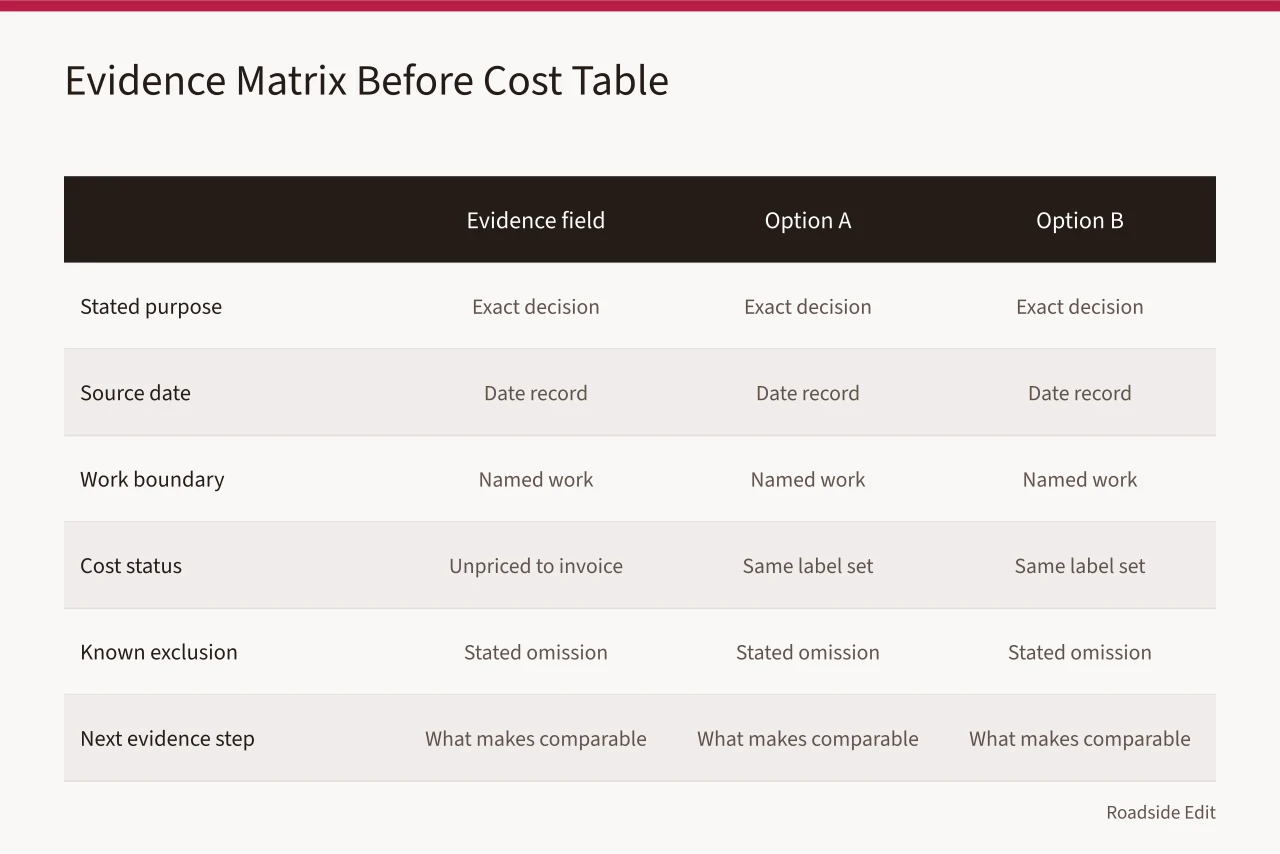
| Evidence field | Option A | Option B | Option C |
|---|---|---|---|
| Stated purpose | Record the exact decision | Record the exact decision | Record the exact decision |
| Source date | Date each record | Date each record | Date each record |
| Work boundary | Named work or question | Named work or question | Named work or question |
| Cost status | Unpriced, allowance, proposal, award, or invoice | Same label set | Same label set |
| Known exclusion | Source-stated omission | Source-stated omission | Source-stated omission |
| Next evidence step | What would make it comparable | What would make it comparable | What would make it comparable |
The GAO Cost Estimating and Assessment Guide explains that an estimate should have a defined purpose, scope, technical basis, assumptions, data, methods, and updates. The guide is for government cost estimating, not a local options workshop. It reinforces a basic editorial rule: figures only become comparable when readers can see the basis on which each was made.
For example, a documented $8,000 concept study and a $75,000 contractor proposal are both financial records. They should not be placed in a lowest-to-highest option list. The first may help define a path; the second may price a limited package after different evidence was collected.
Keep treatment goals from becoming price labels
Options that concern existing roadside buildings, signs, or features can have different treatment goals. Those goals need their own description before a budget note suggests one is cheaper, easier, or more realistic.
The National Park Service Standards for the Treatment of Historic Properties describe preservation, rehabilitation, restoration, and reconstruction as distinct approaches. They do not choose an approach or set a price for a particular property. The source supports reporting the option's stated treatment goal rather than compressing every alternative into one generic "renovation" cost.
This matters because a repair-and-retain option may require different evidence than a reuse option. A replacement proposal may price materials but omit documentation. A planning article can report each source's scope and limit. It should not say that a particular approach is less expensive without comparable current sources.
Mark the cost status honestly
When an amount does appear, state what kind of record it is. The label tells readers how far the option has moved from idea to work.
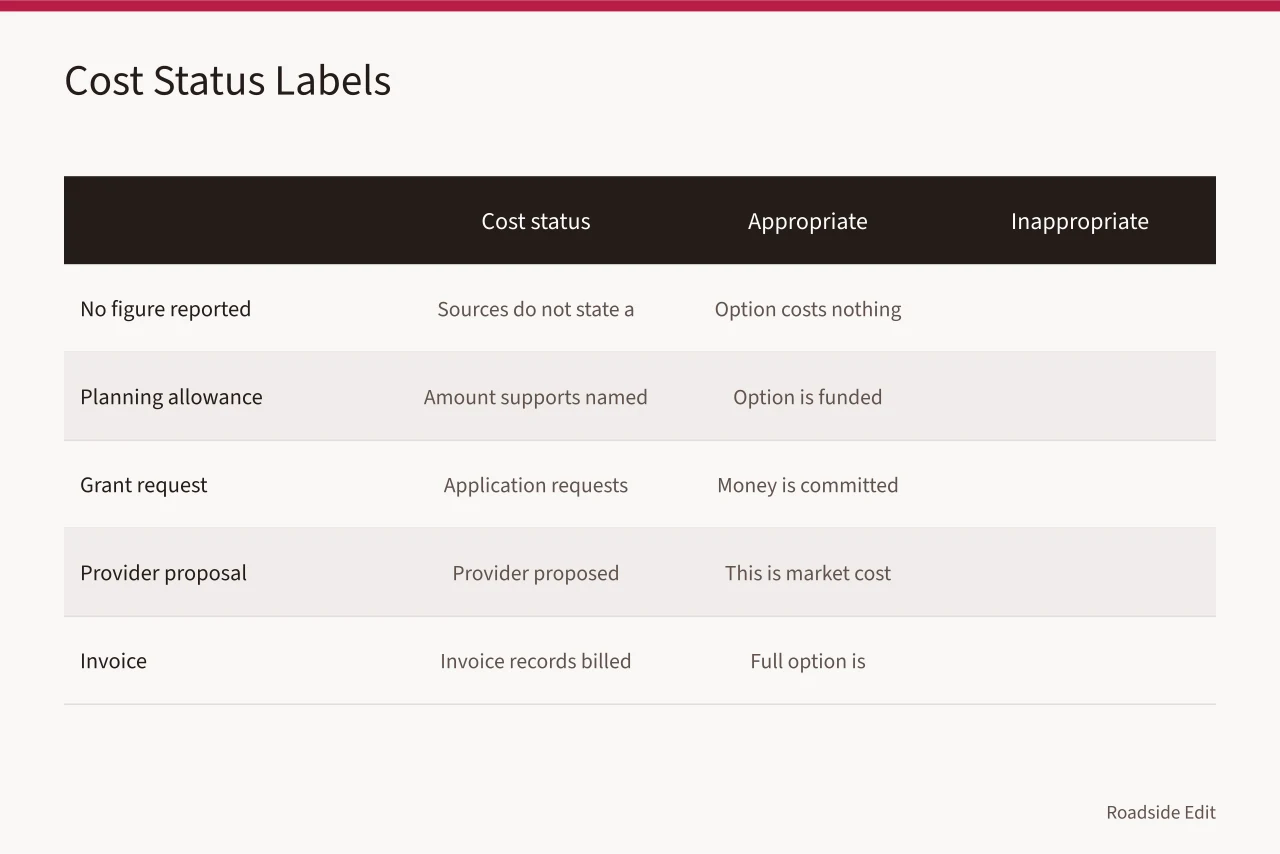
| Cost status | Appropriate wording | Inappropriate wording |
|---|---|---|
| No figure reported | "The reviewed sources do not state a price." | "The option costs nothing." |
| Planning allowance | "The amount supports the named study or review." | "The option is funded." |
| Grant request | "The application requests the stated amount." | "Money is committed." |
| Provider proposal | "The provider proposed the listed scope on the stated date." | "This is the market cost." |
| Invoice | "The invoice records billed work for the described task." | "The full option is complete." |
The option label must travel with the number. If an article lists a public award, its stated purpose should be visible in the same sentence or table cell. If a proposal expires or the option changes, update the row rather than leaving the old amount to imply current availability.
Do not let sponsorship decide the comparison
A company, funder, designer, or owner may support an option, supply a price, or appear in a list article. That can be relevant context. It is not an independent reason to rank that option first. Attribute the contribution and leave the financial statement in its own evidence lane.
FTC's endorsement guidance says disclose a material connection between endorser and marketer when it could affect the weight or credibility people give an endorsement.
In an options article, disclose the connection near a recommendation, review, or cost statement it affects. A disclosed sponsor claim may still be useful, but it remains a claim from that source.
Avoid sentences such as "Option B is the best value" if the evidence consists of a sponsor-provided number and an unpriced concept from another party. The honest comparison is that the first option has a documented offer and the second has not reached a comparable cost stage.
Publish the comparison as a decision record
A good options article tells readers what can be decided now and what requires more evidence. It may conclude that two options deserve further study, that one has a defined short-term scope, or that available records do not support a cost ranking.
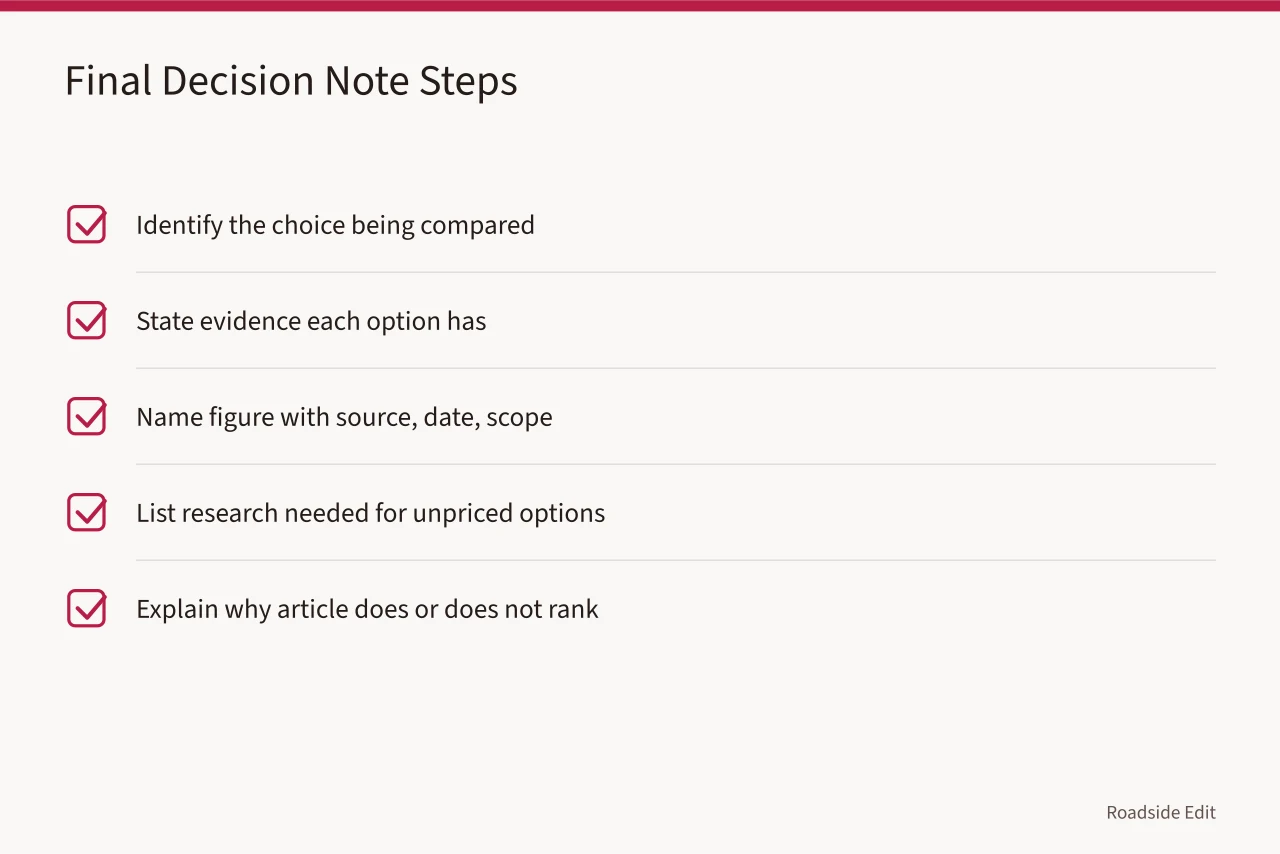
Use a final decision note:
- Identify the choice being compared.
- State the evidence each option currently has.
- Name any figure with its source label, date, and scope.
- List the research or scope work needed for unpriced options.
- Explain why the article does or does not rank by cost.
This approach is useful for readers because it leaves no mystery about the gap. It also gives a later editor a clear place to add a new proposal, award, or review without rewriting the earlier record.
Check before publishing
Read the article as a person who wants to know whether the figures really answer the same question.
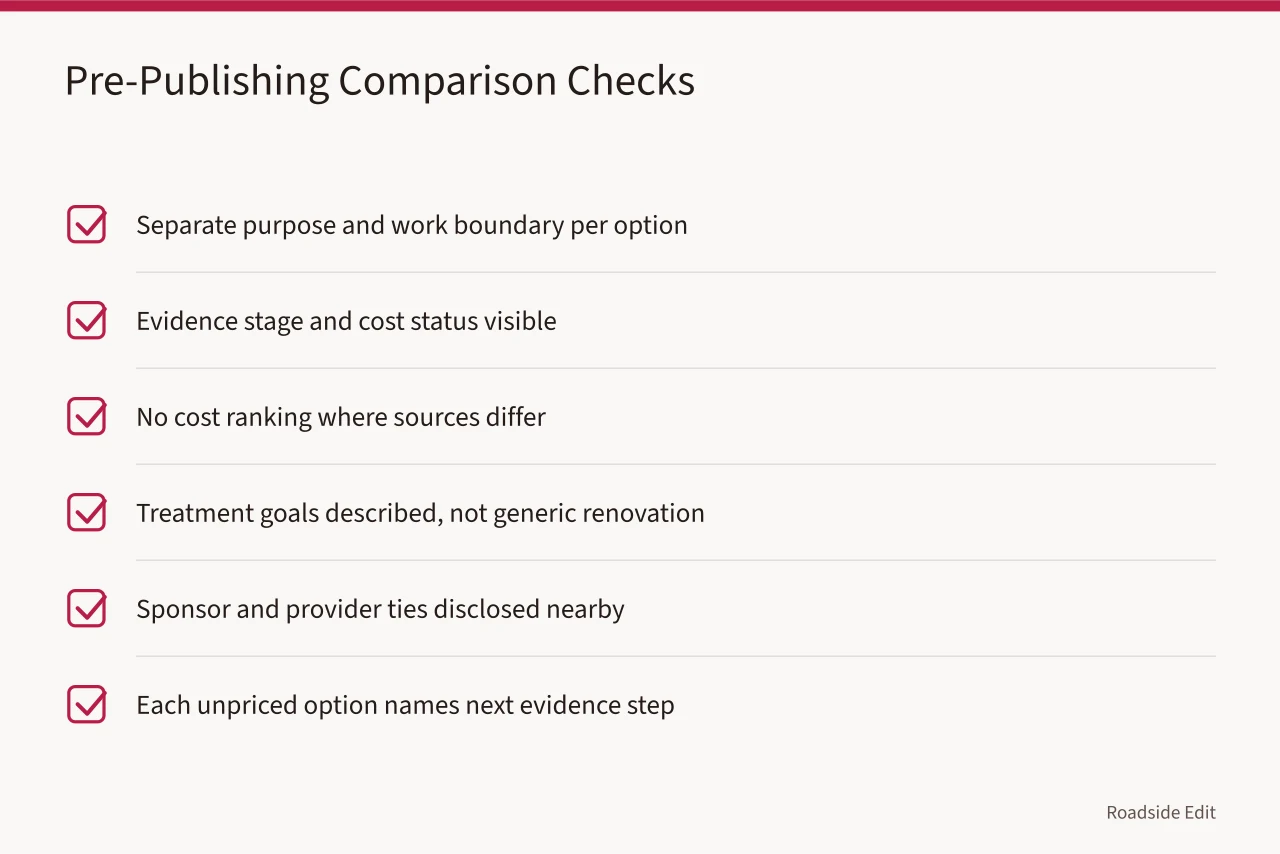
- Does every option have a separate purpose and work boundary?
- Are evidence stage and cost status visible for every figure?
- Does the article avoid a cost ranking where sources are not comparable?
- Are treatment goals described instead of reduced to a generic renovation label?
- Are sponsor and provider relationships disclosed near affected statements?
- Does each unpriced option identify its next evidence step?
The strongest option comparison does not pretend that all ideas can be priced on day one. It shows why some need more work before a meaningful cost comparison can happen.
Common questions
Can an option with no price be included in a comparison?
Yes. State its purpose, evidence, and next research step. Do not assign a placeholder cost just to complete a table.
Is a planning award evidence that an option is affordable?
No. Report the award's stated purpose. A planning amount does not establish the cost of later work.
When can options be ranked by cost?
Only when current sources describe comparable work, dates, assumptions, and exclusions. If those conditions are missing, explain the gap instead.