Guides
Part of How to plan neon sign restoration costs without guesswork
How to compare neon sign restoration cost scope before you commit
Neon sign restoration cost scope checklist for 2027 helps U.S. owners compare deliverables, evidence, exclusions, approvals, and commercial disclosures.
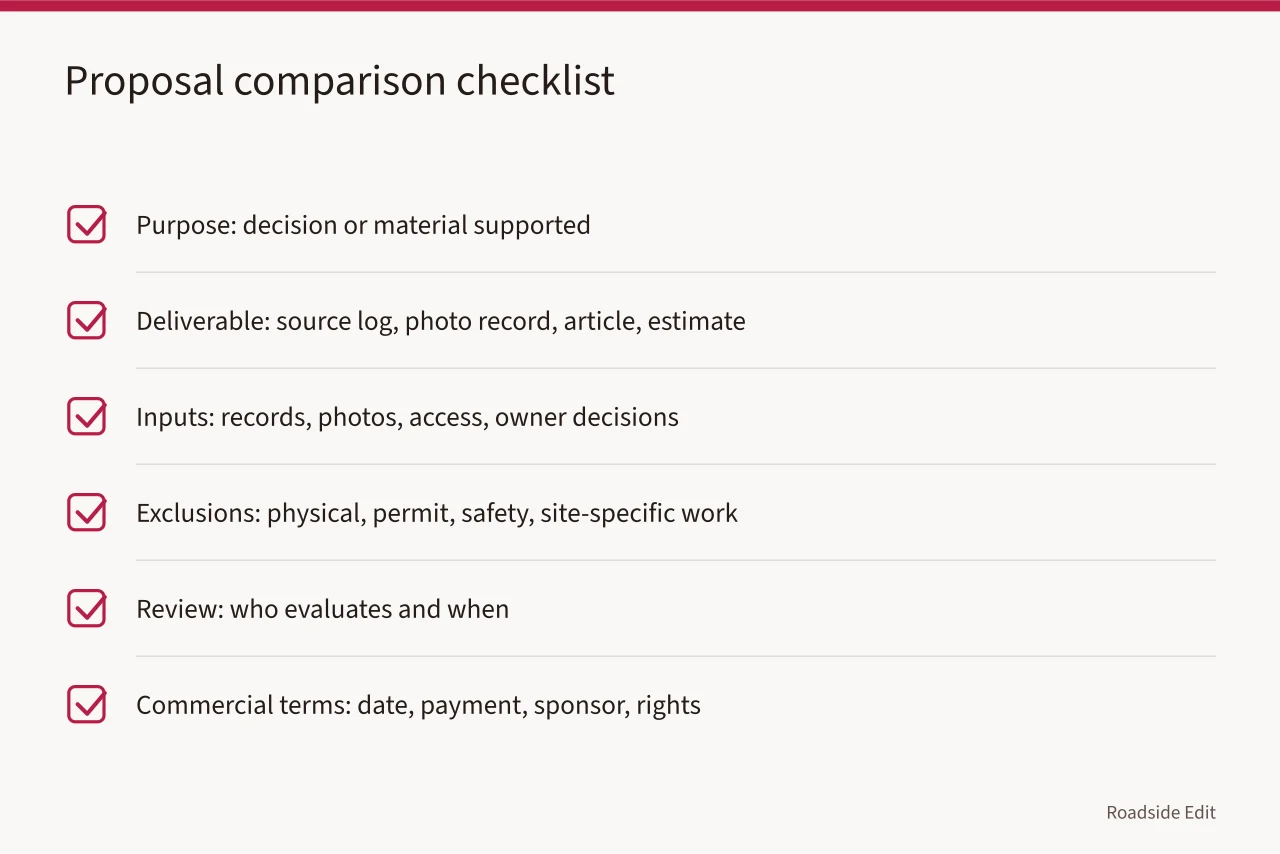
Use this checklist when reviewing a proposed cost, sponsorship package, research assignment, or public-facing profile involving a historic neon sign. It organizes what the price is meant to cover. It is not a repair checklist or a technical direction for the actual property.
What to take away
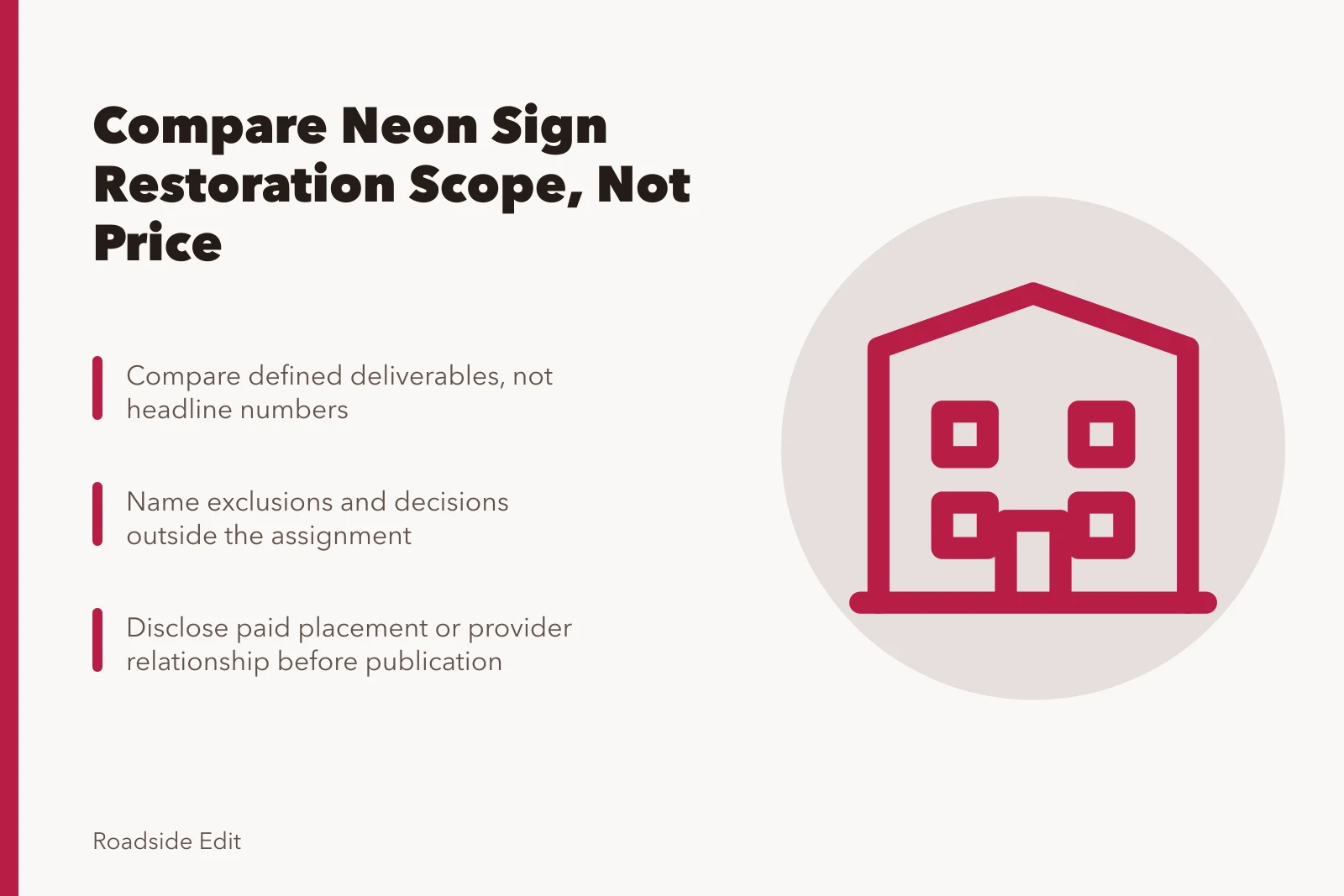
- Compare defined deliverables, not headline numbers.
- Record what evidence the proposal assumes will be available.
- Name exclusions and decisions that remain outside the assignment.
- Disclose a paid placement or provider relationship before publication.
Checklist
| Check | Record before comparing proposals |
|---|
Check grant-specific language carefully
The National Park Service's Historic Preservation Fund grant manual directs applicants with allowability questions to the manual, their grant agreement, and their grant manager. That is a useful reminder to keep program rules separate from a private owner's budget. A grant form or funding rule should not be copied into an article as if it governs every sign project.
Use the same questions for every option
Ask each potential provider or content partner what will be delivered, what it excludes, and what could change the work. If one price covers research and a second covers a public article, they are not directly comparable. The checklist should reveal the difference rather than force a false ranking.
Check the record behind each cost category
Before accepting a scope line, identify the evidence it assumes. Research work may depend on dated images and accessible public records. A writing assignment may depend on approved quotations and usable photo credits. A public profile may require disclosure language and a separate source review. Write those assumptions next to the item instead of treating them as invisible extras.
The National Archives digital-photo documentation guidance identifies information such as file formats, metadata, captions, naming conventions, and associated documentation. It does not provide sign-project prices. It supports allowing time to preserve the source and context of images used in a scope file.
Keep technical questions outside the comparison
If a proposal raises electrical, structural, access, permit, utility, or hazardous-condition questions, record that boundary. Do not use a general content or research price to answer it. The OSHA electrical eTool for Subpart S covers electrical-installation topics including qualified-person considerations. It is not a cost estimate for a sign. It supports directing site-specific electrical questions to an appropriate qualified process.
Separate disclosure from evidence
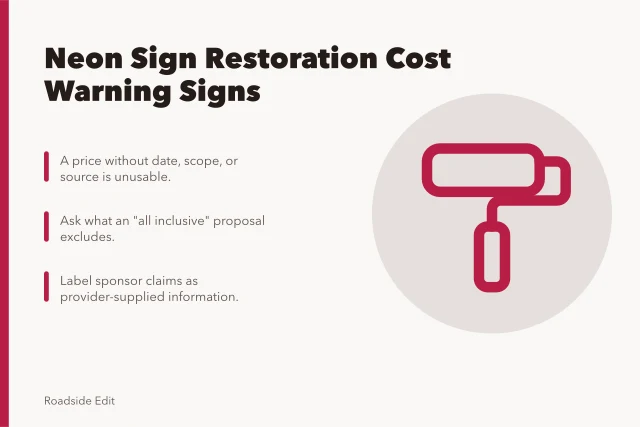
A paid listing or provider-sponsored profile can be useful to readers when its relationship is clear. Payment does not establish a factual claim about history, scope, safety, or outcome. Retain a disclosure note separately from the sources used to support the public description.
The Federal Trade Commission's endorsement guides address endorsements and testimonials in advertising. They are not project-pricing guidance. They are relevant when a public profile includes a paid relationship or testimonial that readers may need to evaluate.
Save a comparison record
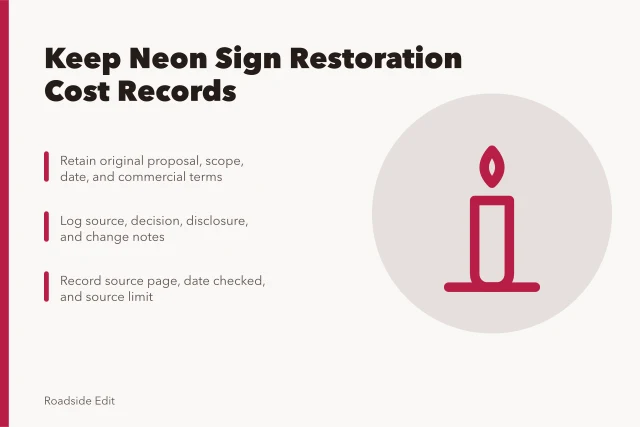
After reviewing options, keep a one-page note showing the date, proposal version, stated deliverables, client inputs, and exclusions. Record the fee basis, source assumptions, and next decision.
Do not rank a provider because a number looks lower, and note whether each option answers the same question. A narrow research assignment, a public profile, and a technical review may be reasonable proposals, yet they are not interchangeable products.
If an input changes, such as access to a historical photo or a decision to publish a sponsored placement, update the note before assuming the original comparison still applies. This record makes a later article easier to describe honestly.
Finish with a decision note
Write the selected option, the reasons, the evidence reviewed, the decision-maker, and the next action. If a sponsor or provider appears in a published list, state the relationship. This keeps useful commercial content from being mistaken for an independent certification.
Common questions
Does a detailed checklist create a fixed price?
No. It makes the assumptions and deliverables visible so a price can be evaluated responsibly.
Should safety work appear in the scope?
It should be named as a boundary when relevant, but this checklist does not define or direct site-specific safety work.
Can a paid listing be included?
Yes, when payment, selection method, and source of claims are clearly disclosed.