Guides
Part of How to plan neon sign restoration costs without guesswork
Neon sign restoration cost planning: warning signs owners should not ignore
Neon sign restoration cost planning warning signs help owners spot unclear scope, unsupported numbers, and paid claims that read as independent advice.
A porcelain-enamel station sign and a 1960s plastic-faced box sign fail in different ways, and their repair quotes carry different risks. The warning signs below are about the paperwork, not the tube.
What to take away
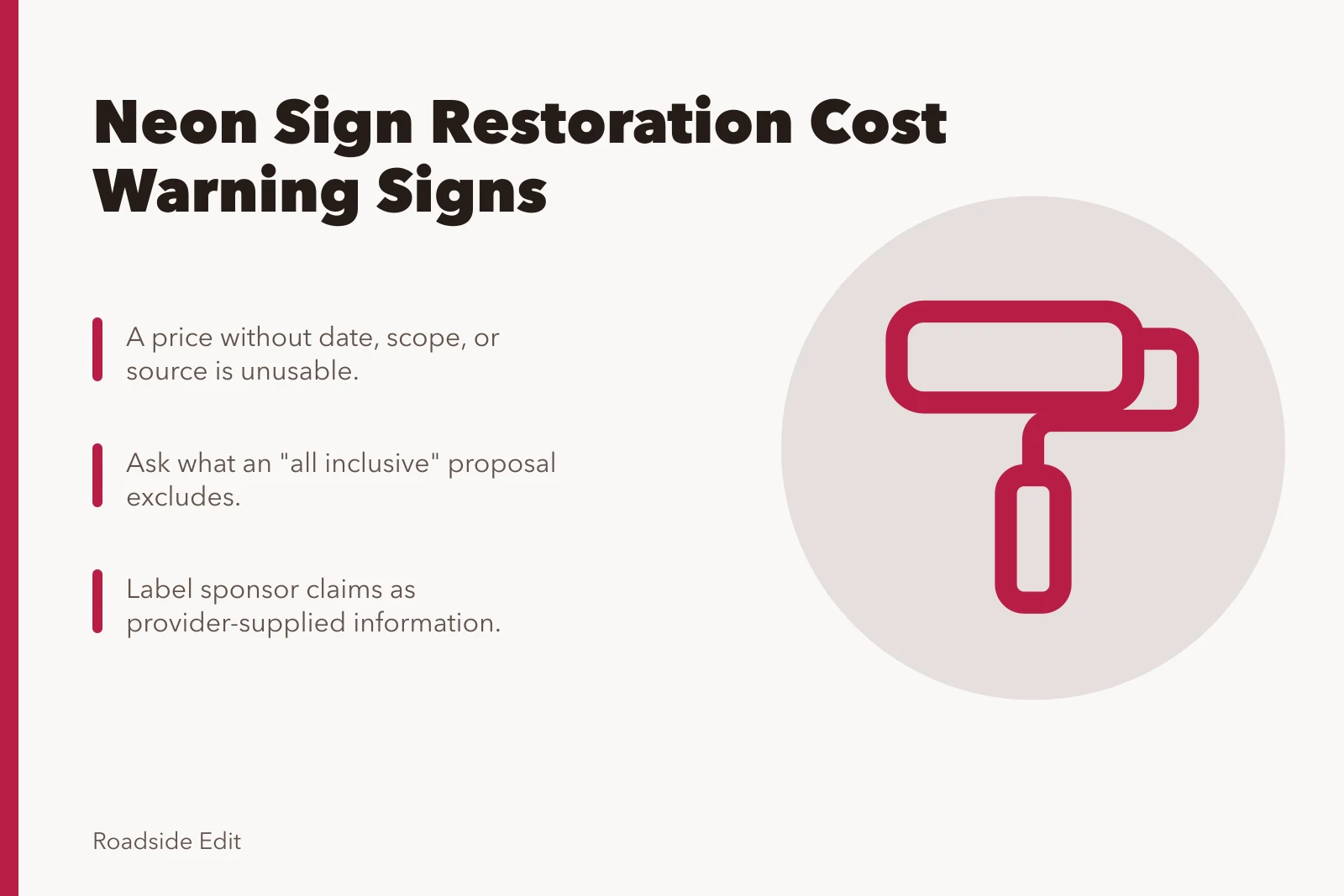
- A number with no deliverable, date, or source cannot be compared to another number.
- "All inclusive" without a stated exclusion list is a scope gap, not a bargain.
- A provider case study is provider-supplied information, never a benchmark.
- Paid placement must be labeled where the reader sees it, not in a footnote.
- Every published figure needs a review note naming who updates it and when.
Read the quote before the total
| Warning sign | Corrective response |
|---|---|
| Price with no date, scope, or source | Request the assumptions and the deliverable list in writing. |
| "All inclusive" with no exclusions | Ask what stays outside: access, permits, disposal, reinstallation. |
| One project example offered as a market rate | Label it a dated example or drop it. |
| Sponsor outcome claim with no attribution | Mark it provider-supplied and keep it out of comparisons. |
| Budget with no change record | Open a dated decision log before work starts. |
The National Park Service cost-estimating handbook directs that anticipated historic-preservation impacts land in direct cost line items or in itemized general conditions. It does not price a private sign project, and it does not set scope for one. What it supports is a habit: preservation costs belong in named line items, not folded into a generic total.
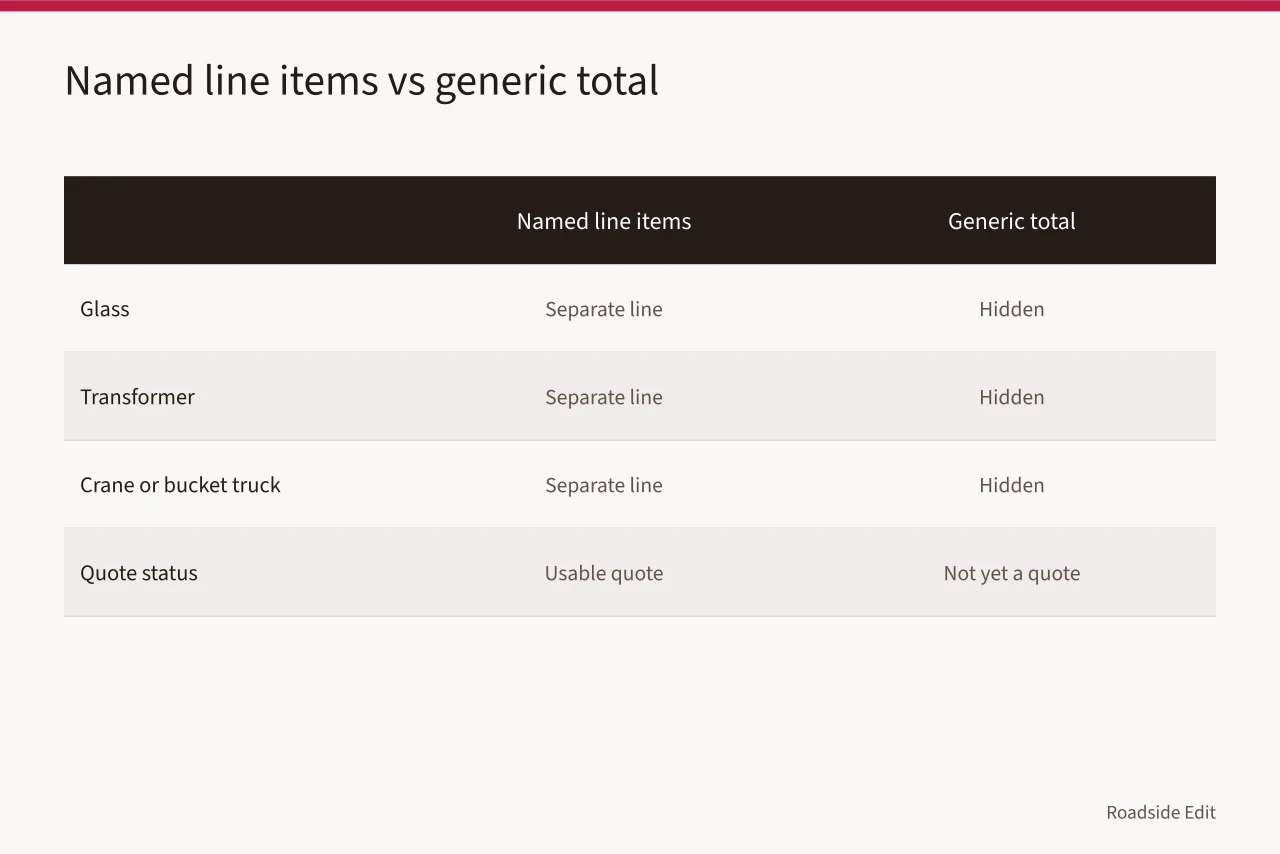
For a neon job, that means asking which line carries the glass, which carries the transformer, and which carries the crane or bucket truck. If the answer is "the total," the quote is not yet a quote.
Missing information is a finding
An unnamed owner, a missing survey, an unstated access arrangement, or a provider who will not explain a figure is a result. Write it down as one.
State what is unknown. Name who can close it. Say whether publication waits. A reader comparing three proposals needs to see which of the three is missing a fact, not a smoothed-over average.
When a number changes, say so
A page that quietly swaps a figure for a new one teaches readers to distrust every figure on it. Correction practice is short: keep the earlier date, describe what the update rests on, and stop repeating the retired number in later marketing copy.
A photograph is context, not evidence
An image of a sign shows what a sign looks like. It cannot establish price, ownership, working condition, or the scope another property needs.
The National Park Service documentation standards and guidelines cover how historic properties get recorded. They say nothing about what a specific sign should cost.
They do support stating the source, date, and limits of any historical material you publish.
Where the quote crosses a trade boundary
When a proposal touches these areas, the estimator's number stops being controlling:
- electrical service
- canopy structure
- fall access
- permits
- utility connections
- suspect coatings A writer or researcher cannot settle it.
The OSHA electrical eTool for Subpart S covers installation topics, including qualified-person requirements. It is not an estimating manual. It is the reason a site-specific electrical question goes to a licensed electrician and to the authority having jurisdiction, and why a cost page should say so plainly rather than guess.
When the money is the message
A sponsored profile, a provider quote, or a paid placement is fine when the commercial relationship is visible where the reader meets it. The warning sign is copy that dresses a paid statement as a neutral test or an independent recommendation.
The Federal Trade Commission's endorsement guides govern endorsements and testimonials in advertising. They are not cost guidance. They matter when a price, an outcome claim, or a testimonial sits next to a paid relationship. Keep the disclosure beside the claim, not in a footer.
Retire the stale comparison
Before repeating any figure, check four things: proposal date, scope version, whether the source still exists, and whether a relationship was disclosed. If any of the four moved, the comparison is obsolete.
Keep a review note on the page itself. It names the claim reviewed, the latest supporting record, the date checked, and the person who owns the next update. One line stops an old marketing number from becoming a permanent editorial fact.
For owners weighing whether a site is worth saving at all, gas station preservation: regional warning signs to check before 2027 lays out the signals that decide the question.
Common questions
Is the lowest price always a warning sign?
No. A low number becomes hard to judge when its scope, assumptions, exclusions, and source are unclear. Ask for those four before comparing it to anything.
Can a publication use provider case studies?
Yes, with the source, date, relationship, and limits of the example disclosed. A case study describes one job; it never sets a rate for the next one.
Why keep a change log on a cost page?
It shows why a figure moved and stops a retired assumption from returning as current fact. It also tells the next editor who owns the update.
Who resolves electrical or structural questions in a quote?
A licensed electrician or engineer, and the authority having jurisdiction for permits. A cost page can name that boundary; it cannot answer across it.