Guides
Part of How to plan neon sign restoration costs without guesswork
Neon sign restoration cost planning: budget notes that explain each number
Neon sign restoration cost notes with public price ranges for tubing, transformers, labor, access, surveys, permits, and records. Each number gets a dated source.
Budget notes give a total context. They explain why a category appears, what information it relies on, and what can change. This is useful whether a reader is organizing a small research assignment, reviewing a provider proposal, or describing a sponsored project. It does not set a price for technical work.
What to take away
- Tie every dollar line to a dated source.
- Separate glass, electrical, labor, access, and permits.
- Use public price lists for materials and hourly rates for labor.
- Mark structural and permit unknowns as site-specific.
Note each number
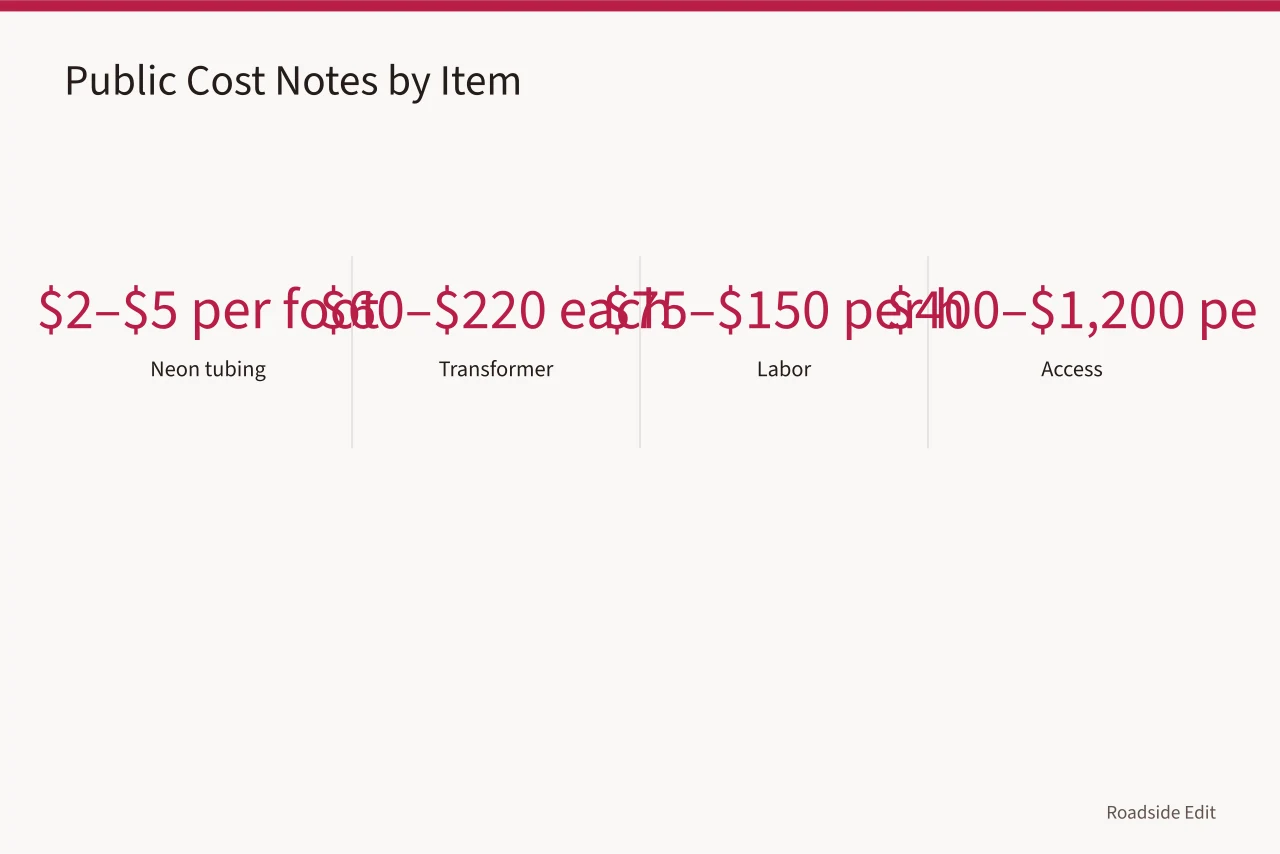
| Item | Provider or tool | Public cost note |
|---|---|---|
| Neon tubing | EGL, Voltarc | $2 to $5 per foot for clear 10 mm or 12 mm tube |
| Transformer | Franceformer, Allanson | $60 to $220 each for 12 V or 15 kV systems |
| GTO cable | Cole Wire, WireMold | $0.75 to $2.00 per foot for GTO-15 |
| Electrodes | Eurobend, Neon Products | $8 to $25 each |
| Labor | Neon Works, Spectrum Neon | $75 to $150 per hour for glassblowing or service |
| Access | United Rentals, Sunbelt Rentals | $400 to $1,200 per day for bucket truck or lift |
| Survey | American Sign Museum, The Neon Museum | reference collections for condition and history |
| Estimating | SignCAD, OnCenter Software | sign shop estimating support |
| Permit | local city office | $50 to $500 plus plan review |
Note the unknowns
The National Park Service's predesign guidance describes a project program and an independent estimate as planning tools for its own projects. It supports a limited principle: an estimate should follow a defined program, not replace it.
If a line covers electrical, structural, access, permit, or hazardous-condition issues, state that it needs the proper site-specific process. The OSHA electrical eTool for Subpart S covers electrical-installation topics, including qualified-person considerations. It is not a budgeting tool.
Preserve the explanation with the number
When a proposed category changes, note whether a new source, owner decision, missing record, or changed deliverable caused it. This makes later public copy easier to correct. It also helps a sponsor explain what it paid for without asking readers to infer more than the record supports.
Use a separate dated note for donated labor, donated materials, or a discounted service. Identify the provider, date, stated contribution, and any conditions. Do not describe a donation as a cash budget item unless the responsible program or accounting record treats it that way.
Tie each budget note to a record
Each planning ledger line should point to a brief, source note, proposal, or decision.
A research category may point to a list of dated photos and archives to review. A communications category may point to a draft article, disclosure statement, and image-credit list. A review category may point to the defined question that the relevant professional or authority must address.
The National Archives guidance on agency recordkeeping describes federal responsibilities for records documenting activities and decisions. It does not establish a private sign budget. It supports retaining the dated record that explains why a material scope or cost category changed.
Keep commercial language accurate
When a business, provider, or sponsor pays for a profile or placement, save the disclosure wording with the budget note. Payment can support a defined publication service. It does not verify historical claims, technical results, or a general price claim for other properties.
The Federal Trade Commission's endorsement guides address endorsements and testimonials in advertising. They are not budget-planning rules. They are relevant when a public statement about a cost, provider, or result is connected to a paid relationship.
Add an update trigger
Close each note with the next fact that could change it: a missing source, new owner decision, changed deliverable, unavailable image permission, or a request that belongs to another role. Record who will review that trigger and when. This makes uncertainty visible rather than hidden inside a broad total.
Before approving a revised note, compare it with the last approved version. State what changed, why it changed, which record supports the change, and whether a public description or disclosure also needs revision. This prevents a later price or scope reference from losing its original context.
Common questions
Why not use a single contingency percentage?
An arbitrary percentage can hide the specific questions that need resolution. Name the uncertainty instead.
Is an independent estimate always required?
Requirements depend on the program and property. This guide recommends a defined scope before comparing numbers.
Can sponsors use these categories in a public story?
Yes, if the story labels the relationship and does not imply a category is an independently verified outcome.