Guides
Part of How to plan neon sign restoration costs without guesswork
How owners should keep neon sign restoration cost records
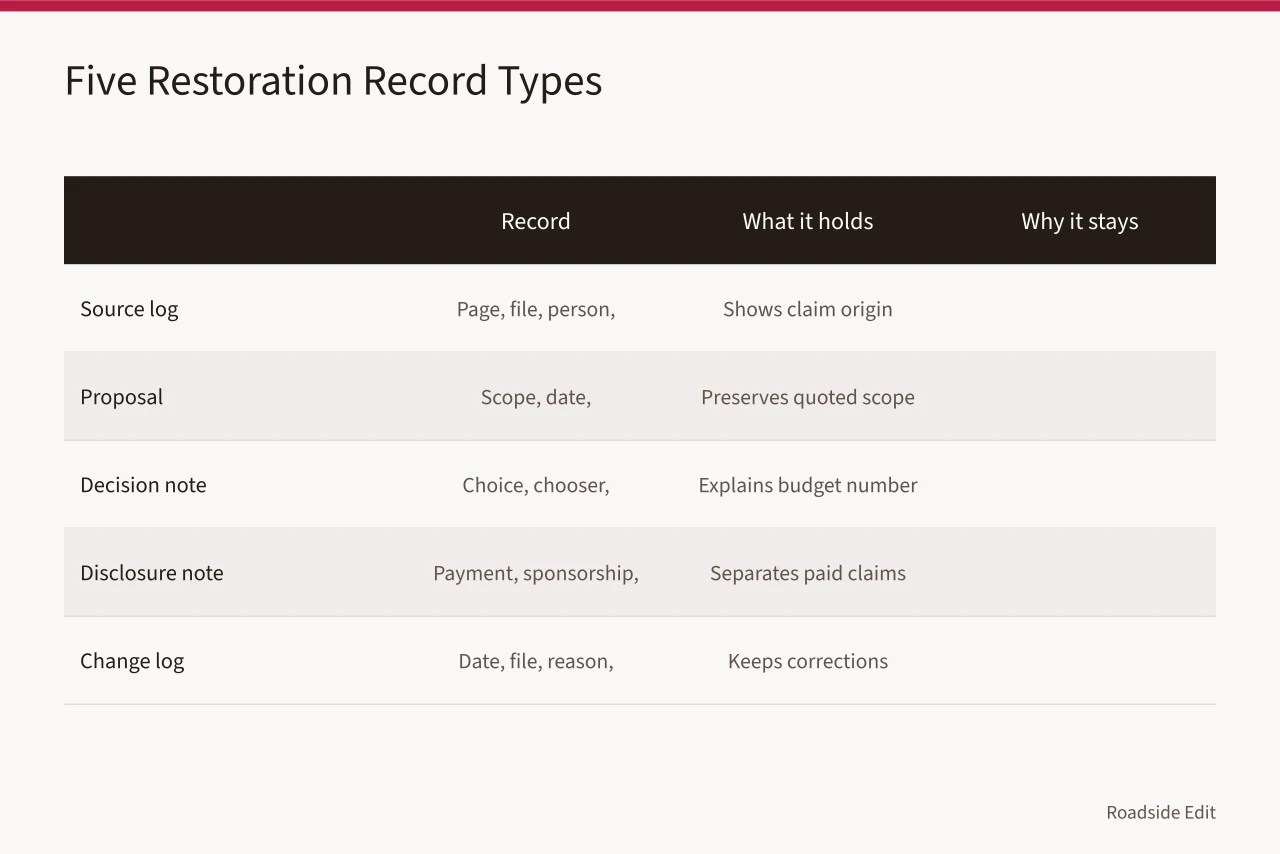
Five record types carry a neon sign restoration budget: source log, proposal, decision note, disclosure note, and change log, each dated and kept together.
Cost records let an owner explain what a figure meant on the day it was used. Five record types do that work: source log, proposal, decision note, disclosure note, and change log.
What to take away
- Keep the original proposal and its date, not a retyped total.
- Save scope, exclusions, and assumptions alongside the number.
- Retain rejected proposals that shaped a decision, marked unselected.
- Log every correction with a date and a reason.
- Keep sponsor and paid-placement wording with the public copy it appeared in.
Five record types, and what each one holds
| Record | What it holds | Why it stays |
|---|---|---|
| Source log | Page, file, or person, plus the date checked | Shows where a claim came from |
| Proposal | Original scope, date, exclusions, terms | Preserves what was actually quoted |
| Decision note | What was chosen, by whom, on what evidence | Explains the number in the budget |
| Disclosure note | Payment, sponsorship, supplied information | Separates editorial text from a paid claim |
| Change log | Date, file changed, reason, reviewer | Keeps corrections from looking arbitrary |
A proposal for a porcelain-enamel panel repair and a proposal for a full re-tube are different documents. Keep both even when only one is funded.
Keep the rejected proposals
An owner who solicits three bids and signs one should keep all three. The two unselected proposals explain why the chosen scope looked reasonable, and they date the market the decision was made in.
Mark them unselected and keep the date and the scope as submitted. Do not edit them later to match what was built. A rejected proposal that says "transformer replacement excluded" is evidence about what the accepted bid also left out.
The source log carries the survey
A survey day produces the raw material for every later cost figure. Log the survey date. Log the firm or the person who walked the site. Log what they recorded:
- canopy soffit condition
- dry-stand pipe
- neon tube diameter
- transformer load
- pump-island footprint
A source log entry reads: "Canopy soffit, photographed 14 March, surveyed by [firm], noted spalling at two bays." That entry supports a line item later. A note that says "canopy needs work" supports nothing.
The National Park Service publishes sample Historic Preservation Fund grant applications that show how narrative, worksheets, and attachments are bundled so a reviewer can follow a project. They are grant forms, not a neon budget template. The transferable habit is bundling: keep the story, the numbers, and the backup in one place.
Decision notes explain the number
A decision note is short. It names what was chosen, the date, who chose it, and which source or proposal supported it. "Accepted Bid B, 2 April, porcelain panels retained and repainted rather than replaced, on [firm] survey of 14 March."
That single line answers the question a future reader will ask: why does this budget line look like this? Over-painting original enamel is a common failure, and a decision note is where the reasoning either holds up or does not.
Disclosure notes stay with the public copy
When a supplier pays for a listing, provides a price range, or submits a testimonial, keep the disclosure wording exactly as published, next to the copy it ran with. Payment does not establish anything about historic value or technical condition.
The Federal Trade Commission's endorsement guides cover endorsements and testimonials in advertising. They are not recordkeeping rules, but they are the standard a reader may apply when an article carries a commercial relationship.
Media records: original separate from published
Keep the original file apart from the cropped or annotated version that ran online. Record the source page, caption, credit, and whether the image documents the project or illustrates it.
The Library of Congress guide to photographic evidence advises weighing an image's date, place, and visible context while seeking original records. Applied here, that means a 1960s plastic-faced box sign photograph and a 1950s porcelain-enamel photograph are not interchangeable evidence for the same claim.
The change log
Updates to each material, one line apiece:
- date
- file or page changed
- reason
- source reviewed
- who decided
- whether the public disclosure changed Never delete the earlier version without a note.
The National Archives guidance on agency recordkeeping describes federal duties for records documenting activities and decisions. It does not govern a private cost file, but it supports the same practice: keep the dated material that explains a decision.
A spreadsheet is enough
Six columns carry the whole system:
- date
- record type
- source
- scope or claim
- decision
- responsible person Add a status column for open or closed.
Sort by date. Filter by record type when a reviewer asks for proposals only. One tab per project keeps a corridor survey separate from a single sign.
Common questions
Should an owner retain rejected proposals?
Yes, when they informed a decision or explain a public comparison. Mark them unselected, keep the date, and leave the scope as submitted.
What belongs in a disclosure note?
Payment, sponsorship, provider-supplied information, affiliate interests, and the selection method used for the published material. Keep the wording as it ran.
Can a simple spreadsheet work?
Yes. Most reviewer questions are covered by six things:
- Date
- Record type
- Source
- Scope
- Decision
- Responsible person