Guides
How to keep roadside building care records that hold up to review
Roadside building care records guide for 2027 helps U.S. editors retain observation history, service status, source limits, media credit, and corrections.
A care record is the history behind a maintenance statement. It should show what was seen, what someone reported, what source supports a public claim, and what remains unconfirmed. Without that trail, a fresh caption can quietly replace a past observation and a provider report can look like independent proof.
This guide organizes care evidence. It does not assess a building, prescribe a repair, or decide a property-specific permit or safety question.
What to take away
- Keep the original observation and add later updates as dated entries.
- Label visible facts, owner reports, provider reports, and verified records differently.
- Store the source, scope, and stage alongside every public claim.
- Retain image credit and removal history with the local asset.
- Make handoff files clear enough for a new editor to review quickly.
Open a record for each exterior area
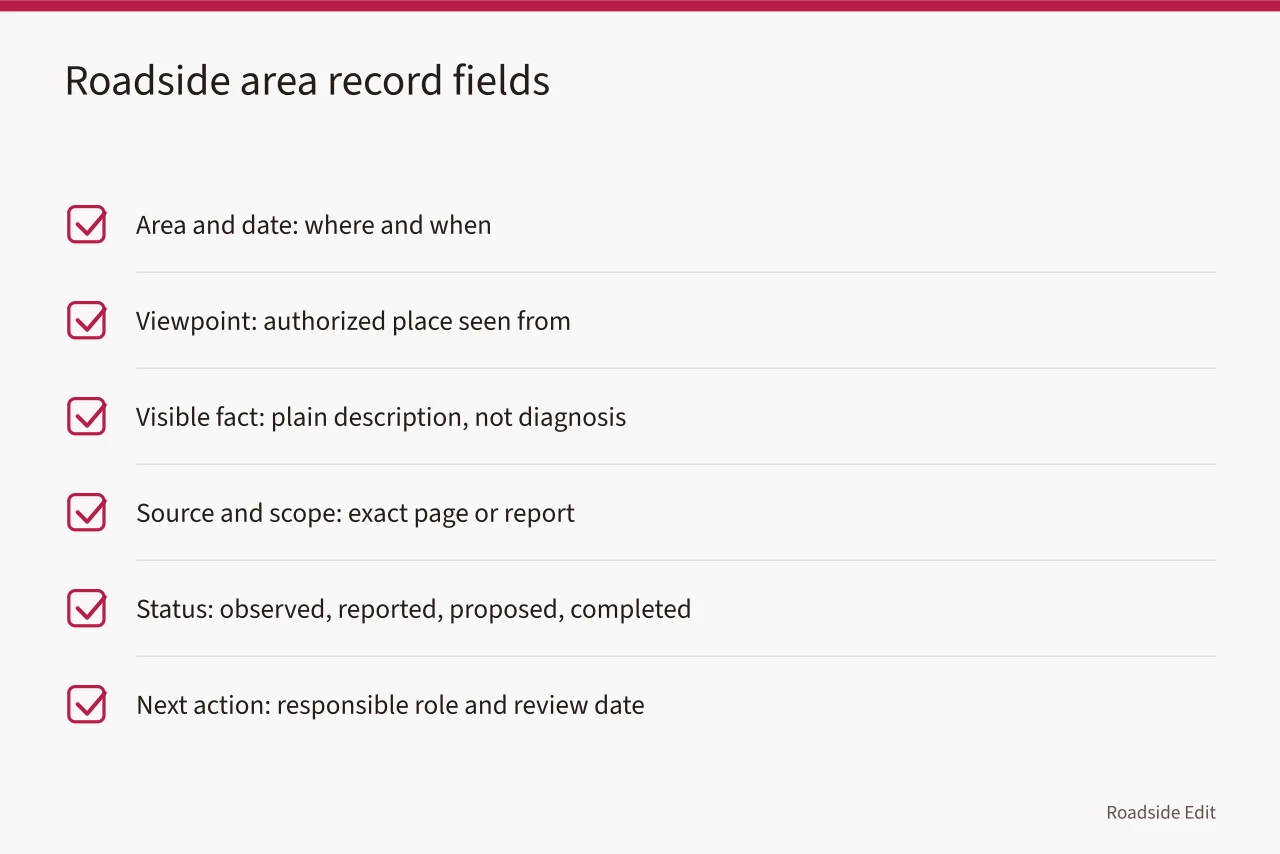
Use stable area names such as main sign, north facade, entrance path, or parking edge. Each record contains the first observation, related image, source note, notification, service report, closeout, and correction. This keeps a seasonal review from becoming a pile of disconnected photos.
The National Park Service's Preservation Brief 2 explains that work on historic masonry depends on existing masonry and mortar conditions. It does not recommend a treatment for an unassessed roadside building. Its useful records lesson is to preserve the material question, source, and appropriate scope rather than turn a visible condition into a repair instruction.
Keep four kinds of entries separate
An observation says what can be seen. A report says what an owner or provider told the site. A proposal says what might happen. A completed entry says what a source reports was done. These categories must not merge.
- Observed: "Leaves visible at drain opening from sidewalk view."
- Reported: "Manager reported that cleaning was scheduled."
- Proposed: "Provider proposed a site visit."
- Reported complete: "Provider's dated note says cleaning was completed."
The National Archives says records tied to the same project, transaction, study, or subject should be retained together when the connection provides context. Read the National Archives recordkeeping requirements. That policy governs federal agencies. It supports keeping the observation, report, service note, and correction together while preserving their different status labels.
Preserve source limits and image provenance
A historic image may identify a place or recorded scene. It does not prove present ownership, care status, or condition. Retain the exact source page, local filename, credit, caption, and reason for use. If an image must be removed, remove the caption and claim that depend on it, then note the action in the record.
The National Park Service's documentation standards and guidelines emphasize reliable sources and clear limits that allow a record to be independently checked. The standards address historic documentation. The same practice helps a care record: state what the source supports and leave unsupported property conclusions out.
Keep commercial updates out of evidence
Businesses may submit service descriptions, price offers, or paid placements. Preserve the original message, sender, date, disclosure, and approved wording in a commercial file. It can support an attributed service statement. It is not independent evidence that a condition exists or that the service is appropriate.
The Federal Trade Commission says advertising that looks like independent content should be recognizable as advertising. Read the FTC native-advertising guide. It does not decide a care question. It supports a clear public disclosure and separate commercial records.
Correct and hand off the record
When better evidence changes a location, caption, or status, create a correction card with old wording, new wording, source, date, reason, and editor. Do not quietly overwrite the original note. At handoff, provide the area index, open questions, latest review date, active sources, image records, and correction log. Keep private contacts and access details out of the public article file.
Common questions
Can a provider report be called verified?
Only if appropriate evidence has been reviewed by the responsible party. Otherwise label it as a provider report or reported completion.
Why keep older observations?
They make changes traceable and stop a newer note from rewriting what was known at an earlier date.
What should leave when an image is removed?
Remove the local asset, caption, credit, and any claim that relies on the image. Keep a restricted record explaining the removal.