Maintenance
Part of How to Research Roadside Building Case Studies
Roadside building case studies tips: where to stand on a live site
Roadside building case studies tips for visiting a motel, diner or filling station mid-restoration: permission, scaffold and drop-zone rules, three questions.
What to take away
- A roadside building mid-restoration teaches more in an hour than a finished one does in a day.
- Never walk under, onto or beside scaffolding without being taken there by somebody responsible for it.
- Work at height is the highest-risk activity on any small building site. Stay out of the drop zone.
- Go with a plan of three questions. Site visits collapse into small talk without one.
These roadside building case studies tips are for the first visit to a live project: a motel, diner, filling station or sign being restored while you watch. That is where the abstractions turn concrete. You can see the stucco opened up, the original paint under the later one, the porcelain panel behind a newer sign face, and the thing that was found which nobody expected.
It is also somebody's workplace, and the rules follow from that.
Getting on site at all
Ask the owner, not the contractor. The owner decides who is on their site; the contractor manages what happens once you are there.
Getting on site
- Ask the owner, not the contractor
- Request a specific short window
- Offer to come when it suits
- Say you will follow instructions
- If no, ask about an open day
Ask for a specific short window, offer to come when it suits, and say plainly that you will follow their instructions. Most refusals come from vagueness rather than unwillingness.
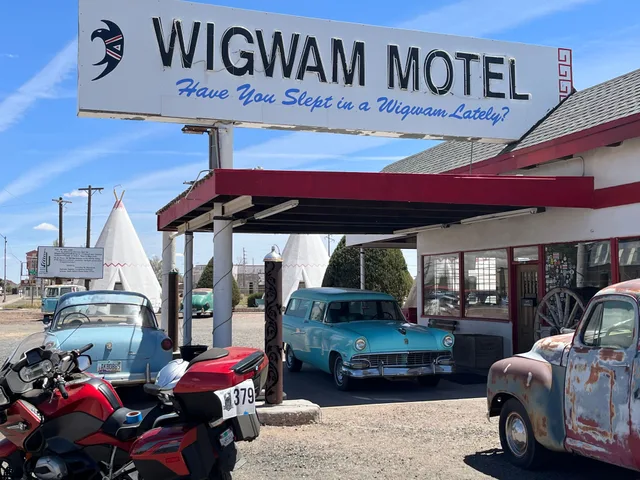
If the answer is no, ask whether there will be an open day later. In the meantime, a finished renovation that rents rooms gets you inside a comparable building without anybody's insurance being involved. The Blue Swallow Motel in Tucumcari, New Mexico, is one: the National Park Service notes that it received a Cost-Share Grant from the National Park Service Route 66 Corridor Preservation Program in 2007 for restoration of the neon sign, neon swallows, and office windows, and that it continues to operate as a popular overnight destination.
Where the roadside case studies are
Grant programmes are a good map of restored roadside buildings to study. The National Park Service's account of Route 66 in Oklahoma says its Route 66 Corridor Preservation Program has assisted cost-share grant projects there including the restoration of the Firestone Station in Bristow, the Rock Cafe in Stroud, the Meadow Gold sign in Tulsa and the Vickery Phillips 66 Station in Tulsa. A filling station, a cafe and a sign: three building types, three different kinds of site to read.
Many such properties are listed in the National Register of Historic Places. When a federal agency's project touches one, the Federal Highway Administration's Section 106 tutorial explains that Section 106 requires the agency to take into account the effects of its actions on properties listed in or eligible for the National Register, and to give the Advisory Council on Historic Preservation an opportunity to comment. That review record is often the best written account of what a project found and changed.
Scaffolding is not a viewing platform
The temptation on a live site is to get closer, and scaffolding looks like the way, especially against a motel parapet or a tall sign pylon.
Scaffolding is engineered, inspected and erected by trained people, and the Occupational Safety and Health Administration's scaffolding requirements cover why: capacity, planking, access, guardrails and the sequence in which it is put together and taken apart. A visitor climbing on a scaffold puts themselves and the crew at risk and voids somebody's arrangements.
Look at it from the ground. Ask for photographs from up there instead, which crews frequently have.
Stay out of the drop zone
The other constant hazard on a small building site is things falling, and the same body's fall protection material is about the two directions of that problem: people falling, and objects falling onto people below. On construction sites, fall protection is covered by OSHA 29 CFR 1926 Subpart M.
For a visitor this reduces to one habit. Never stand directly below where work is happening, whether that is a canopy being reroofed, a sign being lowered from its pole, or a crew on a lift at a motel's upper walkway, and never cut the corner under a hoist, a ladder or an open edge.
Wear whatever they give you and put it on before you walk on, not after somebody asks. On most sites that means a hard hat, a high-visibility vest, safety glasses and your own sturdy boots.
Arrive with three questions
The visits that produce nothing are the ones without a plan. Three questions is the right number.
Good ones: what did you find when you opened this up, what changed in the design because of it, and what is the next decision you have to make. Each opens a real conversation. At a filling station that might be what lay under a later canopy; at a motel, what the original window openings were.
Bad ones: how much did it cost, and when will it be finished. Both get a defensive answer.
What to look at while you are there
- Where old work meets new, before it is covered
- The back of elements you normally see only from the front
- Materials laid out before installation
- Whatever has been kept aside, which is usually the interesting bit
- Marks, stamps and writing exposed during stripping
On a roadside building, the back of a sign cabinet, the fixings of porcelain enamel panels and the layers of paint on a stucco wall are the places where those things show up.
Afterwards
Write it up the same day. Send a short thank you and ask whether you may use the photographs, and where a project is ongoing, ask if you may come back at the next phase.
Return visits are how a case study becomes a record rather than a snapshot.
How to find projects worth visiting is in the roadside case-study method, which also covers arranging repeat visits to live sites.