Guides
Part of How to run a roadside building case study method that holds up
Roadside building case study questions editors should ask before running one
Roadside building case study questions for 2027 help U.S. editors test evidence, dates, scope, and results before presenting a local project story.
A case study can make a roadside building memorable, but it can also make one weak record carry an entire story. The strongest case studies do not begin with a conclusion. They begin with a small set of questions about the place, the evidence, the project stage, and the result that can actually be documented.
What to take away
- Build a case study from verifiable records, not a smooth narrative assembled from guesses.
- Separate what existed historically from what is true at the time of publication.
- Identify a project's stage before writing about its result.
- Give each important claim a source that names the property and supports that claim.
What is the case study trying to show?
Before collecting sources, write one narrow question. It might be "How was a storefront documented before work began?" or "What records describe a route-side feature at two points in time?" Avoid a question that assumes success, decline, or restoration before the evidence has been reviewed.
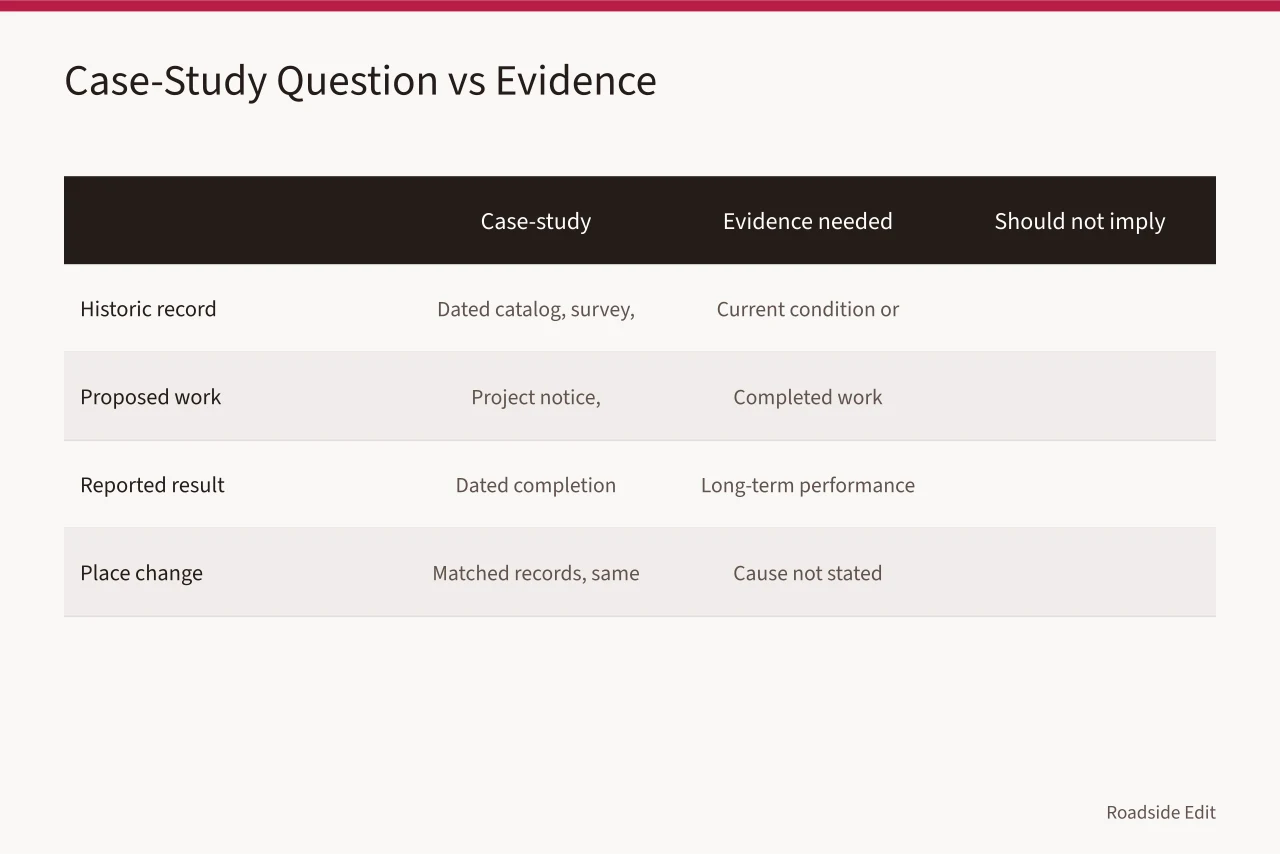
The question acts as a boundary. It tells an editor which records belong in the article and which appealing details do not. A town history may offer useful context but not answer a question about one building. A business description might identify a service but not establish what happened at a particular property.
What does each source contribute?
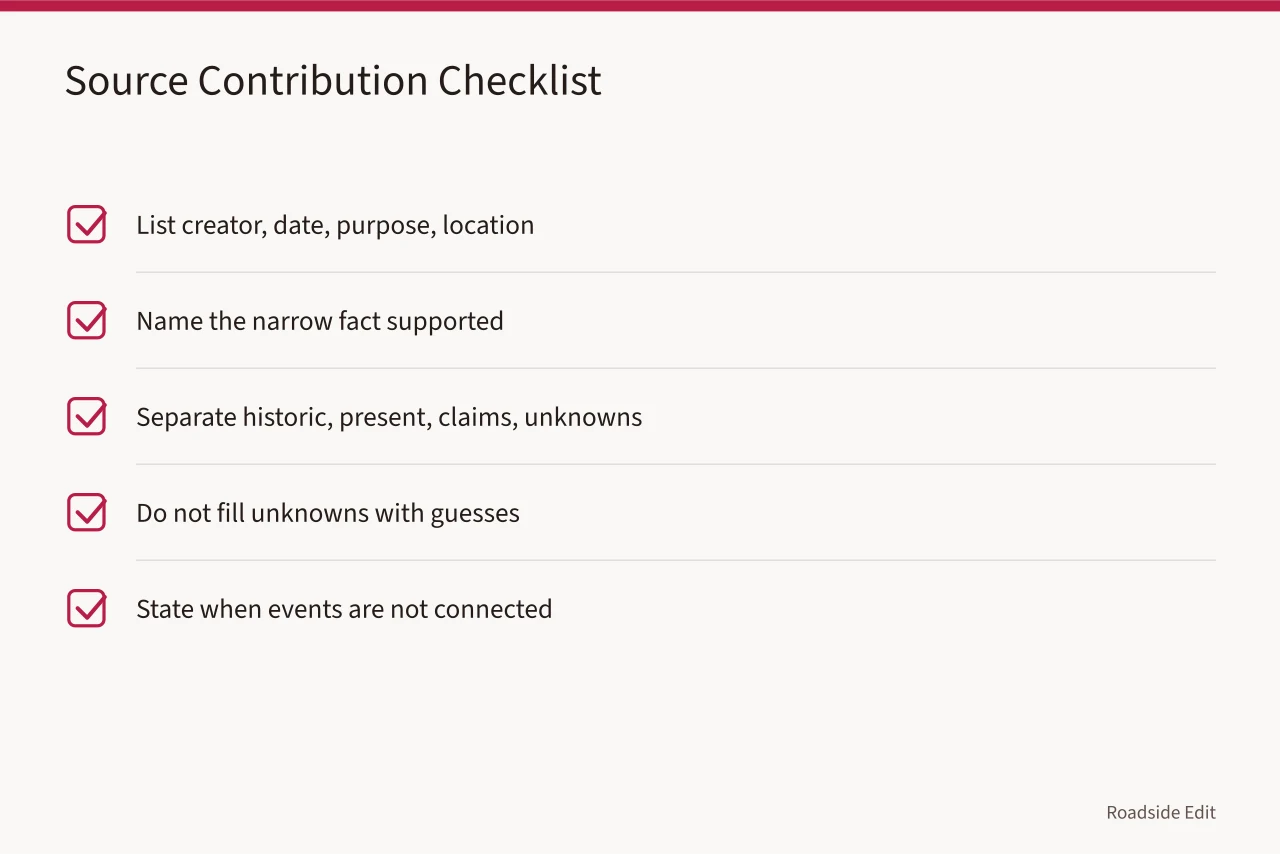
List every source with its creator, date, purpose, location detail, and the narrow fact it supports. Do this before drafting. It prevents a common error in local articles: a photo, map, announcement, and provider statement are written as if they were identical kinds of proof.
Harvard's source-evaluation guidance asks readers to consider evidence, relevance, scope, and a source's goals. Use Harvard's questions for evaluating sources. In a roadside case study, those questions help determine whether a record belongs beside a claim. A catalog record may be excellent for identifying an image. It is not necessarily useful for a current condition statement.
Use a comparison sheet with separate lines for historic facts, present facts, project claims, and unknowns. Do not fill the unknown column with a plausible explanation. If the evidence does not connect two events, say that the connection has not been established.
Does the record identify the same property?
Names are unstable. A roadside building can have a former business name, a new operator, a route number that changed, or an address that was renumbered. A case study needs a stable way to show that two records concern the same place. Look for an address, coordinates, parcel detail, catalog identifier, legal description, or a reliable description of adjacent features.
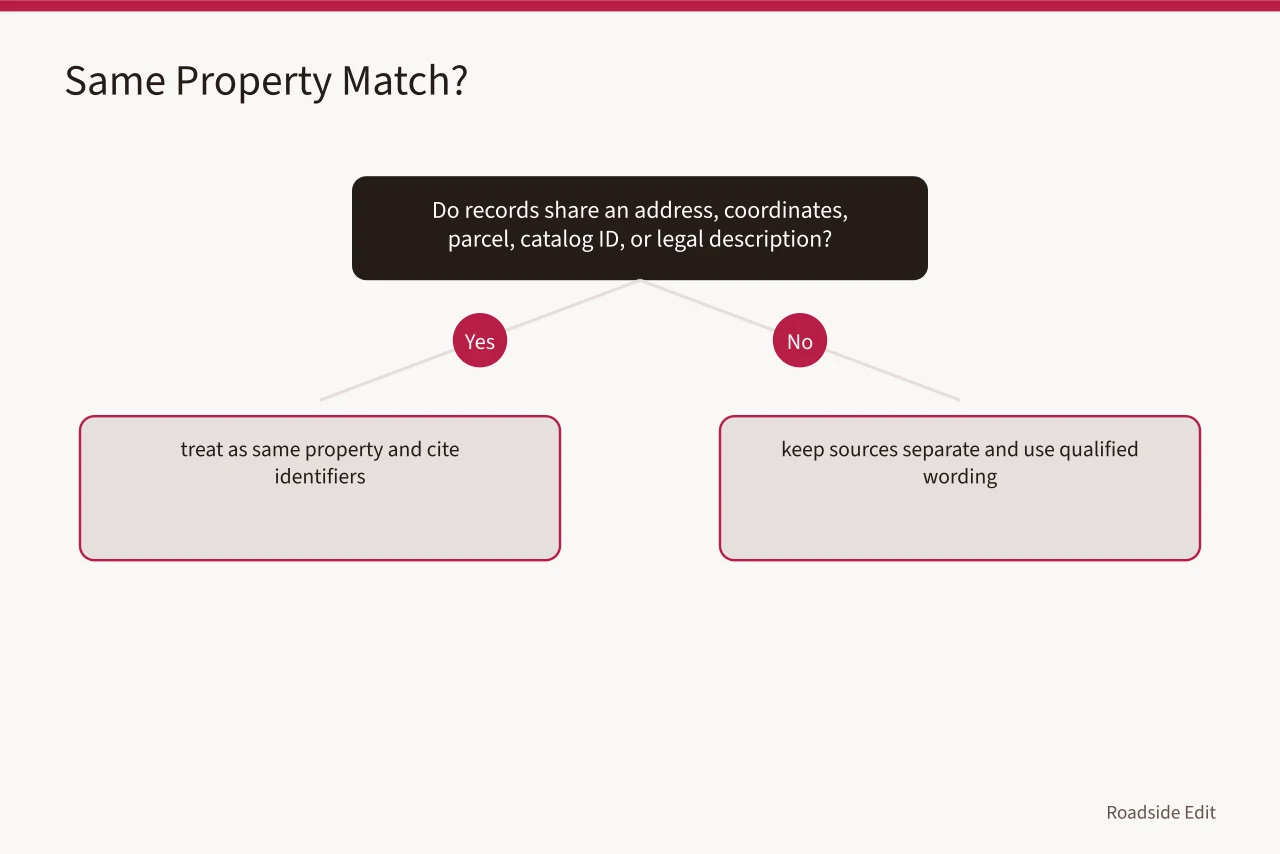
If the match stays uncertain, keep sources separate. Don't claim an older record documents the current building just because the town and building type are similar.
A qualified sentence works better: "A dated record identifies a building of this name in the town." It tells the reader what has been found without claiming a match that cannot be checked.
The National Archives explains that citations should provide the information another researcher needs to find a source. Follow the National Archives guidance for citing research sources. Retaining a source title, date, collection, and record identifier gives a future editor a way to revisit a property match rather than relying on a shortened reference.
What stage does the project record show?
Many case studies fail at the verb. "Planned," "funded," "approved," "underway," and "completed" are different states. A grant announcement usually supports an award or proposed effort. It does not necessarily support a final result. A rendering supports a design concept, not the condition after construction.
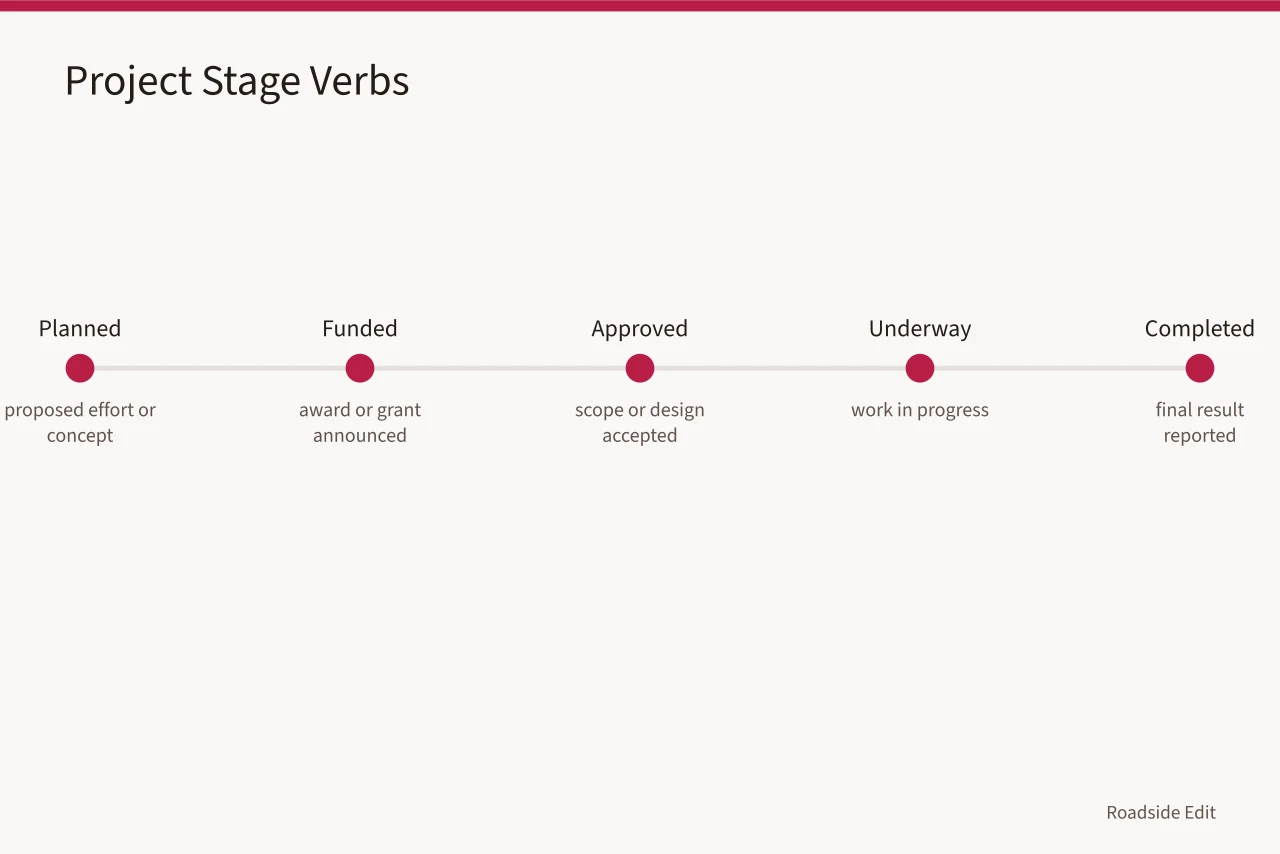
The National Park Service's documentation standards describe the need for reliable documentation and stated limitations in architectural and engineering records. Read the NPS documentation standards. Apply that discipline to the case study: label the record's stage, preserve its date, and avoid claiming a result that its creator did not report.
When a provider or sponsor supplies material, attribute it. "The provider states that it completed the work" is not the same as an independently verified completion record. A case study can include the statement, provided the attribution is clear and it does not contradict stronger evidence.
Are the visual records being read honestly?
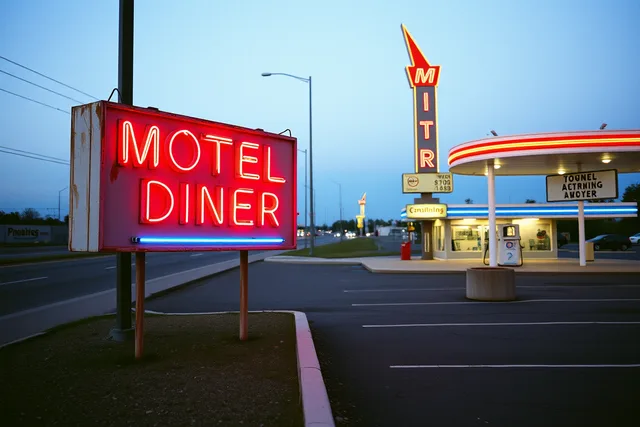
The Library of Congress catalog identifies the image and its subject. That is enough to use it as an illustration of the documented view. It does not establish current display conditions, ownership, maintenance, visitor access, or the outcome of a later project. Add those facts only if a separate, direct source supports them.
Ask three questions about every image: Who created or cataloged it? When was it made? What visible detail is the article asking it to prove? If the answer goes beyond the catalog information and visible view, find another record or cut the assertion.
What counts as a result?
A result should be stated at the same scale as its record. If the record says a sign was repaired, write about the sign. If a project report says that a survey was completed, write about the survey. Do not scale the result up to an entire district, route, business, or community without evidence that addresses the larger claim.
The National Park Service's Heritage Documentation Programs distinguish reports, photographs, measured drawings, and field records within their collections. Review the NPS Heritage Documentation collection information. This supports an editorial rule: call each record by what it is. A photograph cannot stand in for a measured drawing, and a field record cannot be silently converted into a later project outcome.
Make the final paragraph answer the original narrow question and nothing more. Readers can see the source trail, understand the time frame, and decide how much weight the case study deserves. That is far more useful than a heroic story with no way to verify the central claim.
A final case-study review
Before publication, check each paragraph against the source list and confirm every present-tense statement has current support. Confirm no quoted or paraphrased project language has shifted from planned to completed, and check the image credit matches the exact catalog page.
Then read the article once as a skeptical local reader. Could they tell which facts are documented, which are attributed, and which remain unknown?
If not, make the prose smaller. A case study does not need to answer every question about a roadside building. It needs to answer its own question accurately.
Common questions
Can a case study use an old photograph?
Yes. Use it for a dated historical observation that the catalog supports. Do not use it as proof of a current condition or a later project result.
Is a grant announcement proof that work was finished?
No. It supports the announcement or award described by the source. Find a later responsible record before stating that the work was completed.
What if two records appear to describe the same property but use different names?
Look for stable identifiers such as an address, catalog number, coordinates, or a reliable description. If the match cannot be confirmed, keep the records separate.