Guides
How roadside design studios can build a case study method readers can audit
Roadside design studio case study method for 2027 shows how to define evidence, report limits, credit media, and correct the public record clearly.
A roadside design case study should make its evidence visible. It should not open with a verdict that a place was saved, improved, successful, historic, profitable, safe, approved, or worthy. It should open with a specific question, a defined place and time, and a record of what the article can support.
This method supports a transparent U.S. editorial case study of a roadside sign, building, motor court, shop, or route feature. It can cover a public project or design question.
It is not a condition assessment, preservation treatment plan, construction record, legal finding, or business or project endorsement. It gives writers a repeatable way to build an account readers can check and later correct.
What to take away
- Frame one answerable question before collecting material.
- Create an evidence ledger before drafting the narrative.
- Keep direct observation, sourced fact, interpretation, and proposal distinct.
- Treat images as records with limits, not decoration or proof of an outcome.
- Publish a correction path and disclose provider-supplied or paid material.
Start with a question that can be checked
Avoid a broad prompt such as "What happened to this old roadside place?" It invites a collage of claims with no shared standard. Instead, identify a smaller question that readers can understand and available sources can address.
Useful questions include:
- What do dated public records and photographs document about the visible change at this location between two stated years?
- Which records describe the documented use of a roadside building, and which details remain unconfirmed?
- What alternatives did a public project describe, and what source identifies their stated purpose?
- What information would a future researcher need before making a project-specific recommendation?
The question needs a boundary. If an article compares a 1970 photograph with a 2026 image, it can report visible differences between those images. It cannot diagnose material failure, determine ownership, identify a permit, or state why a change occurred without other evidence. A narrow question gives the article a place to stop.
| Define first | Why it matters |
|---|---|
| Subject | Prevents route-wide history from becoming a fact about one property. |
| Location | Requires a source to identify the actual place being discussed. |
| Time range | Keeps current assumptions out of older records. |
| Editorial question | Tells readers why each source is present. |
| Decision boundary | Shows what belongs with an owner, agency, or qualified professional. |
Write the boundary in the opening. Readers should not have to reach the conclusion to learn that an image is illustrative, a source is undated, or the article does not verify a project claim.
Build an evidence ledger before writing prose
Open a ledger with one entry for each item. Do this before drafting. A good story can otherwise outrun the record long before the final fact check. The ledger may be a spreadsheet, a database, or a dated project note. What matters is that each claim has a traceable source and each source has a stated limit.
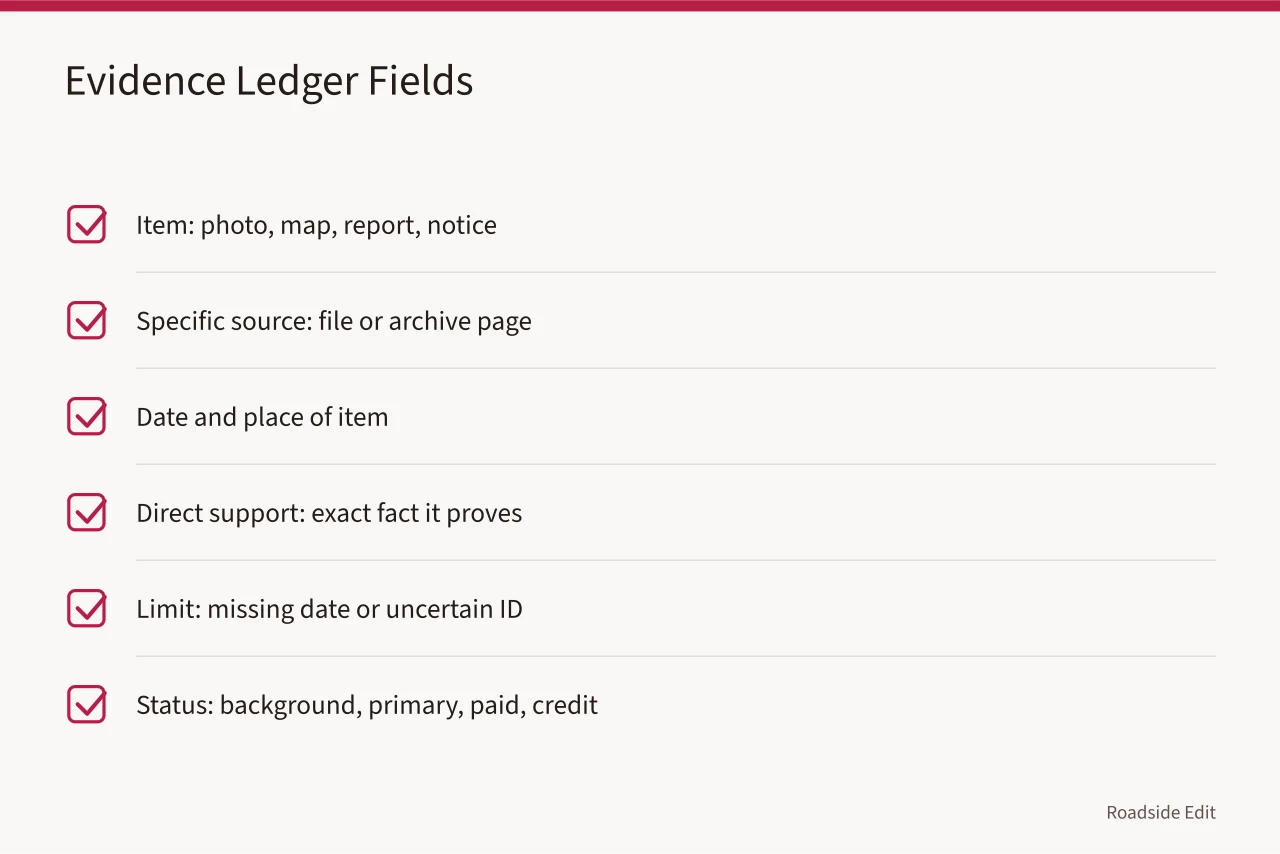
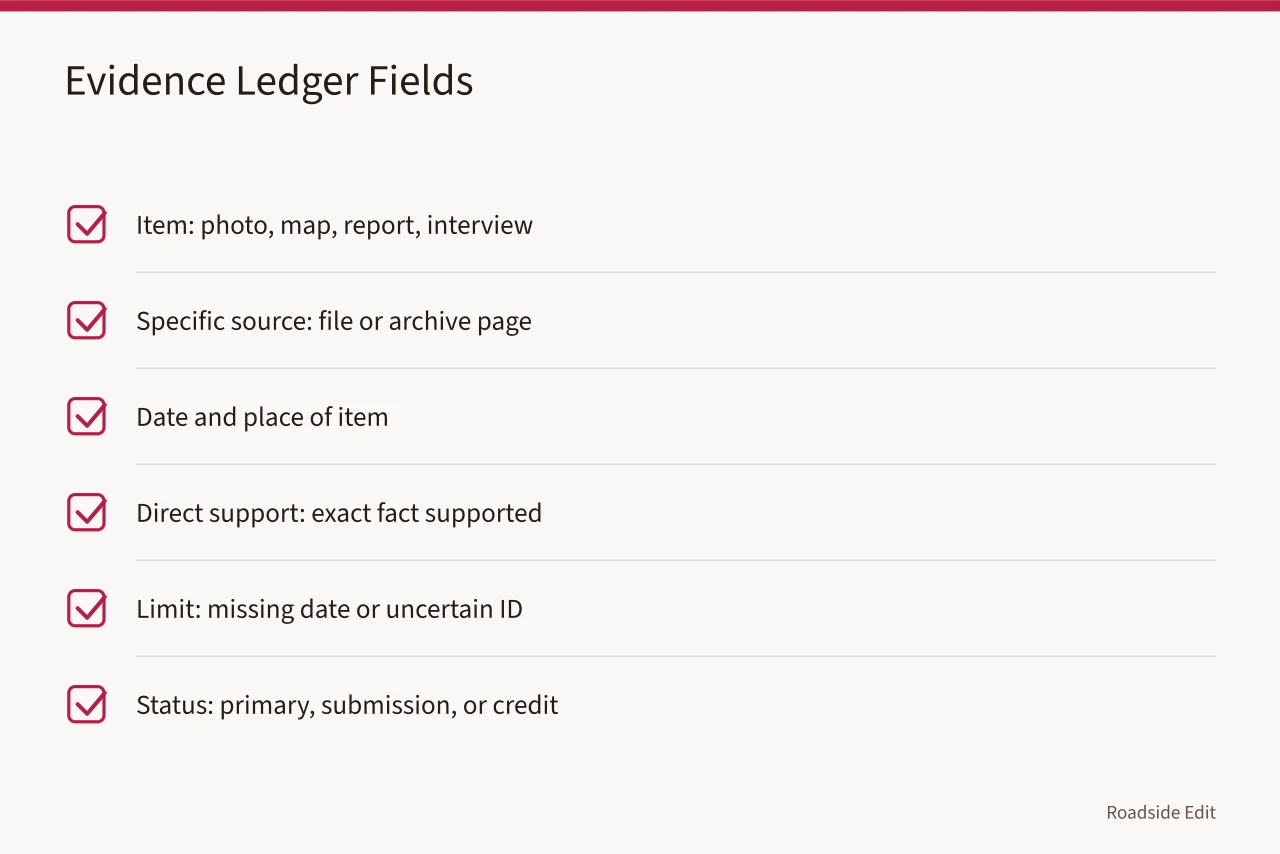
| Field | What to record |
|---|---|
| Item | Photo, drawing, map, report, interview, public notice, or submission. |
| Specific source | File page, record page, archive reference, or publisher page. |
| Date and place | When the item was made or published and what location it covers. |
| Direct support | The exact fact or observation the item can support. |
| Limit | Missing date, uncertain identification, incomplete view, or possible bias. |
| Status | Background, primary record, provider submission, paid material, or media credit. |
The National Park Service's historic-recording guidelines call for complete citations, accurate reporting of gaps, reliability assessment, and a distinction between supported facts and educated guesses. Read the National Park Service recording guidelines. The document concerns ships, not roadside sites. Its evidence discipline is still applicable: a reader should be able to identify what is documented and what is an interpretation.
Do not use a search result as a source record. Follow it to the actual page, item, catalog entry, or document. If a source moves, keep the title, access date, and enough detail to find it again.
This is not to make research look formal. It prevents a later correction from becoming a hunt for an unattributed sentence.
Separate four kinds of statements
Case studies become unreliable when statement types are blended into one smooth paragraph. In notes, mark what you observed, what a source says, what you infer, and what someone proposes. In published copy, make those differences plain.
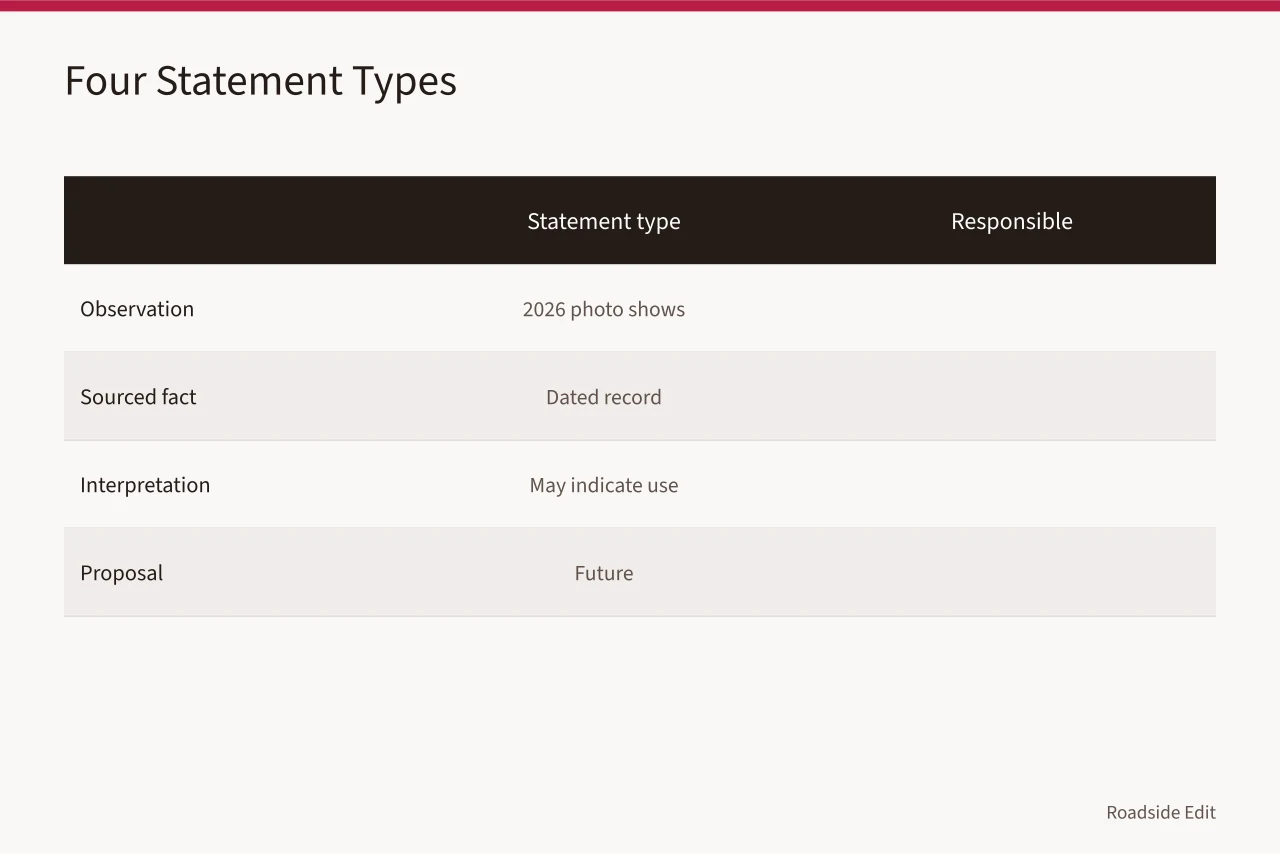
| Statement type | Responsible wording |
|---|---|
| Observation | "The 2026 photograph shows peeling paint on the sign face." |
| Sourced fact | "A dated public record identifies the property by this address." |
| Interpretation | "This may indicate a change in use, but the available record does not establish why." |
| Proposal | "A future project could investigate this through an owner-authorized survey." |
Do not upgrade observation into cause. A photograph can show a crack. It cannot, by itself, prove the material, condition beneath the surface, safety risk, needed repair, or cause of the crack. A newspaper clipping can document what a reporter wrote at a stated time. It may not settle present ownership, funding, or operating status.
Use attribution when the speaker has a role in the story. "The project organization states" is better than presenting its description as an independent result. If a statement has not been verified, say that rather than hiding the gap in confident phrasing.
Use maps, photographs, and views with care
Maps are useful for orientation, route context, and named features. They are not complete histories of a parcel or proof that a visible building had a specific use. The U.S. Geological Survey describes topographic maps as representations of natural and man-made features.
See the USGS explanation of topographic maps. That description does not establish a fact about a particular roadside property. It supports the more limited practice of saying what a map depicts and then seeking other records for ownership, dates, or project details.
Photographs require the same restraint, so record the source page, creator or credit information, date if available, place, and exactly what the image shows. Add an image only if it helps the reader understand the documented question.
A useful caption is specific and modest: "Roadside facade photographed from the public street in 2026." A caption like "abandoned business awaiting restoration" carries claims about status and intent an image may not support.
Before presenting a comparison, test whether the views are comparable:
| Comparison question | Why ask it |
|---|---|
| Is the location reliably the same? | Similar storefronts or route features can be mistaken for each other. |
| Are the dates known? | An undated view cannot establish a sequence. |
| Is the perspective comparable? | A close-up and a wide view may not depict the same feature. |
| Did context change? | Crop, lighting, season, traffic, and later work affect interpretation. |
| What remains uncertain? | The article should not act as if uncertainty disappeared. |
The National Archives explains that photographic materials can be affected by handling and storage. Review National Archives guidance on photographs. It does not authenticate a specific image or identify a roadside site's date. It supports a basic source question: what is known about the copy, its custody, and the conditions in which it has been retained?
If two images cannot fairly support a before-and-after conclusion, use a narrower sentence. Explain how the images differ and what their captions identify. Do not declare that a particular project caused the difference unless a direct record supports that link.
Describe a project without borrowing certainty
A case study may use owner statements, provider descriptions, public officials' remarks, community memories, or public notices.
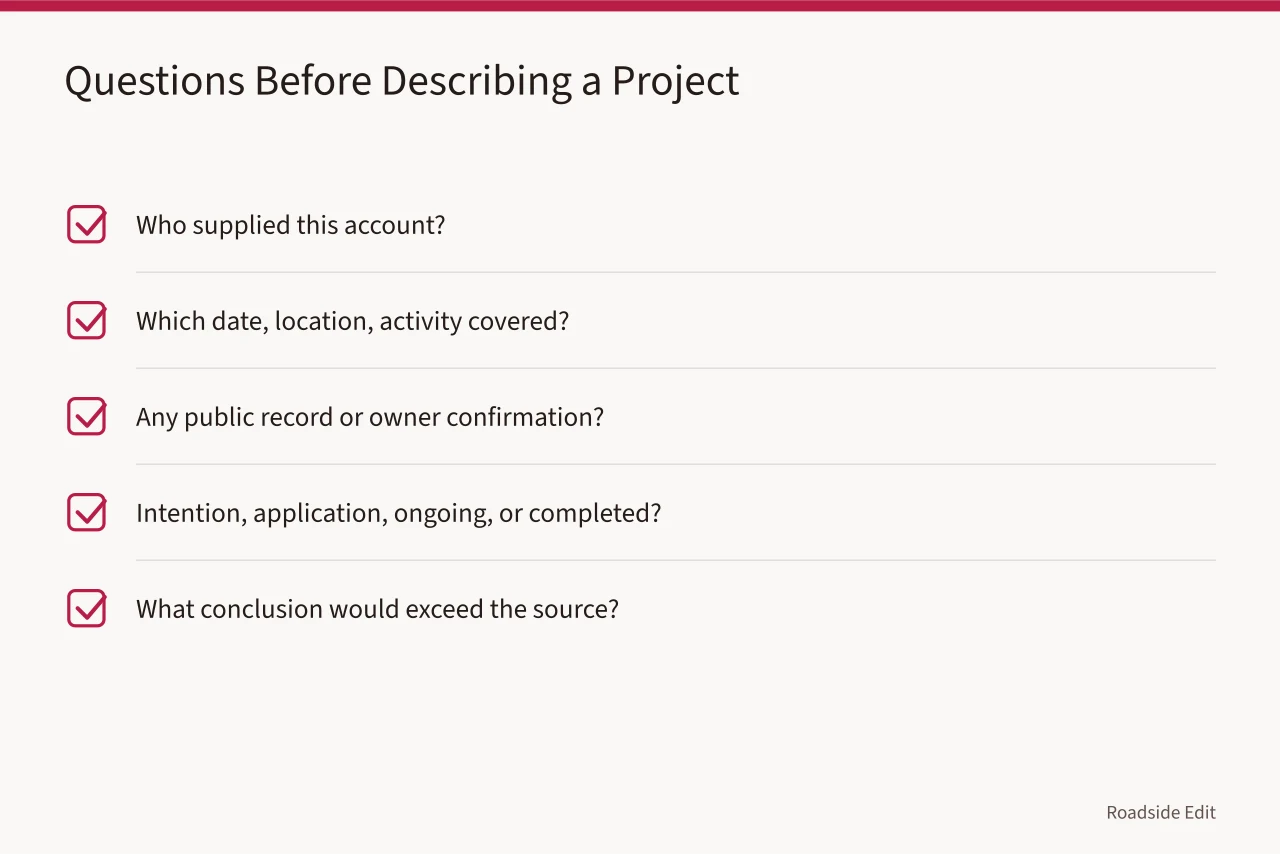
Paid listings may apply. Each adds meaningful context and needs attribution and scope because a provider's description reports what it says it did while a sponsor listing can help readers find a business if paid status is visible. Neither is independent proof that work was approved, completed, safe, or successful.
Ask these questions before describing a project:
- Who supplied this account, and were they directly involved?
- Which date, location, and activity does the statement cover?
- Is there a public record, owner confirmation, or other source that supports the narrow claim?
- Does the statement report an intention, an application, ongoing work, or completed work?
- What conclusion would exceed the source?
For current work, ask the owner or responsible organization who may confirm scope, completion, costs, permits, and public statements. Do not ask an article to decide whether work meets a code or whether a design is safe. Those questions belong with the responsible authority or a qualified professional working within the actual assignment.
Credit media and keep permission questions open
Finding an image online does not grant a right to republish it. Ask who made it, who owns it, what license applies, whether credit is required, and whether the planned use is allowed.
Point credit to the exact page where the image appears. Keep the source information in the project file in case the page or terms change later.
The U.S. Copyright Office says fair use is decided case by case, not automatic permission for a short excerpt or educational purpose. Read the Copyright Office fair-use overview.
That overview does not decide whether a particular image or quotation is permitted, and it supports a prudent editorial practice: obtain permission or rely on clearly stated terms. Do not assume publicly visible material is free to publish.
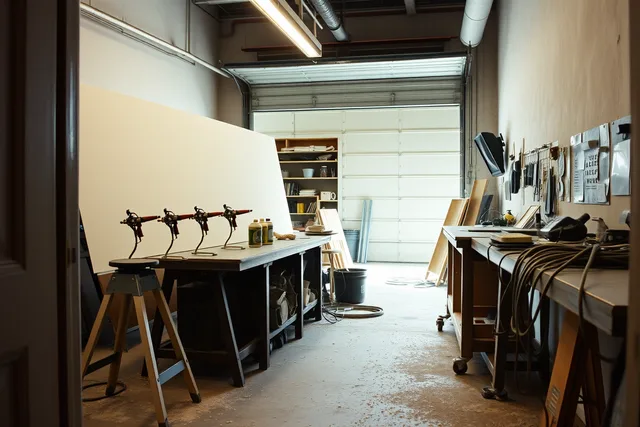
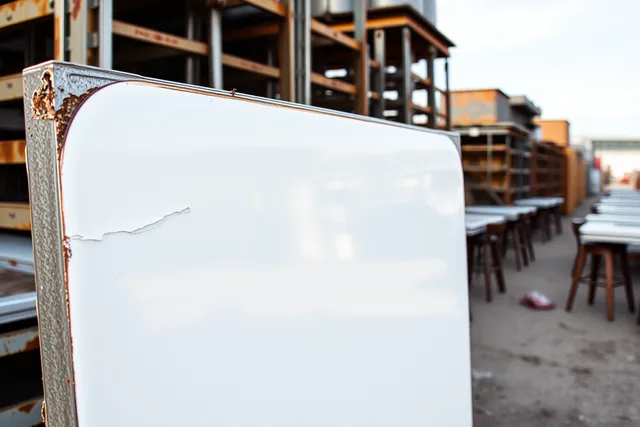
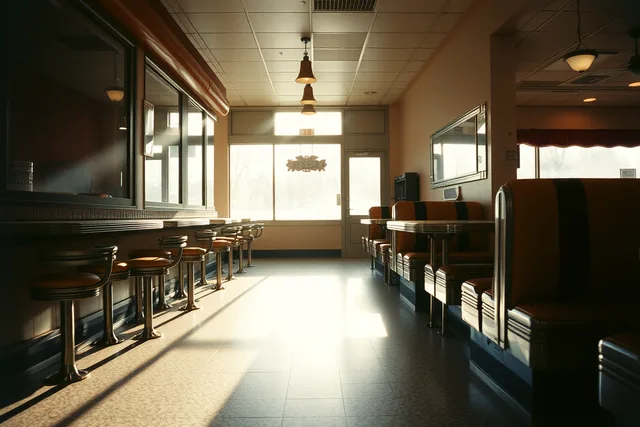
Do not use an unrelated roadside image as visual proof of a project, provider, or claimed treatment. If the image is there for context, label it illustrative. If an author asks for removal and the publication has no clear basis to retain it, remove it while the source question is resolved.
The image is illustrative only. It does not establish present condition, ownership, safety, project history, or status for any other roadside location.
Draft a study readers can audit
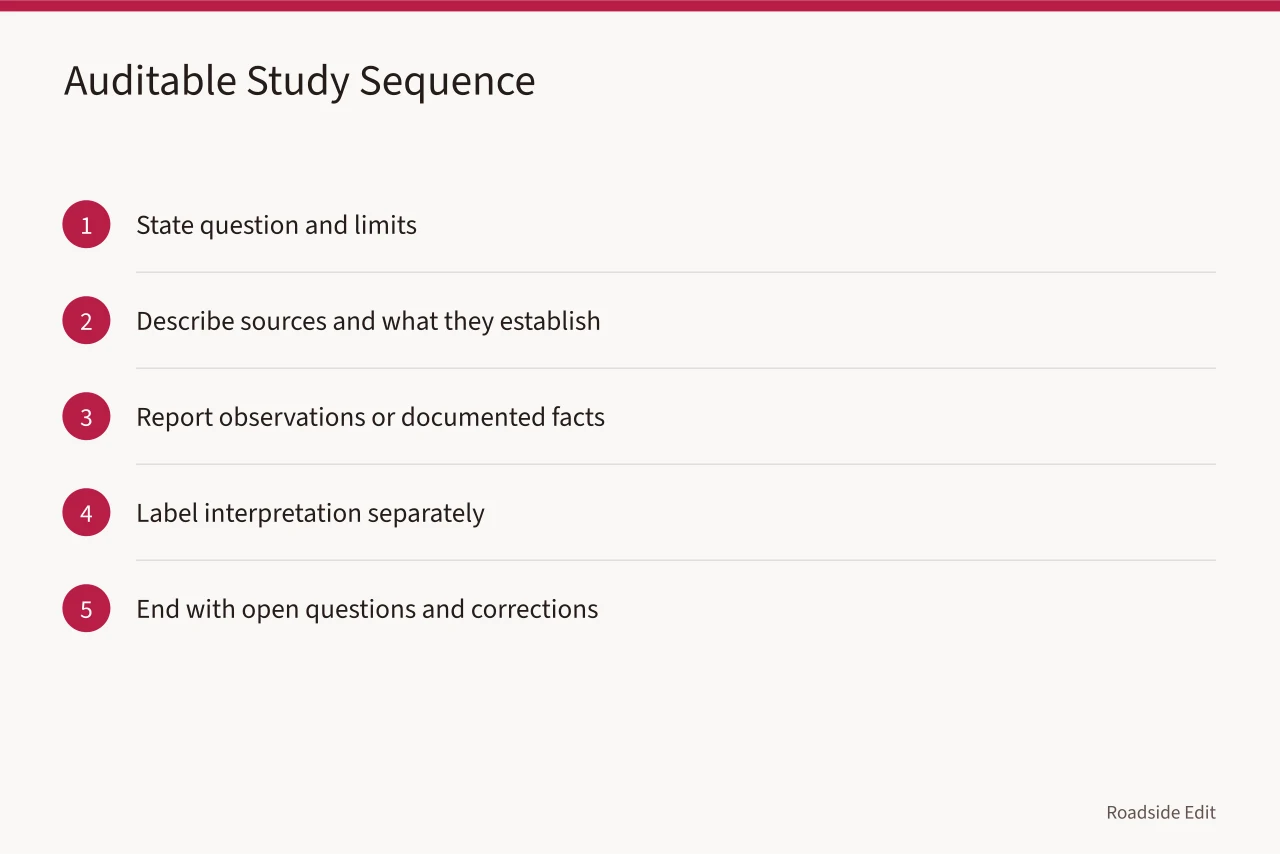
Use a visible sequence. First state the question and the geographic and time limits. Next describe the sources and what each can establish. Then report direct observations or documented facts. Put interpretation in its own paragraph or label. End with unanswered questions, next research steps, and a correction path.
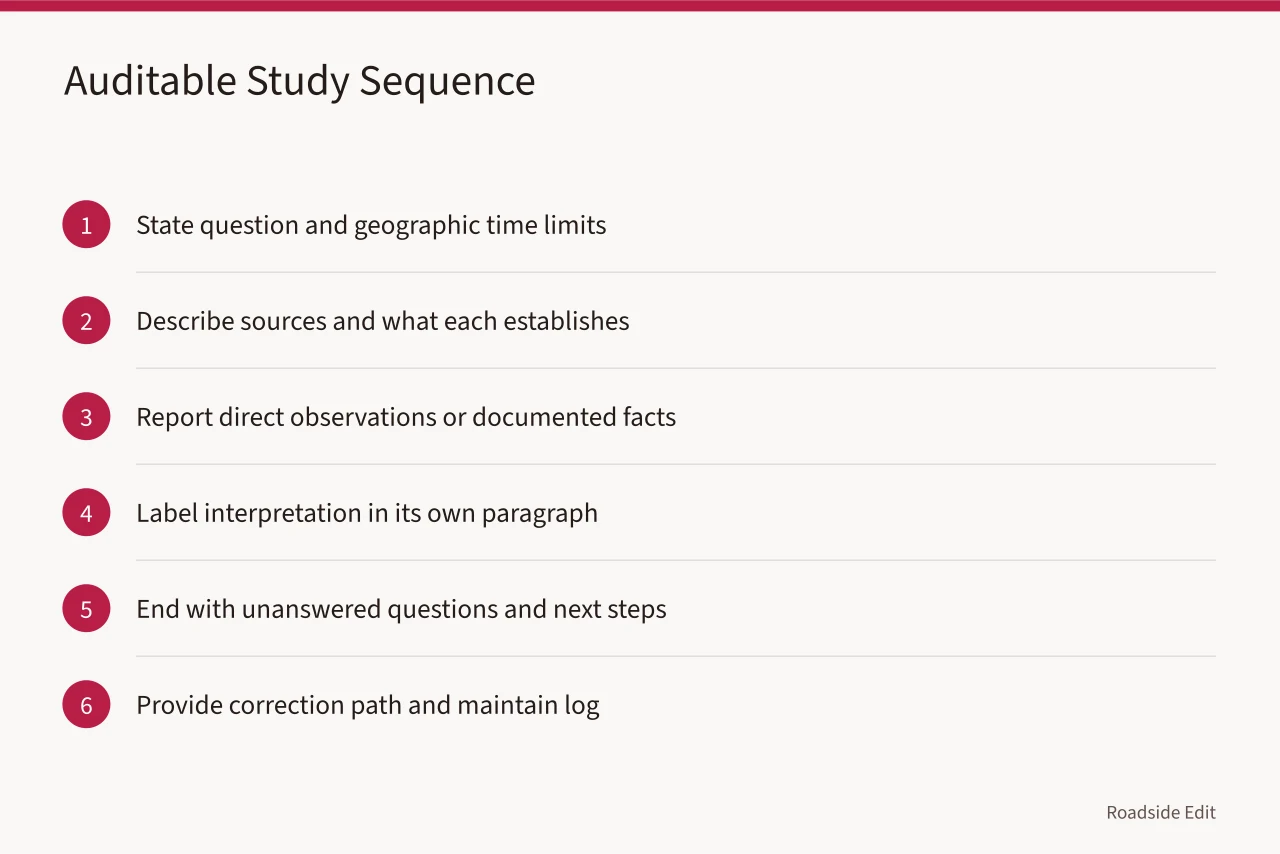
This structure prevents uncertainty from being hidden in a final disclaimer. It also allows an editor to check whether the headline, meta description, captions, table entries, and conclusion promise more than the sources establish.
Before publication, run this review:
- Is every consequential sentence tied to an identified source or labeled as an observation?
- Does each source support the exact claim beside it, including the correct time and place?
- Are provider, sponsor, and contributor statements attributed?
- Does every image credit point to the page where the media came from?
- Does the article say when it lacks a date, location, or confirmation?
- Is there an email address or editorial route for factual corrections?
Maintain a short correction log. Note the date of a correction, the source that prompted it, the exact sentence changed, and why. A correction is not an embarrassment. It is evidence that the case study treats the public record as something that can improve.
Make commercial material transparent
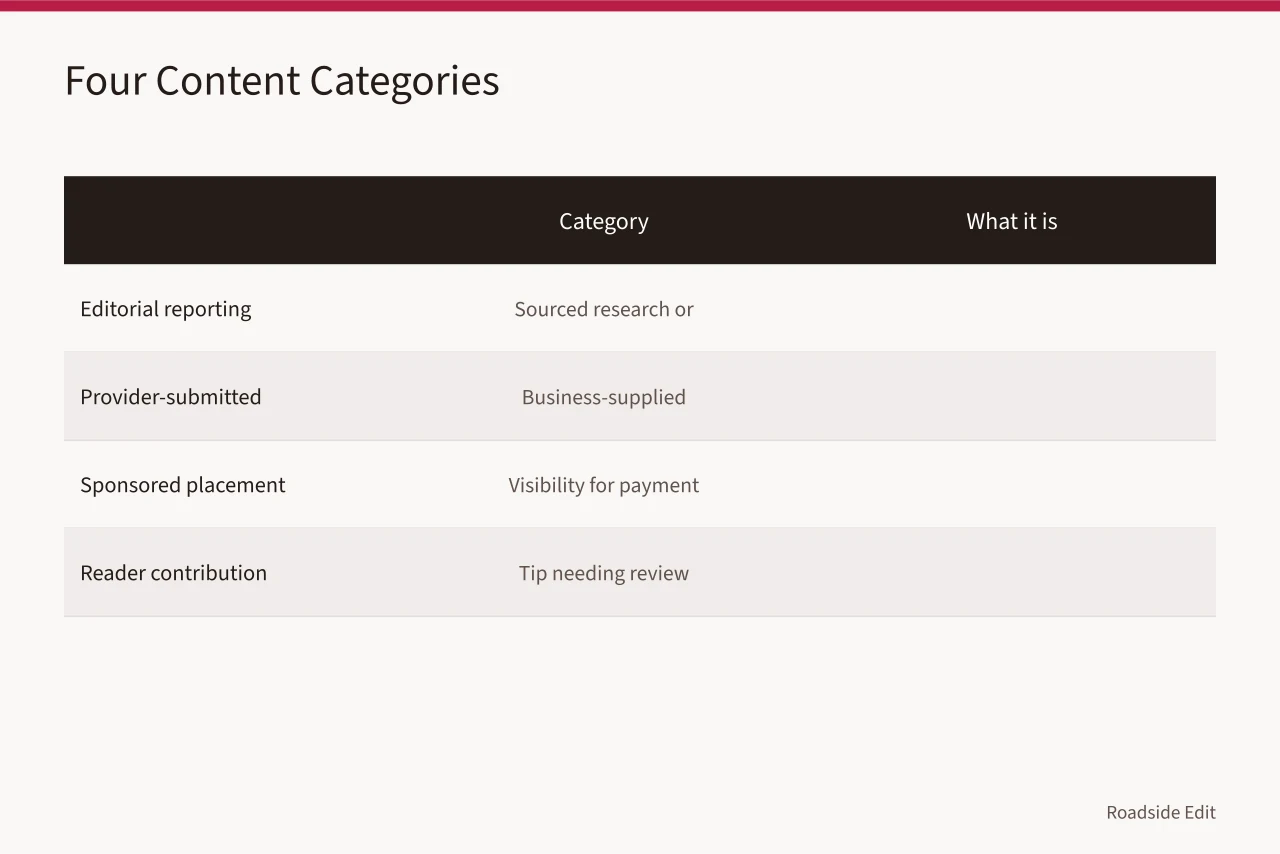
RoadsideEdit may later host sponsored profiles, submitted listings, or paid placements. A case-study page should make those relationships easy to recognize. Keep four kinds of content visibly distinct:
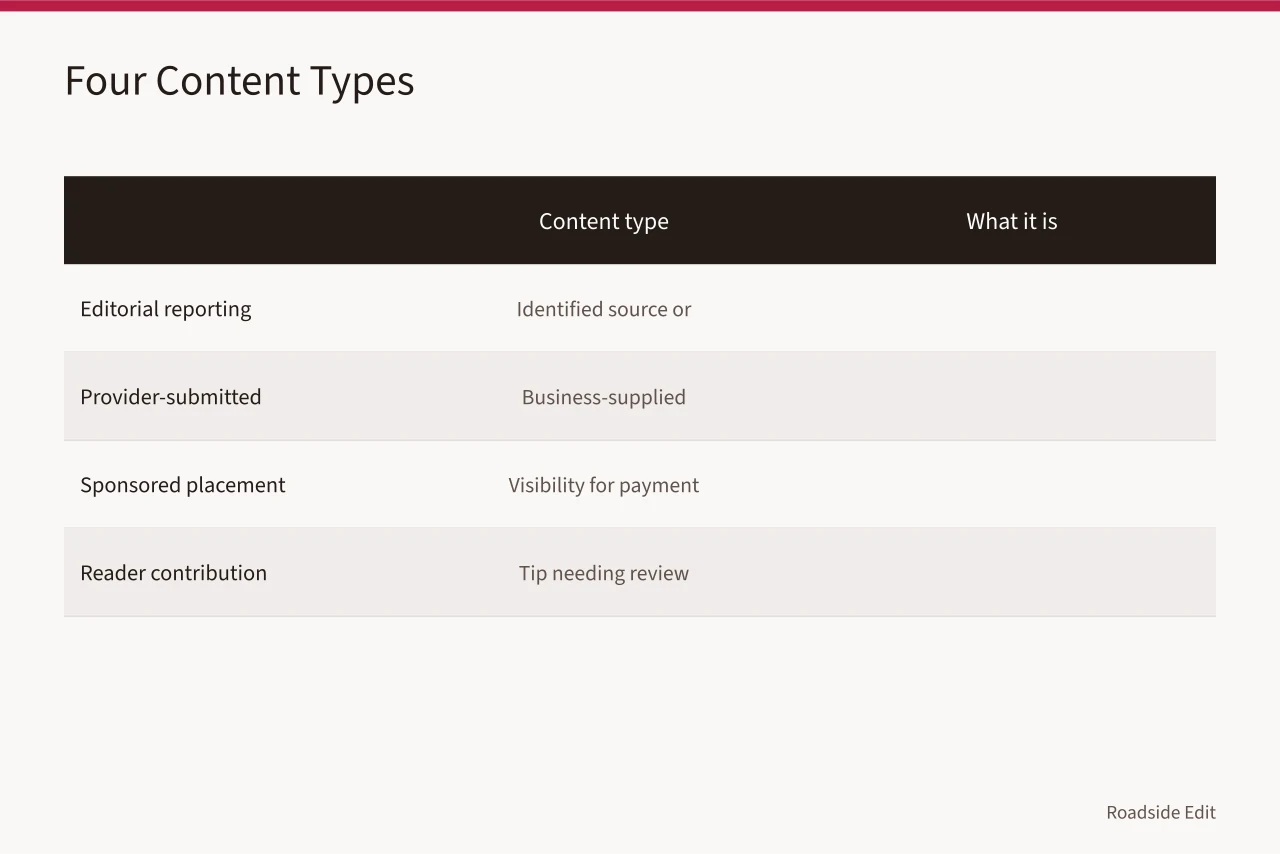
- Editorial reporting: Research supported by an identified source or direct observation.
- Provider-submitted information: A description, photograph, or correction supplied by a business.
- Sponsored placement: Visibility provided in return for payment or another material relationship.
- Reader contribution: A tip or account that needs review before it becomes a factual statement.
This does not make commercial material unusable. It gives it the right role. A business can explain its services and provide a correction without requiring the publication to treat the statement as an independently verified result. Readers can decide how much weight to give the material because they know where it came from.
Common questions
Can a case study include a recommendation?
Yes, when it is identified as a proposal and the article states what project-specific evidence or authority would still be needed.
Is an old photograph proof of current condition?
No. It documents what is visible in that image at its stated or estimated time, not the present condition.
What should happen when sources conflict?
Identify the conflict, compare dates and scope, seek a stronger record when possible, and do not hide the uncertainty.
Can a study name a business?
Yes, when the source and commercial relationship are clear. Do not convert a provider's own statement or a paid placement into independent editorial judgment.
In this guide
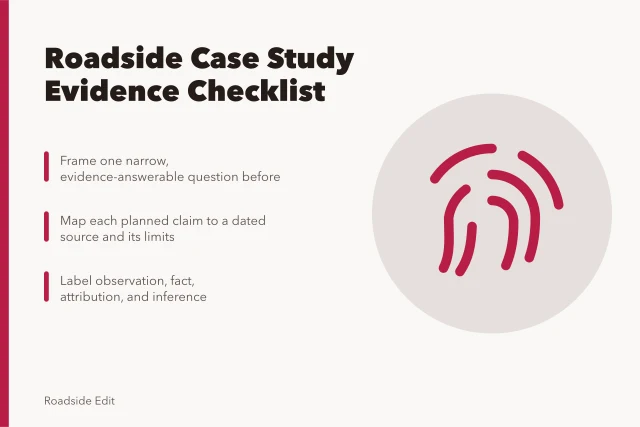
- Roadside design studios case study checklist: what to settle before you draftRoadside design case study checklist for 2027: frame one answerable question, map evidence, separate claims from inference, credit media, and correct the record.
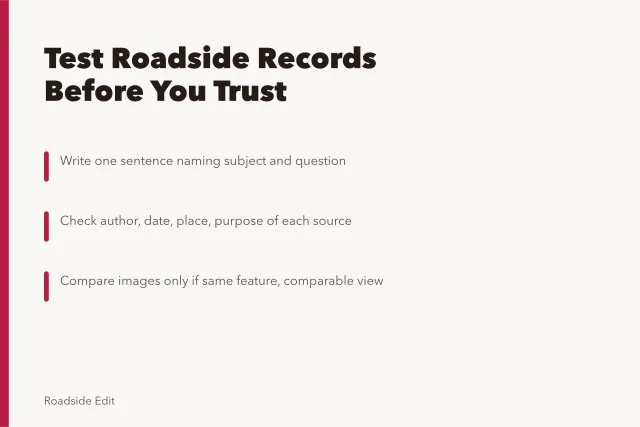
- Roadside design studios case study method comparison questions to ask before you trust a recordRoadside design case study questions for 2027 help readers test sources, compare records fairly, credit media, and state what evidence cannot show.
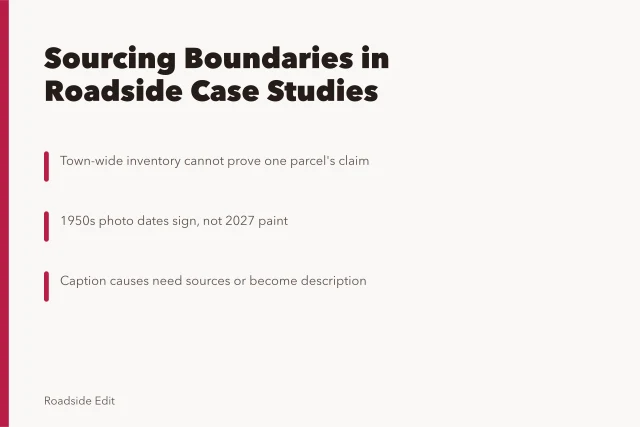
- How roadside design case studies handle warning signs and weak sourcingWarning signs in roadside design case studies flag labels without records, parcel claims built on town-wide sources, and captions that add causes.