Guides
Part of How roadside design studios can build a case study method readers can audit
How roadside design case studies handle warning signs and weak sourcing
Warning signs in roadside design case studies flag labels without records, parcel claims built on town-wide sources, and captions that add causes.
A porcelain-enamel station sign and a plastic-faced box sign from the same decade fail differently, and a case study that files both under "historic signage" has already lost the reader. The warning signs below are the weak-sourcing traps roadside design case studies meet most often, and they survive a fact check and still mislead.
What to take away
- A county inventory cannot support a claim about one parcel; restore the boundary or drop the sentence.
- A 1950s photograph dates the sign, not the paint on the tube in 2027.
- A caption that names a cause ("failed after the roof leaked") needs a source, or it becomes description only.
- When a material claim changes, fix the headline, caption, facts box and any syndicated copy, not just the paragraph.
- Write the research question before you write the sentence it is meant to support.
- A National Register nomination, a dated survey and a State Historic Preservation Office file are three different records, so name the one you used.
A source can be accurate and still wrong for the sentence
Most weak sourcing is not a bad source. It is a good source stretched past its boundary.
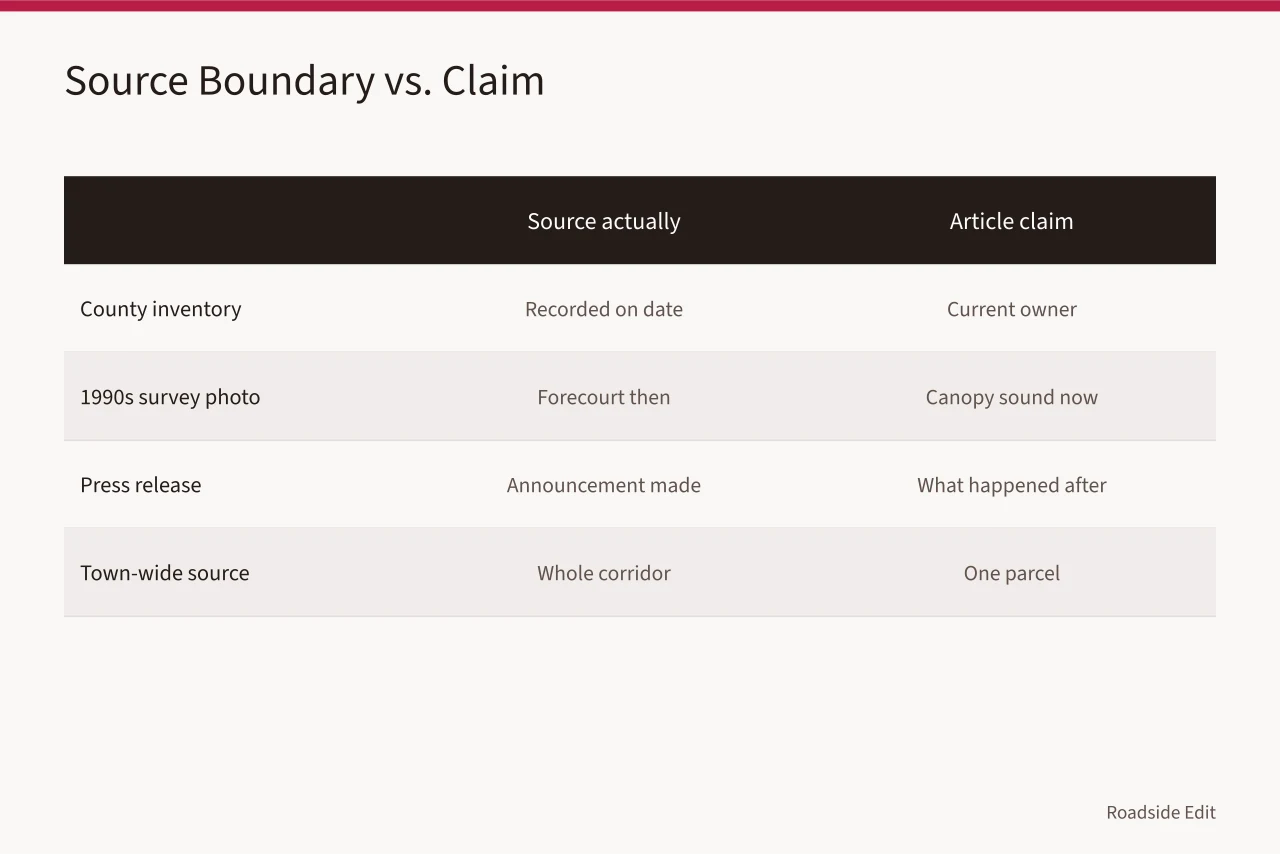
A county inventory lists what the county recorded, on the date it recorded it. It does not establish who owns the concrete tipis at the Wigwam Motel in Holbrook, Arizona today, whether the canopy at the 1939 Blue Swallow Motel in Tucumcari is sound, or whether a rehabilitation finished as permitted.
A 1990s survey photograph shows the forecourt as it looked when the photographer stood there. It does not date the neon transformer on the pole sign in 2027.
A press release records what an organization said. It does not record what happened after the announcement. El Vado Motel in Albuquerque, built in 1937, reopened in 2018, and the announcement and the reopening date are two different records.
The National Archives defines primary sources as original records or firsthand accounts created at the time under study. Read the National Archives guide to primary sources. A primary source still has a creator, an audience, a date and a limit. Put all four in the research note.
| Warning sign | Editorial response |
|---|---|
| The page calls a sign or building historic with no record cited | Attribute the label, name the record, or cut it |
| The source covers a town or corridor, the article describes one parcel | Restore the original geographic boundary |
| A 1950s source supports a 2027 status claim | Date the claim or find a current record |
| The caption adds a cause, condition or outcome | Keep the caption to what is visible |
| A supplier's or sponsor's statement reads as an editorial finding | Attribute it and disclose the relationship |
| A reopening announcement is reported as current operating status | Report the announcement and its date, or find a current record |
| A porch sign, canopy or booth claim rests on one photograph | Name the second record or narrow the claim |
The label is doing the work the record should do
"Historic" is a finding, not a description. It belongs to a listing, a determination of eligibility, or a survey with a date and a preparer. Without one of those, the word is a compliment.
The "Welcome to Fabulous Las Vegas" sign, designed by Betty Willis in 1959 and fabricated by YESCO, entered the National Register in 2009. The 32-foot donut at Randy's Donuts in Inglewood went up in 1952. Neither fact makes the next good neon sign historic.
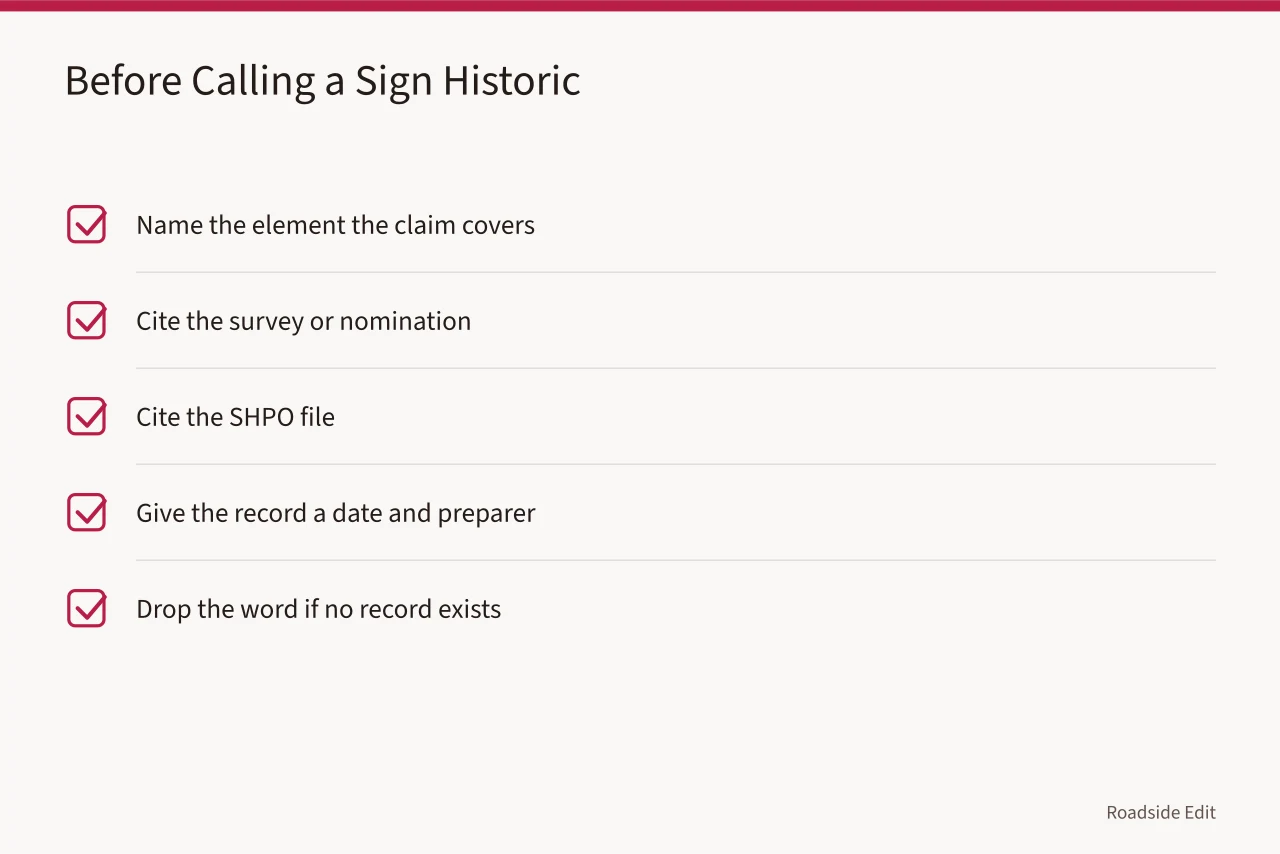
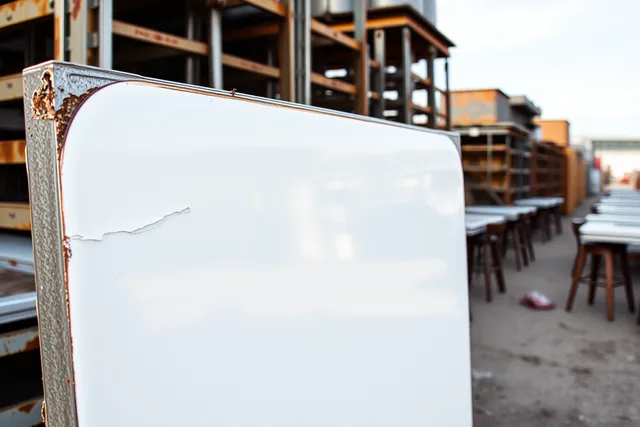
The same applies to "original." Porcelain-enamel panels, neon tube and transformer, chrome-edge trim and laminate booth tops all get replaced in stages. A sign can hold its original face and a 1970s transformer, or the reverse.
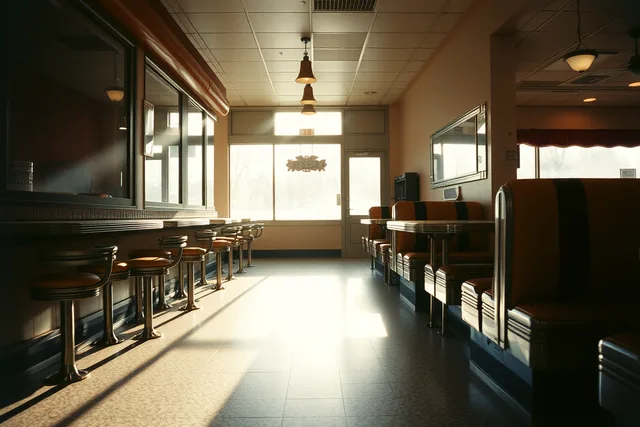
Formica laminate reached diner booth tops after its introduction in 1913. A booth top swapped out in 1974 is not the top a 1939 photograph shows.
Ask which element the claim covers, then cite the survey, the National Register nomination, or the State Historic Preservation Office file that says so. Nominations use NPS Form 10-900 and carry a boundary description, which is the parcel-level detail a town-wide inventory lacks.
Section 106 review and the Secretary of the Interior's Standards both turn on documented character-defining features, not on the word "historic." Consult the NPS historical-documentation standards. The Federal Historic Preservation Tax Incentives program pairs a 20% credit for income-producing certified historic buildings with a 10% credit for non-historic buildings placed in service before 1936.
A photograph carries a conclusion nobody wrote
An image records a sign face, a facade, a roadway, a pump island. It also records a dry-stand pipe and a soffit. It cannot establish whether a canopy is sound, whether the enamel spalled from a freeze, whether a permit exists, or whether a project succeeded.
A 2026 photograph of the Blue Swallow's neon says nothing about the transformer behind it. Date the image, name the viewpoint, and describe what a reader can see. If a caption needs a cause, the cause needs its own source.
Context is not decoration. The National Archives warns against casual alteration of archival records and discusses retaining contextual information when a note must be moved. Review NARA's paper-record guidance. The page addresses physical records. The editorial lesson transfers: strip the context from a photograph and you have created a new factual error.
One corrected sentence is not a correction
A material fact usually appears in more than one place. Search the whole page and the whole feed before you close the ticket.
| Change | Follow-up check |
|---|---|
| Ownership | Headline, opening, caption, facts box |
| Opening status | Summary, visitor advice, structured data |
| Project status | Timeline, funding language, FAQ |
| Sponsor disclosure | Listing label, promotional copy, syndicated version |
| Named attribution | Research note, caption credit, image licence line |
Record the statement changed, the date, the reason, the source and the editor who signed off. That log lets the team explain a correction later without rewriting history or publishing private correspondence.
The same publication carries a parallel set of planning warning signs for corridor and land-use claims, and the two lists are meant to be run together.
Write the question before you write the sentence
Unknowns get filled with the most plausible story unless someone stops it. Ownership, operating status, funding, safety and proposed work are the fields where this happens most, because they change and because a general web search rarely surfaces the responsible party.
A usable research question names the evidence and the office that holds it:
- "Which current county assessor record lists the owner of the Holbrook Wigwam Motel parcel?"
- "Does the cited rehabilitation have a dated approval notice?"
- "Which SHPO file covers this corridor segment?"
- "What does the 1985 survey sheet say about the canopy?"
Each one can be answered yes or no, or with a document. None of them invites a narrative.
Paid placement is not a finding
A sponsored listing identifies a provider. It does not establish that provider's quality, a project's result, or the fitness of a recommendation. A motel that buys space on a Route 66 travel page is identified as a sponsor, not certified as a preservation success.
The Federal Trade Commission holds that advertising designed to resemble independent content must be identifiable as advertising. See the FTC's native-advertising guide. Readers should be able to separate three things on any page: what was paid for, what a business supplied, and what the editor checked against a record.
Common questions
Does every edit need a correction note?
No. Use one when the change alters what a reader would take from the case study, such as ownership, status or a named finding.
What do I do with a good story I cannot prove?
Attribute it as a reported account, find a record that supports it, or leave it out. A gap is cheaper than a retraction.
Can a photograph be the only source?
Only for a narrow observation of what it visibly shows, with a specific credit and no added cause or outcome.
Can a National Register listing settle an "original" claim?
Partly. The nomination describes what the preparer recorded on a date, and that description covers character-defining features. It rarely settles whether a given panel, tube or booth top is the one installed at opening.
Who signs off on a correction?
Name one editor in the log. A correction with no owner drifts, and the next writer repeats the original claim.