Guides
Part of How to run a roadside building case study method that holds up
Roadside building case study warning signs every editor should catch
Roadside building case study warning signs for 2027 help U.S. editors find missing evidence, date errors, scope drift, and claims that require correction.
Case studies often fail in the final edit. The research may be sound, but a sentence becomes broader than its record, a date falls out, or an attractive image is asked to prove more than it can. These warning signs are editorial checks. They help a local story remain useful without presenting inference as fact.
What to take away
- Review the claim beside each link, not simply the fact that a link exists.
- Keep source date, geographic reach, and stated purpose visible when they limit a conclusion.
- Treat photographs and promotional material as distinct types of evidence.
- Correct a weak sentence by narrowing or removing it, not by disguising the gap.
Warning sign: a source is present but the claim is unsupported
A source can be reliable yet still wrong for the sentence it backs. A federal map may describe a region well but say nothing about one address. A historic survey may name a building in a past year but not who occupies it now.
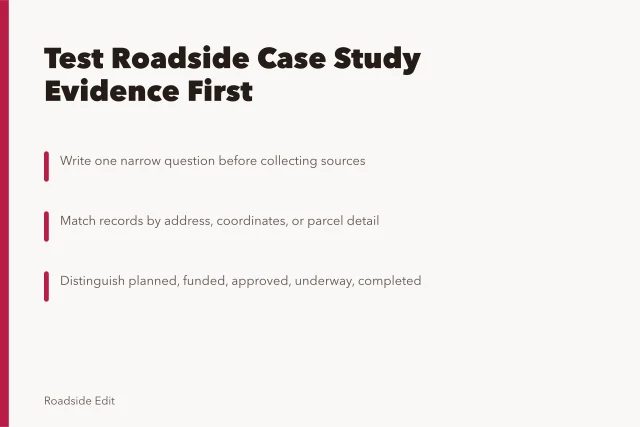
Start every review by asking, "Could a reader open this exact page and find support for this exact claim?"
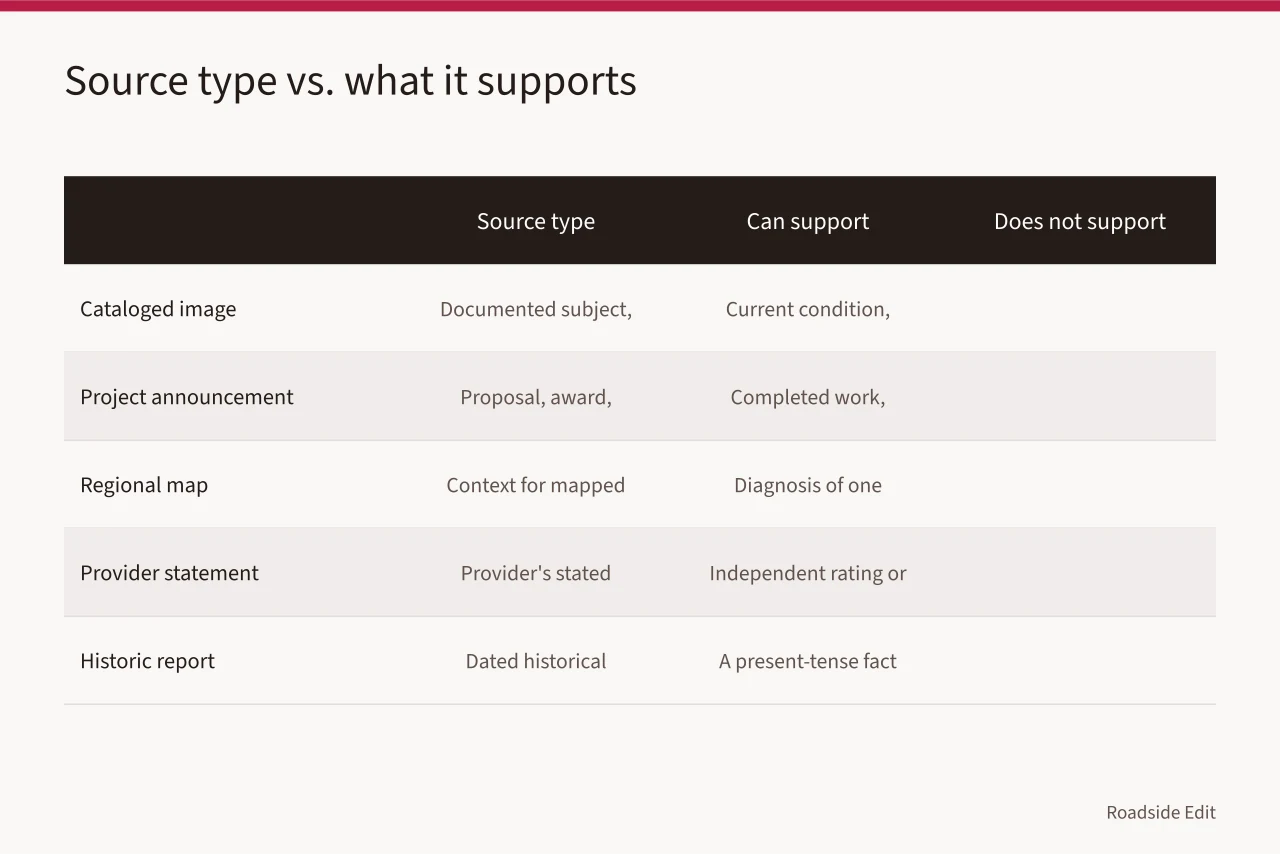
| Source type | It can often support | It does not automatically support |
|---|---|---|
| Cataloged image | A documented subject and image date | Current condition, ownership, or public access |
| Project announcement | A proposal, award, or stated intent | Completed work or long-term result |
| Regional map | Context for a mapped area | A diagnosis of one building |
| Provider statement | The provider's stated service | An independent rating or outcome |
| Historic report | Dated historical information | A present-tense fact |
This check catches a familiar writing mistake: a paragraph begins with evidence and ends with a conclusion that the evidence never reached. Split the paragraph. Keep the supported fact. Then identify what else would be needed to make the larger claim.
Harvard's guide to integrating sources says writers must make the link between source material and their point clear. Read Harvard's guide to integrating sources.
For a roadside case study, that link must be plain. Tell the reader if a record is an image catalog, a plan, a completion report, or an attributed statement. Never give it a different role.
Warning sign: the timeline has been flattened
Case studies need time markers. A building may be photographed in one decade, surveyed in another, and discussed in a later project proposal. The mere order of those records does not establish a continuous story of ownership, decline, repair, or use. Look for a source for each bridge between events.
Keep a simple timeline during editing:
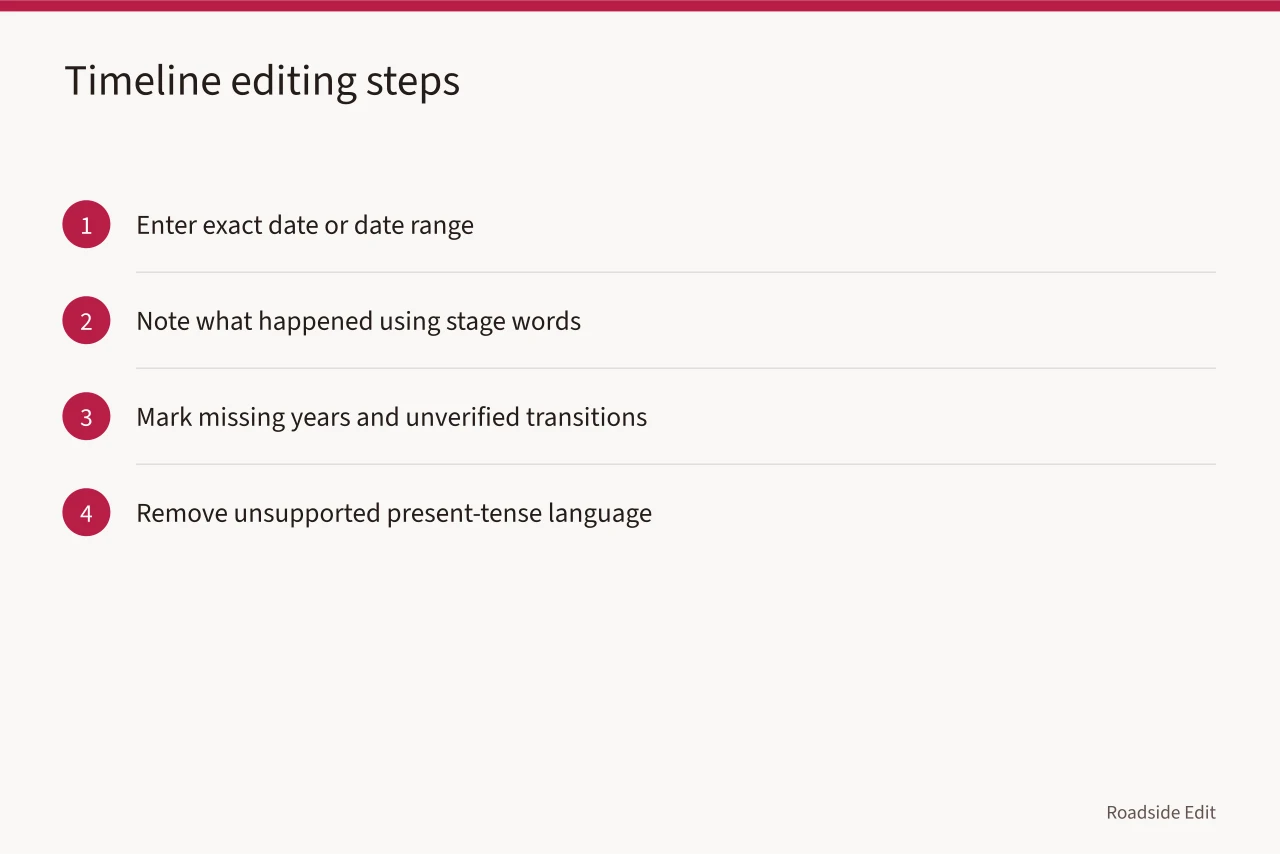
The National Park Service documentation standards call for reliable records and clear limits in documentation work. Read the NPS documentation standards. A web case study should follow the same common-sense rule. A gap in the record is information. Do not cover it with an assumed outcome.
If a source says a project was funded, report the funding. If it says plans were approved, report the approval. Avoid the tempting word "completed" until an appropriate record says the work finished. That single distinction prevents many misleading local narratives.
Warning sign: regional context has become a property verdict
Maps, climate summaries, route histories, and local plans can add excellent background. The warning sign appears when a writer uses them to diagnose a particular roadside building. For example, a flood map may place an area in a mapped hazard zone. It does not tell readers that one building was damaged, unsafe, uninsured, or subject to a particular requirement.
NOAA's U.S. Climate Atlas provides temperature and precipitation information at regional scales. Explore the NOAA U.S. Climate Atlas. It can support a carefully limited statement about the source and its mapped information. It cannot establish a building's maintenance history or explain why a particular project succeeded or failed.
When regional context is useful, state its scale in the article. Name the area, the record date, and the subject covered. Then keep the property question open until a direct source identifies the property. This does not weaken a case study. It lets readers see the difference between setting and evidence.
Warning sign: commercial material is carrying the conclusion
Provider submissions, sponsored descriptions, and business profiles can contribute facts. They should remain attributed. A case study should not say that a company produced "excellent" work, solved a property problem, or is available now merely because the company says so. Those phrases are either opinions, time-sensitive facts, or claims that need another record.
The Federal Trade Commission's disclosure guidance explains that material connections should be disclosed when they could affect how people evaluate an endorsement. Read the FTC's Disclosures 101 guidance. This source supports transparent disclosure in a commercial context. It does not validate a provider's claims or make a paid placement an editorial recommendation.
In a case study, label provider-supplied information as such. If an independent public record confirms a limited fact, cite that record where the fact appears. Keep the disclosure separate from the evidence. Readers should never have to guess whether a glowing line is an observation, an advertisement, or a verified result.
Warning sign: the image has become the evidence file
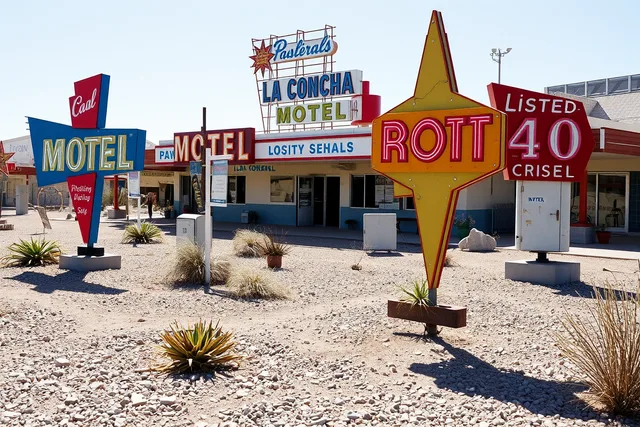
The image catalog identifies the photographed subject and its source. That is the appropriate basis for the caption. The photo cannot establish a building's condition, an organization's current role, an access feature, a property boundary, or the status of a project. Keep those questions with the records built to answer them.
This is also a useful correction for before-and-after presentations. Two images do not automatically show the same angle, season, property, or work stage. Give each one its own date and source. Describe the visible difference only when the match is clear. Do not claim a cause unless a record states it.
A correction path that preserves trust
When a source does not support a published sentence, act on the sentence. Replace it with the narrower supported fact, add a current direct source, or remove it. Do not simply add another link that tells the same partial story. A correction note can state the record used and the date of the revision when the change matters to readers.
Do this before publication as well. Read the case study with the source tabs closed. Mark every factual statement that would need proof. Then open the record for each mark. Any statement that cannot survive the check needs a change. The final article will often be shorter, clearer, and much easier to update.
Common questions
Is a newer source always better for a case study?
No. A newer source may answer a different question. Use historic records for historic facts and current records for current claims. Do not let either one replace the other without reason.
Can a case study include a paid provider profile?
Yes, if it is clearly disclosed and limited to factual, attributed information. It should not be used as proof of a project outcome or a recommendation.
What should I do when a direct source is missing?
State only the narrower fact that is supported, identify the limitation if it matters, or leave the claim out until a suitable record is found.