
Guides
How to run a roadside building case study method that holds up
Roadside building case study method for 2027 helps U.S. publishers create clear, sourced local stories with documented scope, dates, evidence, and limits.
Roadside building case study method for 2027 publishes a local story without claiming a full report on a property.
A good case study explains why a roadside place matters, what records describe it, what a dated project source says, and what stays unknown.
It should not guess at present condition, ownership, safety, price, or public access. It should not guess at future plans either.
The best case studies are specific. They identify one place, one time frame, and one question. They show the reader where the evidence came from. They also preserve the difference between a historical image, a public record, a provider statement, and a current project update.
What to take away
- Define one place, one editorial question, and one time frame.
- Build the story from records that support distinct, nearby claims.
- Separate history, documentation, project status, and current facts.
- State what the sources do not establish.
- Disclose commercial participation and do not turn it into an endorsement.
Start with a narrow editorial question
An effective case study is not a general article about an entire route, town, or building type. It asks a focused question the available evidence can answer.
It may ask what an archival record identifies about this roadside sign or what dated public records say about a local theater's historical context. It may ask what a project notice states about a particular phase of work or which primary sources document the site at different times.
Avoid questions that demand unavailable evidence, like "Is this building safe?", which requires a qualified, current assessment, not archive photos or general guidance.
"What is it worth?" requires current, property-specific information, and "Will it be restored?" needs a responsible source that announces or authorizes that future action. A publishing case study can be valuable without answering those questions.
Build an evidence card for every source
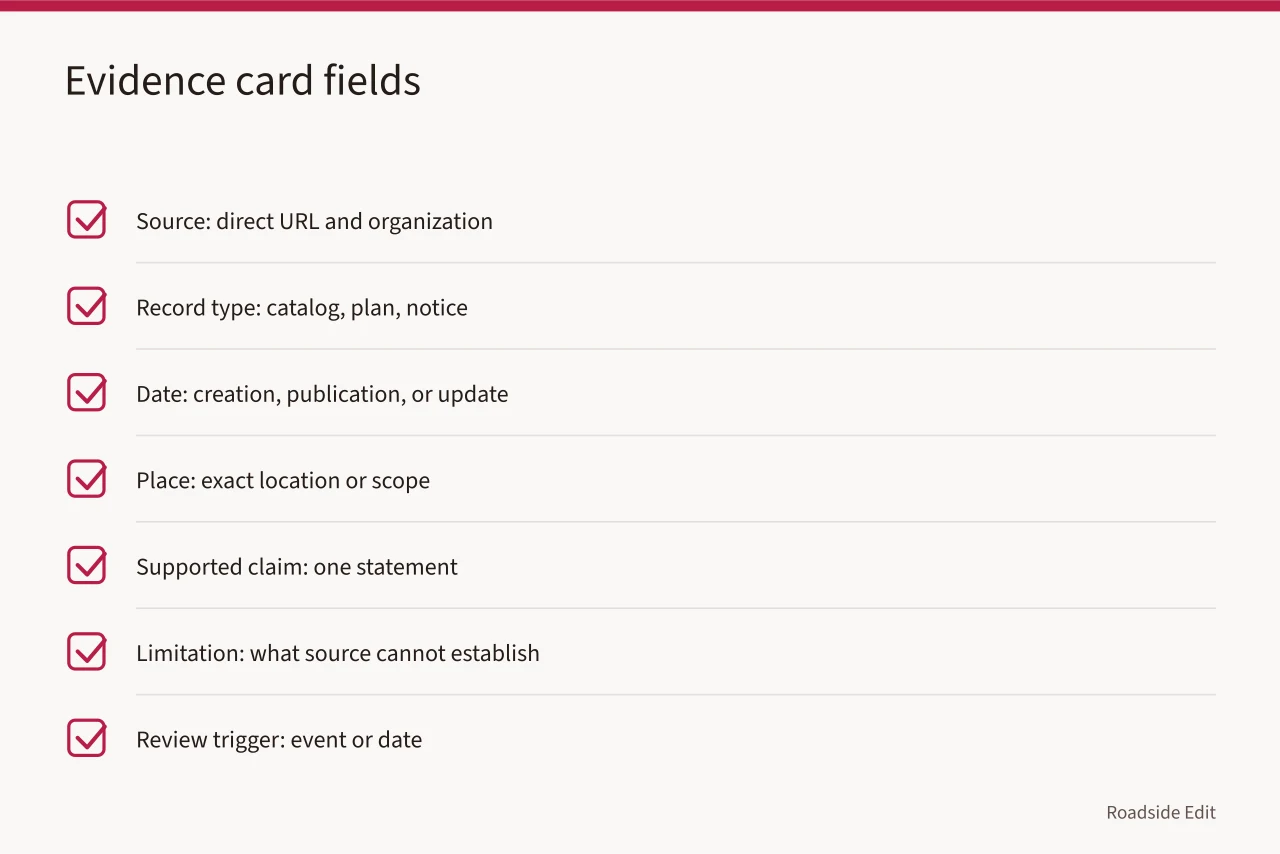
Before drafting, make a small evidence card. It prevents a useful record from being stretched beyond its purpose.
| Field | What to record |
|---|---|
| Source | Direct URL and issuing organization |
| Record type | Image catalog, archive item, public plan, project notice, or provider statement |
| Date | Creation, publication, or update date supplied by the source |
| Place | The exact location or geographic scope named by the source |
| Supported claim | The one statement the source supports |
| Limitation | What the source cannot establish |
| Review trigger | An event or date that requires a new check |
Harvard's Guide to Using Sources recommends checking an author's qualifications, a source's purpose, scope, and currency before you rely on it. Read Harvard's source-evaluation guidance.
In a roadside case study, an archive catalog best supports its own record, while a current agency update better supports a current project statement. The sources can sit together, but do not make them say the same thing.
Decide what the article will and will not claim
Write a claim boundary before the first paragraph. A boundary might say: "This article documents the site's historical context and publicly available records. It does not assess physical condition, recommend work, identify current ownership, or predict future use." The note guides every sentence that follows.
This is especially useful for case studies that may later include a business, nonprofit, public office, or paid placement. A company can supply a factual project statement or a link to a source.
The article should disclose commercial participation under the site's policy and separate it from editorial research.
Organize the narrative by evidence type
Readers should be able to see how the story is built. A simple sequence works well.
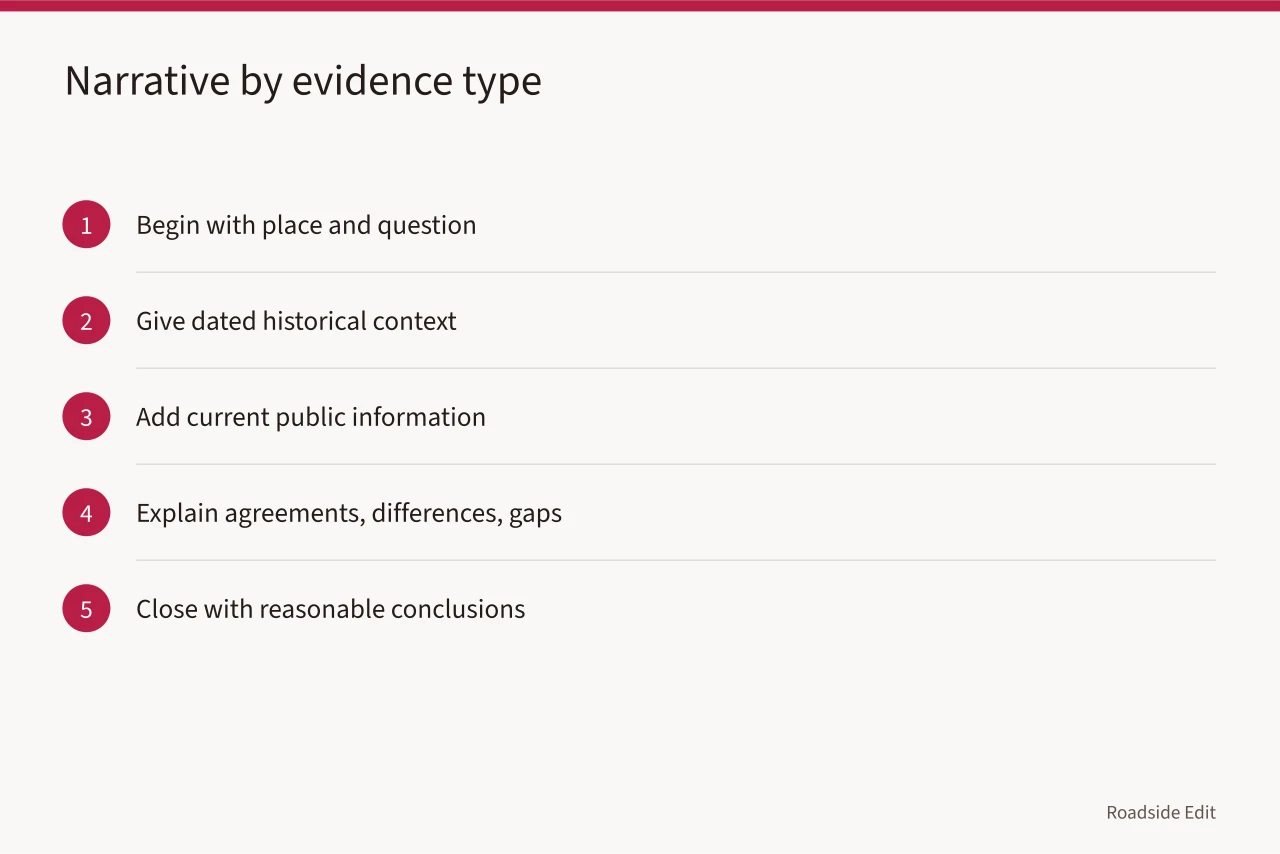
- Begin with the place and the editorial question.
- Give historical context from a dated archive or public record.
- Introduce any current public information with its source date and stated scope.
- Explain where the records agree, differ, or leave a gap.
- Close with what the case study can reasonably conclude and what requires a different source.
This structure does more than protect accuracy. It creates a more interesting story. A reader can follow the movement from an old photograph or record to a later update without being told that the later source confirms every earlier detail. The article becomes a map of evidence rather than a pile of assertions.
Use quotations and images carefully
Short quotations may help when a source uses unusually clear language, but paraphrase is usually more readable. Keep quoted material short, attribute it, and link directly to the source. Never copy an entire catalog description or report passage into the article.
An image should have its own credit link and a caption that repeats only the cataloged facts. A historical image may be visually dramatic, but it should not be treated as a present-day inspection. If the source gives a date, include it. If it identifies a place broadly, keep the broad location rather than adding an unverified address.
Compare before you combine
Many stories use more than one record, so compare them in a note before combining them in prose. Check whether they name the same place, cover the same period, use compatible terms, and answer the same question.
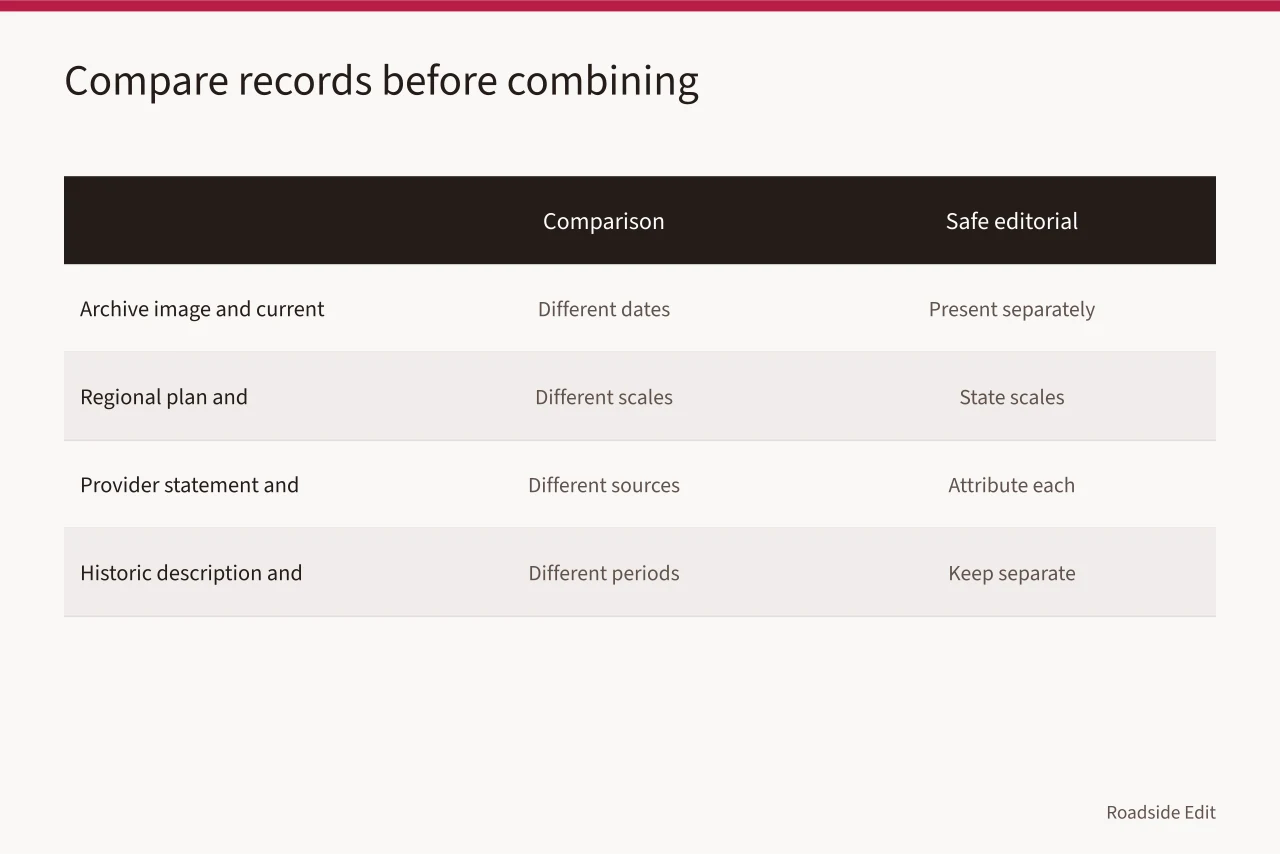
If they conflict, do not quietly pick the more convenient version. Say the records differ, seek a later responsible source, or limit the article to the undisputed facts.
| Comparison | Safe editorial result |
|---|---|
| Archive image and current agency update | Present them as evidence from different dates |
| Regional plan and named-property record | State their different geographic scales |
| Provider statement and independent public record | Attribute each statement to its source |
| Historic description and current listing | Keep historical context separate from present status |
Write a conclusion that fits the evidence
A case study conclusion should not become a recommendation. Restate the narrow finding: the sources document a historical identity, a project stage, a public record, or a change in available information. Then name the next question that would require separate evidence. This tells readers where the research stops without reducing the value of the story.
For example, a conclusion may say that a Library of Congress image record identifies a particular sign at a particular date and that a public project page describes a later program. It should not say the sign remains, that the program repaired it, or that a reader should hire a named provider unless the necessary direct sources support those claims.
Verify the draft sentence by sentence
After the first draft, make a factual pass before editing for style. Highlight every statement that gives a date, location, condition, ownership, project status, business service, amount, or quoted description. Match each highlighted statement to a direct source. The source should sit close enough to the claim that a reader can understand why it is linked.
When a source does not match, choose one of three repairs: narrow the sentence, add a better source, or remove the sentence. Do not solve the problem with a general homepage or an unrelated article that merely uses similar vocabulary. A precise link is more valuable than a larger number of links.
This check also helps prevent accidental duplication. A roadside theater case study can focus on a dated catalog image and history visible in a public record.
A different local project page should focus on the project's stated purpose and date. Even when both pages mention the same town, each has a separate research question and evidence set.
Plan updates without rewriting history
Place-based articles change over time. An update should preserve the original historical record and make current statements clear.
Add a dated note when a public source changes, a project advances, or an earlier statement can no longer be supported. Do not alter an archival caption to sound current. Do not delete a source date just because it is old.
The National Archives agency recordkeeping requirements state that related records should remain together when their relationship gives context. A case-study source packet should therefore keep the original image, public record, provider statement, and correction history in one dated file.
The National Park Service Preservation Brief 47 discusses planned exterior maintenance and regular inspection. It does not assess a building in this article. It supports maintaining a line between a visible observation and a condition or repair conclusion.
The Federal Trade Commission's endorsement guidance addresses disclosure where a material connection could affect how readers evaluate an endorsement. Publish a paid provider statement with clear disclosure beside the statement itself.
For a business profile or paid placement, set a shorter review cycle, because services, links, contact details, and availability change faster than historical context.
Reconfirm the information with a direct source before publication or renewal, keep the verification date, and remove claims that are no longer supported. This protects readers and leaves room for useful, accurately labeled commercial content.
A compact case-study template
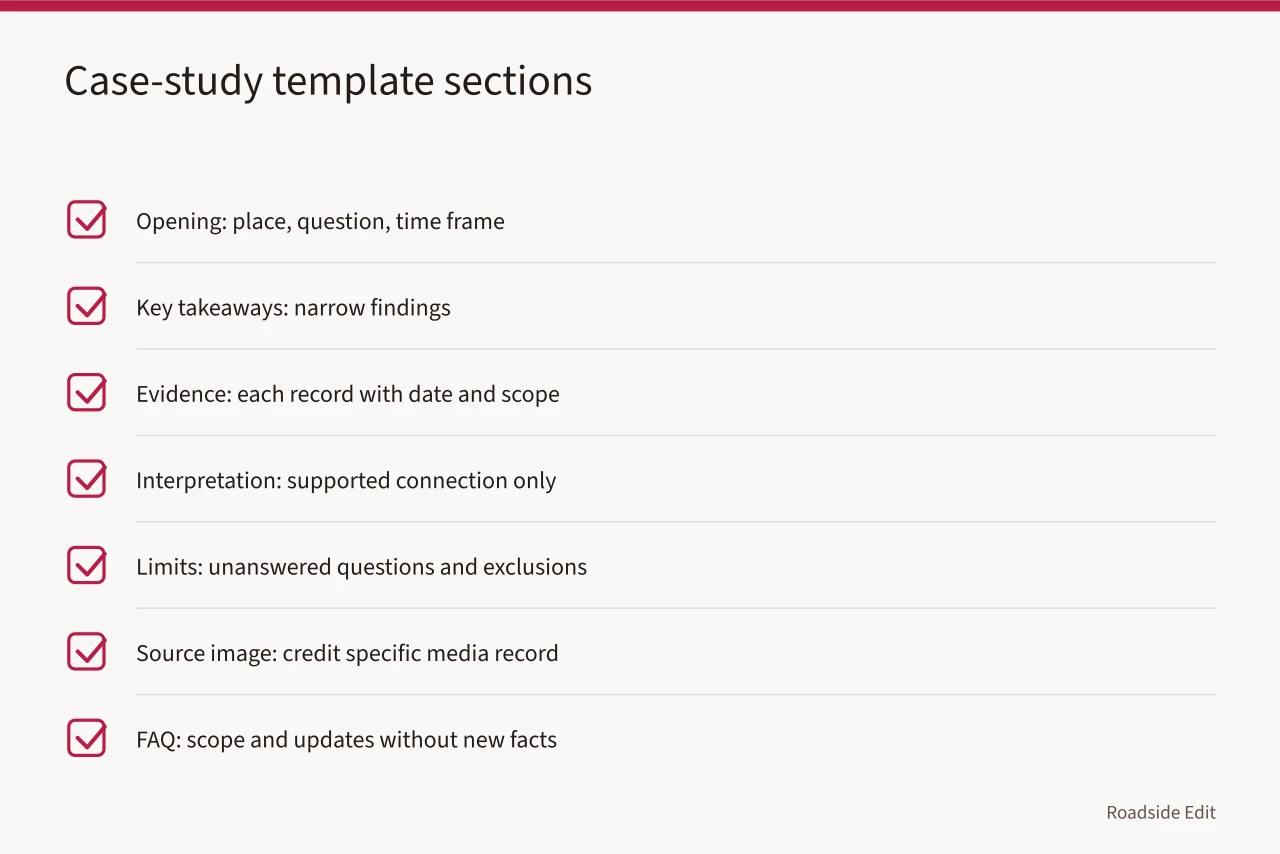
Use the following outline when planning a new page:
| Section | Required editorial job |
|---|---|
| Opening | Name the place, question, and time frame |
| Key takeaways | State the narrow evidence-based findings |
| Evidence | Present each record with date, source, and scope |
| Interpretation | Explain only the connection the evidence supports |
| Limits | State unanswered questions and excluded claims |
| Source image | Credit the specific media record |
| FAQ | Address common scope and update questions without adding new unsupported facts |
Source image
The Library of Congress catalog identifies this photograph as the Diamond Barber Shop in Gallup, New Mexico.
Common questions
Can a case study use a business as its source?
Yes, for a clearly attributed factual statement. Pair it with appropriate independent or public records when the article needs a broader claim.
Does an archival photo prove a current condition?
No. It documents the source's stated date and subject. Use a current direct record for a present-tense statement.
How many sources should a short case study use?
Use the sources needed to support its actual claims. Two well-matched records are stronger than a long list of unrelated links.