Guides
Part of Neon sign restoration options compared: how owners choose the right path
Neon sign restoration options: questions to compare before you choose
Neon sign restoration options questions for 2027 help U.S. owners compare evidence, authority, public interpretation, and property-specific review needs.
The right questions prevent a broad phrase like "restore the sign" from hiding several unrelated decisions. Use this list to compare what information an option produces and what it leaves for the actual property, owner, or responsible authority.
What to take away
- Ask which decision the option supports.
- Ask what evidence the option needs and preserves.
- Ask who can make a property-specific decision.
- Ask whether a public or paid claim is clearly attributed.
Questions for comparing options
| Question | Why ask it |
|---|---|
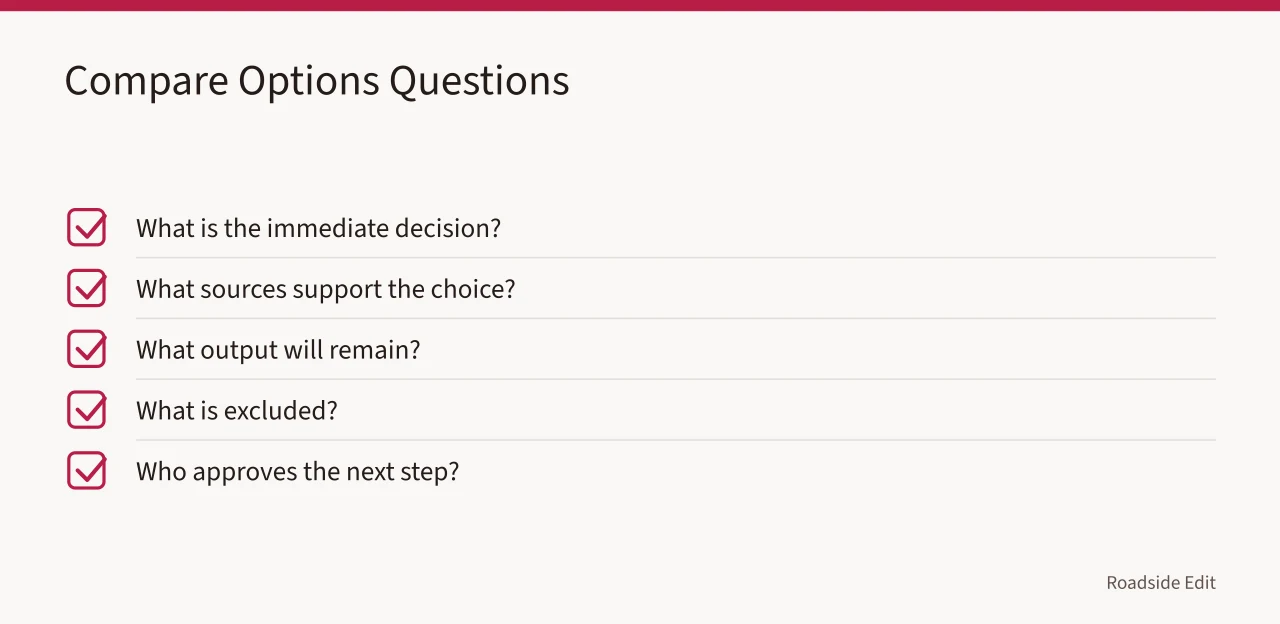
| What is the immediate decision? | Prevents a broad treatment label from replacing a clear purpose. |
| What sources support the choice? | Separates evidence from assumption. |
| What output will remain? | Clarifies whether work produces a record, article, brief, or review. |
| What is excluded? | Keeps site-specific technical work outside an editorial scope. |
| Who approves the next step? | Avoids giving an editor or advertiser authority it does not have. |
The Advisory Council on Historic Preservation explains that federal program alternatives have their own purposes, documentation, and consultation pathways. That does not decide a private sign project. It supports a limited comparison point: a process must fit the project facts, responsible parties, and intended result.
Questions for a public article
Ask whether the historical claim is sourced, whether the photograph is dated and captioned, whether an owner statement is labeled, and whether a sponsor or provider relationship is visible. A useful profile may say that a company supplied its own description. It should not imply that a general article independently selected a site treatment.
Questions for the evidence record
Ask what each source directly shows, when it was created, who provided it, and what it does not establish. A photo may document visible appearance. A directory may document a business association. An interview may document a person's account. Those are different kinds of evidence and should not be rewritten as a single confirmed conclusion.
The National Park Service documentation standards and guidelines concern recording historic properties. They do not determine which option a particular sign needs. They support identifying the source, date, and scope of material used in a historical description.
Questions for the role map
Ask who can supply a record, who can make an owner decision, who is responsible for a public description, and who must address a site-specific question. A role map prevents a provider, sponsor, writer, or editor from being presented as the authority on every part of a project.
The OSHA electrical eTool for Subpart S covers electrical-installation topics including qualified-person considerations. It is not an options comparison. It supports directing electrical questions outside a content or documentation workflow.
Questions for commercial context
Ask whether payment affects placement, whether a provider supplied the text, and whether a testimonial or price statement is independently supported. Keep the disclosure note separate from the factual source register so readers can evaluate both kinds of information.
The Federal Trade Commission's endorsement guides address endorsements and testimonials in advertising. They are not historic-preservation guidance. They are relevant when an option includes a paid profile or testimonial.
Questions at the next decision date
Ask which question has been answered, which source is still missing, who owns the next action, and whether the selected option still matches the current project facts. Record the answer with the date so a later editor does not treat an early plan as a completed outcome.
Keep an options comparison sheet
For each option, save the question it answers, the source packet it uses, the deliverable it creates, the stated exclusions, the responsible role, and the review date. This sheet does not decide a property question. It helps an owner or editor explain why documentation, planning, public interpretation, or a separate review was the appropriate next path.
Questions that require a different process
If the question concerns the actual sign's physical condition, electrical systems, access, permits, utilities, or a local review, a comparison article should identify the question and stop there. It should not tell someone how to inspect, test, repair, move, or alter anything.
Common questions
Can the same evidence support several options?
Yes. A dated photo log may inform research, an article, and a later review. The different outputs should still be described separately.
Does a public profile decide what work should happen?
No. It can share verified information and stated services, but it cannot substitute for a property-specific process.
Are these questions legal advice?
No. They are planning and editorial questions. Legal and regulatory requirements depend on the actual project.