Guides
Part of Neon sign restoration options compared: how owners choose the right path
Neon sign restoration options comparison: warning signs to check before you choose
Neon sign restoration options comparison names re-gassing, tube replacement, transformers, LED retrofits, repainting, and full fabrication, plus warning signs.
An options comparison should name the actual choices and the warning signs beside them. This comparison covers six common neon restoration routes. Each has a different scope, evidence need, and limit.
What to take away
- Re-gassing, tube replacement, and transformer repair are separate jobs.
- Neon-to-LED retrofit and repainting change appearance or materials.
- Full fabrication creates a new sign, not a restored one.
- A photo without a date or source is weak evidence.
- A provider claim should stay attributed to the provider.
Compare the real options
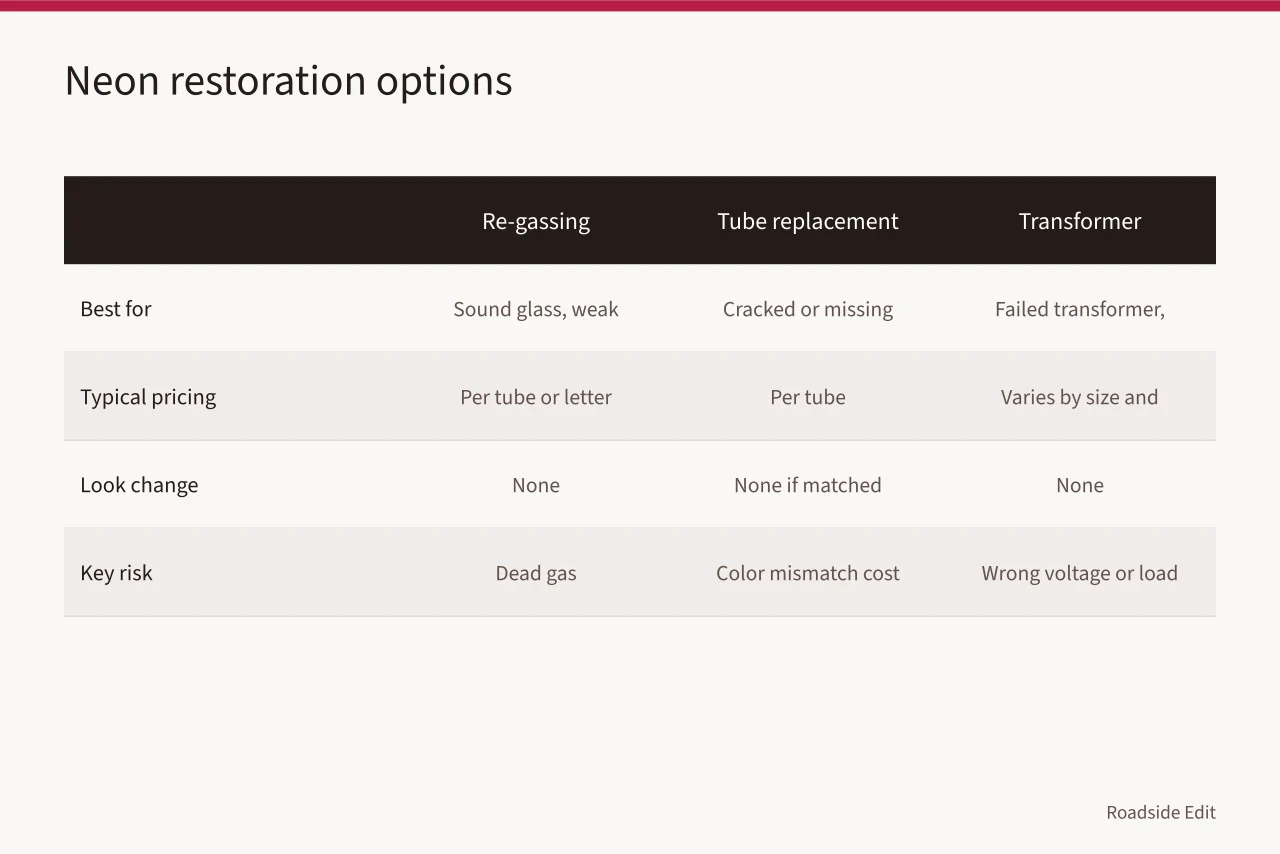
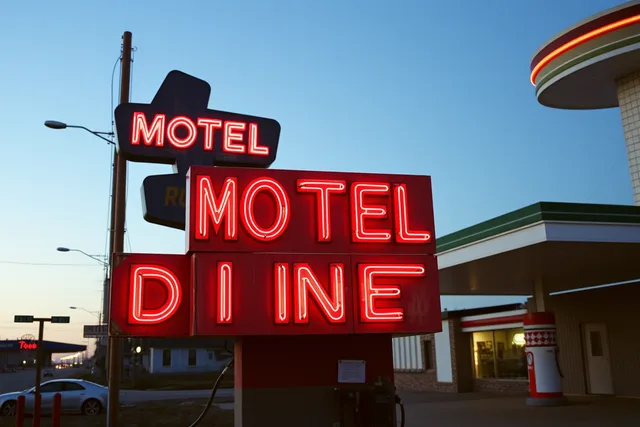
Re-gassing. A neon shop such as Let There Be Neon in New York can refill intact tubes with neon or argon. It suits signs that still have sound glass but weak or dead light. Shops often quote per tube or per letter, not a flat project fee.
Tube replacement. Daco Neon in Omaha lists neon repair and restoration. A bender makes new glass tubes to match the old diameter, gas mix, and color. It suits cracked, blackened, or missing tubes. Pricing is usually per tube, and matching old colors can add cost.
Transformer replacement. Franceformer and Allanson are common neon transformer brands. A failed transformer can be replaced while the tubes stay in place if they test good. The new unit must match voltage, frequency, and load. Street prices vary widely by size and type.
Neon-to-LED retrofit. Diode LED and Super Bright LEDs sell LED neon flex and sign modules. A retrofit can cut energy use and reduce tube breakage. It suits owners who want lower power bills or hard-to-service signs. It changes the look and is not an in-kind restoration.
Repainting and can restoration. Everbrite sells protective coatings for sign restoration. This option covers rust, fading, and chipped paint on the metal can or channel. It suits signs with solid electrical parts but poor surface condition. Color matching matters because new paint can alter historic appearance.
Full fabrication. Neon Works in Austin and other shops build new neon signs. This route suits signs that are missing, crushed, or beyond repair. It can reproduce a look, but it replaces historic fabric. Most shops quote custom projects after a site visit or detailed photos.
Warning signs before you choose
| Warning sign | Better response |
|---|---|
| Restoration used with no defined goal | Ask what decision, record, or public result is actually needed. |
| Historical claim has no source | Attribute it, find evidence, or remove it. |
| Sponsor copy looks like editorial certification | Add a disclosure and identify the source. |
| A guide gives site-specific instructions | Replace directions with a defined question and appropriate handoff. |
| One example is presented as every sign's answer | State the limits and keep the comparison general. |
The Advisory Council on Historic Preservation notes that treatment alternatives are evaluated from basic information about a property and the undertaking. That is federal archeology guidance, not an instruction for a neon sign. It supports the limited editorial rule that a comparison should begin with evidence and the actual question, not with a preferred conclusion.
The National Park Service documentation standards and guidelines concern recording historic properties. They do not settle a sign's history or treatment. They support identifying the source, date, and scope of historical material used in a comparison.
If the comparison raises electrical, structural, access, permit, or hazardous-condition issues, record the question and assign it to the appropriate process. The OSHA electrical eTool for Subpart S covers electrical-installation topics including qualified-person considerations. It is not an options checklist. It supports keeping electrical directions out of public comparison content.
Paid placements, provider-supplied text, and testimonials can appear in a publication when clearly labeled. A warning sign is a sponsored phrase presented as independent editorial evidence. The Federal Trade Commission's endorsement guides address endorsements and testimonials in advertising. They are relevant when a profile, placement, or testimonial includes a commercial relationship.
Avoid words such as approved, original, safe, best, or fully restored unless the source supports the exact claim. Label sponsor-supplied phrases as supplied information. Check the headline as well as the body.
Before publishing, identify each major statement as observation, attributed report, public record, or analysis. If the label is unclear, narrow the sentence or remove it. Save the dated review note with the draft.
Common questions
Is uncertainty a warning sign by itself?
No. Hidden uncertainty is the problem. An article can identify open questions and still be useful.
Can a provider describe its services?
Yes. The publication should label provider-supplied information and avoid treating it as an independent site finding.
When should a comparison be delayed?
Delay it when a key claim cannot be sourced or when readers could mistake the article for property-specific technical or legal guidance.