Guides
Gas station preservation options comparison: four paths before you commit
Compare gas station preservation options for 2027, including preservation, rehabilitation, restoration, and reconstruction, using a practical evidence-first method.
Gas station preservation options comparison asks a simple question: what should remain true about this particular place after work is complete?
A former service station may keep original walls, a canopy, pump islands, signs, or repair bays. It may also have interior finishes, or only a documented footprint. Those facts lead to different treatment choices, not automatically to a cosmetic makeover, replica, or new commercial use.
This guide gives owners, local advocates, journalists, and potential sponsors a clear way to discuss four common preservation treatments without presenting a universal recommendation. It is an editorial framework, not a condition assessment, environmental opinion, preservation approval, or construction scope for a specific property.
What to take away
- Choose a treatment after documenting what survives and why it matters.
- Preservation and rehabilitation often retain more existing material than restoration or reconstruction.
- A compatible new use can be part of rehabilitation, but it does not erase the need to protect historic character.
- Restoration and reconstruction require strong evidence for the period or features being represented.
- Keep a decision record so later readers can distinguish fact, interpretation, and sponsored material.
The four choices are not interchangeable
The federal regulation defines separate preservation, rehabilitation, restoration, and reconstruction treatments for historic properties. Review the definitions in 36 CFR Part 68 before turning one of those words into a project label.
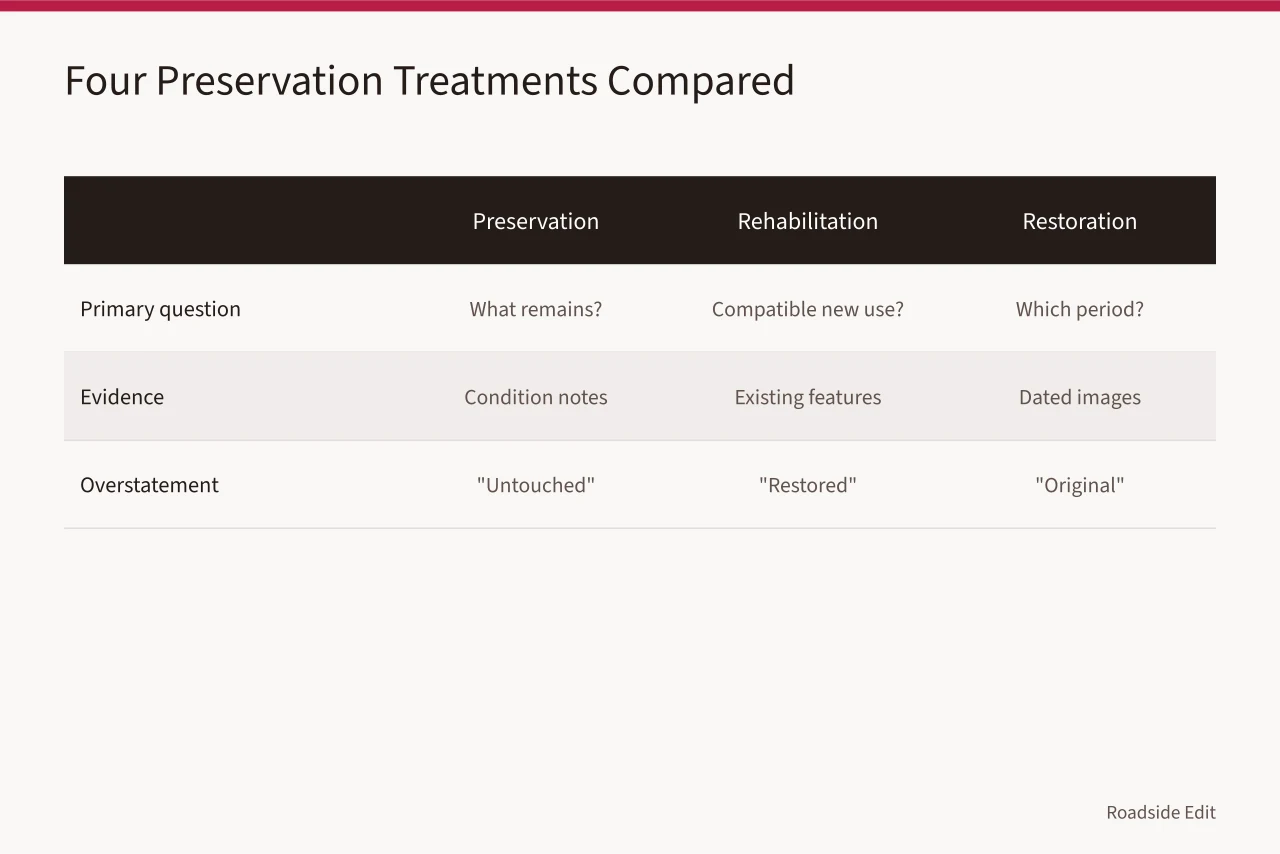
The terms describe different goals. A preservation project seeks to sustain existing form, integrity, and materials. Rehabilitation allows a compatible contemporary use while retaining the property features that carry historic value. Restoration focuses on a selected time in the property's history. Reconstruction creates a new representation of a non-surviving resource from adequate evidence.
| Treatment | Primary question | Typical editorial evidence | Common overstatement to avoid |
|---|---|---|---|
| Preservation | What remains and can be sustained? | Condition notes, photographs, repair history | "Untouched" when repairs occurred |
| Rehabilitation | How can the place serve a compatible use? | Existing features, new-use plan, design review record | "Restored" when substantial adaptation happened |
| Restoration | Which documented period is being represented? | Dated images, drawings, physical clues | "Original" when missing features were recreated |
| Reconstruction | What vanished feature can be accurately re-created? | Strong documentary and physical evidence | "Historic building" when the result is new construction |
The table is a starting point, not a substitute for local review. A station can have a preserved street-facing facade, rehabilitated service bays, repaired historic signs, and contemporary systems. The article should describe that mixed condition plainly instead of forcing the whole property into one flattering label.
Begin with the resource, not the desired result
It is tempting to start with a use idea: coffee shop, visitor center, office, repair business, museum, or event venue. Start elsewhere. Make a feature inventory before deciding what work should look like. Include the building, site circulation, canopy, forecourt, pumps or bases, signage, original doors and windows, bays, interior finishes, and visible additions from later periods.
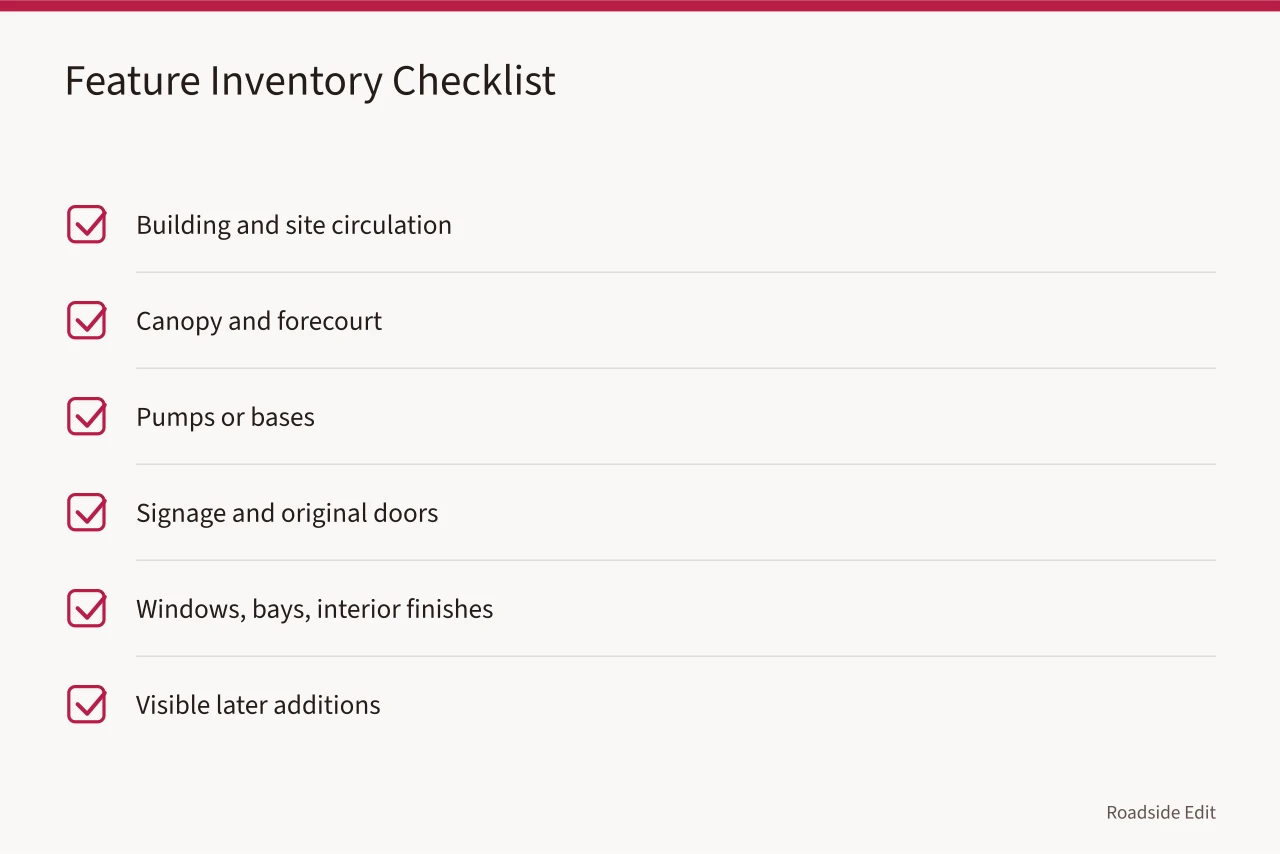
For each feature, record four things:
- Whether it is known to be original, later, or undated.
- Whether it appears to be present, altered, deteriorated, or missing.
- What evidence supports that conclusion.
- What the project proposes to retain, repair, alter, or replace.
The inventory prevents a common problem in online writing. A photograph can make an old station look complete even when the camera hides an altered rear wall, a missing canopy, or a changed interior. Conversely, a worn surface may be part of the building's history rather than proof that every feature must be replaced.
Use conservative verbs. Write "the supplied 1958 photograph appears to show" rather than "the station originally had" unless the source establishes the point. Write "the proposed use would introduce" rather than "the new use preserves" until the plan and review record support that conclusion.
When preservation is the better fit
Preservation is often the useful choice when surviving material and character are the central values and no major functional change is required. Think of a station that can remain a small interpretive site, a seasonal visitor stop, or a carefully maintained landmark. The work may include stabilization, weather protection, repair of materials, and ordinary maintenance.
This does not mean freezing every trace of time. Necessary repairs can be documented. Safety and access work may be needed. The question is whether the project can meet those needs while keeping the existing resource legible.
Preservation is a poor label when a proposal depends on large additions, sweeping alterations, or a new use that changes the spatial experience of the station. Calling that work preservation can confuse readers and create trouble when a local review body uses the term more precisely.
When rehabilitation makes sense
Rehabilitation is often the practical option for a former station that needs a viable contemporary use. A vacant building may become a small office, retail space, community room, archive, or visitor-serving business. The best description names both sides of the decision: what is being retained and what is being altered for the new use.
For example, an article might explain that a proposal retains a recognizable canopy, storefront rhythm, and repair-bay volume while introducing modern mechanical systems and accessible circulation. It should not say the project "brings the station back exactly as it was" if the work is fundamentally adaptive reuse.
Use a rehabilitation page to publish clear boundaries for commercial participation. A business may supply current-use details, photography, opening information, and a description of its work. Those claims should be attributed. Paid placement should never decide whether a project is called historically appropriate.
When restoration is justified
Restoration becomes a meaningful option when a documented period of significance is central to the public purpose. A station may have a well-supported original color scheme, brand treatment, canopy form, or interior arrangement. The record should identify the period selected and explain what supports the choice.
The risk is creating a stage set. Later alterations can have their own historical value, and missing features should not be invented merely because they complete a familiar Route 66 image. A careful page separates features that survive from features recreated from evidence. It also identifies uncertainty instead of disguising it with generic vintage details.
Before using the word "restored," ask these questions:
- Is there a selected date or period, rather than a broad nostalgia theme?
- Do photographs, drawings, physical investigation, or reliable records support the proposed appearance?
- Have later significant features been recorded before removal?
- Will readers be able to tell which visible elements are new work?
If the answer to several questions is no, rehabilitation or a narrower repair description may be more accurate.
When reconstruction should remain exceptional
Reconstruction is the most easily misused option in a roadside-architecture article. It may be appropriate for a lost structure or element when the public purpose is clear and the evidence is strong enough to avoid conjecture. A replica based on a postcard alone, a generic brand image, or a nearby station is not automatically an accurate reconstruction.
Make the contemporary status clear. Readers deserve to know when a structure is new construction that depicts a past building. That clarity does not diminish the effort. It protects the historical record and helps visitors understand what they are seeing.
Compare the options through five decisions
Instead of asking which treatment is "best," compare options against the same five decisions.
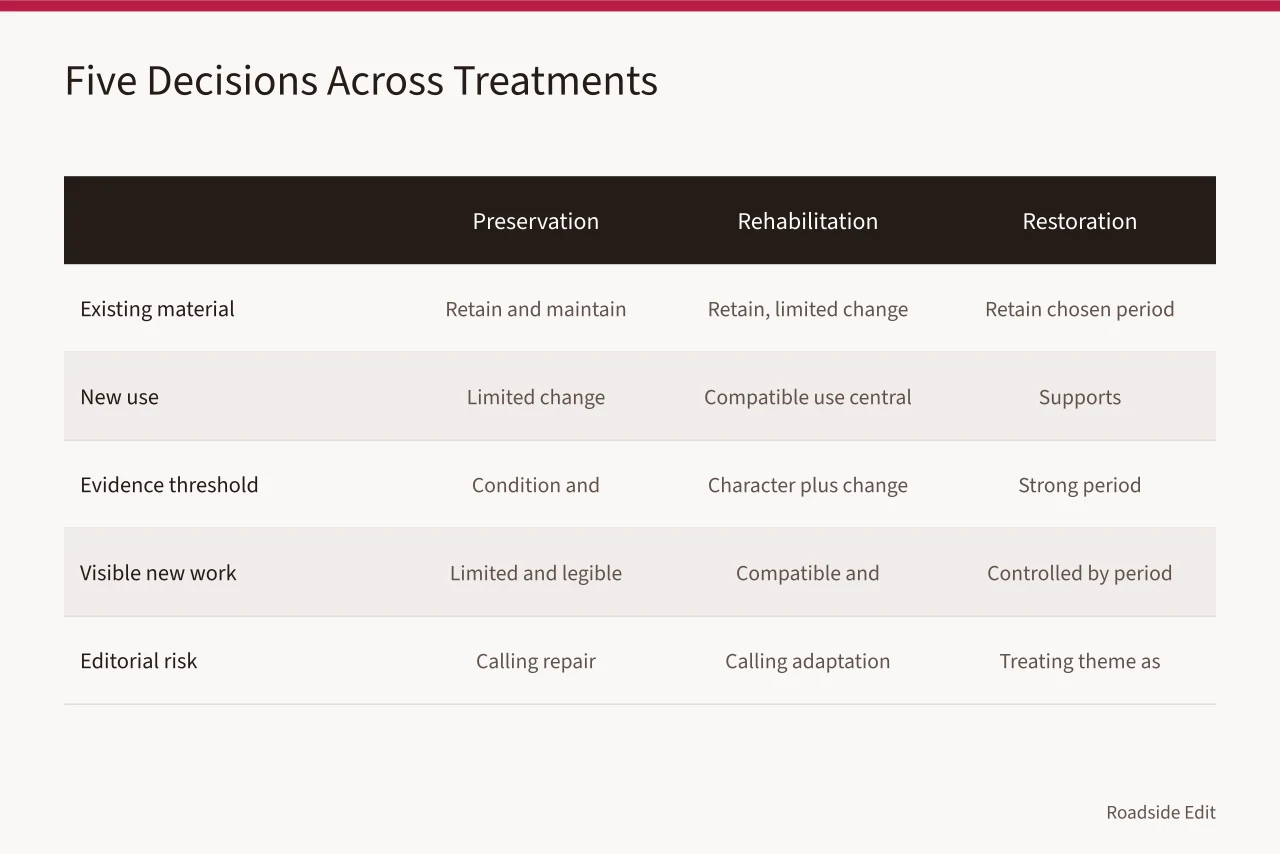
| Decision | Preservation | Rehabilitation | Restoration | Reconstruction |
|---|---|---|---|---|
| Existing material | Retain and maintain | Retain while allowing limited change | Retain material from the chosen period | Preserve any remains; build new depiction only where justified |
| New use | Limited change | Compatible new use is central | Use supports interpretation of period | Use supports understanding of missing resource |
| Evidence threshold | Current condition and significance | Existing character plus change plan | Strong period-specific documentation | Strong documentation and minimal conjecture |
| Visible new work | Kept limited and legible | Designed to be compatible and distinguishable | Controlled by selected period | Clearly identified as contemporary recreation |
| Editorial risk | Calling repair "unchanged" | Calling adaptation "restoration" | Treating a theme as history | Presenting a replica as surviving fabric |
This comparison helps a publisher make useful, non-promotional articles. It also gives an owner a better checklist for a consultant meeting or public conversation.
Keep environmental and regulatory questions separate
A treatment choice does not answer every site question. A former fueling use can involve property-specific environmental review. Local permits, accessibility requirements, building and fire codes, zoning, and historic-review processes can also shape what is feasible. Do not infer approval, safety, contamination, or compliance from a treatment label.
Keep each topic in its own evidence lane. Report an agency record as an agency record. Report a proposed use as a proposal unless an approval is documented. Attribute a business description to that business. This makes the article more useful to a reader who needs reliable next questions rather than a sales pitch.
The National Park Service presents the Secretary of the Interior's Standards for Rehabilitation as standards for historic-property rehabilitation. The standards do not decide an editorial label for an individual project. They do, however, support a careful distinction between work that retains and adapts historic features and a claim that a building has been returned to an earlier state.
Use records that fit the historical claim.
The National Archives' explanation of primary-source evidence clarifies the limit. A dated plan, survey, or photograph may directly answer a narrow question about its own time, but it doesn't automatically prove a present condition or an undocumented original feature, and the article should preserve that boundary.
Commercial material needs a separate label. The Federal Trade Commission's endorsement guidance addresses disclosure of material connections that could affect how readers evaluate an endorsement. Identify sponsored information near the claim and keep a treatment conclusion tied to independent evidence.
Use images as context, not proof
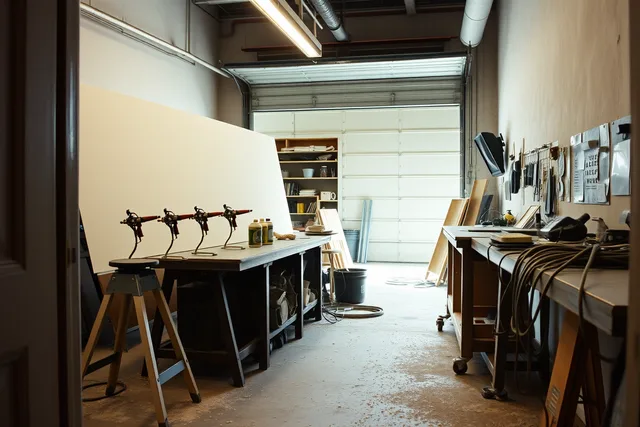
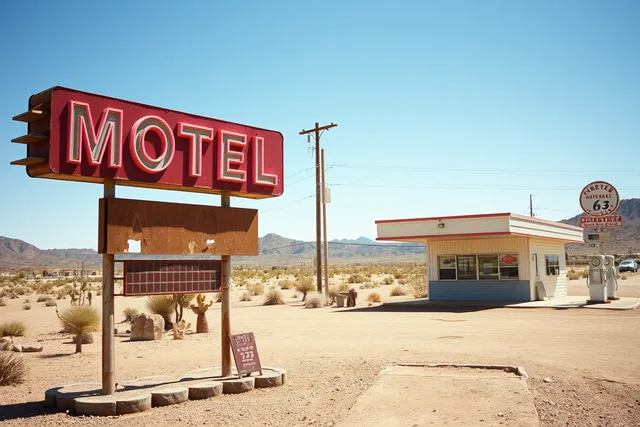
The image illustrates a roadside gas-station setting. It does not document the physical condition, treatment, use, approval, or history of a property discussed in this guide.
An image credit is not a historic source for an unrelated building. Keep its file page, creator or collection where named, license information, and a note about why the image is illustrative. For an owner's supplied photo, state that it was supplied and do not present it as independent verification.
Build a decision record readers can inspect
The most useful options-comparison article has an audit trail behind it. Keep a simple project record containing the source date, the feature discussed, the selected treatment term, the reason for that term, and unresolved questions. When a claim changes, correct the specific sentence rather than quietly rewriting a conclusion.
For a directory or sponsored profile, collect only information the contributor can substantiate: a named project contact, a dated description of current use, image permissions, and links to public records where appropriate. Publish clear inclusion rules and label paid relationships. Credibility is the asset that makes a preservation page valuable to both readers and businesses.
Common questions
Can one service station use more than one treatment?
Yes. A project can preserve surviving features, rehabilitate a building for a new use, and restore a documented element. The article should say which treatment applies to which part of the work.
Is adaptive reuse the same as restoration?
No. Adaptive reuse commonly fits rehabilitation when it adds a compatible new use while retaining character-defining features. Restoration has a period-specific goal.
Does an old photo justify rebuilding a missing canopy or sign?
Not by itself. The evidence, significance, project purpose, and local review context all matter. Describe a proposed re-creation as proposed until the relevant record supports a final decision.
Can a paid profile determine a historic-treatment label?
No. A commercial relationship should be disclosed and should not control the publication's treatment conclusion or ranking.