Guides
Part of Neon sign restoration options compared: how owners choose the right path
Neon sign restoration options: how owners should keep comparison records
Neon sign restoration options records guide for 2027 helps U.S. owners retain source logs, decision notes, disclosures, and corrections across planning paths.
Records make an options comparison useful after the first conversation ends. Keep the sources, decision, current public copy, and unresolved questions together. The next owner, writer, or reviewer should not need to recreate the same work.
What to take away
- Keep source, date, and creator with each record.
- Preserve decisions and their evidence, not just the final choice.
- Save public disclosures with the published copy.
- Record a correction when an option or claim changes.
Keep a simple option file
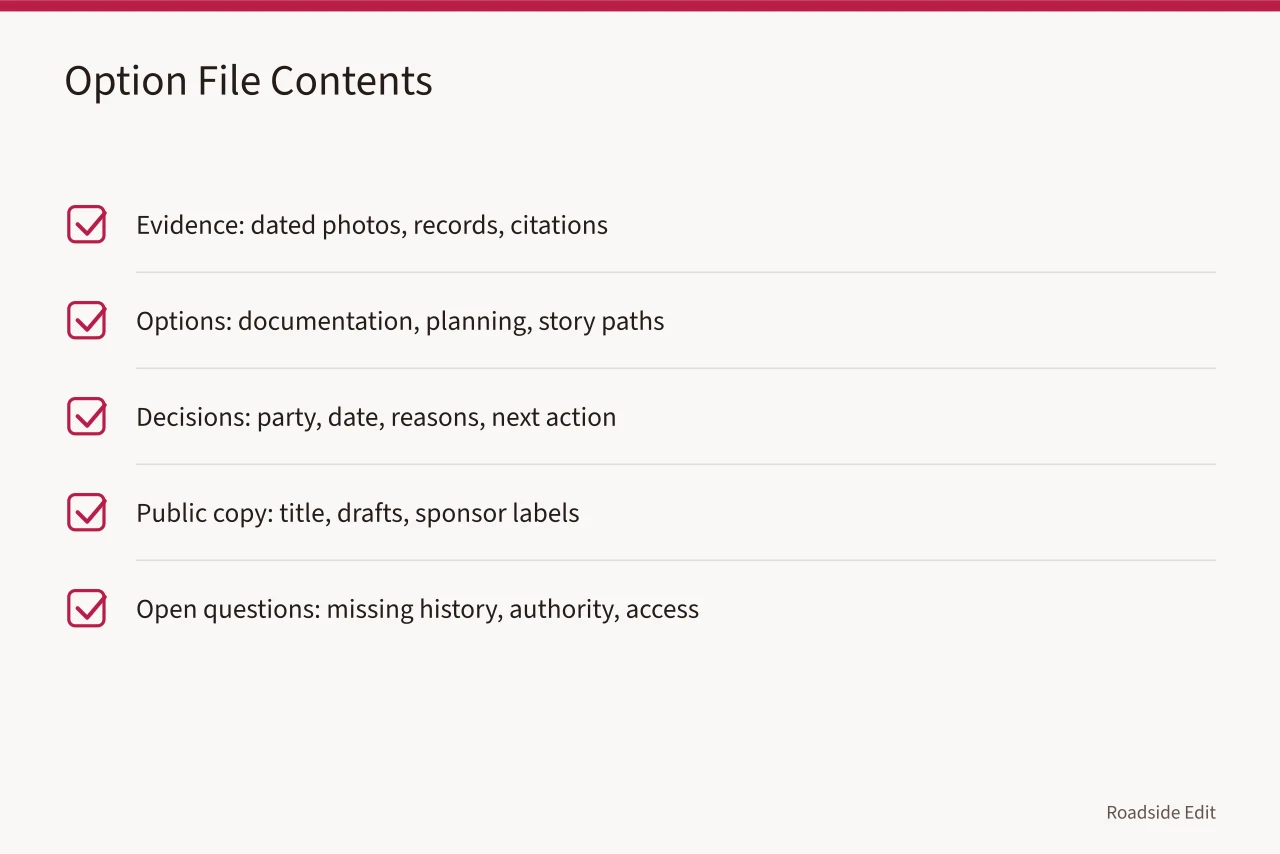
| Section | Contents |
|---|---|
| Evidence | Dated photographs, public records, citations, and source limits |
| Options | Documentation, planning, public story, and review paths considered |
| Decisions | Responsible party, date, reasons, and next action |
| Public copy | Published title, draft history, sponsor labels, and correction notes |
| Open questions | Missing history, authority, access, or other unresolved issues |
The Advisory Council on Historic Preservation explains that federal agencies document alternatives to avoid, minimize, or mitigate effects when integrating NEPA and Section 106. That is a federal-agency process, not a private owner requirement. Its useful lesson for a local record is that alternatives and the reasoning behind them should be documented rather than remembered informally.
Keep changes traceable
If an article replaces a claim, removes a provider, changes a sponsor label, or updates a comparison, add a brief date and reason. The note can be short. It should make clear whether a source changed, a statement was corrected, or the project decision changed.
Keep the original source file where possible and identify any cropped, resized, or edited working copy. A source log should identify the page or repository, the access date, and the statement supported. This lets a future editor verify why one option was described, why another was not selected, and whether the record needs a current review.
Record the final publication date as well.
Separate a source log from a decision log
The source log answers where a statement came from. The decision log answers what the editor or owner chose to do with it; do not combine them.
A source can be accurate but not enough to justify a choice, while a choice may be reasonable but still need its limits stated. Use one row for each key claim: claim text, source, date, source type, and scope limit. Include the draft section where it appears.
The National Park Service documentation standards and guidelines address recording historic properties. They do not decide whether a particular neon sign should be repaired, removed, or advertised. They support the narrower practice of retaining dates, visual records, and descriptions that make later review possible.
Preserve images with their context
Do not treat an image file as proof just because it looks old; when allowed, keep the original file, source page, access date, caption, and known date.
Record location when established and any crop or color adjustment used in publication. If a photograph is illustrative, say so. If its date or location is uncertain, put that uncertainty near the image instead of a precise story from visual clues.
The Library of Congress guidance on photographic collections explains how its image collections provide item records and rights information. It is not a private records system. It supports checking an image record and its stated rights before using a historic image as research material or illustration.
Make disclosures part of the file
Keep the sponsorship label, provider-supplied copy, outreach record, and published placement together. A later editor should be able to see which wording was editorial, which was supplied, and which commercial relationship was disclosed. Do not let a revised draft erase the fact that a claim originated with a sponsor or service provider.
The Federal Trade Commission's endorsement guides address endorsements and testimonials in advertising. They do not govern historic-sign records. They support retaining clear disclosure decisions when commercial material appears in an article.
Schedule a correction review
Set a review date when the record includes a source that may change, a provider statement, an uncertain date, or a repeatable public claim.
At review, check whether the original page remains available, the sentence still says only what the source supports, and an update needs a visible correction note.
Keep superseded drafts instead of overwriting them without a trace.
The National Archives guidance on preserving personal digital records concerns care for digital materials. It does not prescribe an editorial calendar. It supports keeping organized copies and descriptive information so files remain understandable over time.
Prepare a clean handoff package
When responsibility changes, provide the next editor with a short index before sharing the complete file. List the current public title, the date last checked, the location of originals, known limits, open questions, and the person or group that owns the next decision.
Mark any material that may be published only with permission or disclosure. The index should point to the evidence and decision records without trying to restate every detail. A handoff package is successful when the new reviewer can tell what is known, what is attributed, and what still needs confirmation before writing another public sentence.
Common questions
Do records need to be complex?
No. A dated source log and decision table can be enough when they clearly separate facts, options, and next steps.
Should sponsored content be kept with the records?
Yes. Keep the disclosure and the version that was actually published.
Can an old option be removed?
Keep a short note explaining why it was rejected or superseded. That helps prevent it from being revived without context.