Guides
Part of Roadside renovation safety checklist: what to document before work starts
Roadside renovation permit and safety checklist: what to settle before work starts
Roadside renovation safety and permit checklist for 2027: map the scope, agencies, records, review stages, and public claims before work begins.
Before a roadside renovation begins, a project team needs more than a list of permit names. It needs a record connecting the proposed work to the place, the responsible agency or reviewer, issued documents, and an open question.
This checklist helps organize that record, but it does not identify every rule for a property or authorize work.
What to take away
- Start with a precise scope, because review duties often depend on what will change.
- Separate a permit application, review request, approval, inspection, and closeout record.
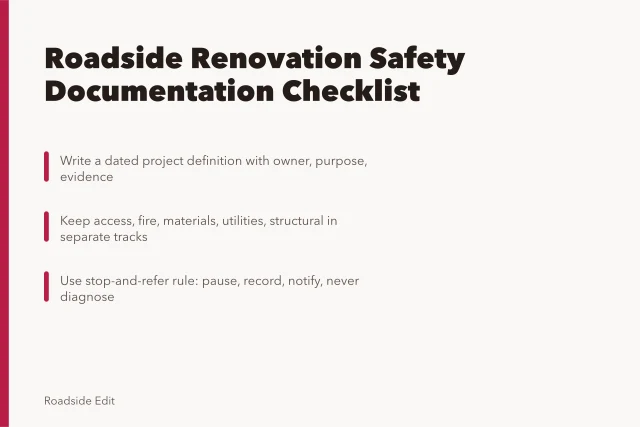
- Keep condition, access, materials, water, historic-resource, and accessibility questions in their own tracks.
- Publish only a review stage that a current document actually confirms.
Map the project before listing permits
Write the proposed work in plain language. Identify the building area, site feature, access route, and work limits. Include what is not part of the current request. A sign repair, a storefront alteration, a parking change, and excavation near drainage may involve different reviewers and documents even when they appear in the same project description.
Then make a contact map. List the local building department, planning or zoning office, fire authority when relevant, utility contact, owner, design professional, and any state, federal, tribal, or historic-preservation contact named by the project record.
Do not assume a statewide or federal page replaces local requirements. The checklist shows who must answer a property-specific question.
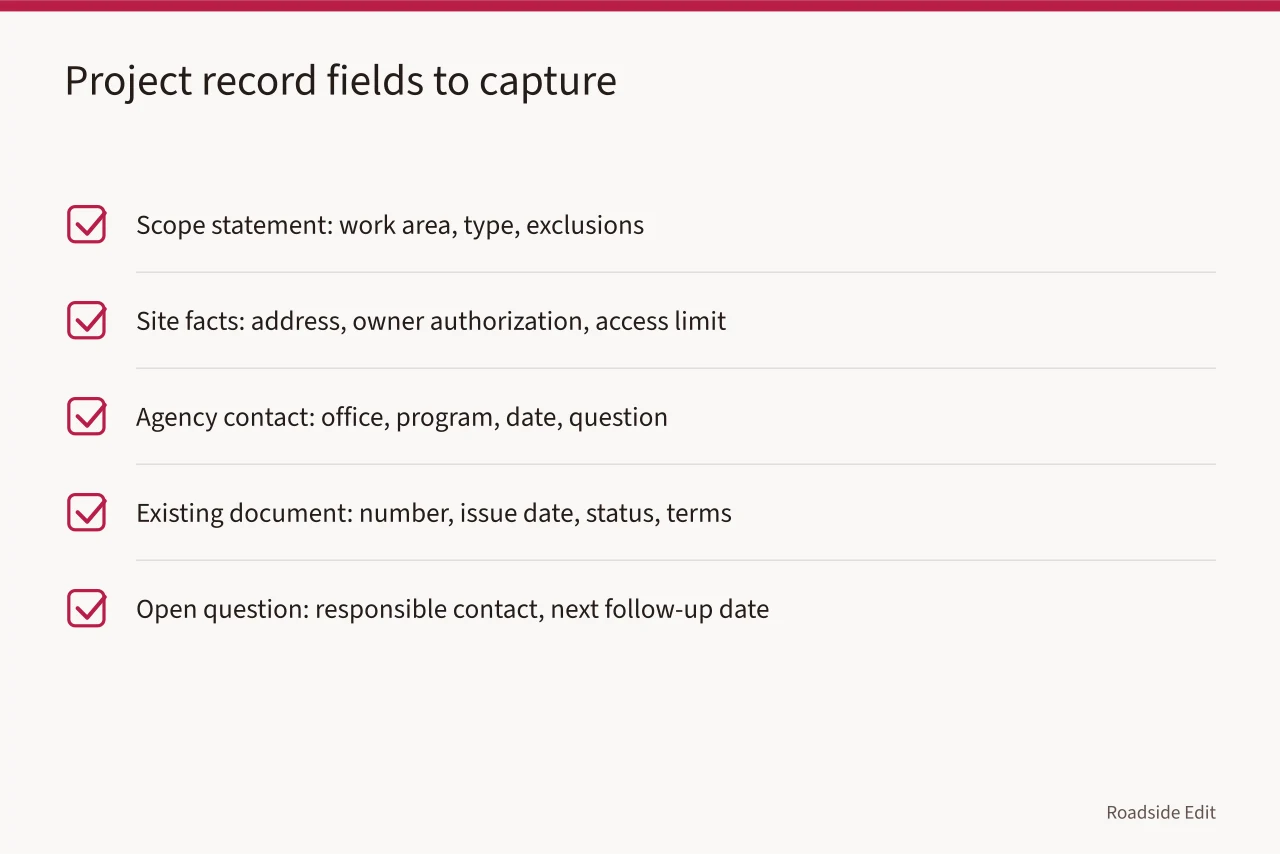
| Project record | What to capture |
|---|---|
| Scope statement | Work area, work type, and stated exclusions |
| Site facts | Address or parcel reference, owner authorization, and access limit |
| Agency contact | Office, program, contact date, and question sent |
| Existing document | Number, issue date, status, and terms that apply |
| Open question | Responsible contact and next follow-up date |
Sort the work into review tracks
One project can have several tracks at once. A building permit may cover physical work, a land-use approval may cover proposed use or site arrangement, and a utility request may cover service.
An environmental or historic-preservation review may apply when public funding, regulated resources, or a listed resource is involved. Each track should have its own status; calling all of them "approved" hides useful information.
For grant-assisted historic-preservation work, the National Park Service says required review and compliance must be completed before grant-assisted work begins. Read NPS review and compliance guidance.
That requirement applies to the program NPS describes. It does not tell a private property owner what every local agency will require. It does show why an article should never treat an application or preliminary conversation as a completed approval.
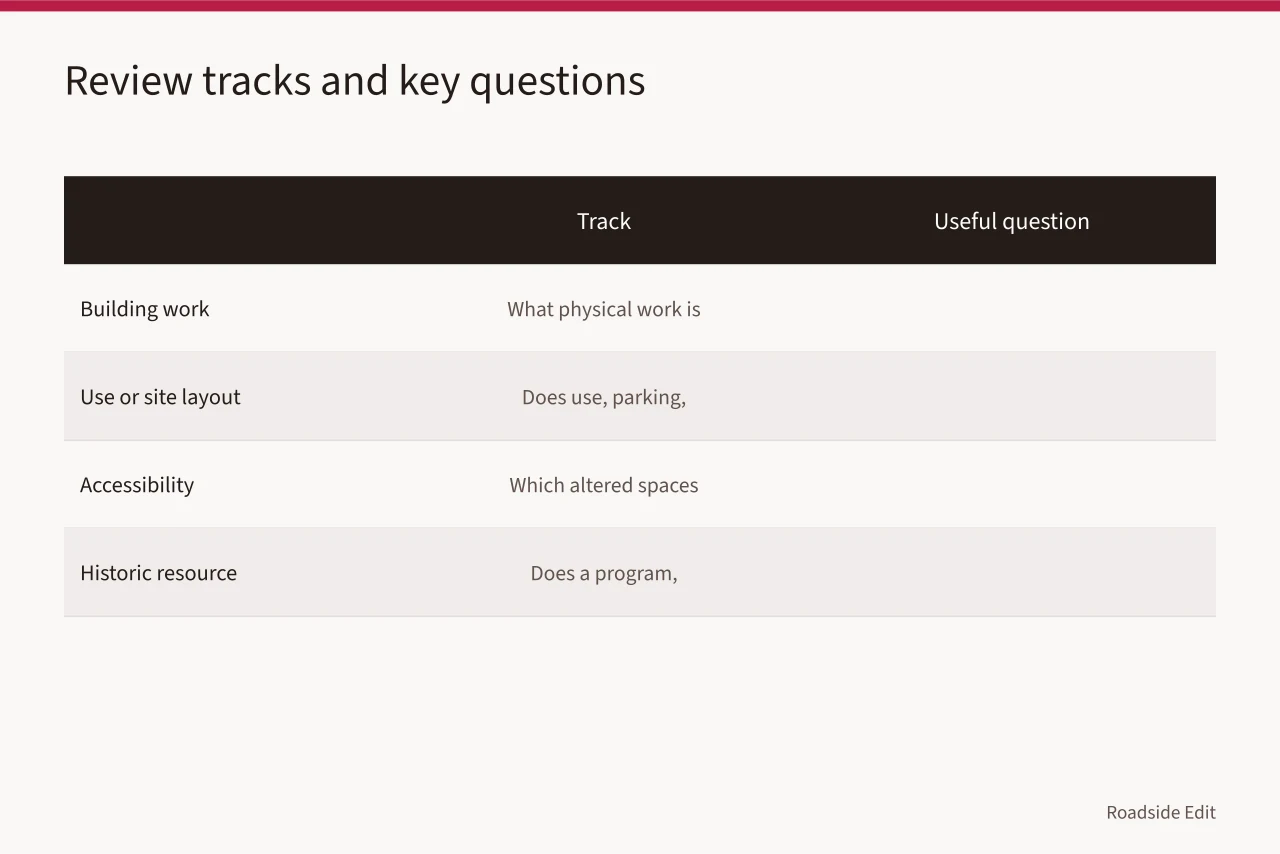
| Track | Useful question for the file |
|---|---|
| Building work | What physical work is proposed, and which office reviews it? |
| Use or site layout | Does the proposed use, parking, sign, or circulation change need review? |
| Accessibility | Which altered spaces or routes may be covered, and who can interpret the applicable requirements? |
| Historic resource | Does a program, designation, grant, or review process appear in the current record? |
| Environmental conditions | Are there documented materials, water, fill, or site conditions that require a separate inquiry? |
Check accessibility against the real scope
Access questions should not wait until a public announcement. The U.S. Access Board explains that additions and alterations at existing facilities are covered by the ADA Standards, and that the scope of work affects how those standards apply to altered elements and spaces.
Review the Access Board's alterations guide. The guide also says it is not a complete stand-alone source for all applicable requirements. Use it to prompt the right question, then obtain the project-specific review that applies to the facility.
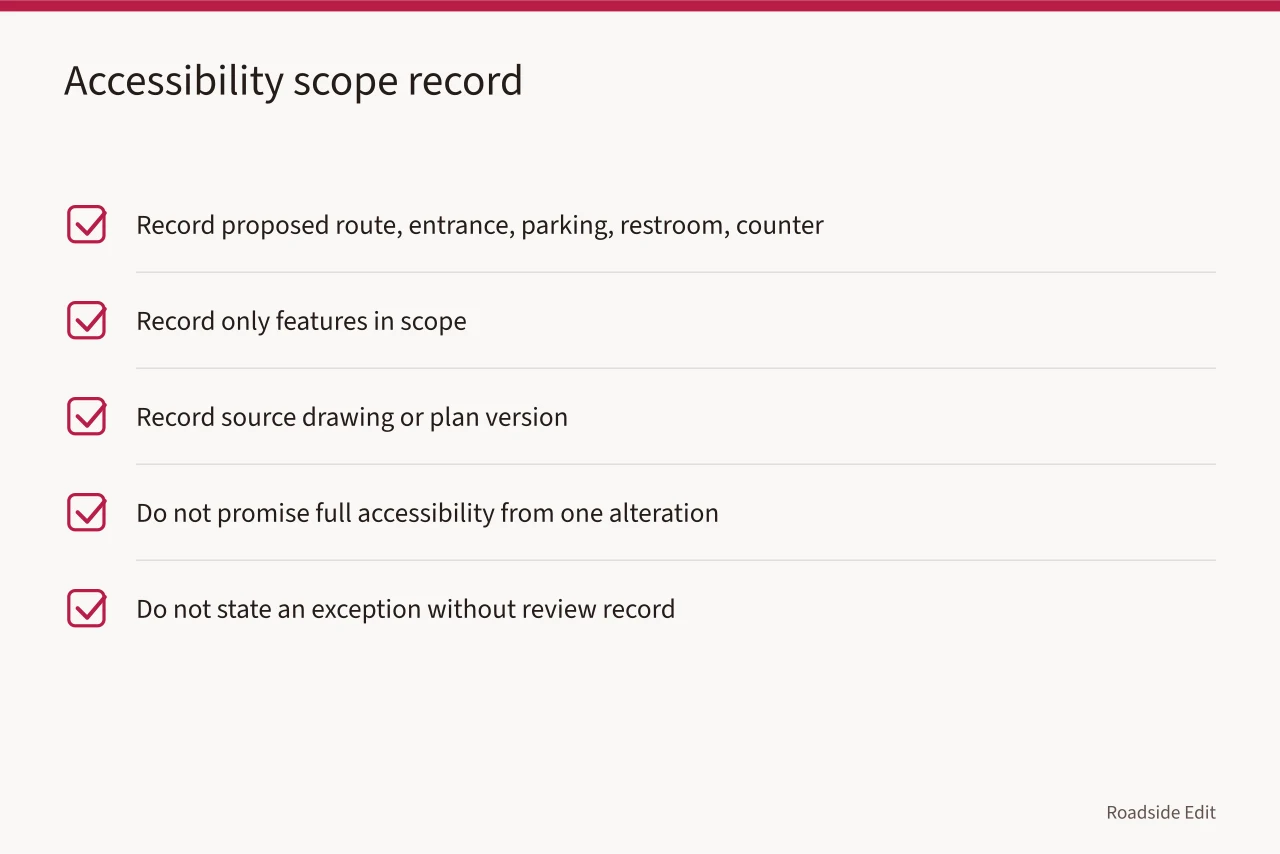
In the permit file, record the proposed route, entrance, parking, restroom, counter, or other affected feature only when it is in scope. Record the source drawing or plan version. Do not promise that a site will be fully accessible based on a single alteration, and do not state that an exception applies unless the responsible review record says so.
Flag materials and site work early
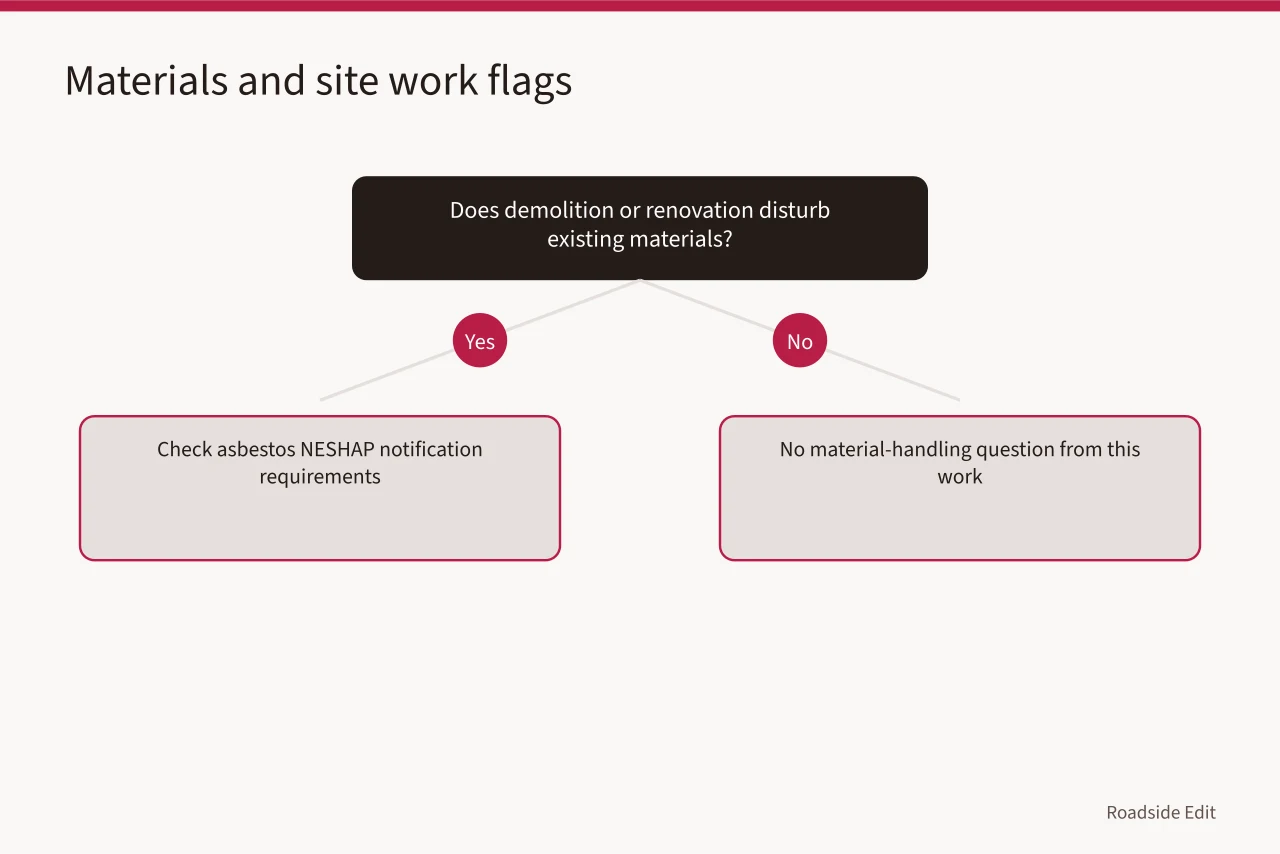
Some compliance questions depend on conditions a short site visit may not reveal. Demolition or renovation can raise material-handling questions, while earthwork, drainage changes, or fill near water can raise other questions.
Mark the potential issue and the source of the information itself. Do not label a material hazardous or a water feature regulated without evidence and the appropriate determination.
EPA's asbestos NESHAP program regulates asbestos emissions during certain demolition and renovation activities and requires notification for covered work. See EPA's asbestos NESHAP overview.
Whether the program applies to a project depends on its facts and the governing rules. The useful checklist action is to identify the work, the existing material information, and the person responsible for making the determination before publication describes the work as routine.
The Clean Water Act Section 404 program covers permits for dredged or fill material discharges into waters under its jurisdiction. Review EPA's Section 404 overview.
This does not mean a roadside property needs that permit. Earthwork or fill plans near a documented water resource should go through the appropriate review path, not be assumed outside the project.
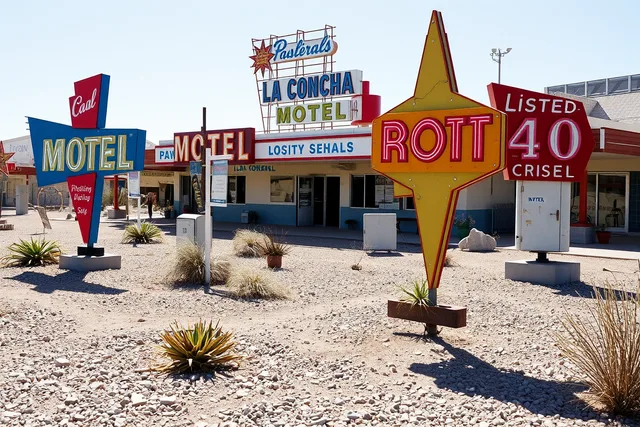
The photograph is historical context only. It does not show a current permit, safety condition, property boundary, approval, or project scope.
Keep the document trail readable
Use one line for each document and status change. Record the document number when the issuer provides one, its issue date, the source, and any stated expiration, inspection, or closeout step. A short status vocabulary keeps the record honest:
- Drafted: the team has prepared a scope or question.
- Submitted: an application or request has been sent.
- Under review: the responsible office has acknowledged or is reviewing the record.
- Issued or approved: a dated agency or authority document confirms that status.
- Closed: the record identifies a completed closeout, final inspection, or other final step.
Avoid phrases such as "permit secured" unless the file contains the issued document and its conditions. If only one track is complete, name that track. For example, "The local design-review application was submitted on [date]" is more informative than "the project has approvals."
Write public updates that match the file
Every public update needs a source and date. A current application can support a statement that an application was submitted. A dated approval can support a statement that the named approval was issued. Neither document automatically supports claims about construction timing, use, occupancy, safety, funding, or other agencies' actions.
Before publishing, ask four questions: What exact work does the document cover? Who issued it? What status does it state? What does it not decide? If the answer to the fourth question is unclear, shorten the update. A restrained statement is more useful than a complete-sounding story that the record cannot support.
Common questions
Does an application mean a renovation can begin?
No. An application documents a request. Work may depend on review, issued permits, property authorization, inspections, or other conditions that the project file should identify.
Can one approval cover every part of a roadside project?
Sometimes, but only if the issued document says so. Keep separate tracks until the record establishes that a single approval covers the listed work.
Should an article list every possible permit?
No. List the review tracks supported by the project facts and tell readers which questions remain open. A generic list can make an article look thorough while missing the actual issue.