Guides
Part of Roadside renovation safety checklist: what to document before work starts
Roadside Renovation Safety Records for 2027
Safety records for 2027 roadside work keep the referral visible, so a reported condition reaches a licensed trade instead of becoming a published conclusion.
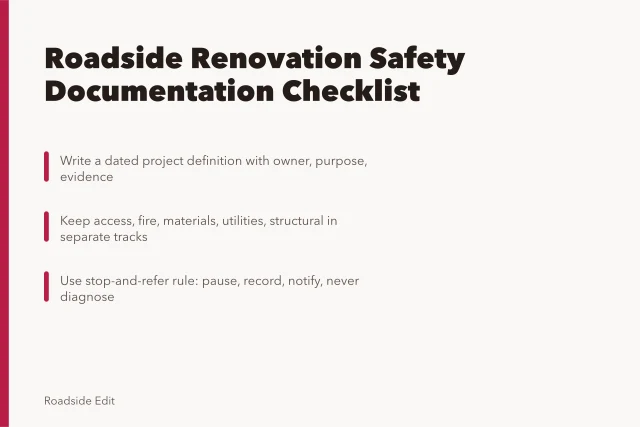
Safety records for a roadside renovation exist to keep a referral visible. The record says who was told, when, and what they were asked to do. It never decides what the condition is.
What to take away
- A record holds four things: the observation, its date, the person who received it, and the next action.
- Write the referral as a referral. "Sent to the electrician" is a fact. "Wiring is failing" is a diagnosis you are not licensed to make.
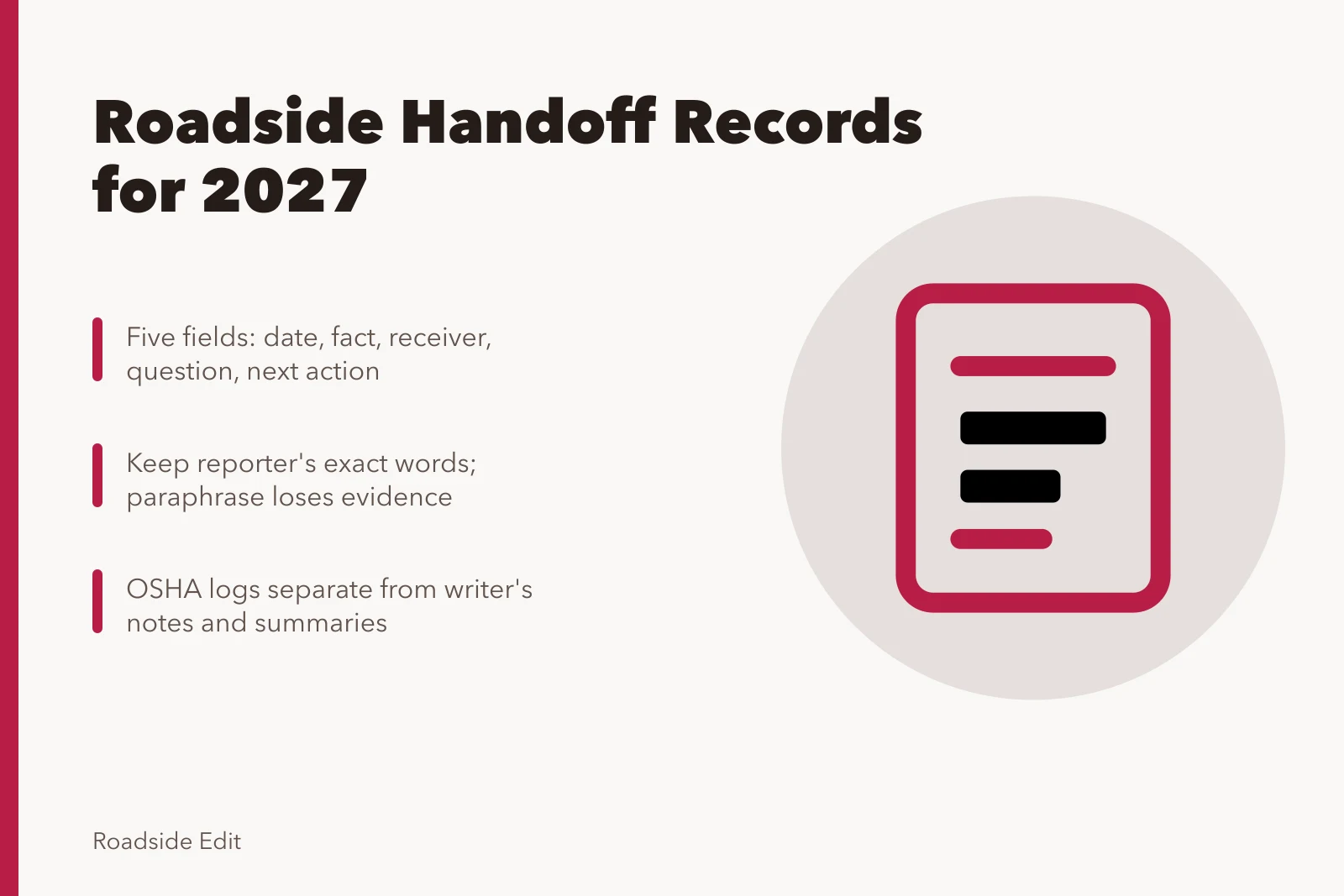
- Keep the exact words of whoever reported the concern. A paraphrase loses the only evidence of what was said.
- OSHA injury and illness logs are a separate file from a writer's notes, and they apply only to covered employers.
- Never overwrite an old entry. Add the new one and link it to the one it corrects.
The five-part handoff entry
A handoff is the moment a question leaves your desk and lands on someone qualified. Write it in five fields, in this order.
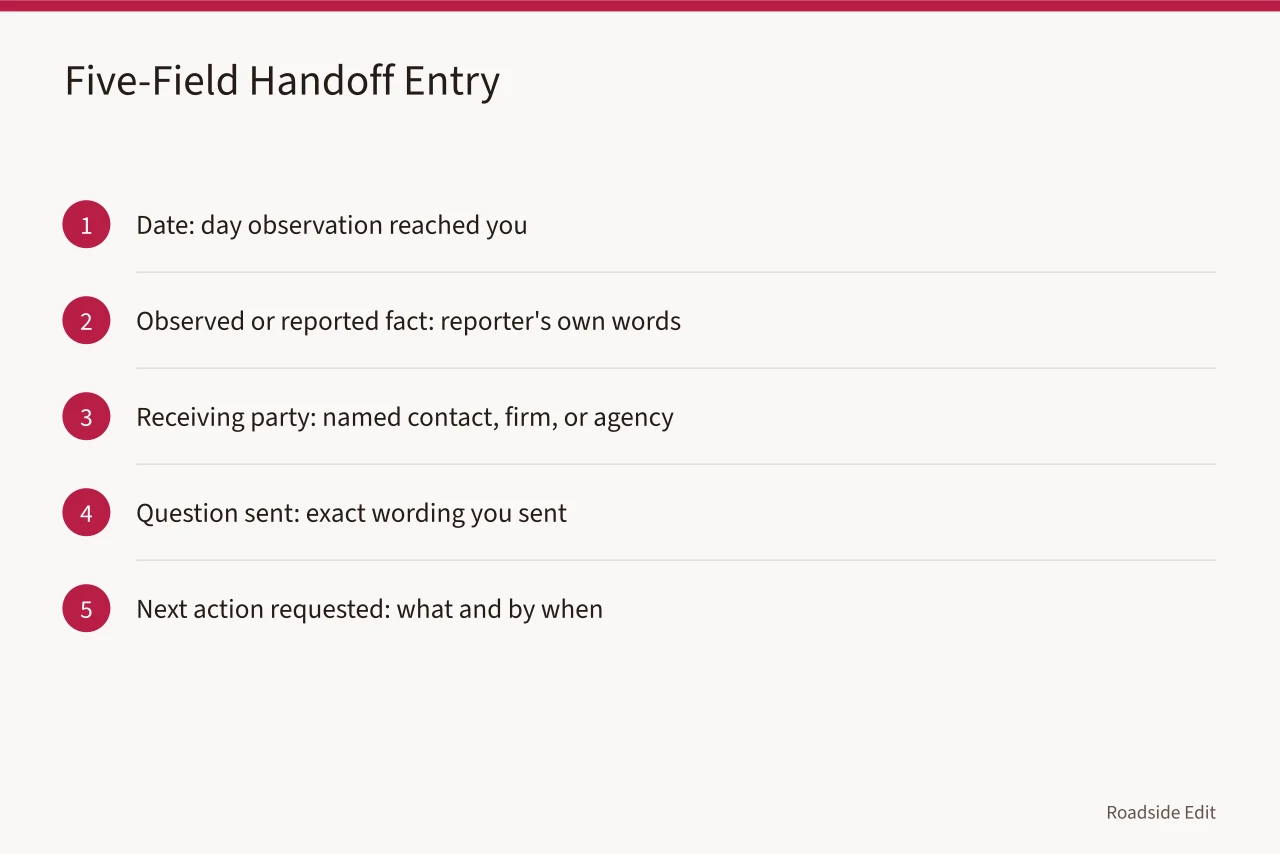
- Date. The day the observation or report reached you.
- Observed or reported fact. What was seen or said, in the reporter's own words.
- Receiving party. The named contact, firm, or agency, not "the team."
- Question sent. The exact wording you sent them.
- Next action requested. What you asked them to do, and by when.
A completed entry reads: "May 12. Property manager reported a loose panel on the canopy soffit, seen from the east sidewalk. Sent to [named electrical contractor] with a dated exterior photo. Asked for a site review and a written scope. Review requested by May 26."
That entry records a handoff. It does not say why the panel is loose, whether the soffit is sound, or what repair is needed. Those answers belong to the licensed trade, and the local authority having jurisdiction sets what counts as compliance.
The next entry carries the result: the contact asked for more information, scheduled a visit, closed the report, or issued a scope. If nothing has come back, write "outcome not recorded." That line is honest. Silence is not.
Where OSHA fits, and where it does not
Covered employers must keep injury and illness records under rules set by the Occupational Safety and Health Administration. Review OSHA recordkeeping requirements. Those rules govern workplace incidents, not project notes, and coverage varies by operation and size.
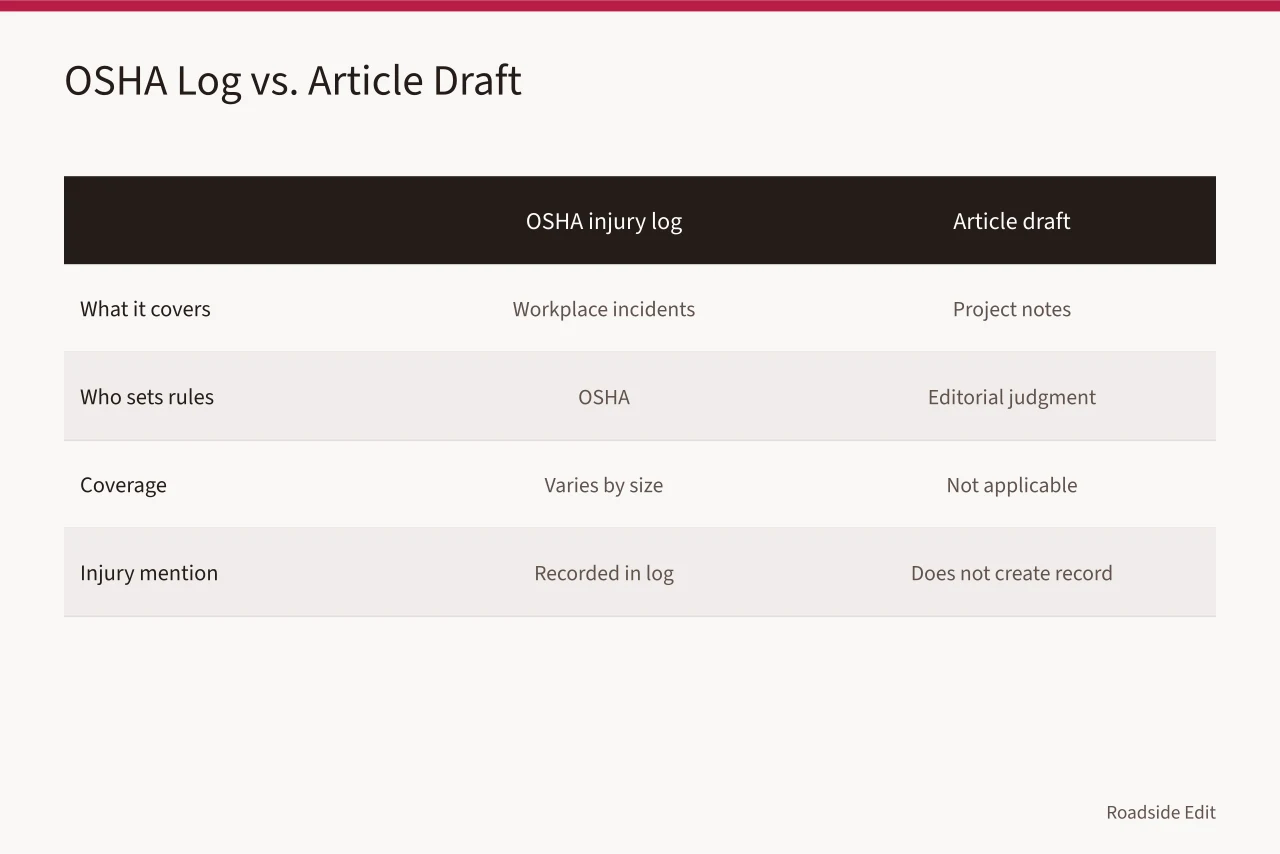
The practical split: regulatory records stay separate from a writer's summary or a public progress note. If a site team member is hurt during a canopy or dry-stand pipe job, that goes in the OSHA log. Your article draft does not become an incident record because you mentioned the injury.
Keeping the source attached
Save the original file or stable link, the source name, the date received, the location detail, and the exact claim the item supports. Note the source type: direct observation, owner statement, government record, historical reference, or outside report. Each carries different weight.
The National Archives describes records management as the creation, maintenance, use, and disposition of records. See the National Archives records-management overview. That program governs federal agency records, not a private preservation file. The lesson travels anyway: keep the context that lets a stranger understand what the record is.
When a newer source arrives, add it as a new entry and connect it to the older one. The sequence stays readable: report, handoff, review, decision, correction. An editor can then explain why a published sentence changed.
Materials questions need scope, not conclusions
Questions about paint, dust, demolition debris, or the coating on a porcelain-enamel sign need careful wording. Record the age information, the work being considered, the source of the concern, and the process receiving it. Do not state that a hazardous material is present unless a qualified record supports it.
EPA explains that demolishing older housing can release lead-containing dust, and that lead-safe practices apply in the contexts its rule describes. Read EPA's guidance on lead-based paint and demolition.
That does not establish lead at any roadside property. It supports keeping the age, scope, and materials question in the file and routing it to the environmental authority or a licensed abatement contractor.
Sponsors, claims, and the public log
Keep one compact log for every article, announcement, sponsored placement, or paid listing. Fields: exact wording, publication date, source record, who approved it, and the correction date if the language changes. If a sponsor supplies a claim, log it as a sponsor statement unless an independent source supports more.
The Federal Trade Commission's endorsement guidance covers disclosure of material connections in endorsements and advertising. Read the FTC's endorsement-guides questions and answers. It does not dictate the wording of a project update. It does mean a paid relationship stays visible when a reader could take the content as independent.
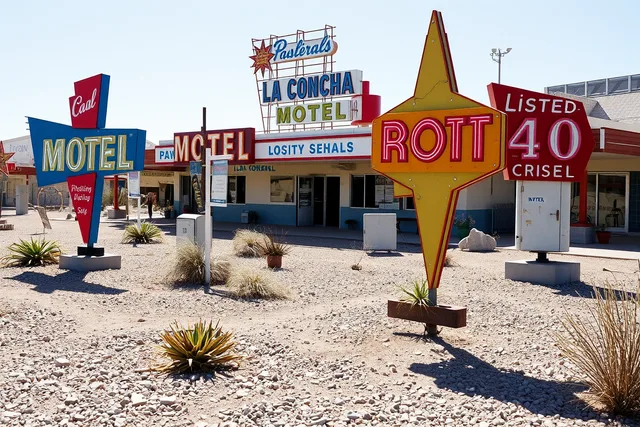
The image is illustrative. It documents no property's condition, access, or project status.
A worked example: the leaning sign
A 1958 porcelain-enamel station sign leans about four degrees off plumb after a spring storm. The writer photographs it from the sidewalk and notes the date.
The entry: "April 3. Sign leans approximately four degrees from vertical, observed from the east sidewalk. Sent to [named structural engineer]. Asked for a site assessment and written recommendation. Assessment requested by April 17."
Nothing in that entry says the sign is unsafe, that the pole is rotten, or that it must come down. The engineer decides. The record shows the referral happened and when.
Common questions
Does every record need to be public?
No. Keep the full internal file and publish only what can be stated accurately and lawfully.
Can a social post serve as a source?
It can be a dated statement. It cannot establish a technical condition, an approval, or a completed repair.
What goes in a correction log?
The old wording, the new wording, the source behind the change, the date, and the reason.