Guides
Part of How to plan a roadside building workflow before the draft exists
Roadside building planning checklist before you write a word
Roadside building planning checklist for 2027 helps U.S. readers define scope, verify sources, organize project stages, credit images, and route open questions.
Planning a roadside-building article or research file works best when the question comes before the story. A broad idea such as "cover this historic place" leaves room for guesses about identity, condition, business status, and project results. A narrow plan shows what sources are needed and where the evidence ends.
This checklist helps a writer or owner organize research and project context. It does not establish a building's designation, current use, permit path, or repair need.
What to take away
- Write one answerable question and an evidence cutoff date.
- Keep historical, current, and submitted information in separate fields.
- Treat project stages as different claims with different sources.
- Credit the exact image source page and keep captions narrow.
- Route property-specific decisions to the responsible owner or authority.
Define the question and the boundary
Write the article question before opening a search tab. "What does the historic record identify at this location?" and "What did a named announcement say it would fund?" are answerable. "Is the building worth saving?" is an opinion and requires a very different kind of reporting.
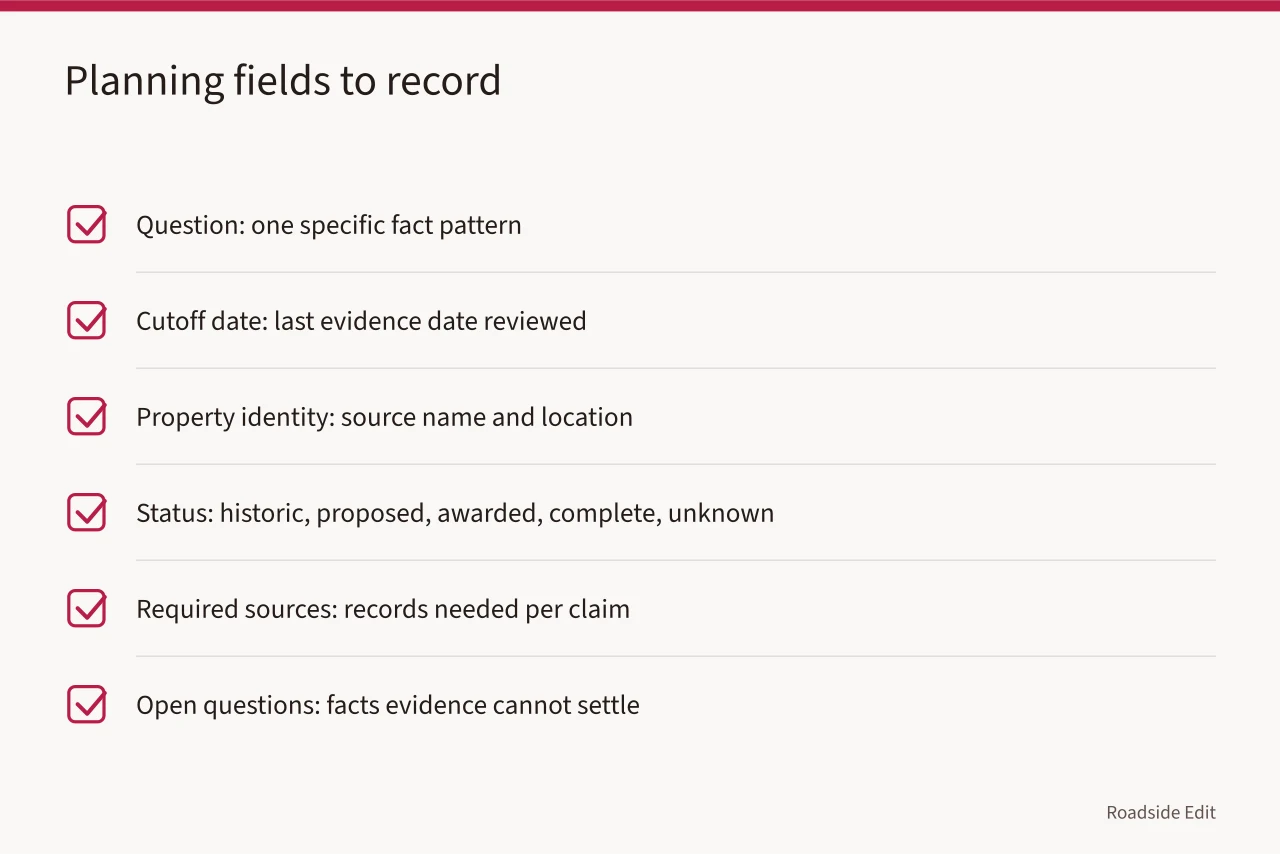
| Planning field | What to record | Purpose |
|---|---|---|
| Question | One specific fact pattern | Prevents an unfocused draft |
| Cutoff date | Last date of evidence reviewed | Makes the time boundary clear |
| Property identity | Source name and location | Anchors the research |
| Status | Historic, proposed, awarded, reported complete, or unknown | Avoids stage confusion |
| Required sources | Records needed for each claim | Stops citation hunting after drafting |
| Open questions | Facts the evidence cannot settle | Sends them to the right role |
The National Park Service's Route 66 National Register overview notes that National Register listings can bring recognition to Route 66 properties and may have tax implications for qualifying preservation projects. A listing is planning context, not proof of current business activity, project eligibility, condition, or a guaranteed benefit for a specific property.
Collect source cards before writing paragraphs
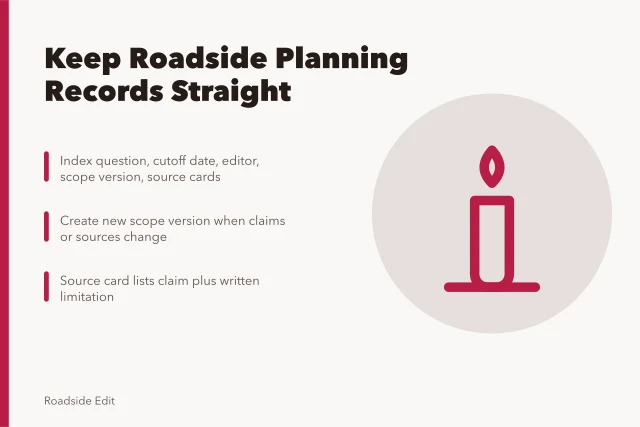
Make a source card for every important page. Include the title, organization, deep URL, page date if shown, access date, geographic or property scope, exact claim supported, and a limitation. If a source is a historical inventory, write that it supplies historical context. If it is an owner update, label it as an attributed statement.
The National Park Service's documentation standards and guidelines emphasize reliable sources and clear limitations that allow records to be independently checked. These standards address historic documentation, but the planning habit applies directly: retain the page that supports the claim and do not write beyond its stated scope.
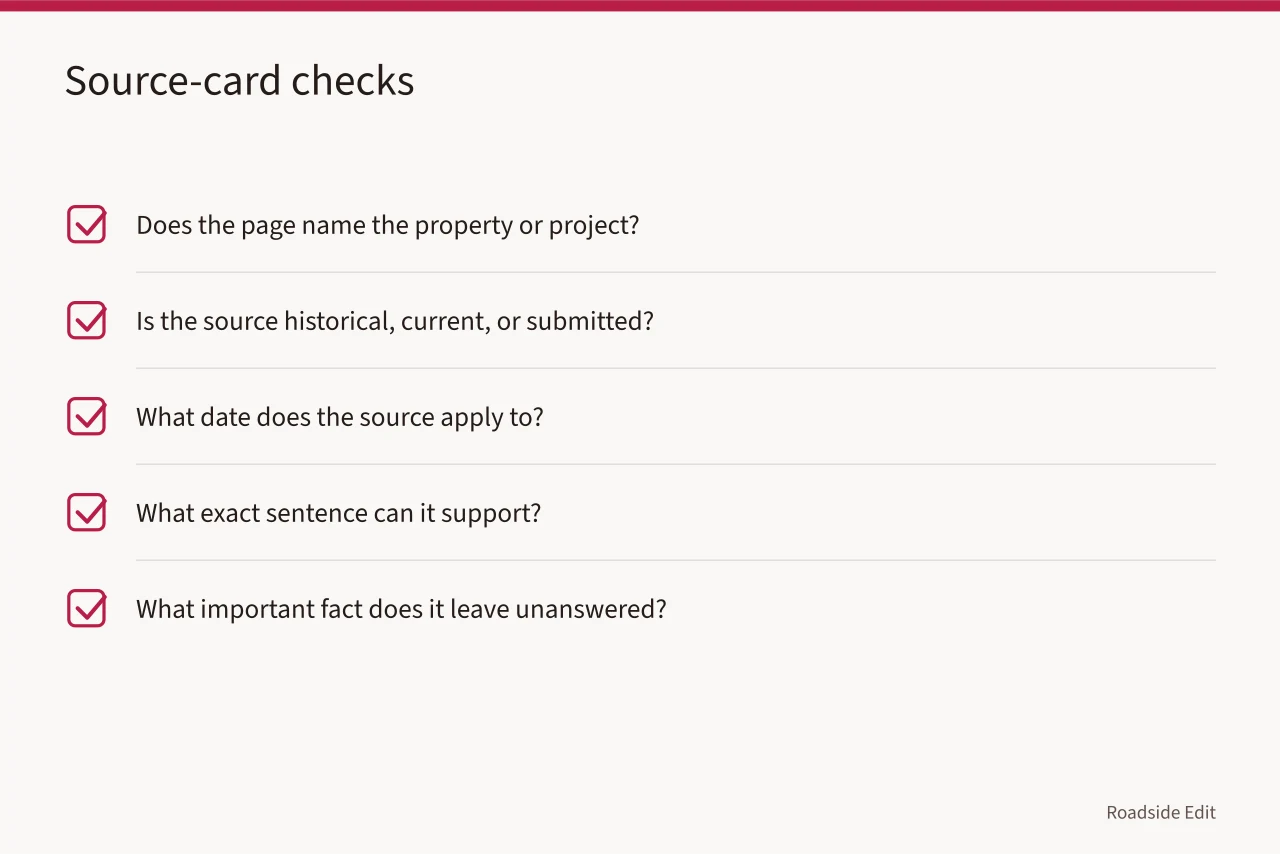
Source-card checks
- Does the page name the property or the relevant project?
- Is the source historical, current, or submitted material?
- What date does the source apply to?
- What exact sentence can it support?
- What important fact does it leave unanswered?
Keep project stages separate
One of the most costly planning mistakes is treating a proposal as work, an award as construction, or an owner update as independent verification. Build a simple project-stage chart and attach a source to each entry.
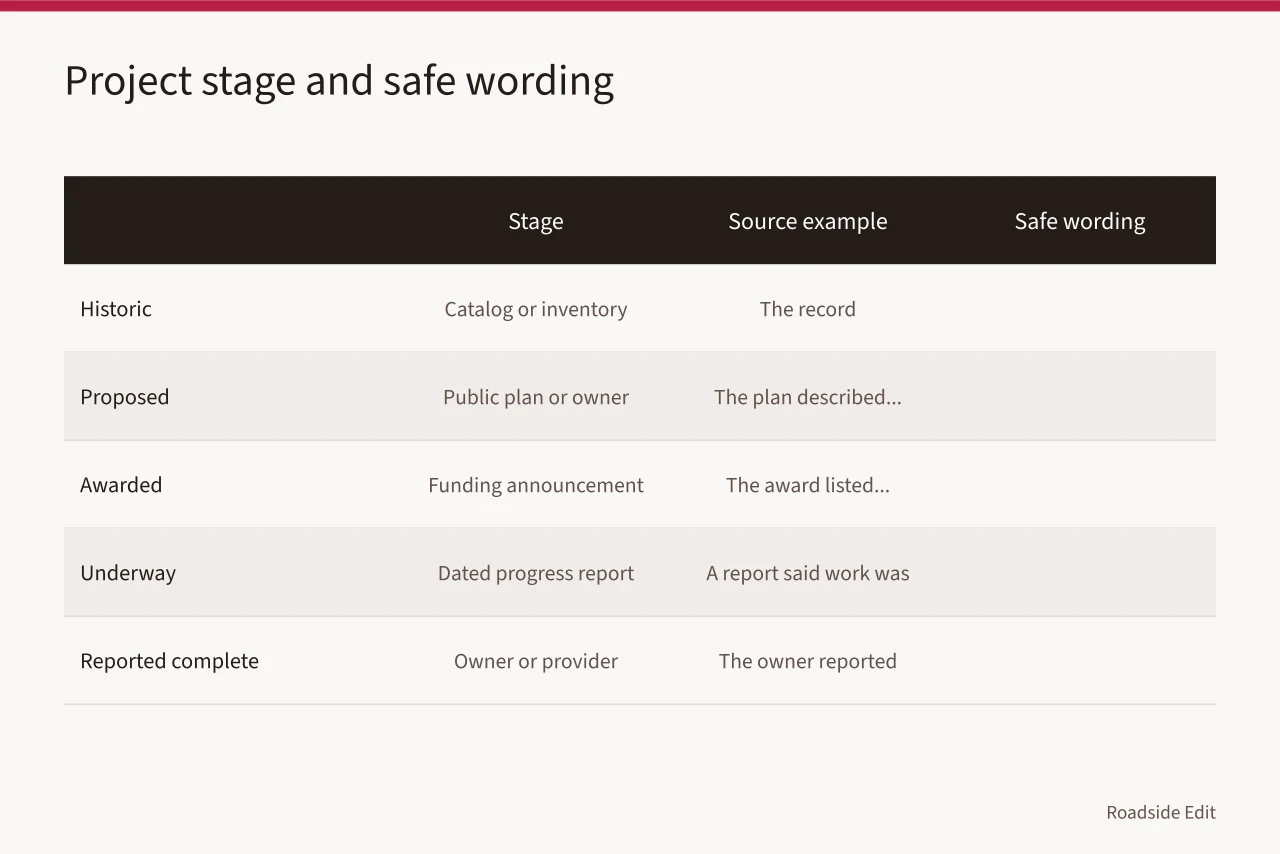
| Stage | Source example | Safe wording |
|---|---|---|
| Historic | Catalog or inventory | "The record identifies..." |
| Proposed | Public plan or owner statement | "The plan described..." |
| Awarded | Funding announcement | "The award listed..." |
| Underway | Dated progress report | "A report said work was underway." |
| Reported complete | Owner or provider update | "The owner reported completion." |
Do not promote a status because it makes a story sound more finished. If no later source confirms an outcome, plan an honest closing sentence that states the available record stops at the earlier stage.
Plan image use before it enters the draft
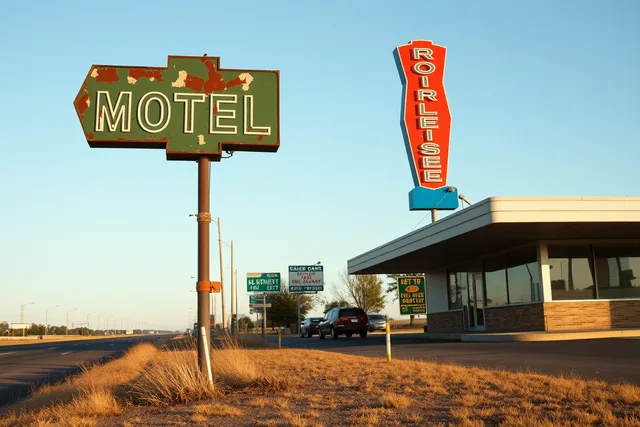
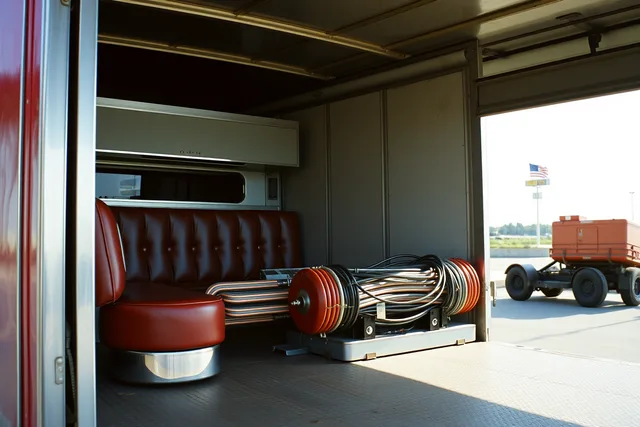
Choose one image that supports the article's visual context and retain the exact source page, credit, local asset name, and caption. A historical image can show a source-recorded scene. It should not be used as proof of current appearance, ownership, safety, or building condition.
For each image, write a purpose note: historical context, source-recorded visual identification, or a dated local observation. This note keeps a strong photograph from taking on claims that belong in sourced text.
Route local and technical questions early
Planning should reveal where general reporting stops. Questions about access, permits, safety, structural performance, utilities, preservation review, or local requirements need the responsible owner, authority, or qualified professional. Do not write a checklist item that assumes the answer.
Turn the uncertainty into a direct research question: Which local office has authority? What record would settle the issue? What property-specific facts would that office need? Is the answer public and current? A clear question is more helpful than an unsupported conclusion.
Separate commercial material from editorial planning
An owner, service provider, or tourism business may later submit information or buy a placement. Preserve that material in a commercial file with its sender, date, and disclosure. It may support an attributed statement, but it is not independent confirmation of a property fact or project outcome.
The Federal Trade Commission says advertising that resembles independent content should be recognizable as advertising. Read the FTC native-advertising guide. It is not a preservation rule. It supports a planning boundary that makes paid or submitted content visibly distinct from evidence-led editorial material.
Build a handoff-ready plan
Before drafting, make a one-page index with the question, source cards, image record, project-stage chart, open questions, and next review date. Keep private contact details, access instructions, and security-sensitive information in the restricted operational file.
The National Archives states that records tied to the same project, transaction, study, or subject should be retained together when that relationship provides needed context. Read the National Archives recordkeeping requirements. This federal policy does not govern a roadside article. Its useful planning parallel is to keep the question, source cards, image record, and later correction in one traceable packet.
The plan is ready when another editor can tell what the article will cover, what sources support it, what cannot be claimed, and who must answer the remaining questions.
Common questions
Does a National Register listing tell me what project to plan?
No. It provides historical or recognition context. A particular project needs property-specific scope, authority, funding, and responsible review.
Can a project announcement prove completion?
No. It supports the announced stage and scope. Use a later source for an underway or completed status.
What should be excluded from a public planning file?
Exclude private contacts, access details, security information, and unsupported property conclusions. Keep only the source-backed material needed for the informational article.