Guides
How to plan a roadside building workflow before the draft exists
Roadside building planning workflow for 2027 helps U.S. readers define questions, collect records, separate project stages, and publish claims with clear limits.
Roadside building planning workflow for 2027 starts before anyone writes a guide, a case study, or a local list. The first task is to decide what the article can responsibly cover. A public record may identify a former motel, station, cafe, or sign. It may say nothing about the present condition, ownership, project cost, or whether a business is open.
What to take away
- Define the article question before collecting material.
- Sort every source by what it can establish and when it was created.
- Keep historic facts, visual facts, current updates, and project stages separate.
- Treat owner and provider material as dated submissions.
- Preserve sources and correction notes so another editor can review the article later.
Start with one planning question
Vague topics create vague articles. "Everything about this roadside building" sounds ambitious but rarely produces a reliable story. A narrower question gives the research a boundary. It might ask what a public record identifies at a location, which features appear in a dated image, or what stage a documented public project reached.
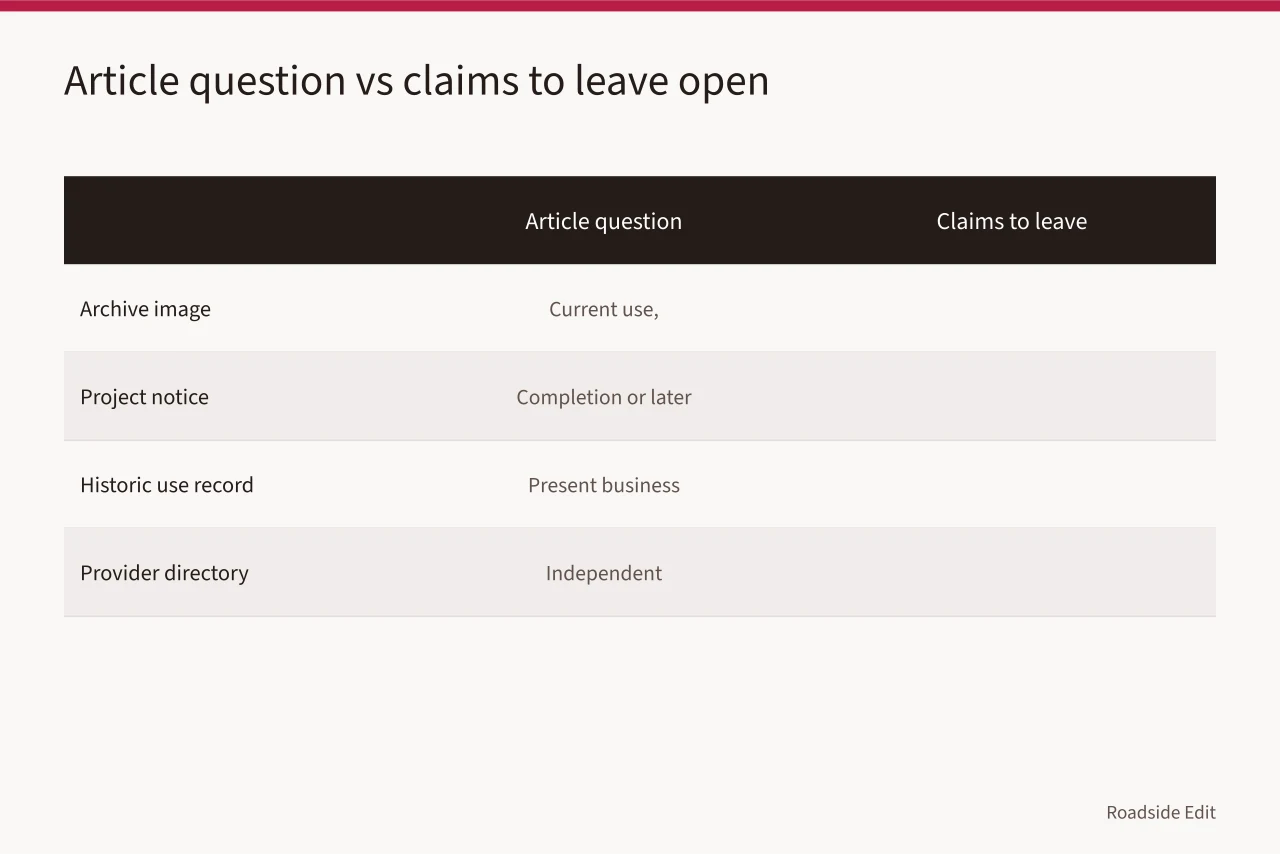
Write the question in one sentence. Then list the facts needed to answer it. If the article cannot answer a question from the available sources, save it for later reporting. Do not fill the gap with a generic description of roadside architecture or a claim borrowed from a nearby property.
| Article question | Useful sources | Claims to leave open without more evidence |
|---|---|---|
| What does an archive identify in this image? | Catalog record and image credit | Current use, condition, or ownership |
| What does a public project notice describe? | Direct project announcement | Completion or later results |
| What historic use does a record name? | Inventory or historic documentation | Present business operations |
| What can a provider submit for a directory? | Dated provider statement | Independent performance assessment |
Build an evidence packet
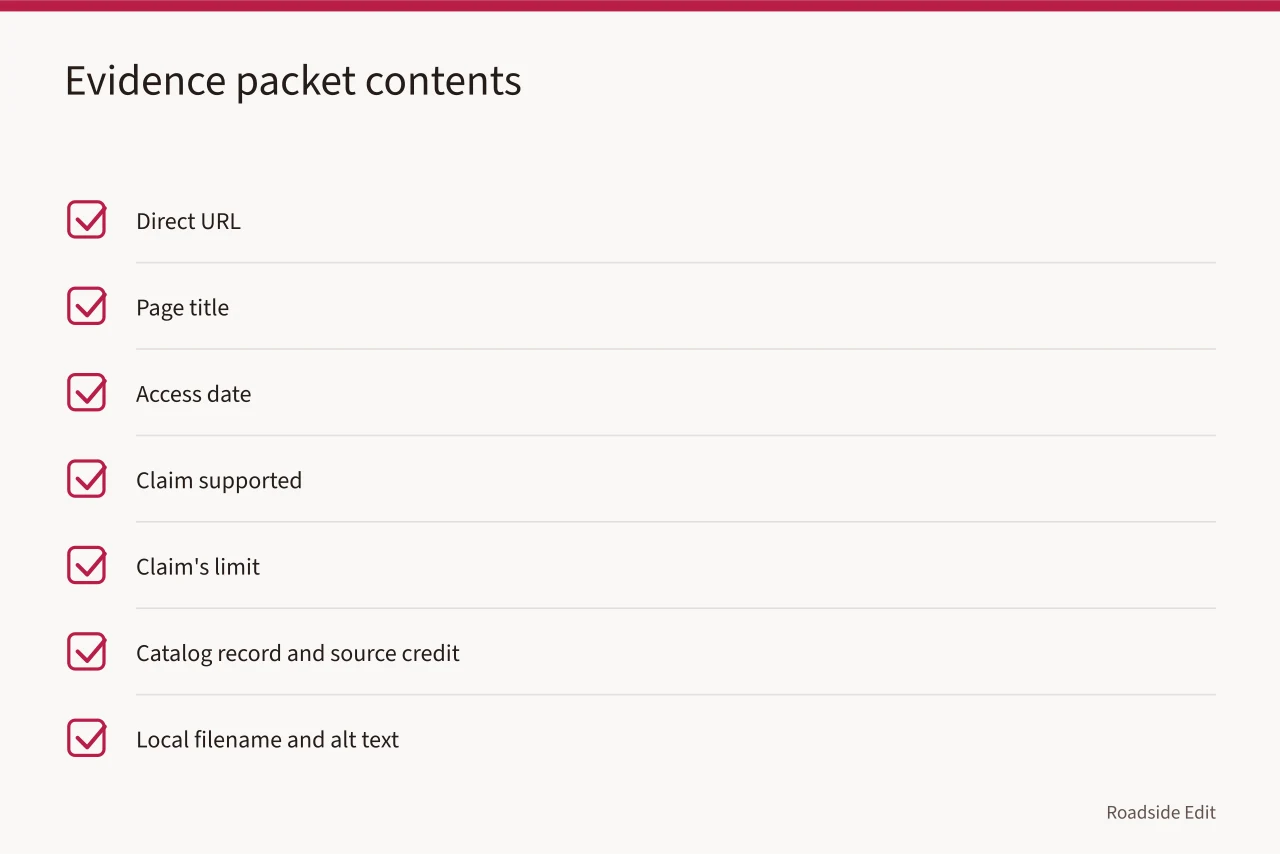
An evidence packet is a small folder of source pages and notes. It should be easy for another editor to inspect. Save the direct URL, page title, access date, claim supported, and the claim's limit. For images, retain the catalog record, source credit, local filename, and descriptive alt text.
Do this before drafting. When sources are saved only after the article is written, editors tend to look for proof of sentences they have already decided to include. That produces overbroad claims and weak captions. A source packet creates a more useful limit: write only what the record can support.
Choose the right level of detail
Not every article needs the same scope. A short image note may focus on the setting and catalog description. A project update may focus on a single public announcement. A list article may identify the inclusion method and make each entry's source visible. The level of detail should follow the source material, not a fixed template.
The National Park Service explains standards for historical documentation that can guide the recordkeeping behind an article. Consult the NPS guidance on historical documentation. It is a reminder to plan the question before selecting technical material. A general editorial article can point readers to an institution's guidance without pretending to apply that guidance to a particular building.
If an article names a material, a repair method, or a safety issue, it needs a source that speaks to that specific point. Otherwise, keep the discussion at the editorial level: explain what has been documented, what is visible, and who could confirm the remaining issue.
Separate project stages
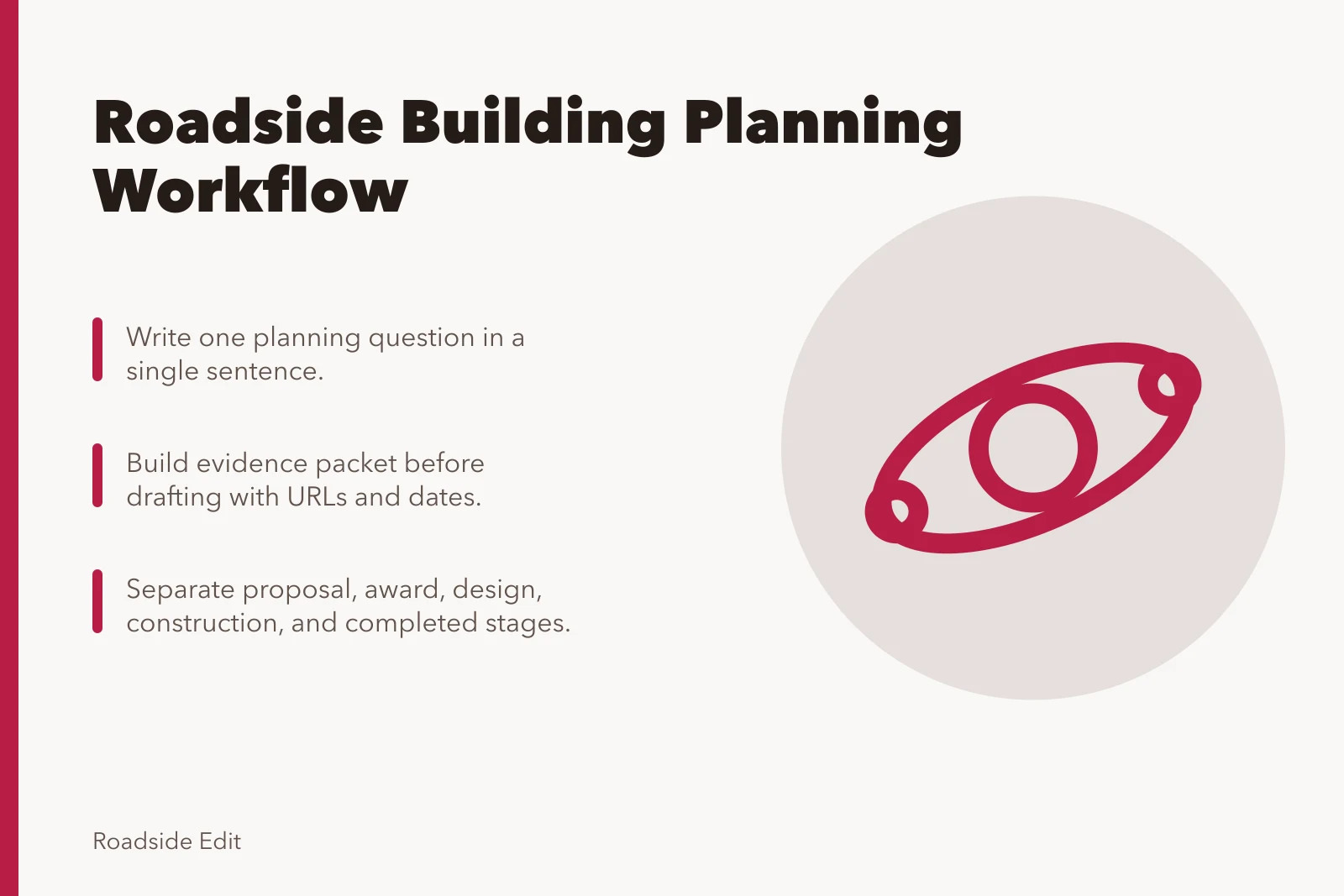
Project language is easy to blur. A proposal, grant award, design phase, construction update, and completed project are different records. Write the stage that the source actually names. Do not convert a funding announcement into a completion claim or a current-condition statement.
Create a simple project note:
| Field | Example entry |
|---|
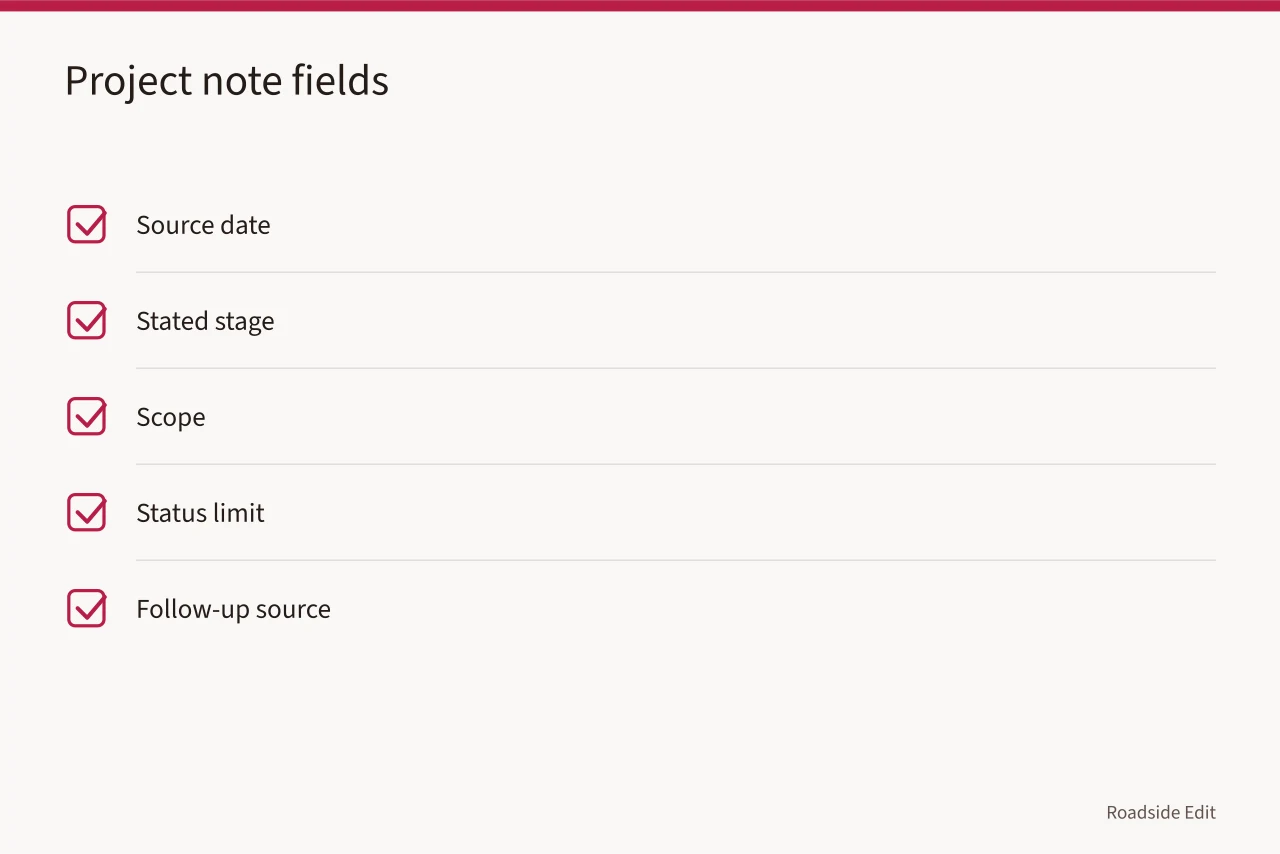
This note also helps when a property owner supplies an update. The owner's statement can be published as a dated attribution, but it should not erase the earlier record. Keep both pieces of information and revise only the sentence that the new material supports.
Plan commercial material with clear labels
Roadside guides often attract businesses that want a directory entry, a review, or a paid placement. That material needs its own workflow. Record who supplied it, when, what the business says it provides, and any terms or limits. A paid placement should be labeled according to the publication's disclosure policy.
Do not turn a business description into editorial research. A provider may say it offers sign restoration or lodging services. Attribute that claim to the provider. Do not imply an inspection, comparative test, price survey, or endorsement unless the publication has actually performed and documented that work.
Assign ownership before the draft exists
Planning is easier when the article file shows who owns each decision. One person may collect public sources, another may prepare captions, and an editor may decide how a submitted correction changes published copy. The file does not need a complicated production system. It needs a clear place for questions that should not be silently answered by the writer.
| Decision | Record in the article file |
|---|
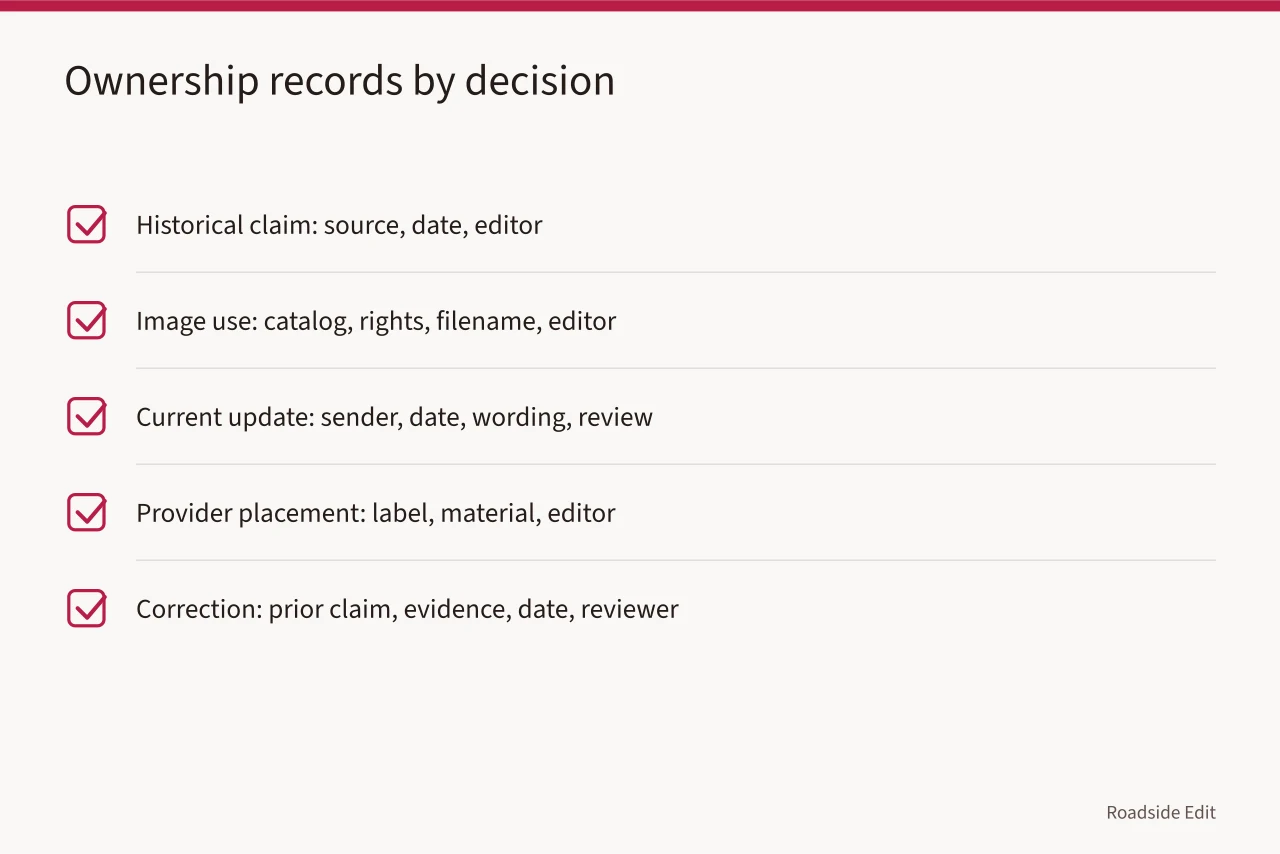
This structure prevents a common handoff problem. Without a record, a future editor may see a statement in an old draft and assume someone checked it. A short approval note makes the source trail visible. It also makes it easier to decline material that needs technical verification or a current property contact before publication.
Set a review point for time-sensitive details
Some facts change more quickly than others. A catalog date and an archival caption can remain historical context. Business hours, admission policies, lodging availability, ownership, project progress, and provider prices can change. Mark those details for a later check if the article needs them.
Do not create a false update by changing an old source's tense. If no current source is available, keep the old claim in its historical frame or leave it out. A page with a smaller, dated scope is more useful than one that appears current but has no current record behind it.
Know when to stop research
Research should stop when the article question has a documented answer and every published claim has a source or an explicit attribution. More reading does not justify new, unrelated claims. Save useful but unused material in a future-topic note instead of stretching the current article to include it.
That boundary makes the publication plan practical. It keeps a short case study from becoming a loose local history, and it protects a later article from repeating the same material under a different title.
Plan photos and captions together
The image record should shape the caption. Use the catalog's identification, location, and date where the catalog supplies them. Do not add construction dates, current hours, or ownership claims simply because the image makes the place recognizable.
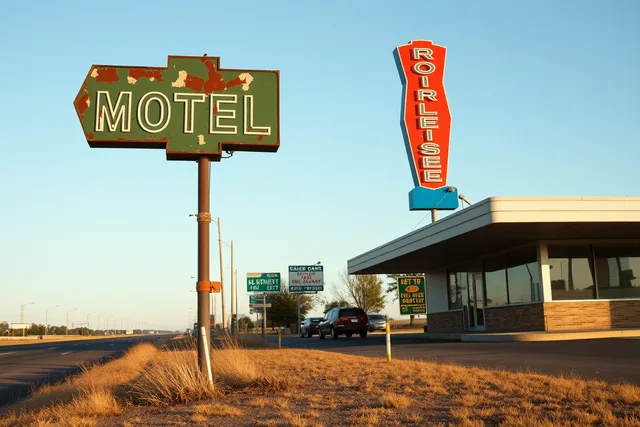
The Library of Congress catalog identifies the planned source image as a Duplex Motel sign on a surviving section of old U.S. Highway 66 in St. Louis, Missouri, photographed in 2021. The record supports the caption's documented scene. It does not establish current availability, the building's technical condition, or a travel recommendation.
Run a prepublication review
Before publishing, open every linked source and read the linked sentence aloud. Ask whether the source proves the whole sentence or only part of it. If it proves only part, split the sentence or narrow the wording. Also check that the article does not repeat a dated historical claim as though it were current information.
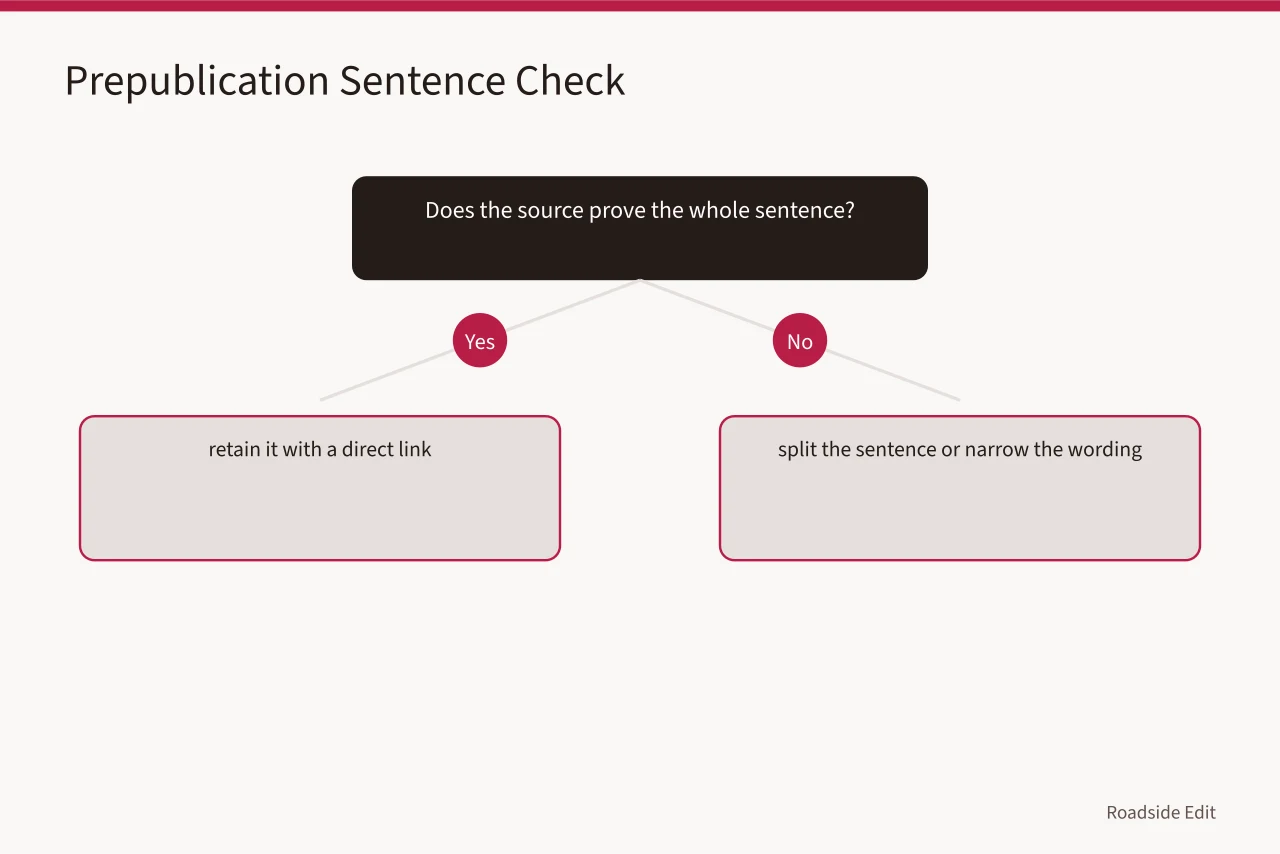
Use this short review table:
| Check | Action |
|---|---|
| Source supports the sentence | Retain it with a direct link. |
| Source supports only historical context | Add the date and remove current wording. |
| Image record supports the caption | Retain the credit and local asset. |
| Provider claim appears as editorial fact | Attribute it or remove it. |
| Project stage is unclear | State the limit and wait for a later source. |
The final article should leave a reader with a clear account of what has been documented and where the record stops. That is more useful than a polished but unsupported narrative.
Build an evidence ledger
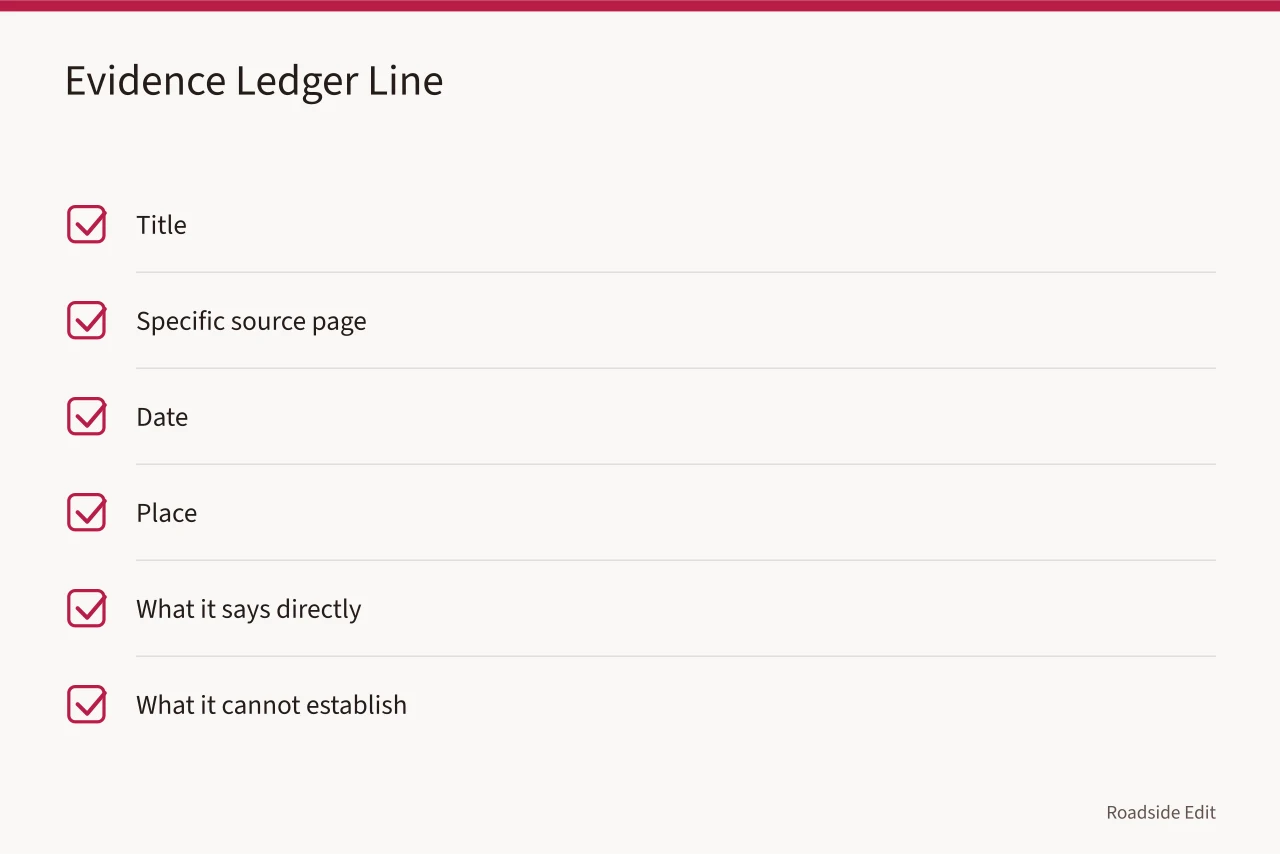
Create one line for every public record, photograph, map, owner update, provider submission, or project notice. Record the title, specific source page, date, place, what it says directly, and what it cannot establish. This ledger keeps a useful source from being stretched into a claim about a different building or a later event.
An institutional preservation library can gather useful guidance and case studies without establishing the condition, designation, or status of every roadside building. Use a specific record for a property fact rather than treating a general route story as proof.
The National Archives advises that photographic material needs context about its history and handling. Read National Archives guidance on photographs. It does not authenticate a particular image. It supports retaining source, date, creator information, and limits beside each visual observation.
Separate project stages
Use clear stages: background research, owner statement, proposal, funding award, public notice, work in progress, and documented completion. A project may move through some or all of these stages. Do not use a grant announcement to say work is complete, or an image of a finished facade to identify the funding, contractor, approval, or cost without a matching record.
The Federal Acquisition Regulation requires agencies in negotiated procurements to establish evaluation factors and significant subfactors. See the FAR rule on evaluation factors. It does not govern an editorial project. It supports deciding what evidence matters before reviewing materials, rather than selecting a conclusion first.
Write a property card
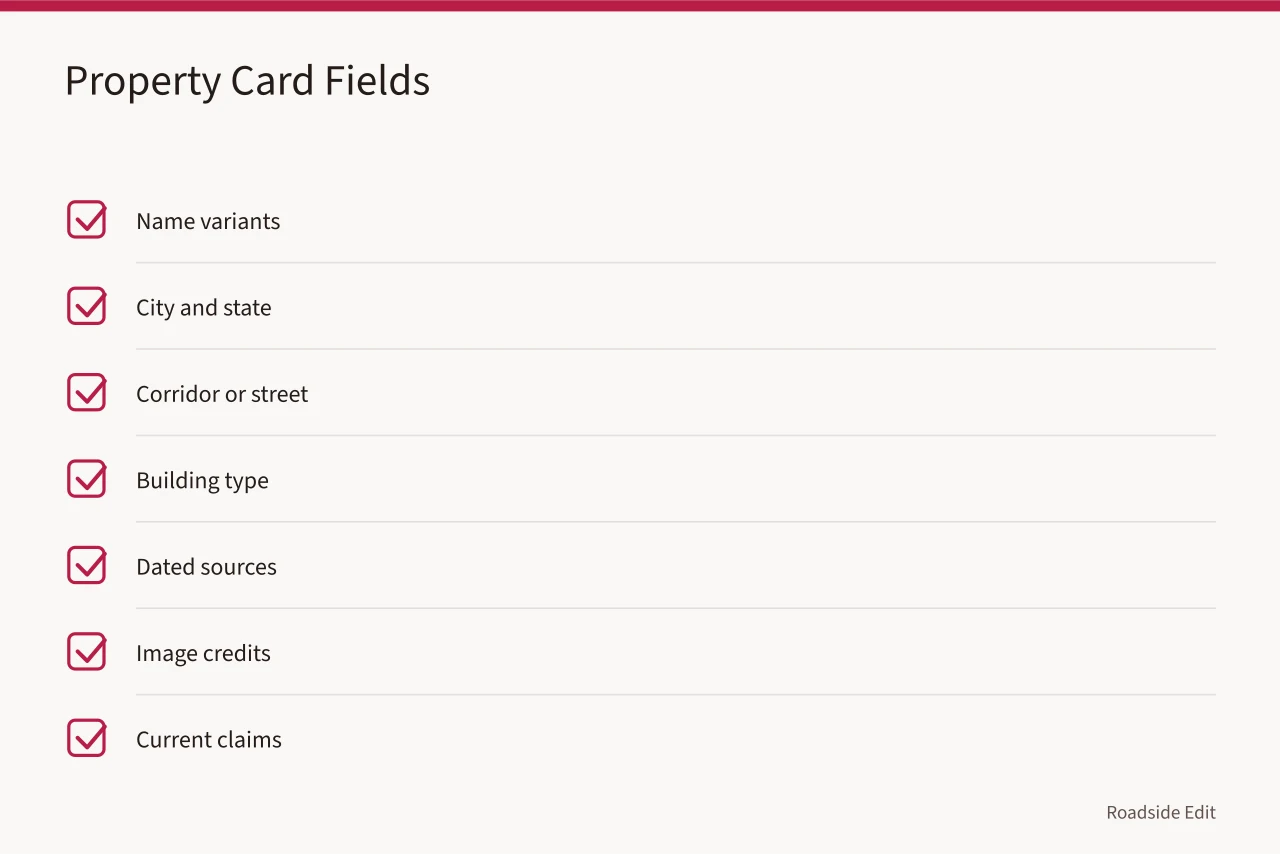
For each building, create a property card with name variants, city and state, corridor or street, building type, dated sources, image credits, current claims, open questions, and correction contact. Use plain language. A card should say "2018 image shows a sign" rather than "sign remains intact" unless a current source confirms the later claim.
The U.S. Geological Survey explains that topographic maps depict natural and man-made features. See the USGS explanation of topographic maps. A map can support a location or feature statement. It does not establish current ownership, business operations, structural condition, or a project outcome.
Keep commercial material visible
Provider descriptions, paid listings, and sponsor submissions can be useful when their role is visible. Identify the source, date, and commercial relationship. Do not write provider language as independently verified reporting. When an owner supplies a correction, attribute it and preserve the prior source in a correction log.
End with a responsible next step
The next step may be a records request, owner contact, catalog check, qualified review, or a pause while evidence is gathered. State the appropriate boundary. A general article should not decide permits, safety, access, technical condition, or treatment. Its job is to make the question and record clear.
The image is illustrative. It does not establish current condition, ownership, safety, or project status.
Common questions
What is the first step in a roadside building planning workflow?
Write one answerable article question, then gather sources that directly address it.
Can a historic source confirm current business information?
No. Keep historical context with its date and use a separate current source for operating information.
How should an article describe a grant?
Use the stage and scope stated by the source. An award is not proof that work was completed.
Can a provider submit material for an article?
Yes. Identify it as a dated provider statement and keep it separate from independently supported reporting.
In this guide
- Roadside building planning checklist before you write a wordRoadside building planning checklist for 2027 helps U.S. readers define scope, verify sources, organize project stages, credit images, and route open questions.
- Roadside building planning questions before you compare property recordsRoadside building planning questions help editors compare property records, map Route 66 listings by state, and flag what a survey still needs to settle.
- How to keep roadside building planning records straight before you publishRoadside building planning records guide for 2027 helps U.S. readers retain scope versions, source roles, authority questions, submissions, and corrections.