Guides
Part of How to plan a roadside building workflow before the draft exists
How to keep roadside building planning records straight before you publish
Roadside building planning records guide for 2027 helps U.S. readers retain scope versions, source roles, authority questions, submissions, and corrections.
Planning records reveal the work behind a roadside-building article. They show the question asked, the source for each stage, scope changes, and what a responsible owner or authority must decide.
Without this record, a draft can silently turn an old image, a new business message, and an incomplete project announcement into one confident claim.
This guide organizes a planning file. It does not establish property status, project eligibility, funding, permit requirements, or building condition.
What to take away
- Keep the question, source cards, and scope versions in one packet.
- Give each source a role and a written limitation.
- Record authority inquiries as questions, not assumed answers.
- Keep submissions and sponsored material outside independent evidence.
- Preserve corrections with their supporting source and reason.
Start with a planning-packet index
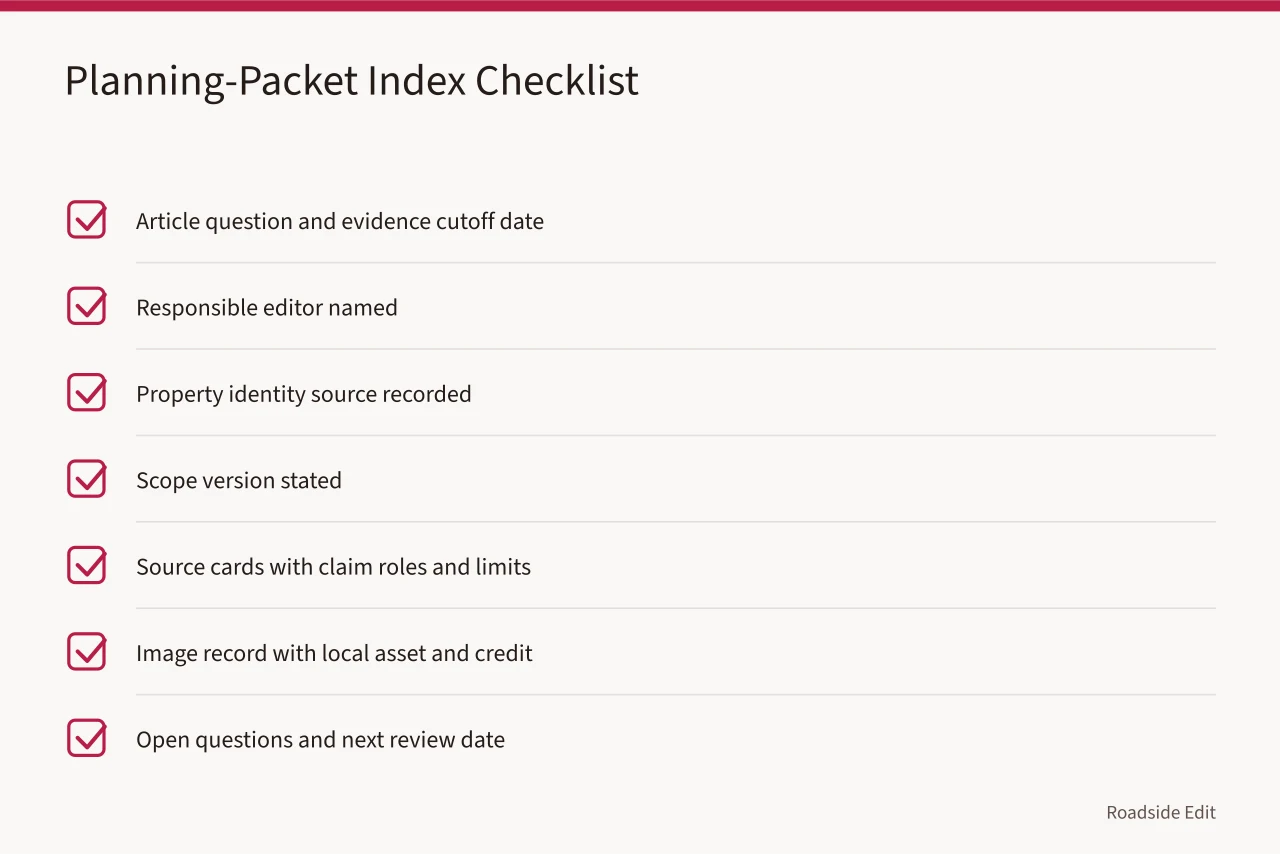
Create an index before research gets busy. Include the article question, evidence cutoff date, responsible editor, property identity source, scope version, source cards, image record, open questions, and next review date. This is the document a new editor should read first.
| Index section | What it contains | Why it matters |
|---|---|---|
| Question | Exact question and cutoff date | Establishes the research boundary |
| Scope version | What the article will and will not cover | Prevents topic drift |
| Source cards | Deep pages, claim roles, limits | Makes review possible |
| Authority questions | Jurisdiction and unanswered issue | Avoids invented local rules |
| Image record | Local asset, credit, caption | Protects media provenance |
| Correction log | Changed text and evidence | Preserves history |
The National Park Service's Route 66 economic impact study overview links readers to a synthesis, technical reports, and case studies rather than presenting one page as the whole evidence base. A small roadside article can follow the same recordkeeping idea: retain the direct page that supports a claim and identify its specific role in the planning file.
Record scope versions instead of rewriting them
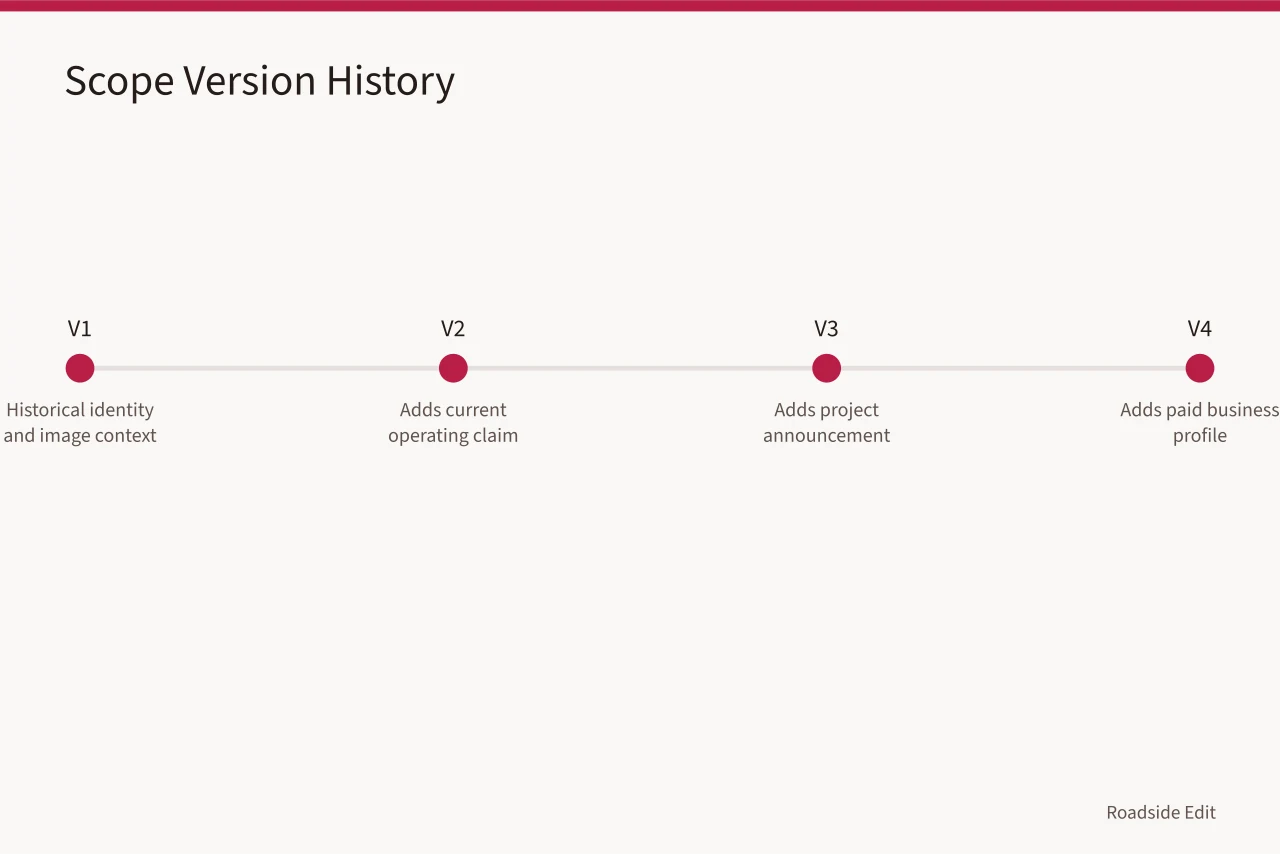
Planning changes. A story may begin as a history of a sign, then add a current business update, an announced project, or a local authority question. When that happens, create a new scope version. State what changed, why, and which claims need a new source.
| Version | Change | Effect |
|---|---|---|
| V1 | Historical identity and image context | Needs archival sources |
| V2 | Adds current operating claim | Needs dated current source |
| V3 | Adds project announcement | Needs source for stage and scope |
| V4 | Adds paid business profile | Needs disclosure and separate file |
Do not edit the first plan until it looks like the fourth. The earlier version tells a reviewer why some sources were collected and why later evidence was needed.
Give sources a job and a limit
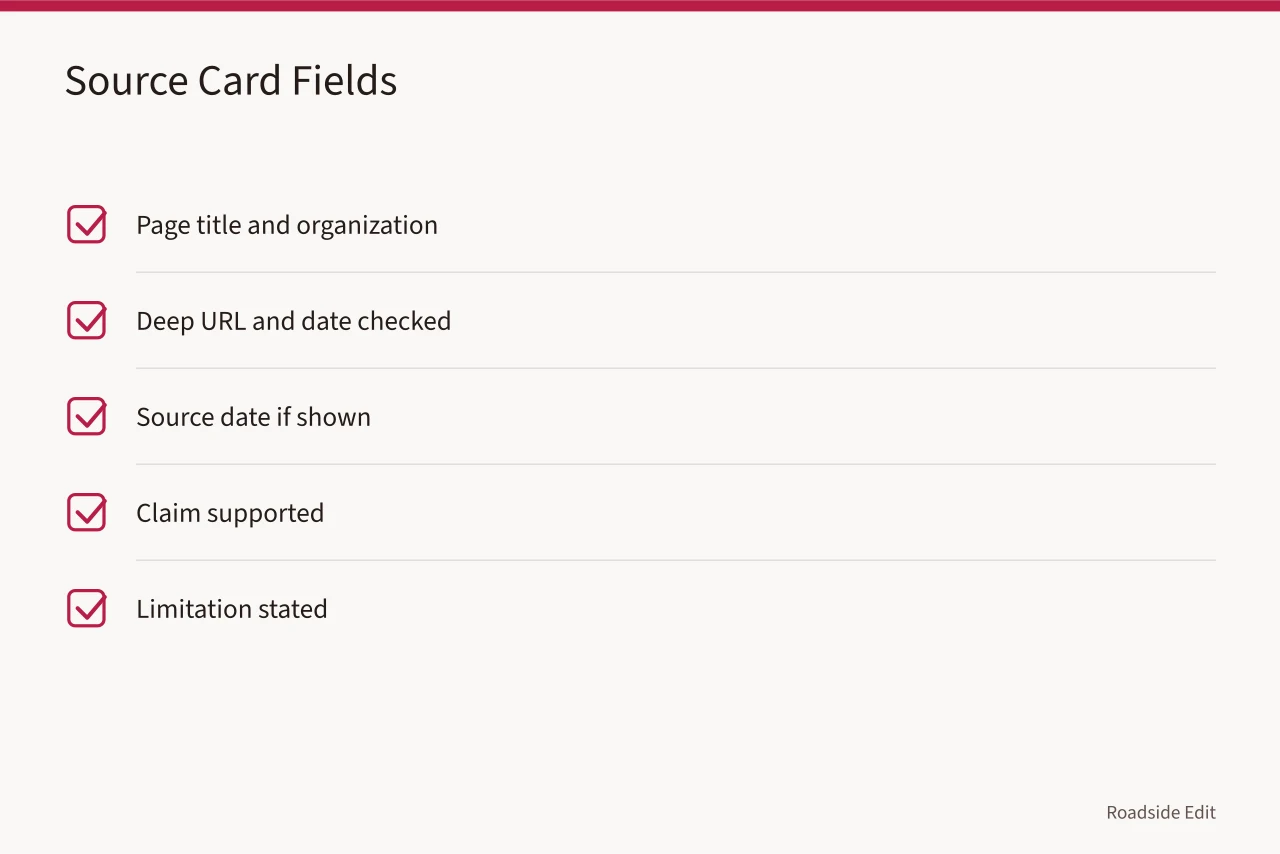
A source card should list the page title, organization, deep URL, date checked, source date if shown, claim supported, and limitation. The limitation is as important as the claim. It tells a later editor whether the source is historical context, an announcement, a catalog description, or an attributed update.
The National Park Service's documentation standards and guidelines call for reliable sources and clear limitations that allow documentation to be independently checked. Although the standards concern historic documentation, they support this planning practice: use a specific source for a narrow fact and record what the source cannot decide about an individual property.
Store image provenance before writing a caption
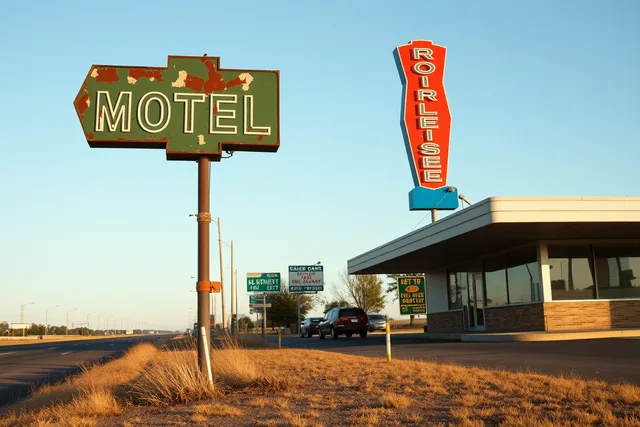
Each planning file should contain an image card. Record the local filename, exact credit page, known date or historical context, alt text, caption, and reason the image belongs in the article. A photo of a motel sign can provide source-recorded visual context. It does not establish present-day ownership, services, condition, or legal status.
Check the caption word by word against the credit page. If the page identifies an image as a 2020 photograph of a sign, write that. Do not add a restoration result or current business claim from memory.
Keep authority questions open until answered
Planning often exposes questions about local permits, signs, historic review, access, drainage, or project rules. Write the question, location, source of concern, and likely authority. Do not insert an answer because a nearby jurisdiction has a similar rule.
The National Archives explains that records related to the same project, transaction, study, or subject should be maintained together when the connection provides context. Read the National Archives recordkeeping requirements. The federal policy does not resolve local building questions. Its useful planning lesson is to retain the authority question, records reviewed, response received, and later correction as one traceable chain.
Separate submitted material from editorial evidence
Owners, providers, and tourism groups may submit facts, corrections, or paid profiles. Keep every original message with its sender role, date, requested wording, attachments, and disclosure status. It may support an attributed statement, but not an independent conclusion until a suitable source confirms it.
The Federal Trade Commission says advertising designed to resemble independent content should be recognizable as advertising. Read the FTC native-advertising guide. It does not determine a roadside-building fact. It supports a clear boundary between sponsored or paid material and evidence-led planning notes.
Correct the plan when evidence changes
If a source changes, a source card is wrong, or a new record contradicts a planned statement, make a correction entry. State the original claim, revised wording, date, new evidence, reason, and editor. Do not silently update a planning record and lose the origin of a past error.
At final review, make sure every published claim has a source card, every image has exact provenance, and every project or authority question is either sourced or left open. A plan that retains its limits is more useful than a detailed plan that makes unsupported promises.
Common questions
Why keep old scope versions?
They show how the article changed and which new claims required additional evidence. This prevents later editors from assuming all sources were gathered for the same question.
Can an owner submission answer a local authority question?
It can be recorded as an attributed statement. Use an appropriate authority source for a property-specific rule or keep the question open.
What makes a planning file ready for drafting?
It has a bounded question, current scope version, source cards with limits, a credited image record, open-question routing, and a correction path.