Guides
How roadside design studios should keep regional owner records before publishing
Regional owner records hold a dated provenance field for every roadside claim, so a later editor can reopen the source and see what it never proved.
A 1950s porcelain-enamel station sign and a 1960s plastic-faced box sign are both "a sign" in a draft and different objects in a survey. The difference lives in the record, not the photograph. A regional article is only as reliable as its provenance trail.
This guide covers the provenance field table, the separate evidence folders with their public labels, the geographic boundary wording, and the review-date schedule. It is not a records-retention rule for any public agency and not a legal opinion about privacy.
What to take away
- Every published claim carries its own dated provenance record, not a shared footnote.
- Evidence folders are separated by kind, each with a fixed public label for attributing claims.
- Geographic wording states the boundary the source actually covers, never "regional" alone.
- Time-sensitive claims get a scheduled review date, and the review either confirms, narrows or removes the claim.
- Media and commercial items stay in their own lanes with credit, date and disclosure attached.
Build the provenance field table first
One record per source, and the record travels with the claim it supports. A later editor should be able to reopen the source and see why it was used.
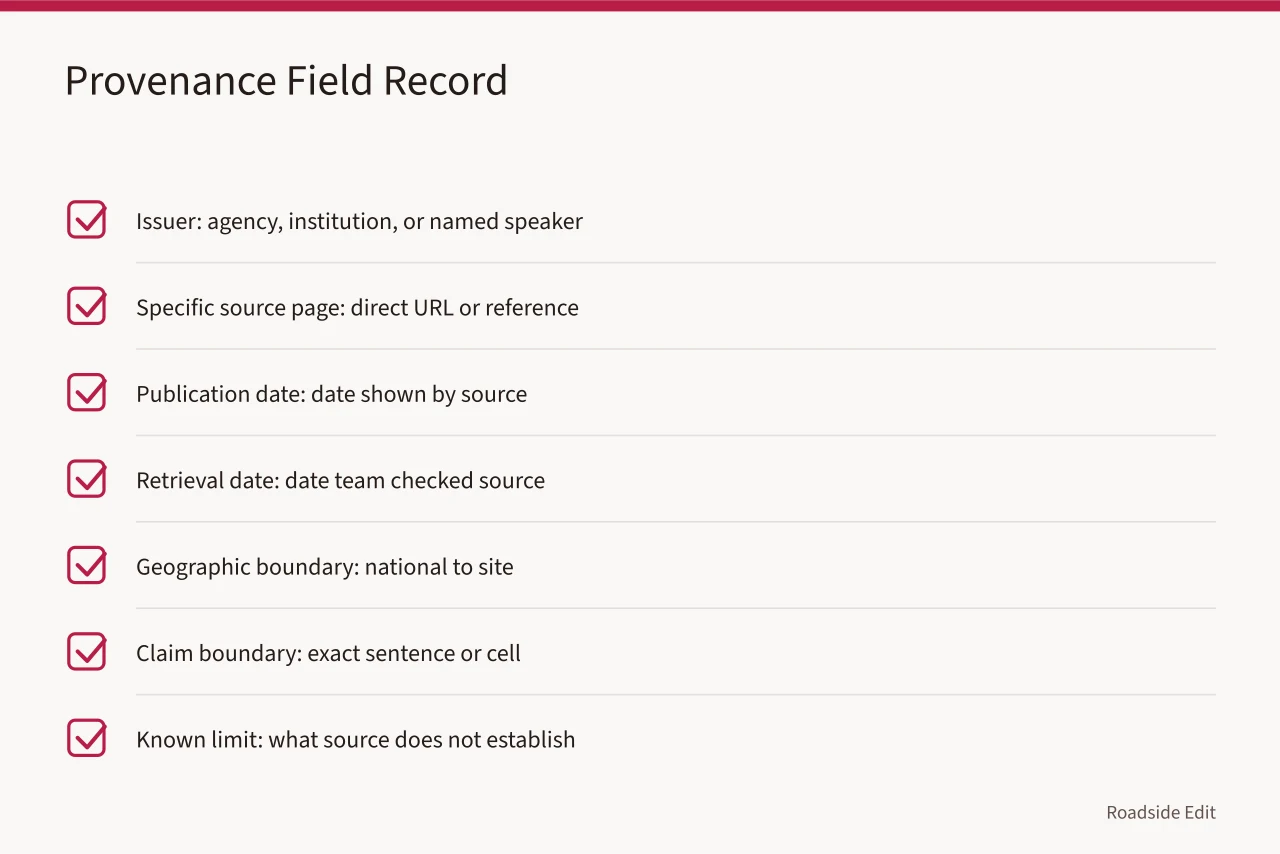
| Field | What to record |
|---|---|
| Issuer | Agency, institution, organization, or named speaker |
| Specific source page | Direct URL or document reference |
| Publication date | Date shown by the source, if any |
| Retrieval date | Date the editorial team checked the source |
| Geographic boundary | National, state, region, county, city, or site |
| Claim boundary | The exact sentence or table cell the source supports |
| Known limit | What the source does not establish |
The National Archives records-management resources organize guidance around records inventory, scheduling, appraisal, and oversight. Those resources govern federal records, not a private editorial file, but the discipline transfers: identify records consistently so a reviewer can tell the original material from a summary built on it.
Never save a bare link. A page can move, change title, or be quietly rewritten. Record the title, issuer, publication date and the limited claim it supported at the time. When the source later changes, the record tells you exactly what needs review.
Separate the evidence folders
Regional research goes wrong when every item lands in one notes document. An observation then reads like an agency finding, and a provider offer reads like independent evidence.
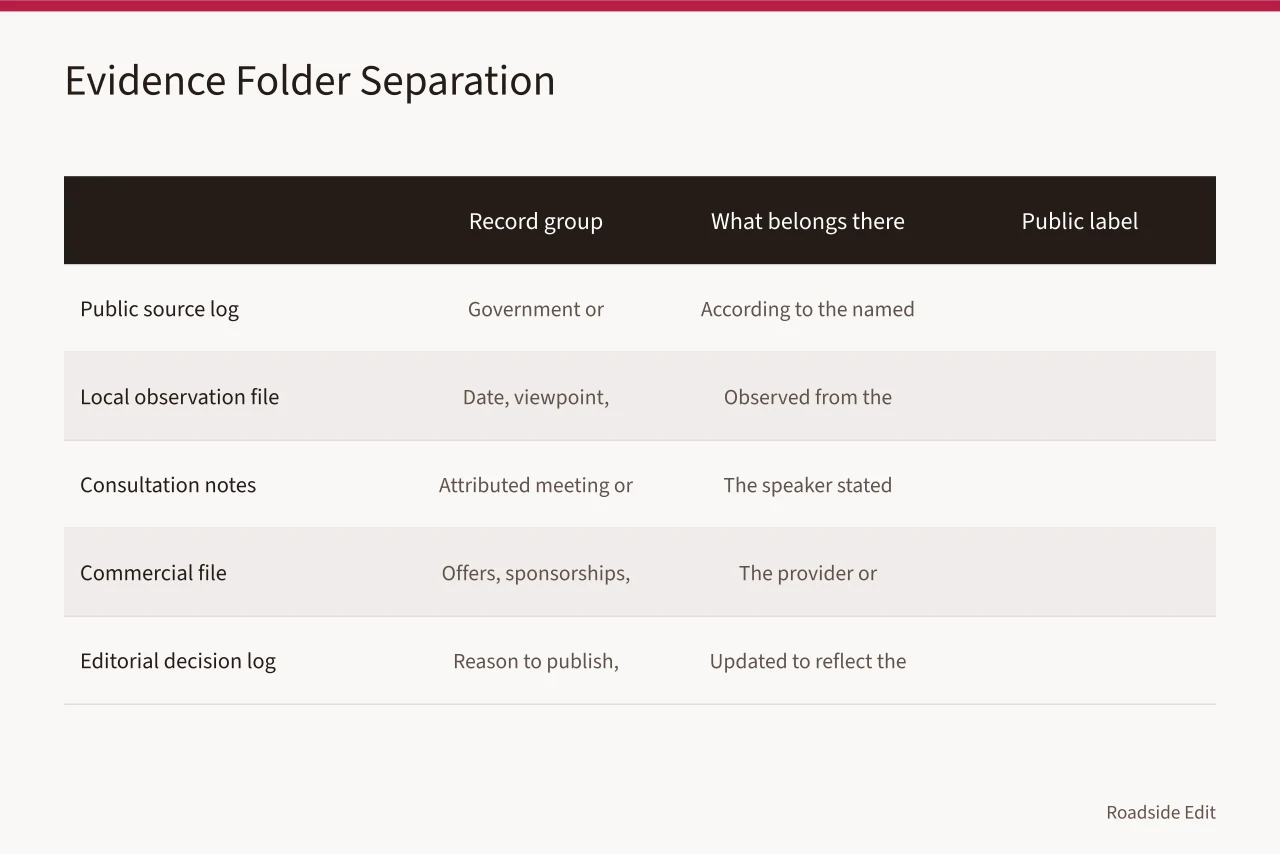
| Record group | What belongs there | Public label |
|---|---|---|
| Public source log | Government, institution, or public-plan material | "According to the named source" |
| Local observation file | Date, lawful viewpoint, image, and limit | "Observed from the stated location" |
| Consultation notes | Attributed public meeting, interview, or comment | "The speaker stated" |
| Commercial file | Provider offers, sponsorships, and paid submissions | "The provider or sponsor states" |
| Editorial decision log | Reason for publishing, correcting, or removing a claim | "Updated to reflect the cited record" |
The National Archives explanation of primary sources calls a primary source firsthand evidence from the period studied. In a roadside file, a contemporaneous meeting record, a dated image, an agency notice or a piece of correspondence sits closer to the event than a later retelling.
Closer is not complete. A primary source can be superseded, partial, or true only of its own place and date. Keep those limits attached instead of promoting the item to universal proof.
An old forecourt photograph supports what was visible on the day it was taken. It does not support a statement about today's canopy, pump islands or dry-stand pipe. A corridor plan explains a broad priority; it does not establish that a particular owner agreed to anything.
Write the geographic boundary into the sentence
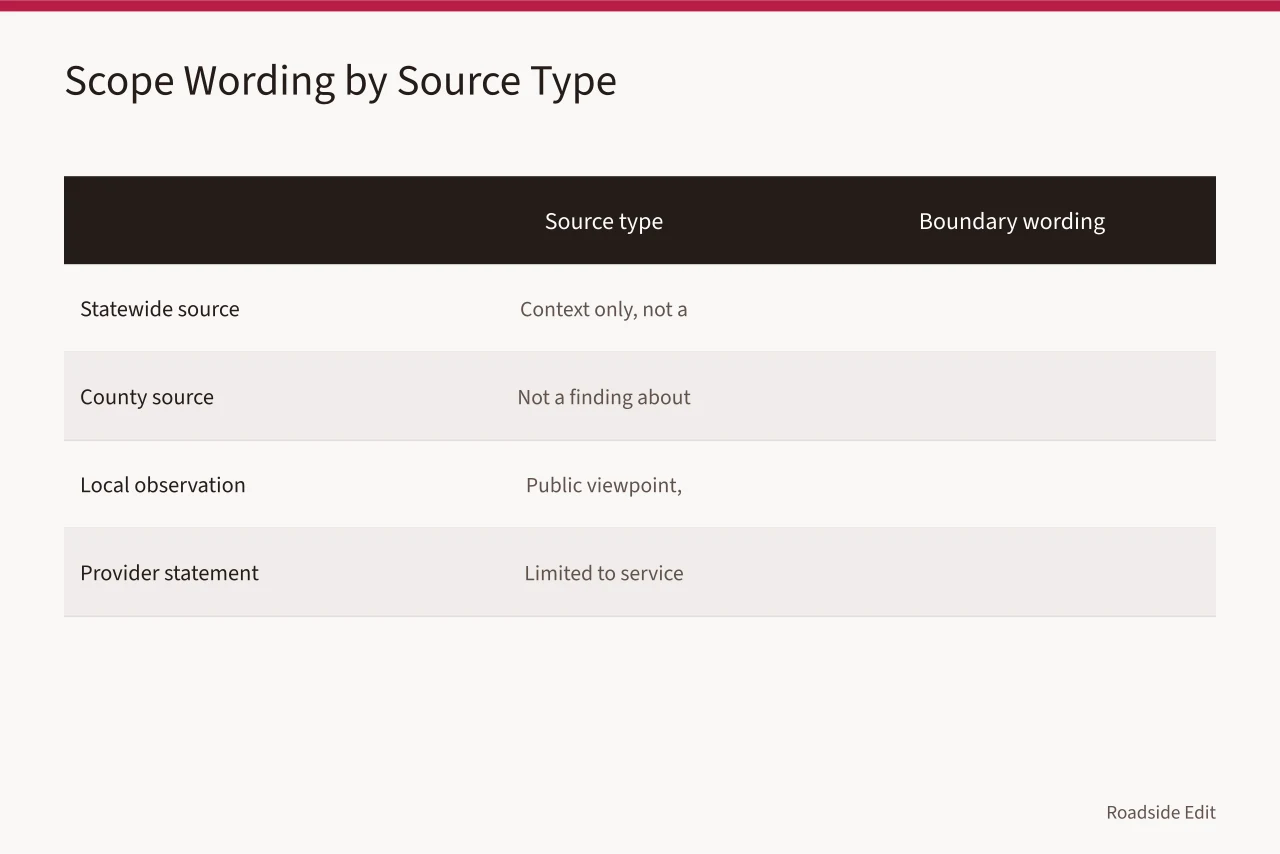
"Regional," "local" and "nearby" hide enormous differences in scope. Put the boundary beside the source, in the article's own words. A county plan does not govern the adjacent city. A state data series does not identify a corridor. A photograph at one motel says nothing about the next one.
The U.S. Climate Resilience Toolkit planning and land-use page treats planning and land-use decisions as places where hazard mitigation and climate vulnerability get folded in. It does not diagnose conditions at a particular site, and it does not decide a local project. That is the model: broad planning context lives in a different lane from property-specific observation.
Wording that does the work:
- "Statewide source, included as context only."
- "County source, not a finding about an individual property."
- "Local observation from a public viewpoint on the stated date."
- "Provider statement limited to the described service area and offer date."
Short, and it stops a reader from handing a source more authority than it holds. A survey day spent mapping a Route 66 corridor by decade and material produces exactly this kind of note, because the material changes at boundaries the plan does not follow.
Schedule the review date
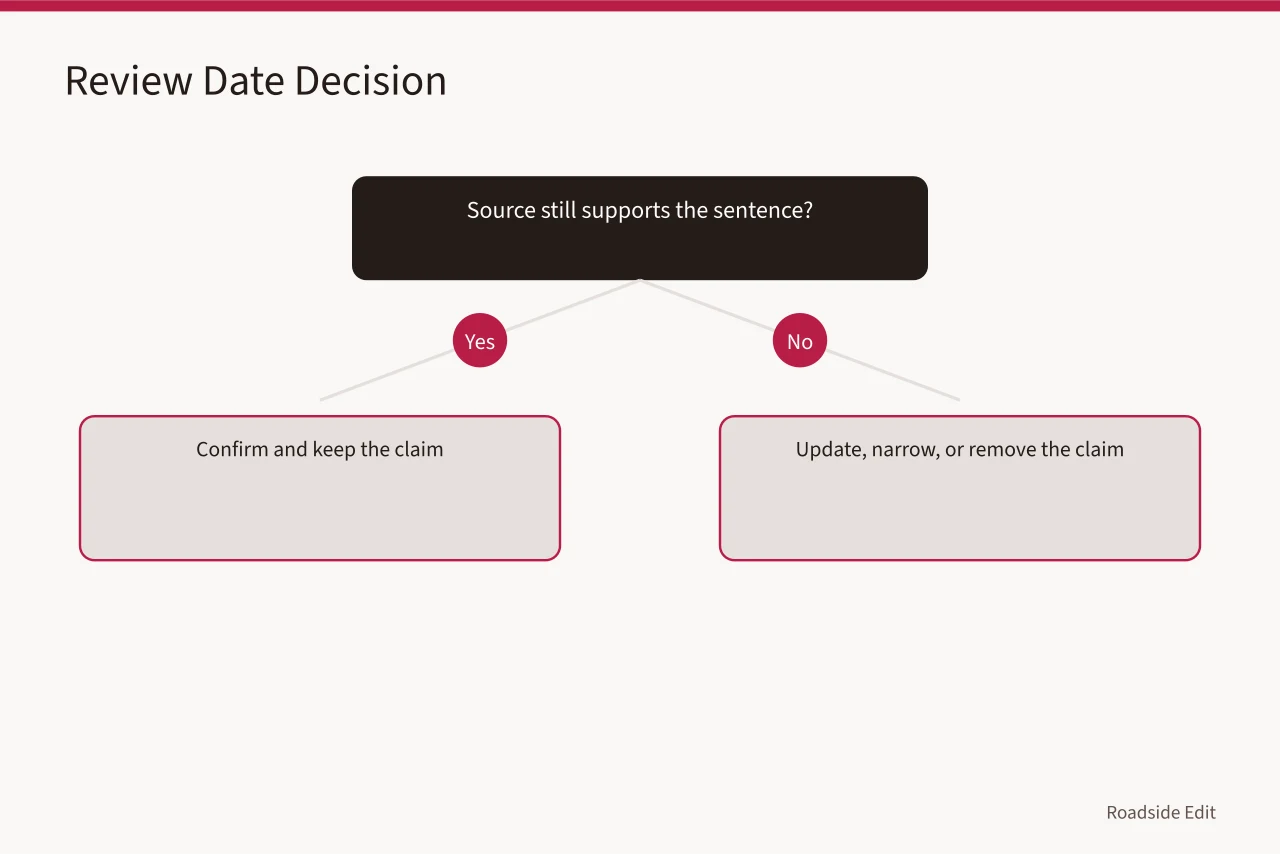
A time-sensitive claim is any sentence about access, an event, a business, or a project. Give each one a review date in the provenance record, and at that date do one of four things: confirm the source still supports the sentence, update it, narrow it, or remove the claim.
| Change event | Record to preserve | Public update approach |
|---|---|---|
| Source page revised | Earlier title, date, and copy of the claim | Check whether the article still matches it |
| Local source updated | Prior and new record dates | Say what changed, if material |
| Image replaced | Prior credit and new source page | Update caption and media ledger |
| Scope narrowed | Earlier broad wording and evidence limit | Correct the article's claim |
| Paid relationship added | Disclosure date and affected statement | Place disclosure near the claim |
The U.S. Fire Administration's guide to community wildfire protection planning walks through identifying stakeholders and assets, writing an action plan, and revisiting it as conditions change. It is about community wildfire planning, not an editorial file. The transferable part is the review point: a document nobody revisits holds stale claims forever.
The goal is not to keep every old sentence. It is to keep the reason the sentence changed. A reader who sees a narrowed claim trusts the rest of the page more, not less.
Keep private and commercial material in their own lanes
Some details help the project team and do not belong on a public page: personal contact information, precise operational notes, private access arrangements, an unverified report about a person or business. Keep them in the project file if authorized and needed. Keep the article on attributable public facts.
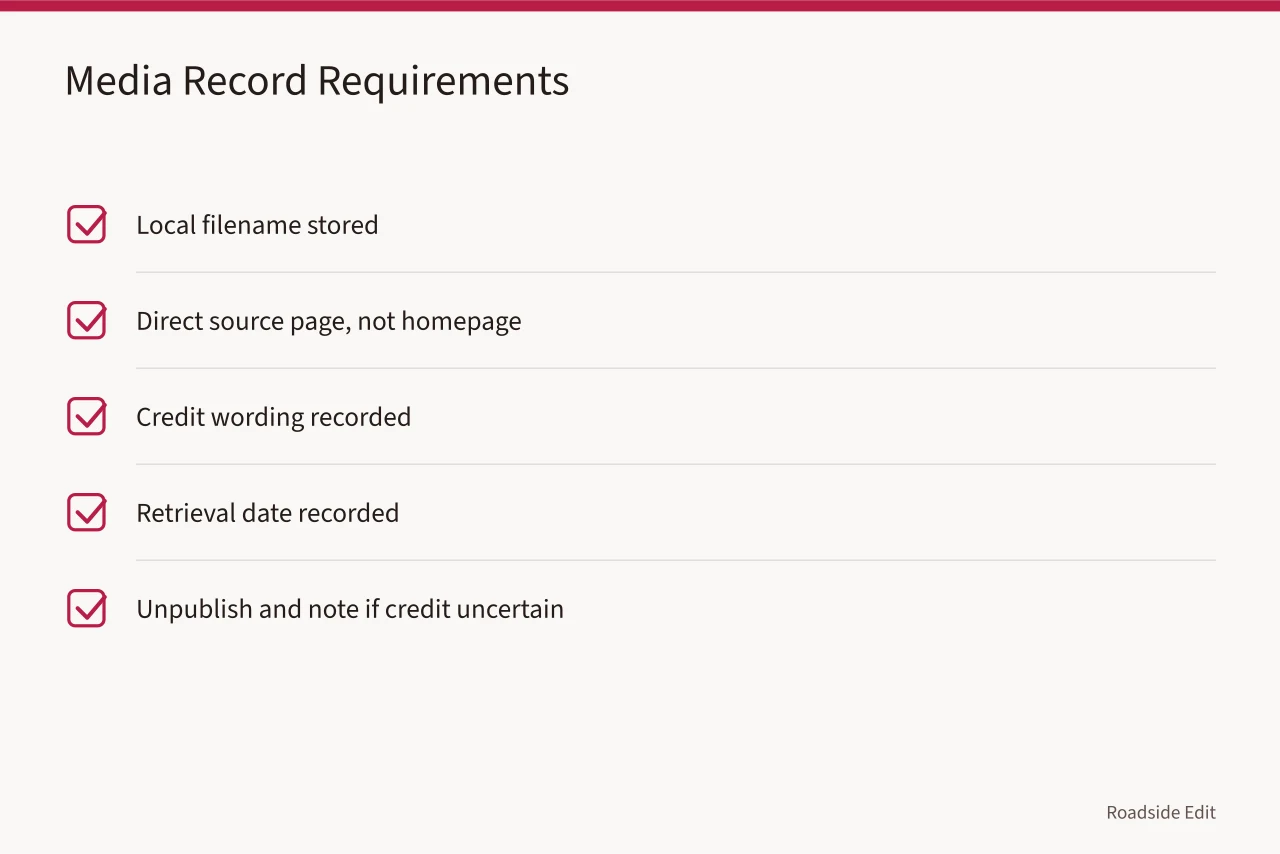
Media needs four things stored together: local filename, direct source page, credit wording, retrieval date. The credit links to the page where the image was found, not a general homepage. If the photographer asks for removal, or the credit becomes uncertain, unpublish the image and note why in the media ledger.
Commercial material gets its own lane too. A sponsor may submit a description of a service. Store it with date, scope, disclosure status and limitations. Never let it supply an unqualified editorial conclusion. That conclusion must not cover price, access, safety or local suitability.
For easements, historic tax credits or cross-border import duties on salvaged neon parts and booths, the studio names the attorney, accountant or customs broker and cites the statute or agency. The record file holds the referral, not a ruling.
Run the pre-publication record check
Before a page goes live, test the claims against the file.
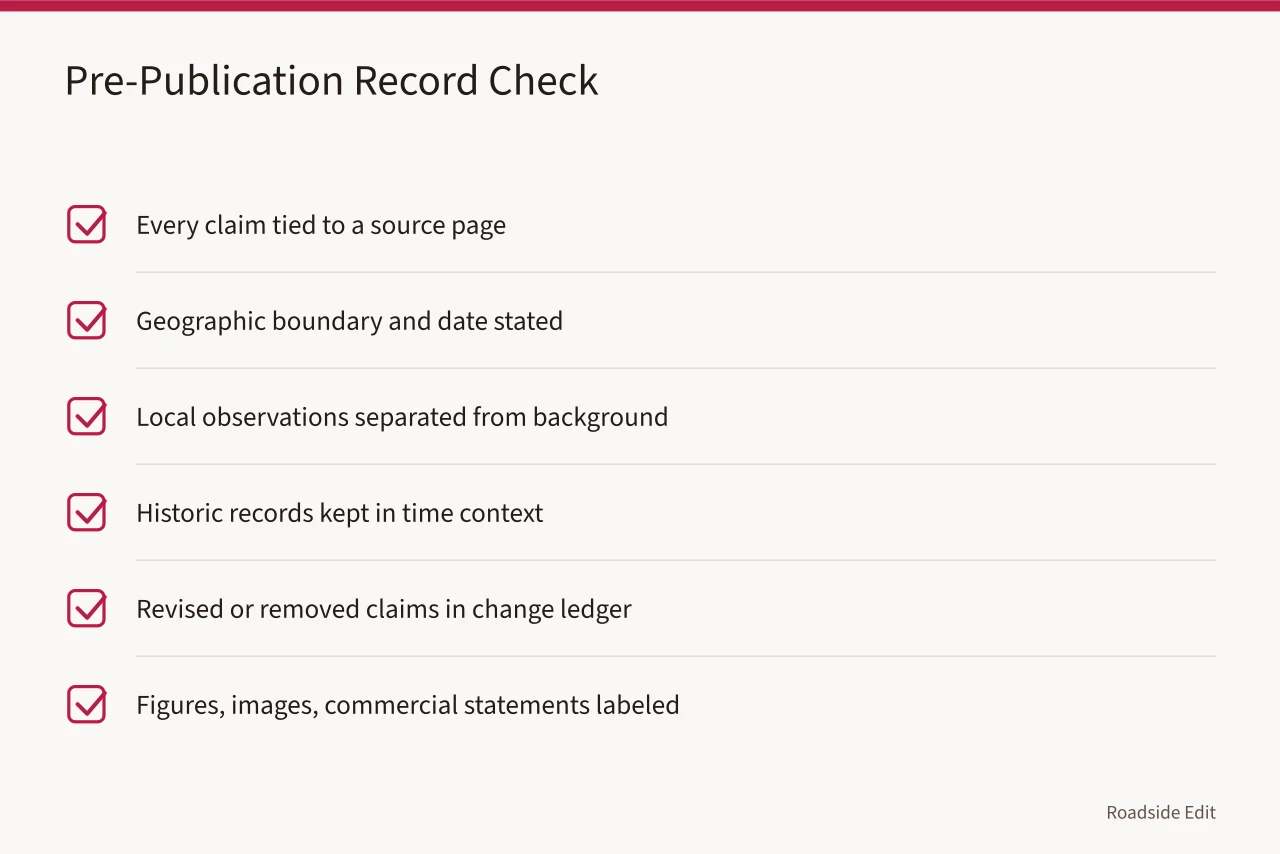
- Can every claim be tied to a specific source page or attributable record?
- Does the record state the source's geographic boundary and date?
- Are local observations separated from regional background?
- Are historic records kept in their original time context?
- Are revised or removed claims written into the change ledger?
- Is every figure, image and commercial statement labeled by its source relationship?
A file another editor can pick up without reconstructing your research is the whole point. Regional content earns authority by showing its limits, not by sounding certain about places nobody surveyed.
Common questions
Should a public plan and a local observation share one source label?
No. Say what each source is. A plan supplies planning context; an observation documents what was visible from a stated viewpoint on a stated date.
What gets saved when an article changes a claim?
The prior claim, the original source details, the reason for the change, the new source, and the date of the update. The change ledger holds all five together.
Can an old photograph support a current site description?
Only for what it visibly documented at the time. A current condition claim needs a current source, or a dated field survey with the surveyor named.