Guides
Roadside design studios: a guide to building a regional adaptation budget
Roadside design studios can build a regional adaptation budget with cost ranges, funding shares, public tools, and steps for 2027 site work.
What to take away
- Set a three-tier budget: regional research, site design, and construction support.
- Use public cost data for ranges, then replace with local bids.
- Label every figure by geography, date, scope, and source.
- Fund work through FHWA ER, FEMA BRIC, or local capital plans.
- Keep unpriced options unpriced until a local scope exists.
Step 1: Build the regional research budget
Regional adaptation starts with data. A roadside studio should budget $5,000 to $15,000 for a regional data review. That covers NOAA Atlas 14 rainfall checks, state DOT plans, and FEMA risk maps.
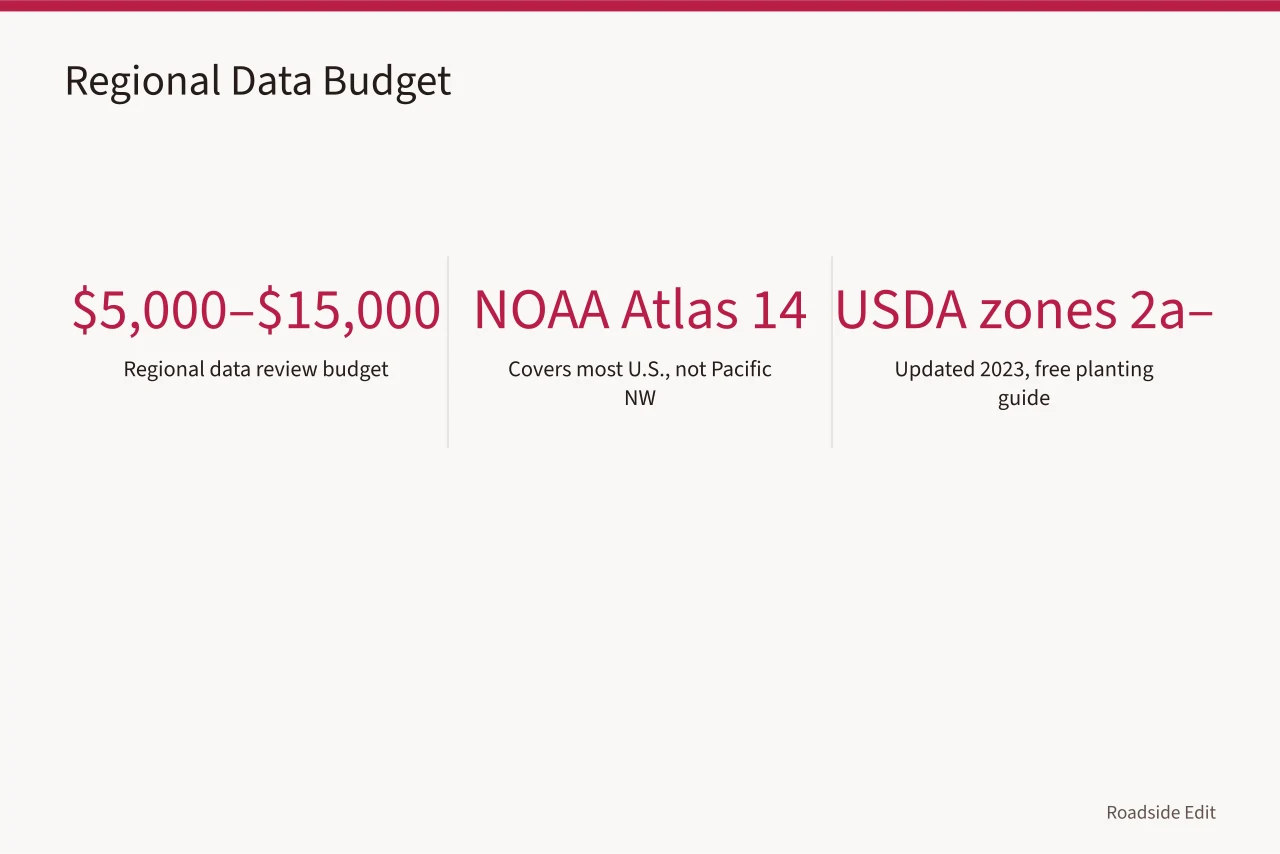
NOAA Atlas 14 provides precipitation frequency estimates for most of the U.S. It does not cover the Pacific Northwest. NOAA Atlas 15 is in development for that gap.
The USDA Plant Hardiness Zone Map was updated in 2023. It covers zones 2a to 13b. It is free and helps choose roadside plantings that fit regional cold and heat limits.
The FEMA hazard-mitigation planning resources collect planning and mitigation materials. They do not price a studio, repair, or project at a roadside property.
Use the U.S. Climate Resilience Toolkit's planning and land-use page to frame hazard and climate questions. It does not identify a repair need or budget for a specific property.
A regional planning source may prompt a studio to ask about access, drainage, heat, or emergency communication. It does not prove a site condition.
Step 2: Price site-level adaptation work
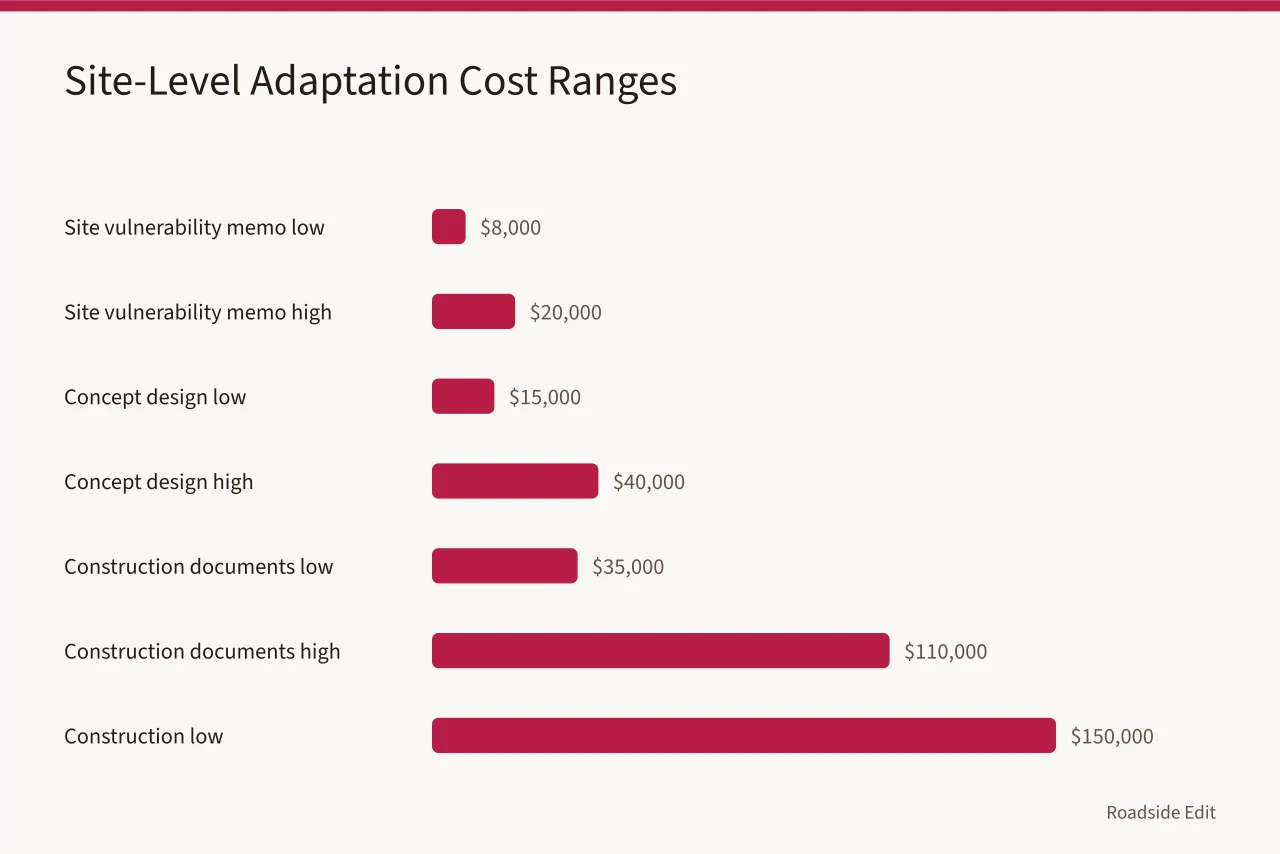
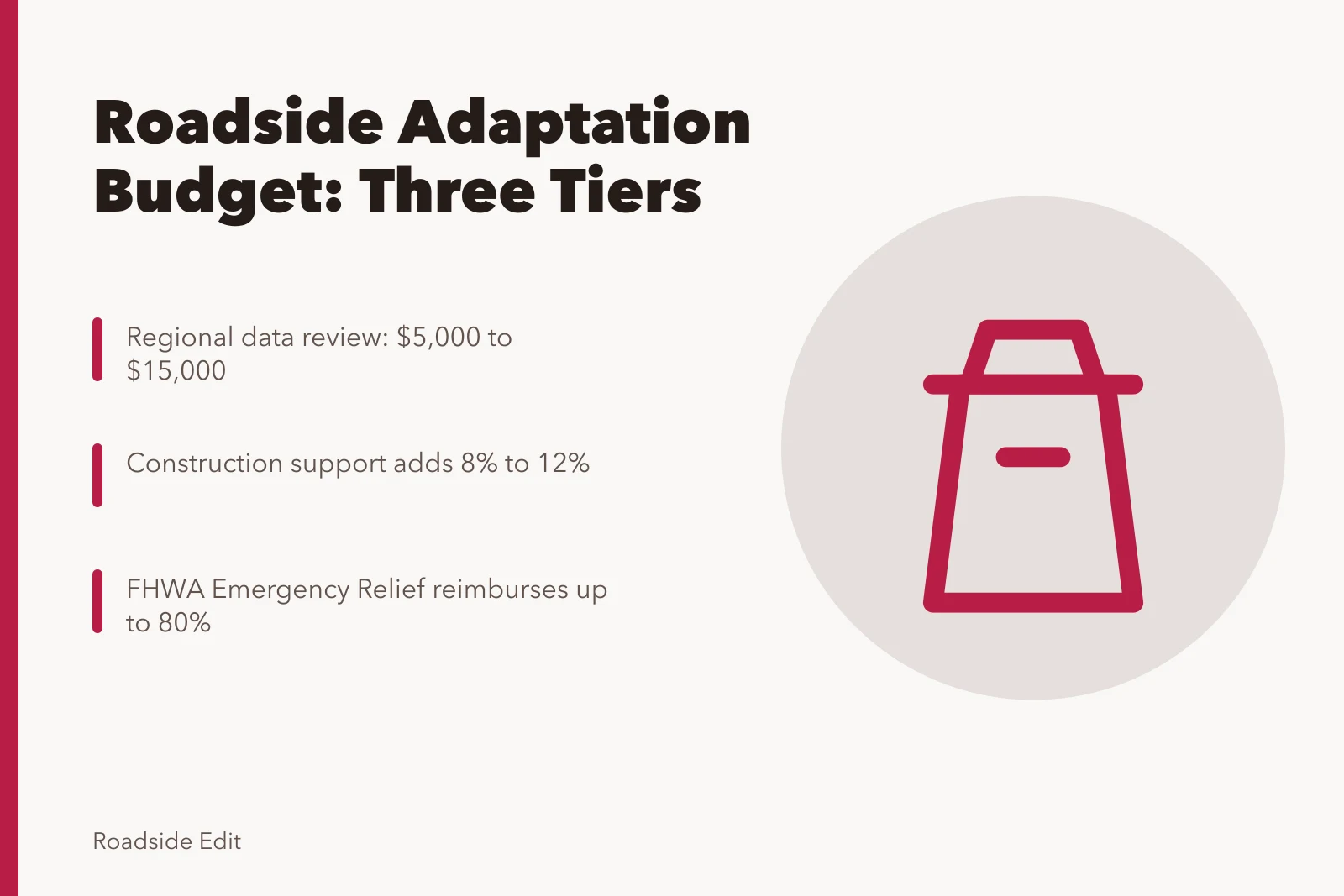
Construction support usually adds 8% to 12% of construction cost. A five-site program can range from $1.2 million to $6.5 million. Design fees often total 12% to 18% of construction.
| Work item | Low | High | Basis |
|---|---|---|---|
| Regional data review | $5,000 | $15,000 | NOAA, state DOT, FEMA maps |
| Site vulnerability memo | $8,000 | $20,000 | Per site |
| Concept design | $15,000 | $40,000 | Per site |
| Construction documents | $35,000 | $110,000 | Per site |
| Construction support | 8% | 12% | Of construction cost |
| Construction | $150,000 | $1,200,000 | Per site |
Use RSMeans by Gordian for early construction ranges. RSMeans is a subscription cost database with city cost indexes for hundreds of U.S. locations. An index above 100 means costs run above the national average.
The GAO Cost Estimating and Assessment Guide describes estimates as needing a purpose, technical basis, assumptions, data, and updates. It is directed at government estimating, not one design studio.
Step 3: Separate local evidence from regional background
The studio record should have two evidence lanes. One lane holds local, attributable material: a property record, a dated proposal, a meeting note, a local fee schedule, or a responsible party's statement. The other holds regional background.
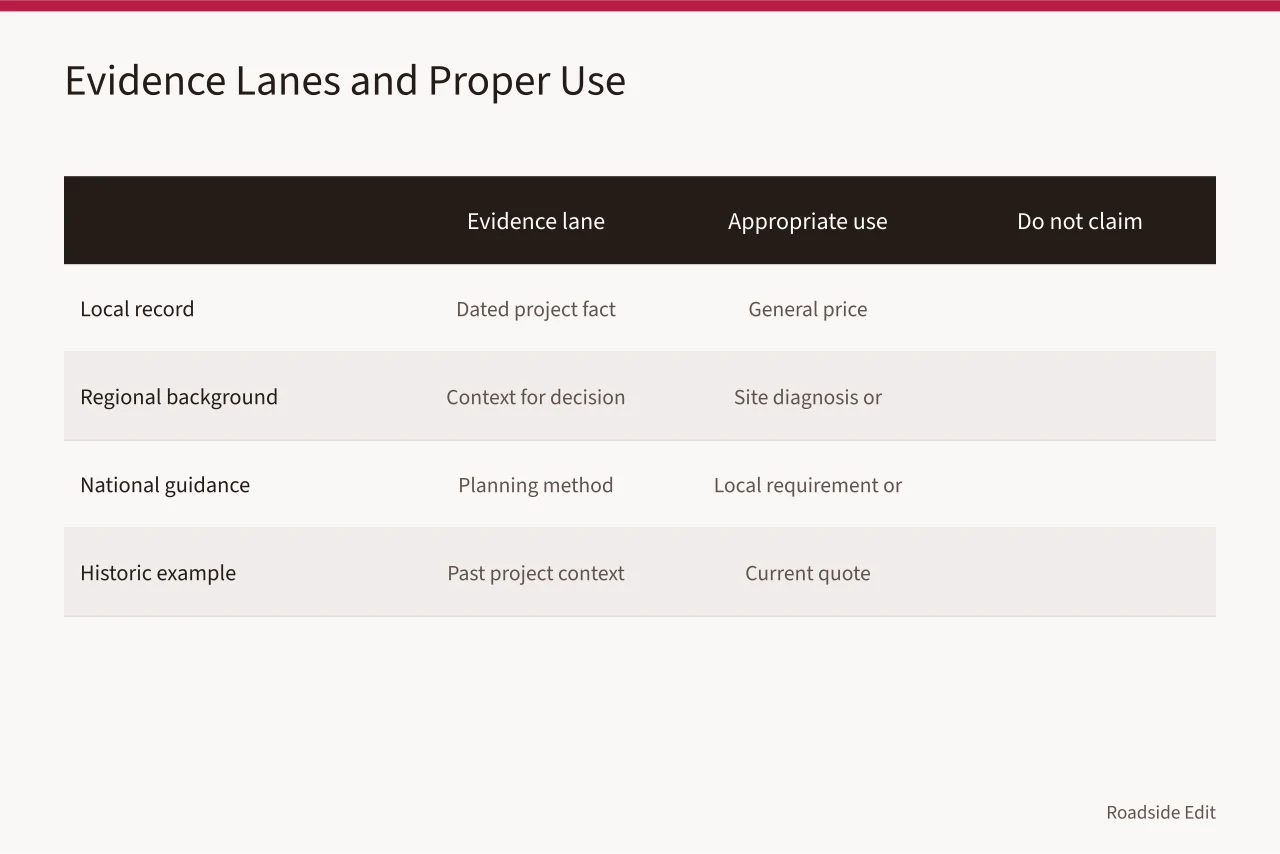
The Bureau of Labor Statistics Occupational Employment and Wage Statistics provides employment and wage estimates by occupation and area. In May 2023, it listed a median annual wage near $47,000 for highway maintenance workers. It is not a construction bid database.
Do not multiply a wage estimate by guessed hours and publish the result as an expected studio or renovation cost. A local provider may have a fixed scope that includes work no wage table measures.
Step 4: Match funding tools to the work
FHWA Emergency Relief reimburses up to 80% of eligible repair costs. It offers quick release up to $100,000 per site for emergency repairs.
FEMA Building Resilient Infrastructure and Communities made $1.8 billion available in FY2023. It typically requires a 75% federal cost share. The FEMA Hazard Mitigation Grant Program also uses a 75% federal share, with up to 100% for small impoverished communities.
The FEMA Benefit-Cost Analysis Toolkit is free. It calculates benefit-cost ratios for hazard mitigation projects. Use it to justify adaptation spending before a grant application.
CDBG-DR funds can support recovery and adaptation. They require a presidentially declared disaster and local action plan.
Step 5: Put season and source age in the record
Regional comparisons often hide timing. A data series may be issued annually. A planning document may stay useful for several years. A proposal can expire sooner.
Use an update note when a source ages out: the regional planning material remains background context, and the local proposal has expired. The article now lists the option as unpriced because the earlier scope changed.
The local source was replaced by a dated record that narrows the stated work. No comparable current record is available for a regional price comparison.
Step 6: Keep commercial claims in their lane
Regional guides can include agencies, suppliers, studios, tour operators, or local businesses. A paid placement may describe services offered in a region. It does not establish that the service fits a given site.
Attribute the source and disclose a financial relationship near a recommendation. Describe a commercial figure as a provider's stated offer, including its scope and date.
Final review for a regional budget guide
Before publication, confirm that readers can tell context from a source that actually prices work.
- Does every figure carry a geography and source date?
- Are local records kept separate from regional and national background?
- Is wage information identified as labor-market context rather than a bid?
- Are unpriced options left unpriced until a local scope exists?
- Are commercial claims attributed and disclosed where relevant?
Regional writing becomes valuable when it teaches readers what information travels well and what must be checked close to the project.
Common questions
Can a regional planning document establish a local renovation cost?
No. It can provide context for planning. A current local scope and source are needed for a defensible price statement.
Should wage data be presented as a contractor rate?
No. Wage estimates are broad labor-market data, not project-specific offers or completed cost records.
What should an article say about an option with no comparable local figure?
State that it is unpriced, identify the evidence needed to define a scope, and avoid a ranking based on regional background alone.