Reviews
Part of How a roadside renovation planning workflow keeps budgets and approvals honest
Roadside renovation planning questions to compare before you commission work
Compare the key roadside renovation planning questions for 2027, from project scope and reuse ideas to access, approvals, budgets, and public claims.
Planning improves when a team asks the right question at the right stage. The following comparison helps separate questions that often get blended together in roadside-renovation conversations.
What to take away
- A condition question is different from a use question.
- A proposed change is different from an approval.
- Accessibility, access, and operations each need their own evidence path.
Compare the questions before commissioning work
| Question | What it is asking | Useful next evidence | Not answered by |
|---|---|---|---|
| What remains at the site? | Current visible or documented conditions | Authorized photos, records, appropriate review | A historic postcard |
| What could the property become? | Reuse scenario | Operating assumptions, constraints | A design preference |
| Can a change proceed? | Applicable review and approvals | Current agency or professional input | A marketing announcement |
| Can people use it safely and accessibly? | Site-specific requirements and design questions | Relevant review and standards application | A general online checklist |
| Can it be funded? | Component-based financial feasibility | Dated estimates and defined scope | A headline project number |
Ask access questions early
Do not treat access as a finishing detail. The ADA Standards include scoping requirements that specify where their accessibility provisions apply. That federal reference does not decide how a particular property must be altered, but it supports treating the applicability question as a distinct early work stream.
An editor should avoid claiming that a building is accessible because it has a ramp, wide door, parking sign, or proposed rendering. Those features may matter, but their adequacy is a project-specific question.
Compare reuse conversations
| Conversation | Good wording | Wording to avoid |
|---|---|---|
| Early concept | "A retail reuse scenario is being considered." | "A store is coming." |
| Stakeholder input | "A meeting discussed possible visitor uses." | "The public approved the plan." |
| Agency record | "A notice dated [date] describes..." | "The project is cleared." |
| Construction | "Work is proposed" or "work is documented as underway" | "Restoration is complete" without support |
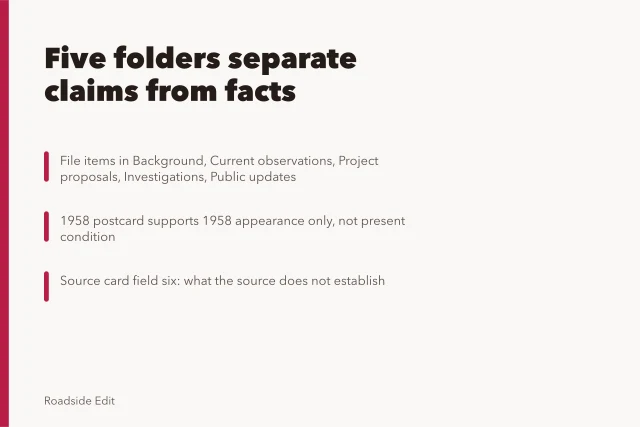
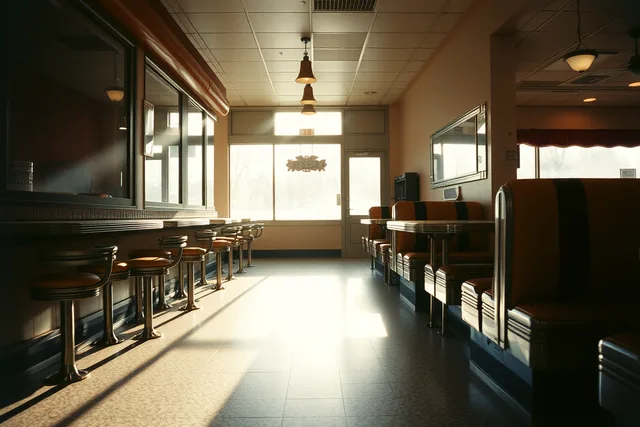
The image is historical context only. It does not establish a property condition, access route, approval, or current use.
Use the comparison in a meeting
Bring the table to a planning session. Put each current claim in one row. If a claim has no source, turn it into a question. If its source addresses a different question, move it to the proper row.
This keeps a project team from treating a preliminary reuse concept as a condition assessment or an accessibility conclusion.
Keep a record of what each source can prove
Project files often mix recent field notes, historic records, sketches, meeting notes, and public announcements. That mix can help, but each item answers a different question. The National Archives records-management overview calls records management a life-cycle responsibility: creating, maintaining, and disposing of records.
For a renovation file, that supports a practical habit. Identify each document by source and date, keep relevant versions, and do not treat a later summary as the underlying record.
This is not a demand for an oversized archive. It is a way to prevent a small claim from drifting as it moves through a project. A dated owner statement may describe intent. A photograph may describe a visible feature. A local notice may describe a review step. None automatically confirms that work is permitted, funded, or complete.
Separate reuse from approval
Reuse questions ask what a place might become. Approval questions ask which reviews or decisions may apply before work happens. They overlap, yet they should not be written as if they are the same.
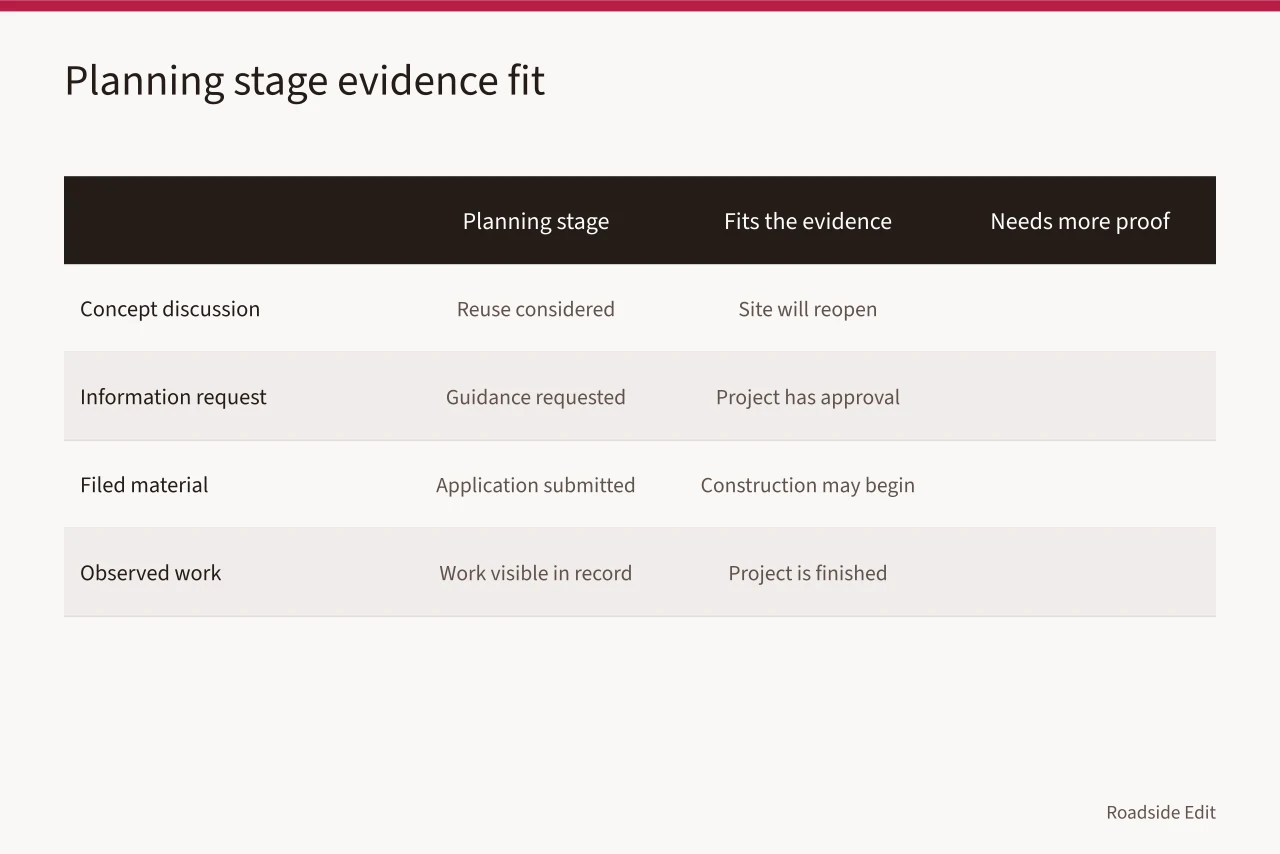
The EPA's reuse assessment guide explains that reuse assessment work considers local context, market conditions, physical attributes, and other information that affects reuse. That supports a planning process that checks assumptions before a concept becomes a public promise. The guide does not select a tenant, a design, or a future use for a particular property.
| Planning stage | Statement that fits the evidence | Statement that needs more proof |
|---|---|---|
| Concept discussion | "A visitor-serving reuse is being considered." | "The site will reopen as a business." |
| Information request | "The team requested agency guidance." | "The project has approval." |
| Filed material | "An application was submitted on [date]." | "Construction may begin now." |
| Observed work | "Work is visible in a dated record." | "The project is finished." |
Ask review questions without predicting the answer
A roadside property may involve local planning, building, transportation, environmental, or historic-preservation questions. The Advisory Council on Historic Preservation's Section 106 introduction explains a federal review process for federal undertakings that may affect historic properties. It is useful for distinguishing a possible review process from a final determination. It does not establish that Section 106 applies to a particular property.
Use the smallest accurate label for the stage in view. "A meeting occurred" is different from "an application was filed." "A notice was issued" is different from "permission was granted." That restraint keeps a published article useful when the project later changes direction.
Keep access questions on their own track
Access work should start before a design is announced as complete. A ramp, a parking sign, a wide opening, or a rendering can matter, but no single feature establishes site-wide accessibility.
The ADA Standards scoping provisions identify where requirements apply within the standards. That supports treating applicability as an early planning question and does not prescribe a site-specific alteration or resolve how a particular existing property should be evaluated.
At a meeting, list the visitor route, the spaces people would use, open items about existing conditions, and the party responsible for the applicable review. Keep that list separate from the reuse concept and cost estimate. It gives the project a clearer record and gives readers a more honest update.
Common questions
Is a permit question the same as a design question?
No. A design concept can exist before approvals are determined. Identify each stage and its evidence separately.
Can one source answer every planning question?
Usually not. A property record, an agency page, an owner statement, and a qualified review serve different purposes.
Should an article list every possible rule?
No. State the question and source boundary. Project-specific requirements should be reviewed by the responsible parties.