Costs
Part of How a roadside renovation planning workflow keeps budgets and approvals honest
Roadside renovation planning: how to build a budget you can defend
Roadside renovation budget planning in 2027 starts with a clear scope, dated assumptions, a cost baseline, and honest treatment of funding limits.
A roadside-renovation budget is useful only when it tells readers what is included, what remains unknown, and when the figure was prepared. A single total can create false confidence. It may combine a limited planning assignment with construction work, omit professional services, or treat a grant award as money available for every remaining need.
This guide is a recordkeeping method for editorial planning. It is not a contractor estimate, a funding commitment, or a substitute for site investigation. Use it to describe a figure without pretending it answers questions that its source never addressed.
What to take away
- Split the project into work that can be described and work that is still unknown.
- Keep a dated source note beside each public number.
- Separate a funding award from the full cost of a proposed project.
- Update the article when scope, assumptions, or funding status changes.
Start with a defined decision
Before entering a dollar amount, state the decision the amount is meant to support. It might cover a records review, an existing-condition survey, temporary weather protection, a design package, a permit application, or a construction bid. Those are different tasks with different evidence behind them.
The GAO cost-estimating guide describes a cost estimate as a process with purpose, scope, schedule, technical baseline, and assumptions. It covers data, methods, and updates. It addresses government programs, not an individual roadside property.
The editorial lesson is narrower: a number deserves a stated basis. A public article should not turn an early planning figure into a final construction cost claim.
Write a one-sentence budget purpose before building the table. For example: "This figure covers the research and design work needed to compare reuse options." That sentence limits accidental overstatement. It also helps an editor notice if a later paragraph starts calling the same figure a renovation budget.
Build a cost map before a total
Readers can understand a preliminary budget when components are visible. A cost map is not a promise that every item will occur. It is a way to show where the estimate stops.
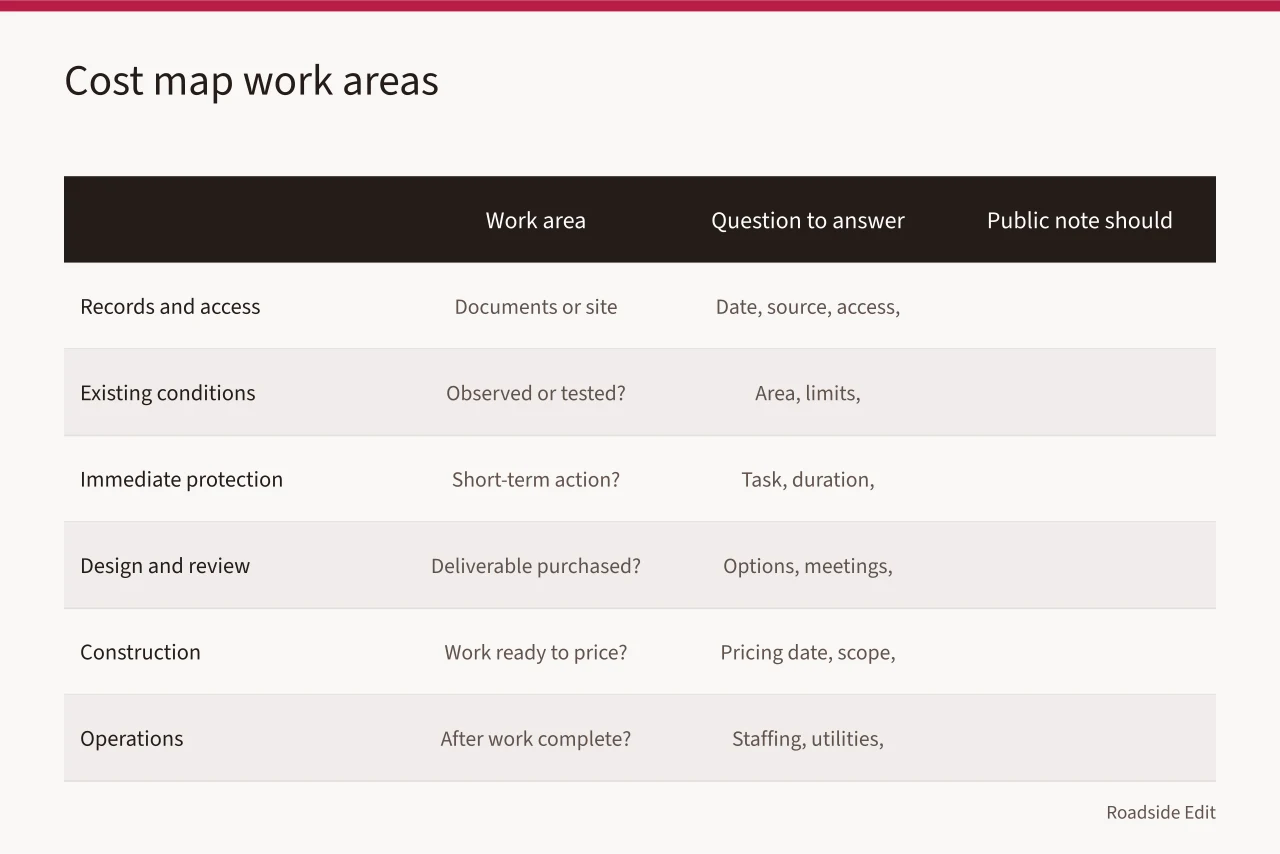
| Work area | Question to answer | What the public note should say |
|---|---|---|
| Records and access | What documents or site access are needed? | Date, source, assumed access, missing records |
| Existing conditions | What must be observed or tested? | Area examined, limits, and responsible party |
| Immediate protection | What needs short-term action? | Defined task, duration, and exclusions |
| Design and review | What deliverable is being purchased? | Number of options, meetings, and revision boundary |
| Construction | What work is far enough along to price? | Pricing date, scope basis, and contingency treatment |
| Operations | What happens after the work is complete? | Staffing, utilities, maintenance, and opening date assumptions |
EPA's resource coordination guide recommends identifying project components and phases when matching resources to a community project. It does not provide a rate card for roadside renovation. The source supports breaking work into defined pieces, not borrowing another place's budget as a local price.
This distinction matters in editorial work. A project may have money for planning while protection, design, construction, and operations remain unfunded. A headline that says "$250,000 renovation" could therefore be misleading if the source records only a grant for a limited eligible activity. State the amount, the named activity, and what the source does not establish.
Record assumptions where readers can find them
An estimate has conditions even when the source does not list them neatly. If the underlying record does not address tax, site access, lead time, permits, utility work, professional services, or contingency, write "not stated in the source" instead of guessing.
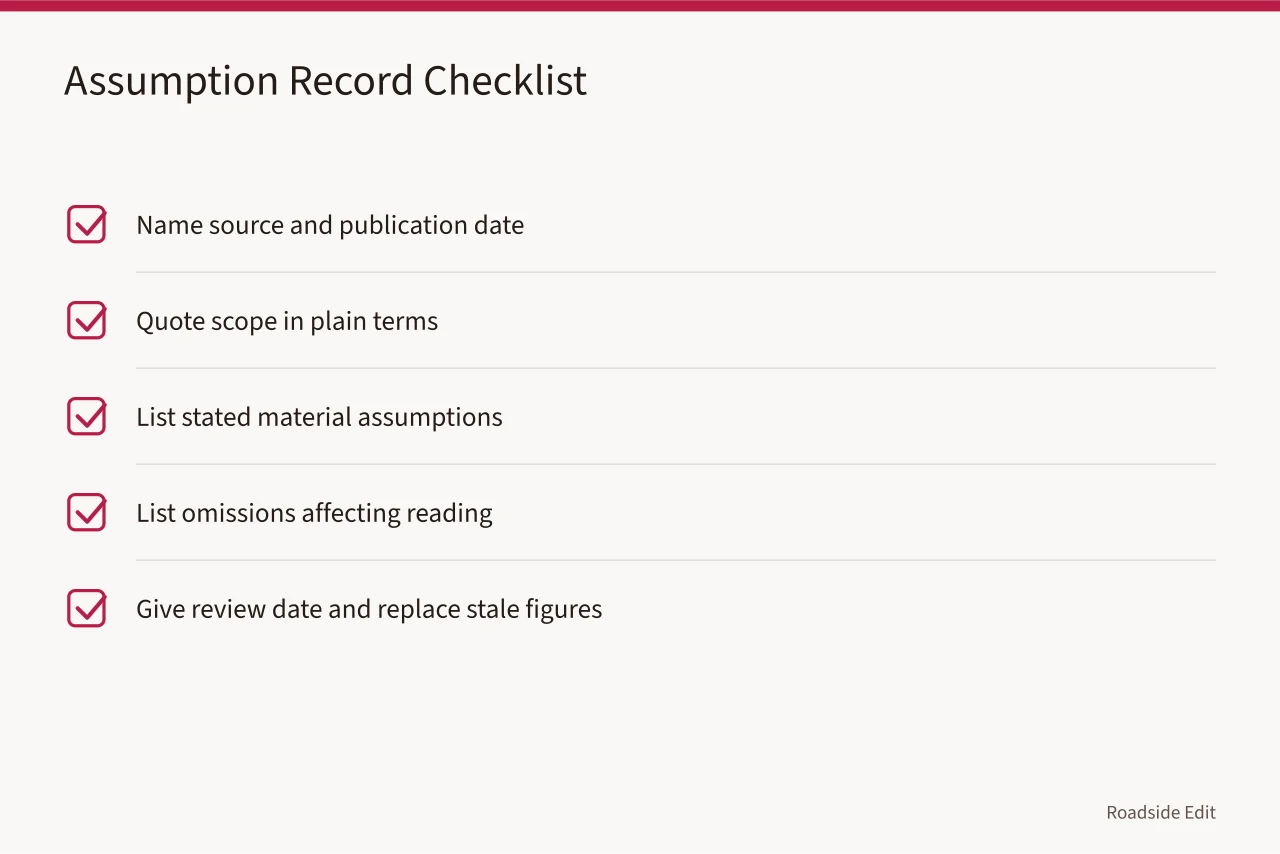
Keep the working record simple:
- Name the source and its publication or issue date.
- Quote the scope in plain terms without broadening it.
- List material assumptions that the source states.
- List the omissions that affect how the number should be read.
- Give the article a review date and replace stale figures rather than silently carrying them forward.
Records can also explain why a budget remains preliminary. The National Archives records-management resources group material around inventory, scheduling, appraisal, oversight, and records guidance.
A property owner is not a federal agency just because an article cites that page. Still, the source reinforces a useful discipline for any project file: preserve records so a later reader can distinguish a source document from an editorial summary.
For a roadside place, the file may contain photographs, correspondence, permits, assessment reports, invoices, funding notices, contractor proposals, and meeting notes. Each item answers a different question. Do not treat an undated photograph as evidence of current physical condition or treat an old proposal as a current offer.
Treat funding language with care
Funding terms are easy to compress badly. "Awarded," "committed," "available," and "spent" have different meanings. An award can be limited to a named activity, may have conditions, and does not show that all other costs have been covered. A proposal can show a requested amount rather than an approved one.
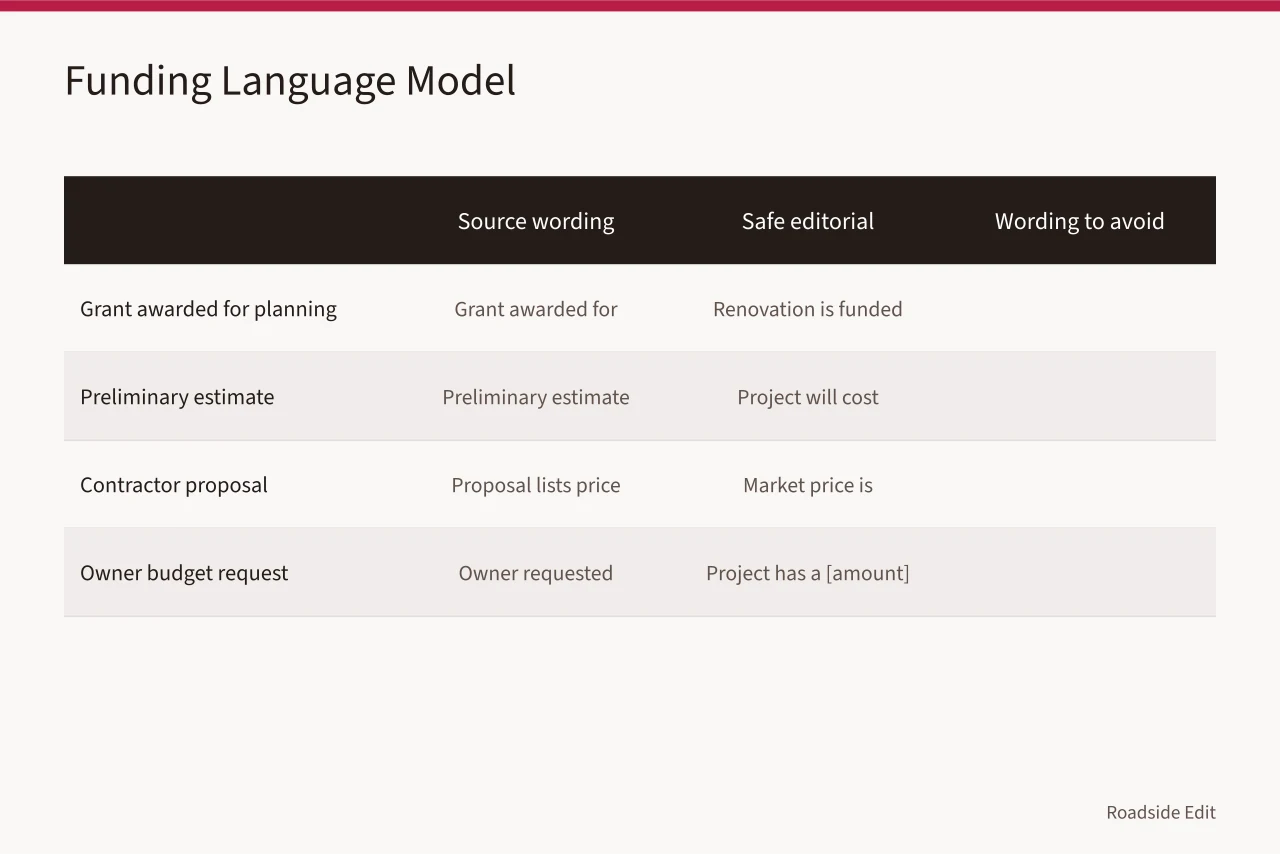
Use this wording model when the source allows it:
| Source wording | Safe editorial wording | Wording to avoid |
|---|---|---|
| Grant awarded for planning | "A grant was awarded for the stated planning activity." | "The renovation is funded." |
| Preliminary estimate | "A preliminary estimate dated [month and year] covers the stated scope." | "The project will cost [amount]." |
| Contractor proposal | "A proposal lists a price for the described work." | "The market price is [amount]." |
| Owner budget request | "The owner requested [amount] for the stated purpose." | "The project has a [amount] budget." |
Label any paid placement, sponsored assessment, donated service, or review of a company tied financially to the publisher. Make the relationship clear.
The FTC guidance on endorsements says an unexpected endorser-marketer connection should be disclosed clearly and conspicuously when it could affect how people judge the endorsement.
A disclosed sponsor is still a source with a point of view. Attribute its price or claim to that sponsor.
Check the article before publication
A budget note is ready to publish when it answers four basic reader questions: What does the figure cover? When was it prepared? Who supplied it? What does it leave unresolved?
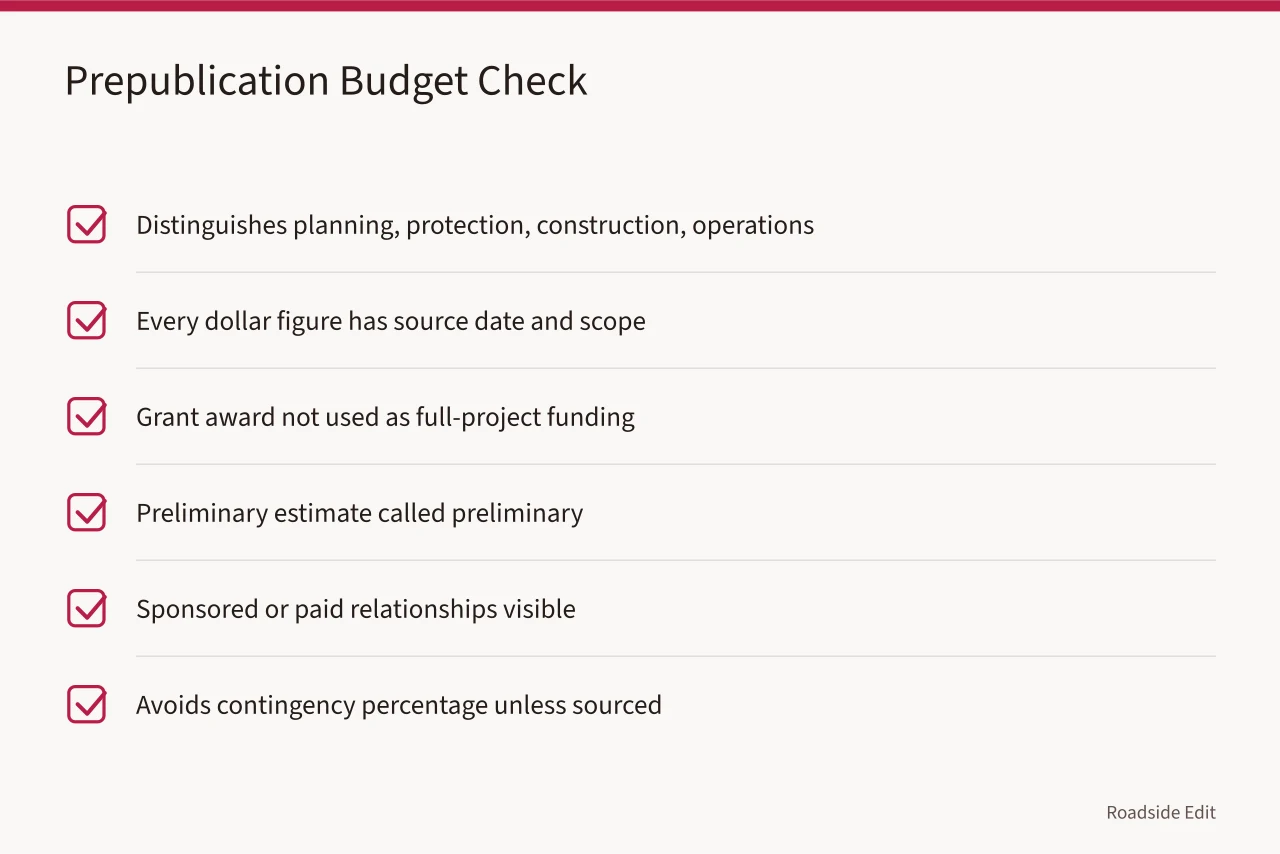
Use this short prepublication check:
- The article distinguishes planning, protection, construction, and operations.
- Every dollar figure has a source date and stated scope.
- The article does not use a grant award as proof of full-project funding.
- A preliminary estimate is called preliminary.
- Sponsored or paid relationships are visible where they affect a recommendation or review.
- The article avoids a percentage for contingency unless the source gives one.
The final copy should leave room for uncertainty where uncertainty is real. That is more useful than a smooth total with no evidence behind it.
Common questions
Is a grant award the full project budget?
No. A grant may support only a named eligible activity. Describe that activity and say whether the source identifies funding for other work.
Should a planning article publish a contractor proposal?
It can report the proposal if the source is attributable and the article states the scope, date, and status. It should not present the proposal as a universal price.
What if the estimate has no contingency line?
Say that the source does not state how contingency was treated. Do not add a percentage from a different project.
When should a budget note be updated?
Update it when the source date, defined scope, funding status, or estimate basis materially changes.