Guides
Roadside design studios: maintenance plan comparison questions to ask first
Compare preventive, condition-based, reactive, deferred, and CMMS-backed maintenance plans for roadside design studios with questions that name real options.
The plan you pick decides what gets recorded, and what gets recorded decides what survives. Compare plan types before you compare price.
What to take away
- Name the plan type first: preventive, condition-based, predictive, reactive, or deferred.
- Ask which standard, software, or provider holds the maintenance record, and who owns the export.
- Ask what triggers work, who approves an exception, and what closes the loop.
- A vendor demo and a public standard are starting points, not findings about your property.
- Every question outside the studio's authority needs a named recipient and a review date.
Which plan types are on the table?
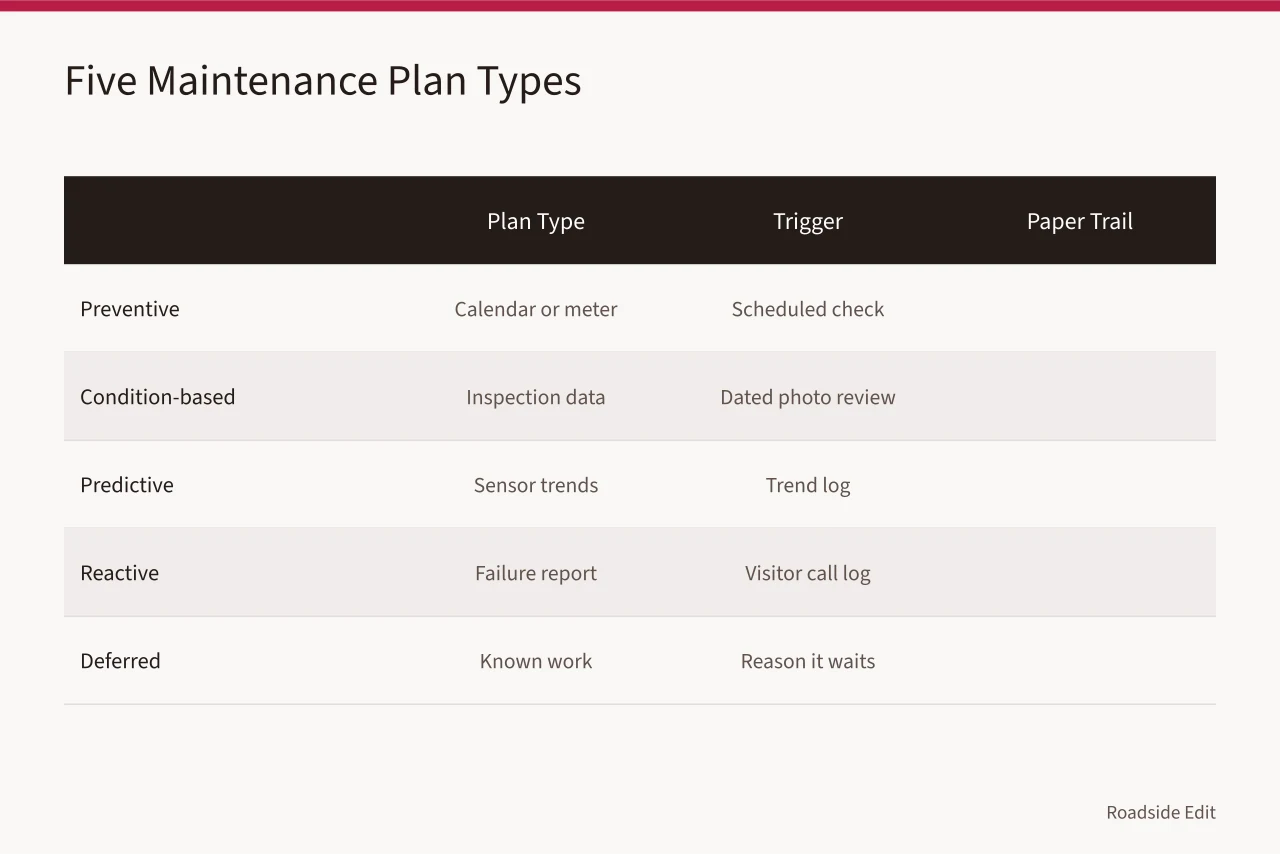
Each one leaves a different paper trail. A preventive plan might schedule a dry-stand pipe check every spring. A condition-based plan might trigger a canopy soffit repair after a dated photo review. A reactive plan logs a call from a visitor. A deferred plan records the work and the reason it waits.
The National Park Service treats condition assessments, treatment plans, baseline documentation, and preventive maintenance as related but separate products. Review the NPS historic architecture overview. None of them is a finding about your building.
Which named tools run the plan?
Compare at least five real systems before committing. UpKeep is a mobile-first CMMS with a free starter tier and paid work-order, asset, and parts modules. MaintainX handles work orders, procedure checklists, and field messaging.
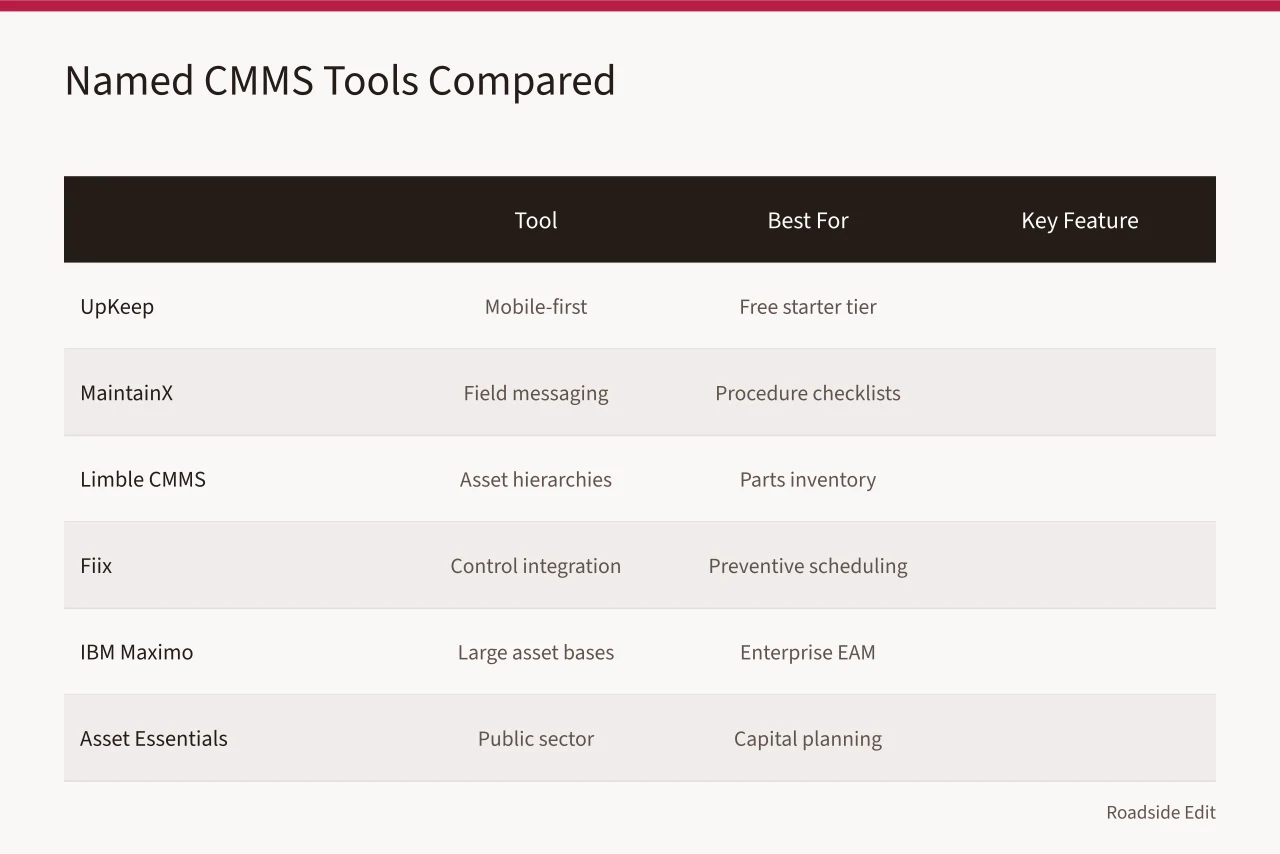
Limble CMMS offers customizable asset hierarchies, preventive schedules, and parts inventory. Fiix by Rockwell Automation schedules preventive work and integrates with control systems.
IBM Maximo is enterprise asset management, used by transportation and utility organizations with large asset bases.
Asset Essentials by Brightly serves public-sector facilities teams with work orders and capital planning. A two-person studio documenting a single 1950s canopy may need nothing more than a spreadsheet and a naming convention. A state historic site with a neon collection needs asset hierarchies and parts tracking.
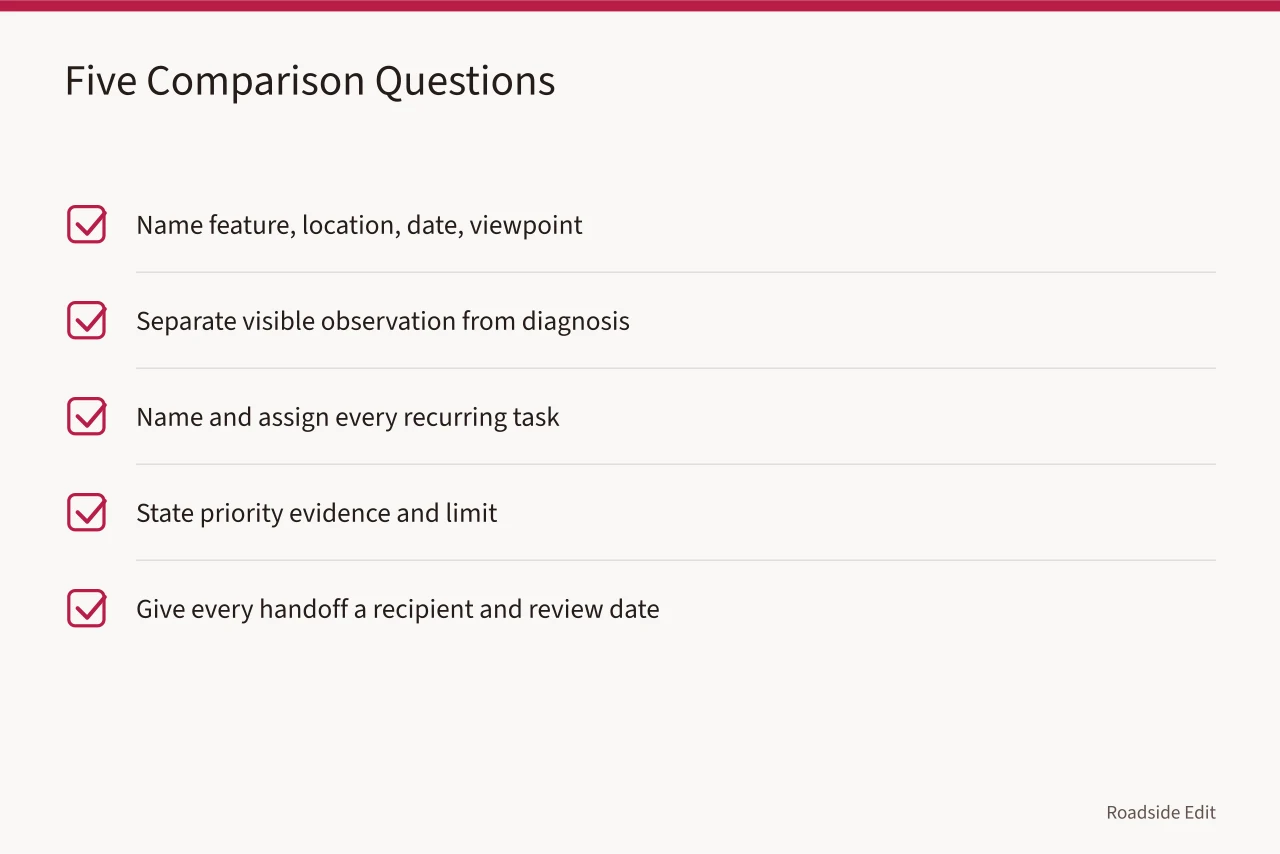
Ask each provider four things. Does it accept photo attachments with dated notes? Can it keep a visible observation separate from a diagnosis? Does it log a handoff to another authority? Can you export a baseline record without overwriting the first image?
What do the public standards actually cover?
Preservation Brief 47 explains that regular inspection and maintenance keep small exterior problems from becoming large repairs. Read Preservation Brief 47 on maintaining historic building exteriors. It is guidance, not a condition finding for your property.
OSHA advises employers to identify and assess hazards through inspections and other information. See OSHA's hazard-identification guidance. A studio observation is not a hazard assessment. The guidance supports routing a possible hazard to the licensed engineer or electrician who owns that call.
The National Archives defines records management as the creation, maintenance, use, and disposition of records. See the National Archives records-management overview. It does not prescribe a private maintenance file, but it supports keeping the original report, the handoff, and the outcome connected.
What comparison criteria come first?
Then add cost model, training, and data ownership. CMMS products commonly price per user per month or per asset, and some price by module. Public standards are free to read and are not a subscription. Ask who owns exported records if you change vendors.
| Ask this | What it prevents |
|---|---|
| What exact task is proposed? | A vague instruction such as "maintain exterior" |
| What triggers the task? | A calendar that ignores context |
| What record will be saved? | An action that cannot be traced later |
| What stops the task? | Work that exceeds its authority |
| Who reviews an exception? | An unowned unresolved issue |
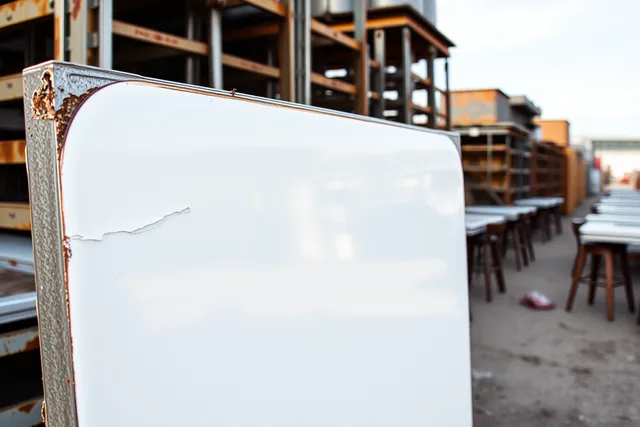
Name the task before assigning it. Cleaning a porcelain-enamel sign face, clearing a forecourt drain, recording vegetation against a curtain wall, and updating a photo log are four different jobs with four different skills. Referring a question to the State Historic Preservation Office is a fifth. Do not fold them into one line item.
A design studio can hold the comparison and the baseline file. It cannot replace the owner, the maintenance lead, or a qualified reviewer.
What should be handed off?
Open a handoff entry for every question that belongs to another authority. Record the observed fact, its date, and its source. Name the recipient, the question sent, and the next review date. Leave out any invented diagnosis or recommended repair. If no reply has arrived, write that the outcome is unrecorded.
A public care update states the date, the source, the known observation, and the next documented action. If the item is only a report, call it a report. If the property team has not supplied a result, do not announce one.
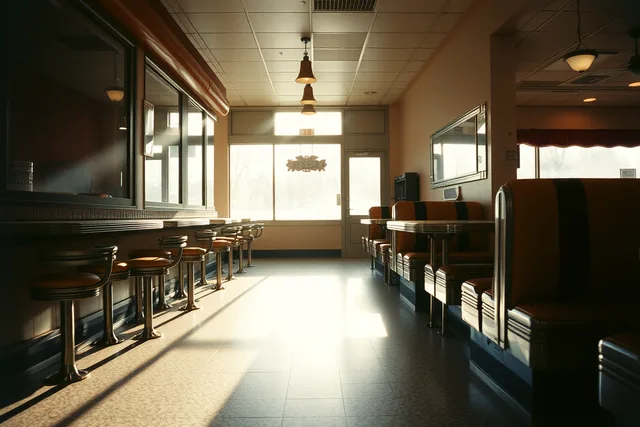
The photograph shows Amboy in 2012. It says nothing about the current condition, care need, or approval status of any other property.
A plan-comparison checklist
- Is the plan type named: preventive, condition-based, predictive, reactive, or deferred?
- Does the plan identify a standard, software, or provider owner?
- Does the record separate a visible observation from a diagnosis?
- Is each recurring task named and assigned?
- Does a priority note name its evidence and its limit?
- Does every question outside the studio's authority have a handoff recipient?
Common questions
What if an observation conflicts with an old record?
Keep both dates, state the conflict plainly, and name the evidence that would settle it. A 1998 survey photo and a 2026 field photo can both be correct about different years.
Can an editor assign a maintenance priority?
An editor can describe a documented priority framework and apply it to a record. The priority decision belongs to the responsible party named in the plan, not to the person writing it up.
Do photographs remove the need for notes?
No. A short note identifies the feature, the viewpoint, the date, and the visible change a reader should understand. A photo without that note is an image of an unknown wall on an unknown day.