Guides
How roadside design studios should keep owner maintenance records
Roadside studio care records for 2027 explain what to save from observations, recurring work, images, decisions, and provider communications for later review.
Care records turn scattered observations into a useful history. They make it possible to see what changed, what work occurred, and where uncertainty remains. A simple folder structure is enough when it preserves dates, context, and the difference between evidence, actions, and decisions.
What to take away
- Save the baseline, observation log, work record, and decision notes in a connected set.
- Retain earlier versions instead of overwriting them.
- Keep commercial offers separate from project evidence and public conclusions.
- Record deferred work and unanswered questions as clearly as completed tasks.
What makes a care record useful later?
A useful record answers four questions: What is this item? When was it created? What does it show or report? What does it not establish? The record does not need to be long. It needs enough context for someone who was not present to understand its role in the care history.
For example, a baseline photograph should identify the date, feature, viewpoint, and visible condition. A work entry should identify the task, source or person who reported completion, date, and any stated limit. A decision note should identify the decision owner, evidence considered, and next review point.
Do not let a photograph, invoice, or provider email carry a conclusion the record does not state.
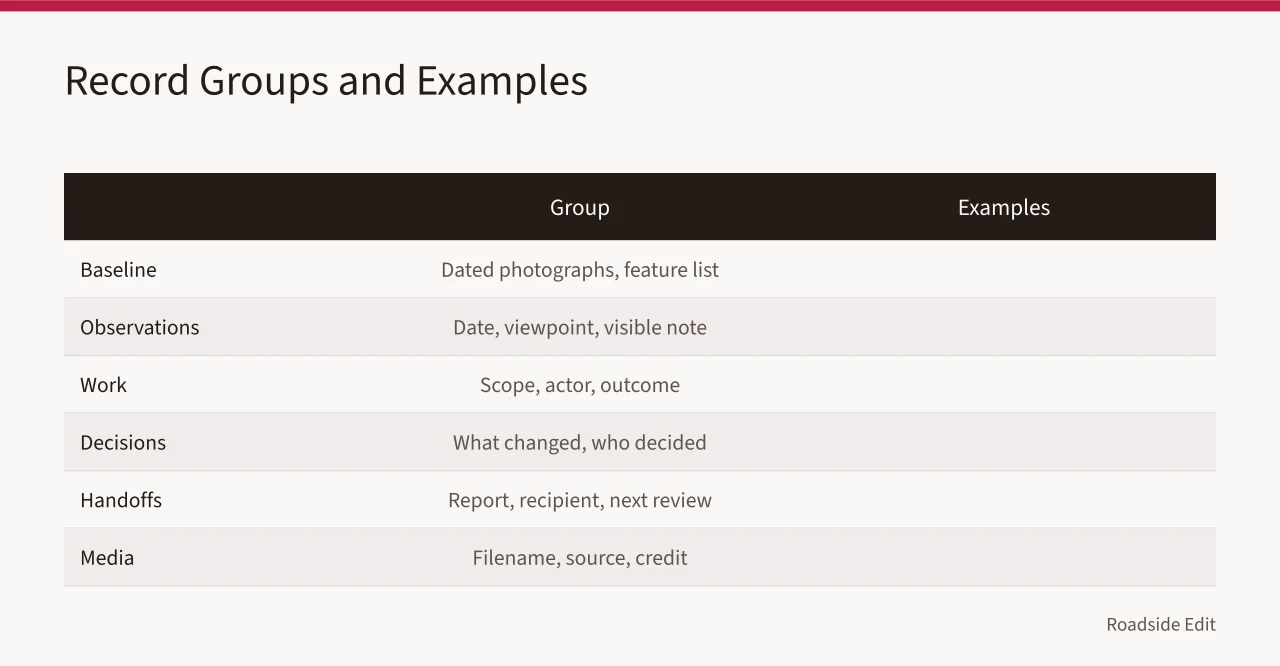
What record groups should the studio maintain?
| Group | Examples |
|---|---|
| Baseline | Dated photographs, feature list, existing records |
| Observations | Date, viewpoint, visible note, access limit |
| Work | Scope, actor, materials or method when known, outcome |
| Decisions | What changed, who decided, stated basis, next step |
| Handoffs | Report, recipient, question, source needed, next review |
| Media | Local filename, source page, credit, and retrieval date |
The National Archives advises agencies to maintain recordkeeping systems that capture and preserve records with their context. Read NARA's recordkeeping requirements guide. This federal guidance is not a retention schedule for a private property. Its useful principle is context: keep related material traceable so later users can understand the project history.
Use a short record ID in every group. The same ID can connect an observed feature, a work entry, a decision, and a public update. This is not an internal link between articles. It is a way to keep the project file from turning into disconnected notes.
How should the baseline and observation log work?
The baseline is the first dated reference point. It might include an existing record, an authorized observation, and photographs from known viewpoints. Label any access limit. A view from a public area can document what is visible from there. It cannot confirm unseen material, a structural result, or a complete condition assessment.
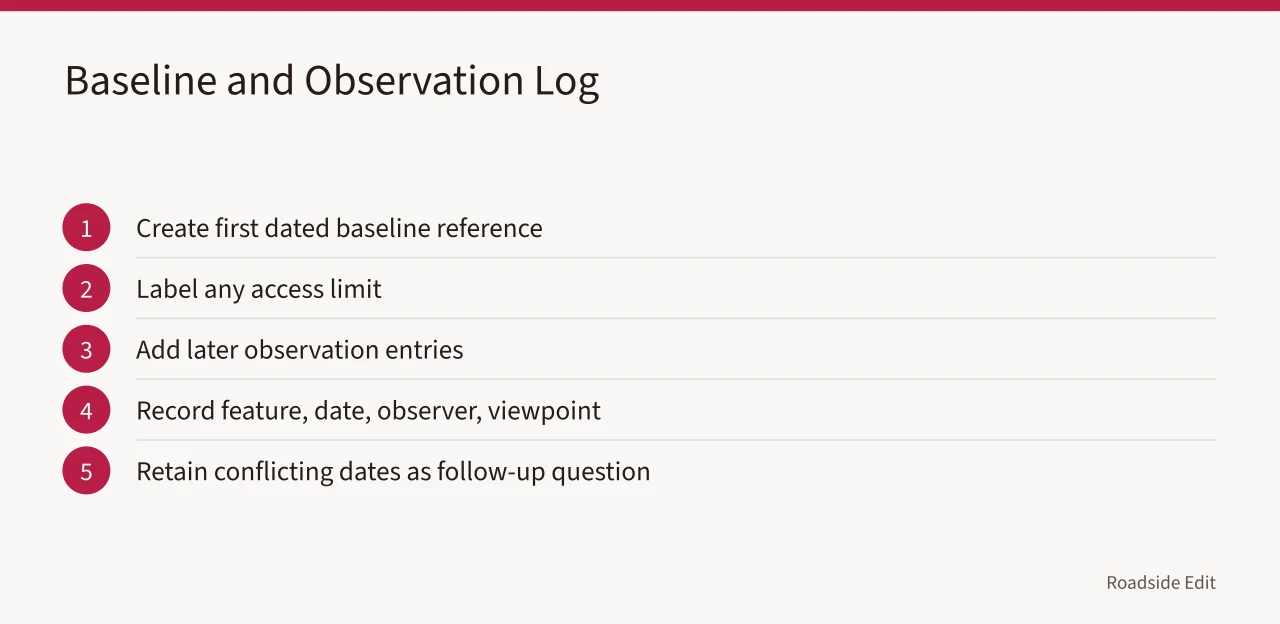
The observation log adds later entries without replacing the baseline. Each entry should record the feature, date, source or observer, viewpoint, visible note, and limitation. If an observation conflicts with an earlier record, retain both dates and create a question for follow-up. Do not solve the conflict by deleting the older note.
The National Park Service's Preservation Brief 47 explains that regular inspection and maintenance can help prevent small exterior issues from becoming larger repairs. Read Preservation Brief 47 on maintaining historic building exteriors. The brief is preservation guidance, not a property-specific finding. It supports keeping recurring inspection and maintenance entries distinct from a technical assessment or treatment decision.
How should work, deferrals, and handoffs be recorded?
For completed work, record what the source says was done, the date, work scope, responsible party if supplied, and any result stated in the source. An invoice shows a transaction. A provider message shows the provider's statement. Neither alone establishes that a technical goal was met. Keep the limit beside the entry.
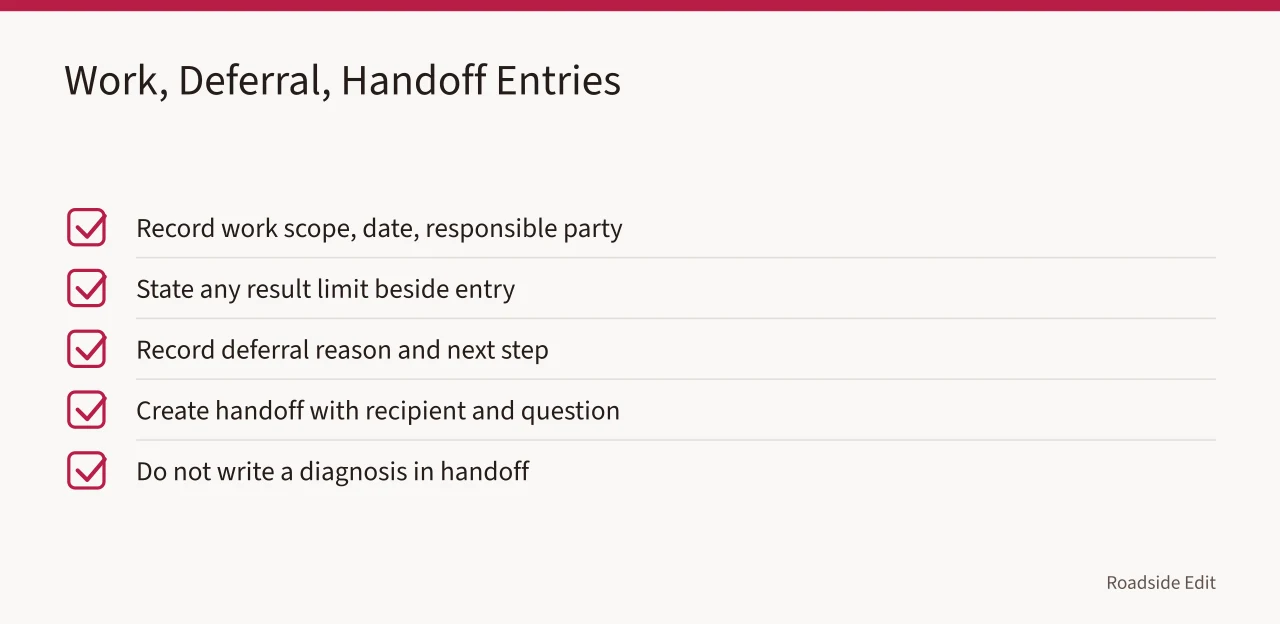
For deferred work, record the reason. A task may be deferred for more information, scope change, owner decision, seasonal timing, or access limit. Other reasons: funding question, unresolved report.
A deferral is useful information because it tells the next studio session why a task did not proceed. Do not report it as a failure or a completed repair.
When an observation or report needs a different authority, create a handoff entry. Include the fact reported, source date, recipient, question sent, source or review needed, and next check-in date. Do not write a diagnosis in the handoff. The later response, if any, becomes a new record tied to the same ID.
OSHA advises employers to identify and assess hazards through inspections and other information sources. See OSHA's hazard-identification guidance. That guidance concerns workplace safety. It does not make a studio report a safety assessment, but it supports referring a potential hazard through the responsible site process rather than asking a writer or visitor to investigate it.
How should change and correction history be kept?
Write a change-log entry whenever the plan, scope, source basis, or public wording changes. Include the date, record ID, old wording or status, new wording or status, reason, source, and owner of the next action. A clear log prevents a newer note from rewriting what an earlier team actually knew.
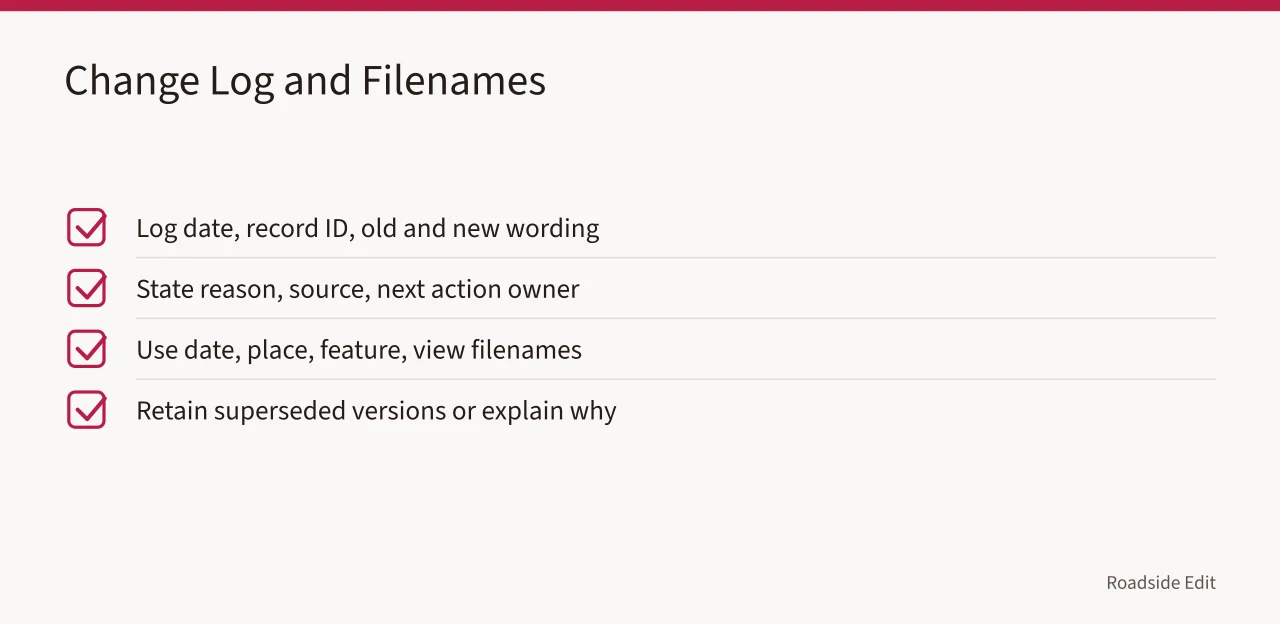
Use consistent filenames so images, notes, and work entries can be found together. A practical pattern is date, place code, feature, and view. When a file is replaced, retain the earlier version or record why it was superseded. A deleted version can erase the reason an article changed.
What belongs in a public update?
Use only shareable, source-backed facts in public content. State the date, source, current stage, and limitation. An article can say that a report was referred, a recurring task is scheduled, or a provider proposed a defined service. It should not convert that language into a claim of approval, safety, completion, or future result without an appropriate source.
For paid placement or a commercial provider statement, preserve the relationship and wording in the record. The Federal Trade Commission's endorsement guidance addresses disclosure of material connections in endorsements and advertising. Read the FTC's endorsement-guides questions and answers. It does not prescribe every project update. It supports separating commercial claims and disclosures from editorial conclusions.
Remove personal information, private locations, or nonpublic documents from public material unless the responsible party has authorized publication. Transparency about process does not require exposing information that does not belong in an article.
How should media records be stored?
Save the local file with a media note: source page, creator information when supplied, rights or license information shown on the page, and date retrieved. The public credit should point to the specific image page.
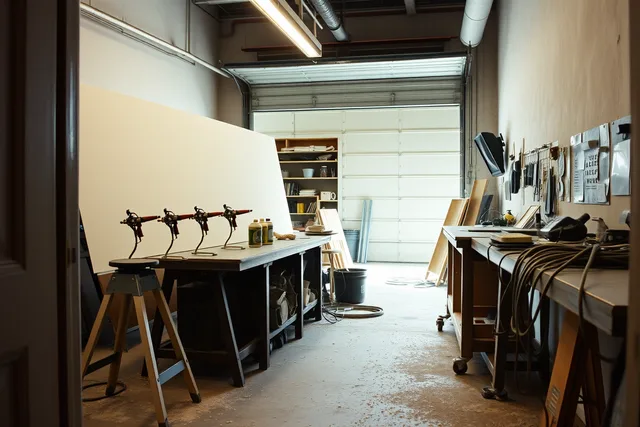
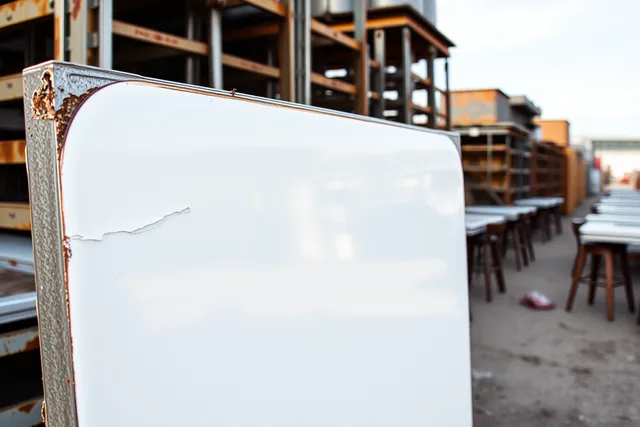
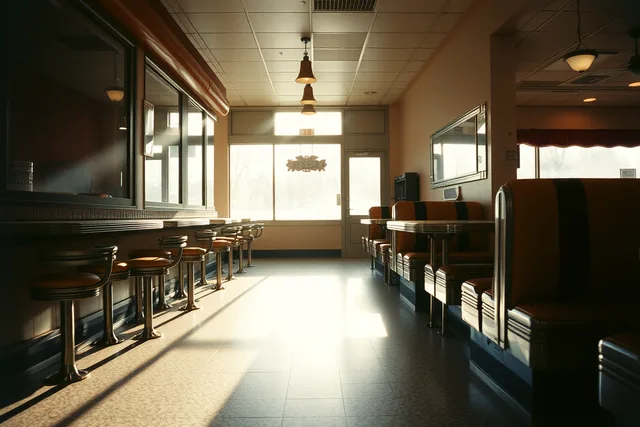
Keep the media role clear: an illustrative photo needs a credit, but it does not prove a current property condition or project outcome.
The image is illustrative only. It does not establish another property's care history, condition, access, approval, or work result.
A care-records checklist
- Does every record identify date, source, purpose, and limitation?
- Is the baseline retained beside later observations?
- Do work and deferral entries state what happened and what remains open?
- Does every outside question have a handoff recipient and next check-in?
- Does the change log preserve prior wording or status?
- Does every media credit point to a specific source page?
Common questions
What is the minimum useful record?
A dated baseline, an observation log, and a note showing what changed or was deferred.
Should old versions be kept?
Yes. Retaining them makes later revisions understandable.
Can a provider proposal be stored with the plan?
Yes, but label it as a proposal and do not treat it as independent evidence or an approved scope.