Guides
Roadside design studios: warning signs your maintenance plan is failing
Roadside studio care warning signs for 2027 help identify weak maintenance claims, missing records, scope drift, and reviews that need a specialist.
A care plan can look organized while leaving the important decisions unanswered. The earliest warning signs are often administrative: a task without an owner, a photograph without a date, or a repair recommendation that does not say who examined the condition. Catching those gaps early keeps routine care from drifting into unsupported repair advice.
What to take away
- A useful task names the feature, trigger, owner, record, and stopping point.
- Photographs document what was visible, not the hidden cause of a problem.
- A missed inspection belongs in the record with an honest explanation.
- Repeated concern should lead to a defined review question, not a copied note.
Tasks with no boundary
"Maintain the exterior" is vague. Readers cannot tell what to inspect, when to act, what minor work is allowed, or when to call an expert.
The National Park Service says regular maintenance can prevent more serious deterioration. Its preservation guidance separates maintenance from treatments that change or repair historic material. Read the National Park Service's exterior-maintenance guidance.
Write the smallest practical task. For example: "After a heavy rain, check the north-side drain outlet for leaves; photograph the area only if water remains after 24 hours; report persistent pooling to the property lead."
That gives a trigger, location, basic observation, and escalation point. It does not pretend to diagnose the drainage system.
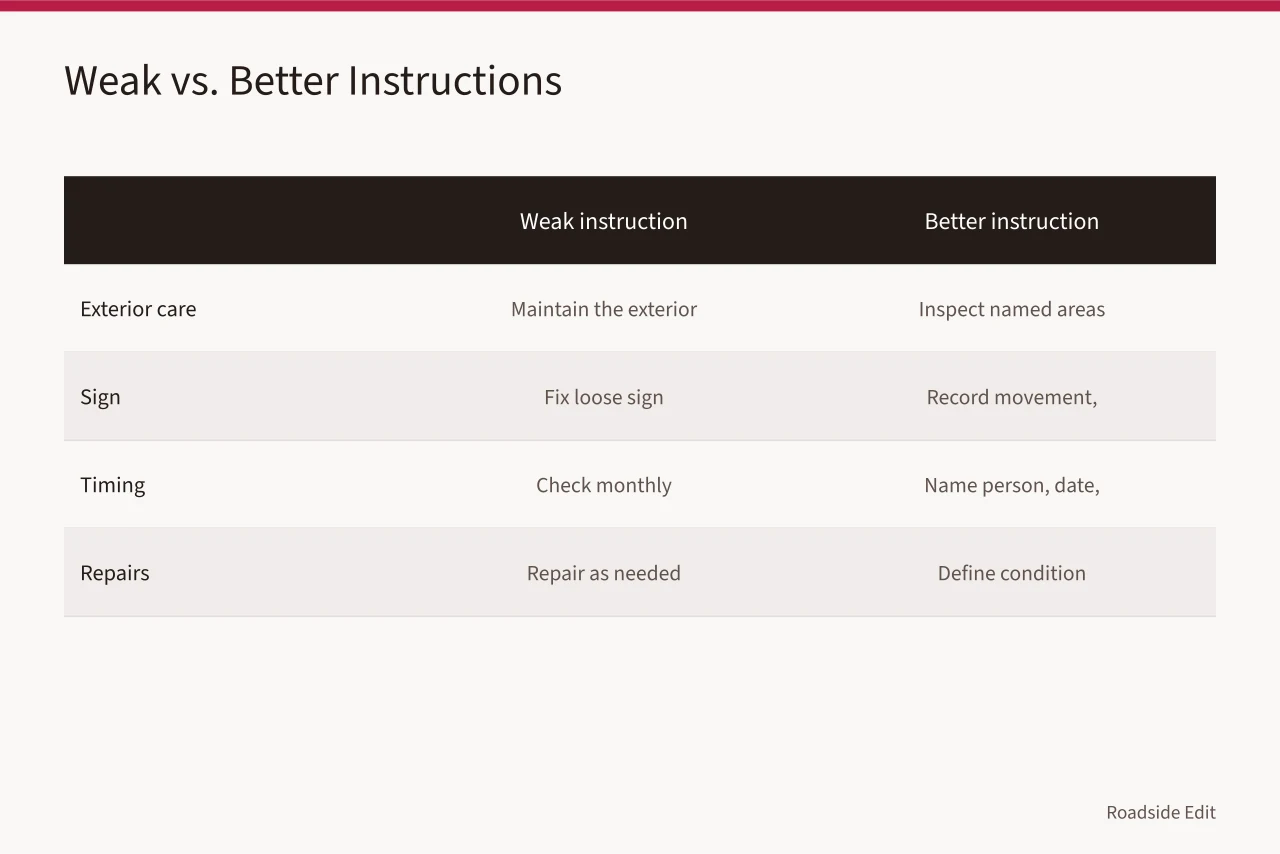
| Weak instruction | Better instruction |
|---|---|
| Maintain the exterior | Inspect named areas after a stated trigger |
| Fix loose sign | Record the movement and request an assessment |
| Check monthly | Identify the person, date window, and record |
| Repair as needed | Define the condition that ends routine care |
Images that carry more weight than evidence
An image can preserve a useful view. It cannot show hidden moisture, confirm structural soundness, or establish why a finish changed. Give each inspection image a date, location, direction of view, and a short observation. Avoid captions that claim a cause the person behind the camera did not verify.
Good recordkeeping protects that distinction. The National Archives explains records management starts by identifying and managing information that documents business. Context matters to whether a record stays useful. See the National Archives' basic records-management concepts
For a small roadside property, keep the original image beside the inspection note. Do not move it into an unlabeled photo folder.
Gaps that no one can explain
Missed observations and delayed tasks happen. The problem is not the gap. It is a log that later replaces the gap with a broad claim like "no problems found."
Record what occurred: the date missed, the reason, any visible condition reported later, and the next review date. That is clearer for staff and more useful to a future owner.
Facility programs commonly separate inspections, preventive work, and training rather than calling all three maintenance. Review GSA's safety and health management policy. The policy governs GSA operations, not private roadside studios, but its separate treatment of those activities is a useful reminder not to turn an incomplete checklist into a safety conclusion.
| Weak record | Better record |
|---|---|
| Issue handled | Date, scope, actor, and observable outcome |
| No problems | Areas observed and limits of the review |
| Repair needed | Visible condition plus a referral question |
| Later | Reason, named next owner, and review point |
Sponsor language that becomes care advice
A vendor may know its own product, but promotional claims are not independent proof that a material suits every building, climate, or existing finish. Keep commercial information in a labeled section, note the relationship, and place care decisions in a separate record.
For older or distinctive properties, changes to material or appearance can call for a different review level. Consult the Secretary of the Interior's treatment standards before treating an advertised product description as a preservation recommendation.
This rule also applies to a sponsor's before-and-after photographs. They may illustrate a service, but they do not replace site-specific evidence. Ask what was observed at this property, what remains uncertain, and who is responsible for the next decision.
When a repeat issue needs a new question
Do not paste the same vague sentence into every review. If a loose panel, runoff mark, or fading finish appears more than once, open a fresh question. State the location, timing, evidence already collected, and what answer would change the care plan. That makes the record useful without claiming more certainty than it has.
A simple escalation question: "Is the recurring water mark related to a blocked outlet, a failed flashing detail, or another source that requires an on-site assessment?"
The wording leaves room for evidence and avoids prescribing a repair from a distance.
Common questions
Does a warning sign mean the building is unsafe?
No. It often means the current note or care record cannot support a conclusion and needs a clearer next step.
Should a missed task be deleted from the log?
No. Keep it, explain the reason it was missed, and assign the next review date.
Can a plan prescribe a repair from one photo?
No. A photograph is limited evidence. It can support an observation, but it cannot replace an appropriate evaluation.