Costs
Part of How to plan vintage diner interior costs without faking an estimate
How to write cost budget notes on vintage diner interiors records
Vintage diner cost budget notes for 2027 show how to annotate historical amounts, tax references, supplied claims, scope limits, and corrections accurately.
Historical cost figures can help a reader understand a diner story when they are annotated with care. The annotation is the value. It tells readers who reported the amount, what the record called it, which work it covered, and why it should not be used as a price, tax result, or promise for another project.
What to take away
- Attach source, date, record type, scope, and exclusions to every amount.
- Keep historic invoices, current estimates, and business statements in separate categories.
- Treat rehabilitation-credit references as program information, not tax advice.
- Correct changed figures with a dated note and preserved source record.
- Exclude a number when its context cannot be stated clearly.
Write a complete annotation
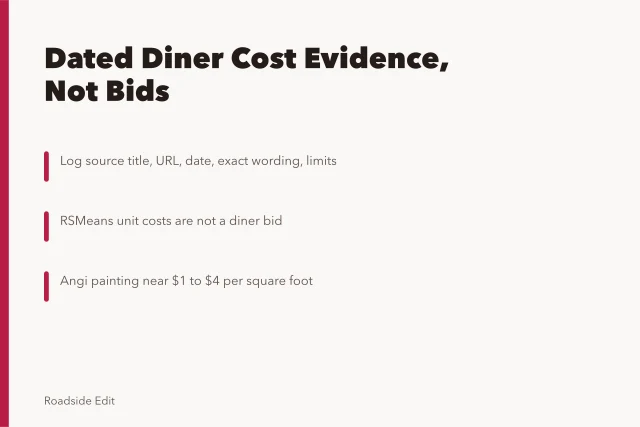
An annotation can be short, but it must answer the questions a reader would otherwise assume away. Start with the record type: invoice, estimate, allocation, news report, or owner statement. Add its date and the scope described in the source. Finish by identifying a significant omission or uncertainty.
The Government Accountability Office's Cost Estimating and Assessment Guide addresses the role of documentation, data, and assumptions in credible estimates. An editorial article does not prepare an estimate. It can follow the same basic discipline by keeping the details that make a published amount intelligible.
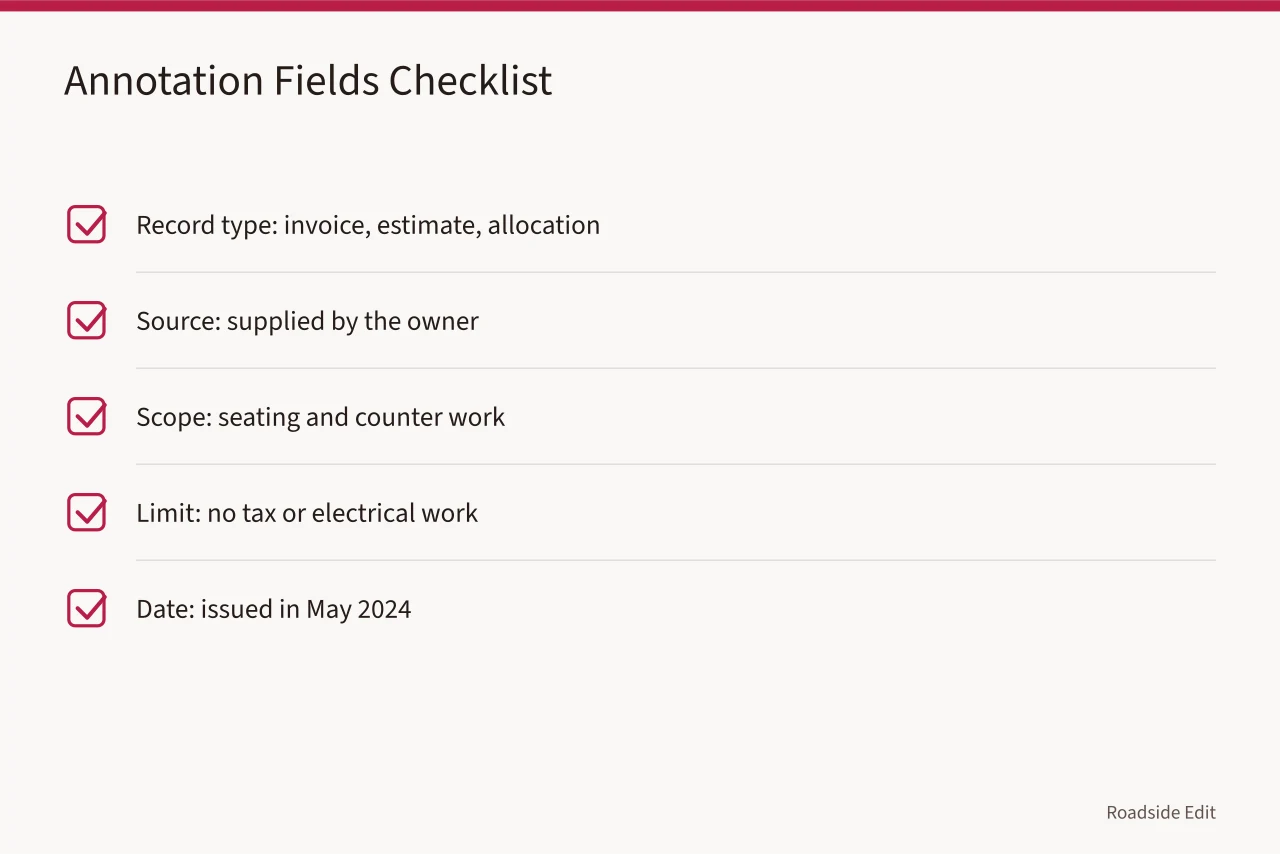
| Annotation field | Example | Why it belongs |
|---|---|---|
| Record type | "A 2024 estimate" | Stops readers treating it as payment |
| Source | "Supplied by the owner" | Explains origin and relationship |
| Scope | "For seating and counter work listed in the estimate" | Prevents a partial amount becoming a full budget |
| Limit | "The document does not identify tax or electrical work" | Makes omissions visible |
| Date | "Issued in May 2024" | Keeps history from sounding current |
Keep the source record with the note
Save the direct page, document, or supplied statement. A sentence such as "the project cost $15,000" is not usable when the reader cannot tell where that figure came from. A better sentence is, "A 2024 owner-supplied estimate lists $15,000 for the stated seating scope; the material reviewed does not identify final payment or separate permit costs."
The National Archives records-management overview supports the practical need for traceable records. For an editor, that means preserving the item and the wording it supports. It also allows a later correction to address the original source rather than guessing why an amount entered the article.
Do not treat tax references as outcomes
An article may explain that a historic rehabilitation program exists. It should not calculate a tax credit, promise eligibility, or describe an expense as qualified based on a photo, an age claim, or a past project figure. Those results depend on property-specific facts and current requirements.
The Internal Revenue Service's rehabilitation credit guidance describes conditions for the rehabilitation credit and qualified rehabilitation expenditures. It supports an informational statement about the program. It does not authorize an article to decide a reader's eligibility or tax treatment.
Use a limit note near any program reference: "This article reports program information only and does not determine eligibility, qualified expenditures, or tax results." That is not filler. It prevents an historical cost story from turning into financial advice.
Separate business accounts from public records
A diner operator, supplier, or contractor may provide a figure that belongs in the story. Attribute it, date it, and keep it within the source's stated scope. If the party paid for placement, supplied free goods, or has another material connection, disclose it where readers encounter the claim.
The Federal Trade Commission's endorsement guidance says material connections that could affect how readers evaluate an endorsement should be disclosed clearly and conspicuously. A label gives readers context. It does not independently confirm a supplier's price or outcome.
Preserve the correction trail
If a contributor says an amount is wrong, ask for the exact sentence, the corrected figure, the record that supports it, and the relevant scope. Keep the prior wording, new wording, evidence reviewed, decision date, and a short public correction note when the change is material. Do not silently replace a number that shaped the article's meaning.
Common questions
Can a historical invoice be called a current budget?
No. It can be dated context when the article states its scope and does not turn it into a current price.
Does an amount from a tax-credit project prove eligibility elsewhere?
No. A published amount does not establish another property's eligibility or tax treatment.
Where should a correction appear?
Update the affected claim and preserve an editorial record of the source, date, and reason for the change.