Reviews
Part of How to plan vintage diner interior costs without faking an estimate
Vintage diner cost planning: questions to ask before you compare figures
A diner cost comparison holds up only when both figures describe the same work, date and status, so ask what each record is before ranking them.
What to take away
- Vintage diner cost planning starts with the questions to ask before you compare figures.
- Name the document type before the number: invoice, estimate, grant allocation, or owner recollection.
- Compare scope, date and status first; a counter repair and a full interior are not a pair.
- Save the source page, date and exact scope wording for every figure you keep.
- Do not call an expense credit eligible or estimate a reader's tax result.
- Disclose who supplied a business figure, and add a column for what would make the record usable.
- Use typical line-item ranges only as a sanity check, never as a quote.
Start with the document, not the dollar amount
Cost records can sit side by side without the article turning into a price guide. The work is asking what each record actually describes, then deciding whether the two belong in the same sentence at all.
Ask what the paper is. A 1962 invoice for a counter repair, a 2026 fabricator estimate for a new laminate top, a state grant allocation and an owner's memory of what the chrome trim cost are four different objects.
A National Register nomination, a State Historic Preservation Office file and a local landmarks designation are records too. Each has a different use in a cost comparison.
The Government Accountability Office's Cost Estimating and Assessment Guide sets out what a documented estimate contains: data, assumptions and a defined scope. A feature about a diner is not an estimate. It can borrow the first question and stop there.
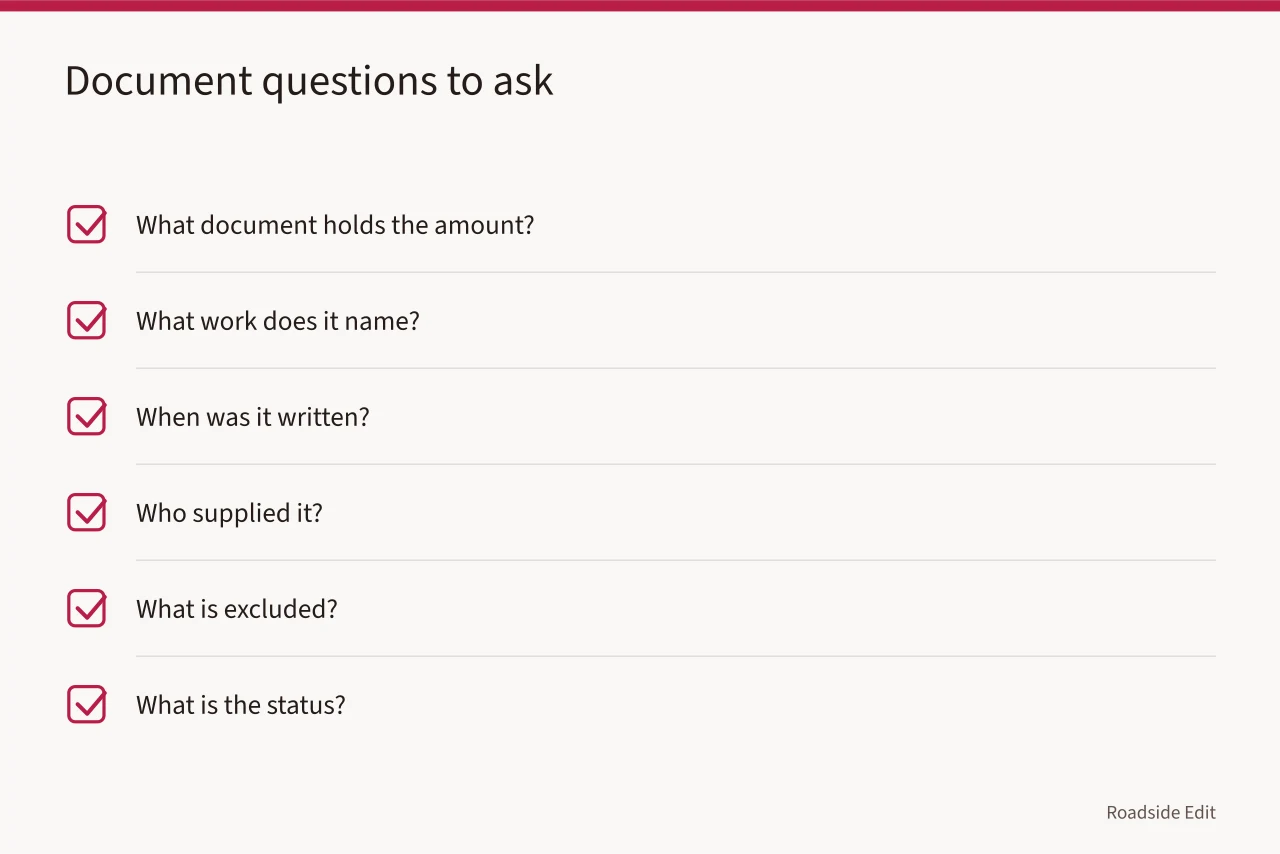
| Question | Why it matters | What would make this usable |
|---|---|---|
| What document holds the amount? | Separates invoice from estimate from recollection | A scan or citation with a date |
| What work does it name? | Defines scope | A line-item scope sheet |
| When was it written? | Places it in time | A dated document, not a remembered year |
| Who supplied it? | Shows the relationship | Named source and their role |
| What is excluded? | Reveals what the total leaves out | A stated exclusions list |
| What is the status? | Paid, quoted, budgeted or allocated | Confirmation the work was carried out |
| What line items does it price? | Separates a counter repair from a full interior | A quantity and unit list |
Decide whether two figures can be compared, and check typical ranges
Two amounts about diners are not comparable by subject alone. They need the same kind of work, the same room, a workable time gap and the same status.
A paid 1974 invoice for booth upholstery cannot be ranked against a current quote for a whole interior. A grant allocation is not the amount finally spent. The National Archives records-management overview is the reason to keep the source page, the date and the exact scope language for each figure you retain.
Where that context is missing, run the records separately. A sentence that reports the comparison beats a conclusion about value: "The two records cover different dates and stated scopes, so they appear here as separate historical contexts."
For roadside preservation, ask whether the record covers work required by a preservation standard. The Secretary of the Interior's Standards for Rehabilitation can drive scope, materials and review time. That is a cost driver, not a number.
In most U.S. markets, as of 2026, these ranges are planning aids, not quotes. Local labor, historic review and material availability move them.
| Line item | Typical range as of 2026 | What drives it |
|---|---|---|
| Counter repair or replacement | $1,000 to $10,000 | laminate vs. stainless, length, substrate |
| Stool re-chroming | $150 to $400 per stool | plating condition, number of stools |
| Booth upholstery | $1,500 to $5,000 per booth | fabric, foam, frame repair |
| Laminate top | $80 to $200 per linear foot installed | grade, edge profile, templating |
| Chrome trim and rail | $2,000 to $15,000 | pieces, pitting, re-plating |
| Neon sign rebuild | $5,000 to $30,000 | tube count, transformer, permits |
| Exterior porcelain enamel | $1,000 to $10,000 per panel | damage, color match, removal |
| HVAC | $8,000 to $25,000 | tonnage, ductwork, historic review |
| Electrical | $10,000 to $50,000 | service upgrade, code, lighting |
| Plumbing | $5,000 to $20,000 | fixtures, grease trap, code |
| Roof | $10,000 to $50,000 | material, pitch, historic review |
| Structural | $20,000 to $100,000 | foundation, framing, engineering |
Ask a fabricator or sign shop to mark which line items its quote includes. A total without that list is not comparable to a line-item estimate.
Ask what a preservation program actually says
A reader who sees a 1948 diner will ask about incentives. Do not answer from the look of the building. Name the program, then state only what its own source confirms.
The National Park Service eligibility requirements list what the federal rehabilitation credit requires of a property, a rehabilitation and a use. The editorial limit follows: no article calls an expense credit eligible, and none calculates a reader's tax position. Those calls belong to the State Historic Preservation Office, the local landmarks commission and the reader's tax adviser.
For a diner in a historic district, ask whether the project needs Section 106 review or a Certificate of Appropriateness. Both can add time and documentation beyond construction cost. Name the program before you quote a figure: Federal Historic Preservation Tax Incentives, National Register of Historic Places listing, or a local Main Street program grant.
Ask who supplied the claim
When a fabricator, sign shop or booth supplier gives a price or a project result, ask who is speaking. A dated business account can run in a profile. It should not quietly become independent proof.
The Federal Trade Commission's endorsement guidance covers material connections that could change how a reader weighs a statement. A disclosure gives context. It does not verify a price or a claim of affordability.
Ask whether the supplier has worked on a National Register-listed diner. Ask for a reference from a preservation architect or a State Historic Preservation Office reviewer. That is context, not proof.
Common questions
Can an article calculate a tax credit?
No. Eligibility and tax treatment turn on property-specific facts and current law. Report a verified program fact and leave the calculation to the reader's tax adviser.
Is an owner update enough to publish a cost?
It can run as an attributed owner update. It should not be presented as independent verification of the amount.
Should two dated figures be adjusted to compare them?
Not without a transparent method and matching scope. In most editorial work, report the records separately and say why.
What belongs in the final column?
The missing item that would settle the question: a dated invoice, a scope sheet, a public record, or a note from the source. That turns an incomplete record into a research task instead of a guess.
What if I only have a typical range?
Treat it as a placeholder. Replace it with a dated quote or invoice before you compare it to another figure.