Guides
Part of How to plan vintage diner interior costs without faking an estimate
How vintage diner owners should keep cost records straight
A diner cost record pairs each published figure with its source, date, scope and disclosure, so an editor can defend the number years later.
A figure in print outlives the conversation that produced it. A booth laminate quote from a fabricator, a survey day billed by a preservation consultant, a neon transformer price from a supplier: once published, each one reads as a fact about the trade.
The record behind it is what lets a later editor say where it came from and what it covered.
What to take away
- One entry per figure: published wording, source document, source date, stated scope, exclusions.
- Never let an estimate, an invoice and an owner recollection share a single label.
- Note which life-cycle stage a figure covers, and say plainly that it covers only that stage.
- Store disclosure language beside the figure it qualifies, not in a separate file.
- Log every correction with the source that prompted it and the date the note went up.
One entry per figure, not one list
A running list of amounts loses the thing that matters: which claim each amount supports. Give every published figure its own entry, written so an editor who has never seen the source can still judge the claim.
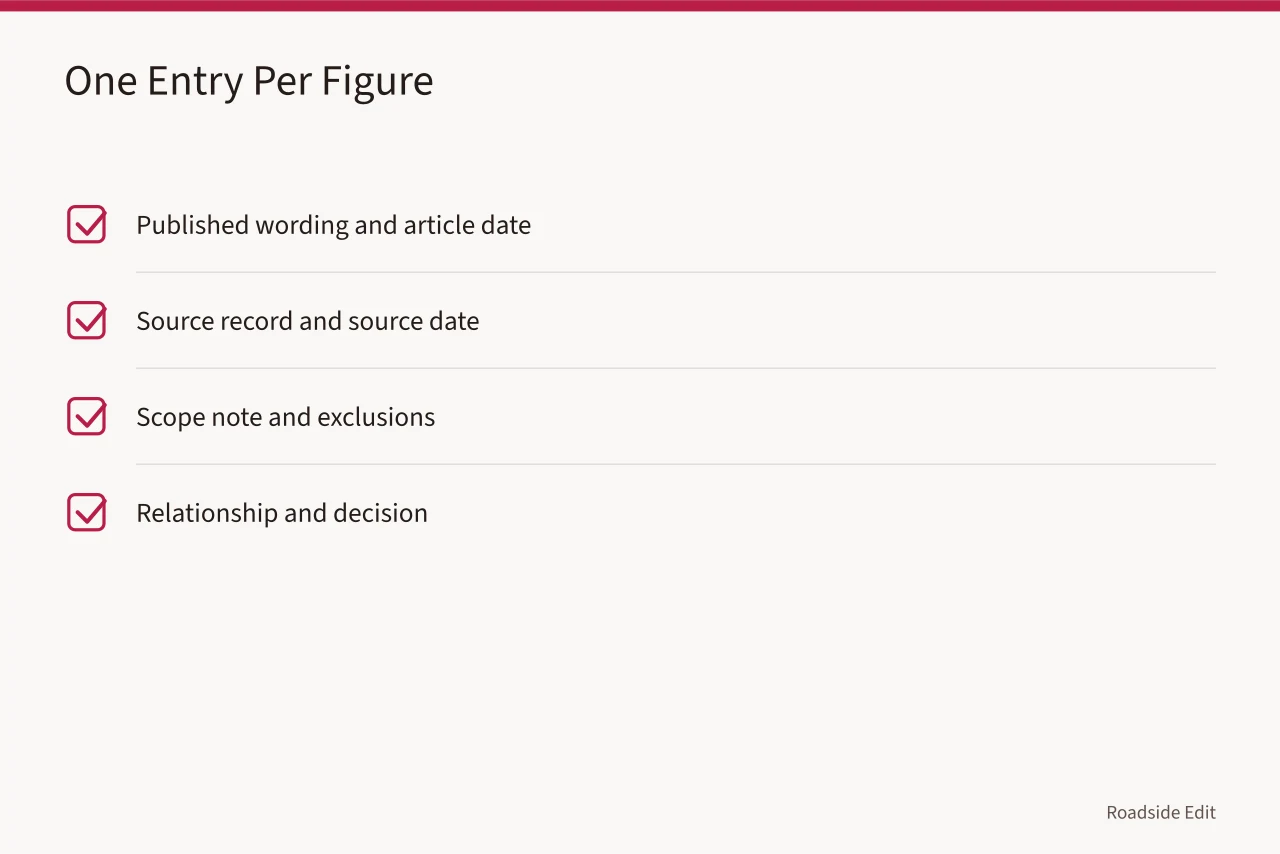
| Field | What to save | Why it matters |
|---|---|---|
| Published wording | The sentence as it ran, plus the article date | Identifies the exact claim under review |
| Source record | Direct link, file, or attributable statement | Lets a second person verify it |
| Source date | When the document was issued | Distinguishes a 2019 quote from a 2026 one |
| Scope note | Trade, room, phase or category named | Stops a partial figure reading as a total |
| Exclusions | What the source does not cover | Preserves the uncertainty the source had |
| Relationship | Owner, fabricator, supplier, sponsor or public body | Drives attribution and disclosure |
| Decision | Publish, revise or exclude, with date | Explains why the article says what it says |
The National Archives records-management overview frames this as managing material across its whole life, from creation to disposition. For a diner feature the working version is narrower: keep the source and the single claim it supports in the same place, so a future update does not depend on anyone's memory of a phone call.
Say what kind of source it is
An invoice, an estimate, a grant allocation, a trade-press report and an owner's recollection are five different things. Filing them under one label is how a proposed scope becomes a billed amount in a reader's mind.
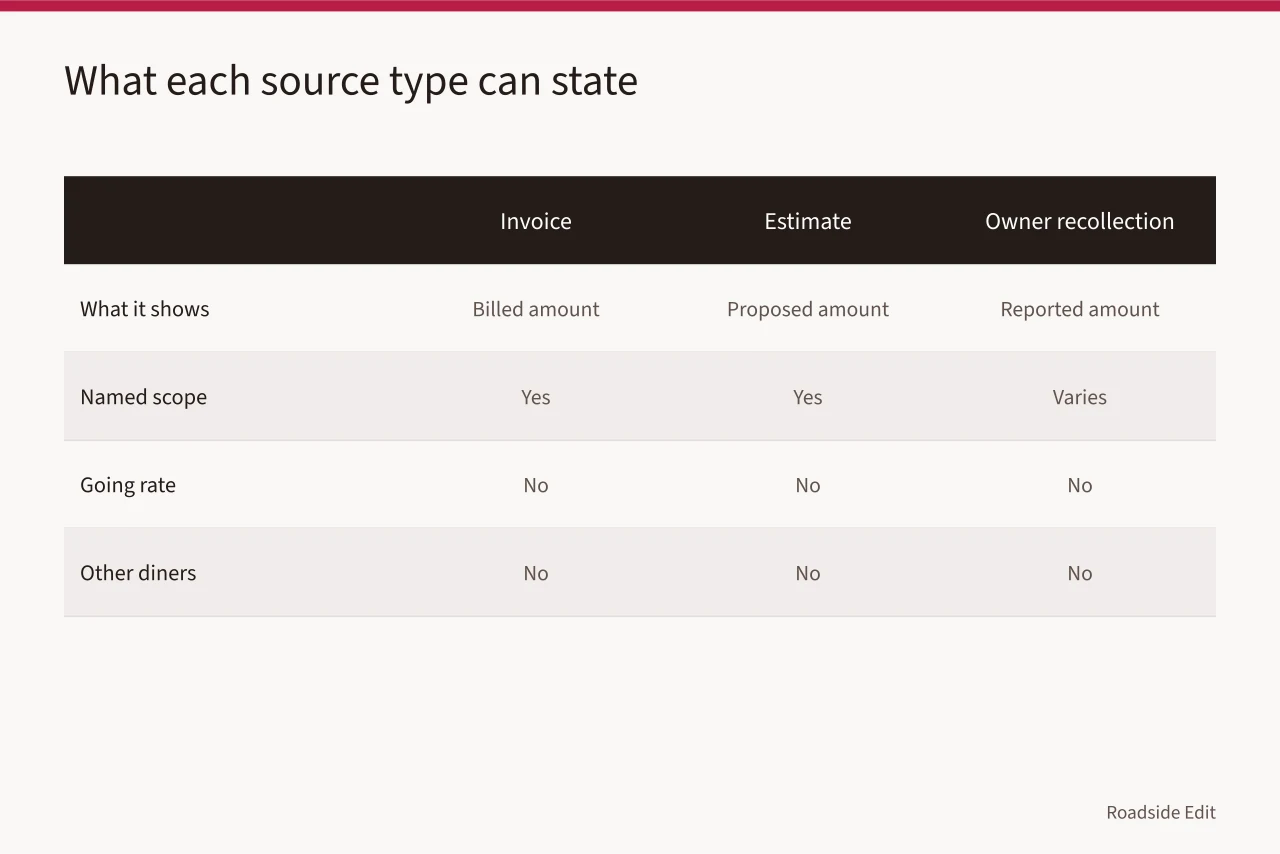
A fabricator's invoice can state what was billed for a named scope. An estimate can only describe what was proposed. An owner's account states what that owner reported. None of the three becomes a going rate for another diner, in another state, in another decade.
The Government Accountability Office's Cost Estimating and Assessment Guide treats documented assumptions as the backbone of any cost figure. Borrow the principle, not the method. Save enough context that a number cannot read as more final or more current than its source allows.
Keep life-cycle notes narrow
A reader who sees one upfront figure will assume it covers everything. The record exists to stop that.
The National Park Service facilities policy context splits life-cycle cost into acquisition, installation, operation, maintenance and eventual disposal or deconstruction. A diner restoration touches most of those: a salvaged back-bar, a re-tubed sign, a compressor, a roof. One published amount rarely covers more than one.
Write the limit into the entry. "The cited record identifies the fabrication phase only; it does not state a full life-cycle amount." That sentence keeps the article honest without asking it to run numbers the source never had.
Supplied figures and disclosures
When a diner, fabricator or sponsor hands over a figure, keep the original wording. Keep the date it arrived, the contributor's role, and whatever evidence came with it. Attribute it in the article to that source.
If payment, free goods or another material connection could change how a reader weighs a recommendation, save the disclosure language in the same entry. The Federal Trade Commission's endorsement guidance asks that connections affecting how readers evaluate an endorsement be disclosed clearly and conspicuously. A disclosure gives context. It does not certify the figure.
The correction chain
When a contributor disputes a number, ask for the exact claim, the replacement wording, the supporting document, the scope and the date. Save the request, the evidence reviewed, the decision and the public note together.
If the change is material, run a dated correction note beside the affected text. Silently swapping a figure that readers may have already used is the one move that costs a publication its record.
A reader who wants the wider field procedure for documenting a site will find it in the roadside architecture safety checklist, which covers survey order and photo logs.
Common questions
Should a record keep a source that is never published?
Yes, when it supports editorial review and was obtained lawfully. Publish only what a reader needs to weigh the public claim.
Does life-cycle context mean the article should estimate total ownership cost?
No. It can name the categories a figure does not cover. Building a property-specific model from a partial record is a different job, and not this one.
What should a business include in a correction request?
The exact claim, one supporting source, the relevant date, and a clear statement of the change sought. Send it to the publication's editor, not to the contributor who supplied the figure.