Guides
How to plan vintage diner interior costs without faking an estimate
Plan vintage diner interior costs with dated, scoped figures from public sources, and never present a range as a bid for a specific property.
What to take away
- Every vintage diner interior cost figure you publish needs a date, a scope and a named source, or it is decoration.
- A public cost range is not a bid. Say which one you are showing.
- Keep historical diner records, current business information and your own interpretation in separate sentences.
- Name the tools you used, then state the limit of each one. RSMeans, Angi, Fixr and HomeAdvisor each answer a different question.
- Label paid or supplied material next to the claim it affects, not in a footer.
- Never write an article that reads as an estimate, a bid or a tax opinion for a named diner.
Decide what the diner cost feature promises
A cost-planning feature for a vintage diner promises less than a project budget. It explains the record around a number: who published it, when, and what work it covered.
That is a real service. An owner who knows a 2018 report covered documentation only will not mistake it for a 2027 quote on booth upholstery.
Write the boundary before you collect anything. This feature explains the dated cost information published for a named diner interior. It identifies the scope stated by its source.
A headline that asks what it costs to restore a diner invites an answer the evidence cannot carry. Condition, code, access and materials differ by property. So do business use and financing.
The National Park Service notes that rehabilitation decisions weigh cost, code requirements, maintainability and project difficulty. None of that overrides a compatible treatment in a program context.
Its economic and technical feasibility guidance teaches one editorial habit: keep a cost figure beside the facts and alternatives that give it meaning. It is not a diner budget.
Build a dated cost-evidence file for the diner interior
Start a file that makes every published statement traceable. A spreadsheet works. The fields matter more than the software.
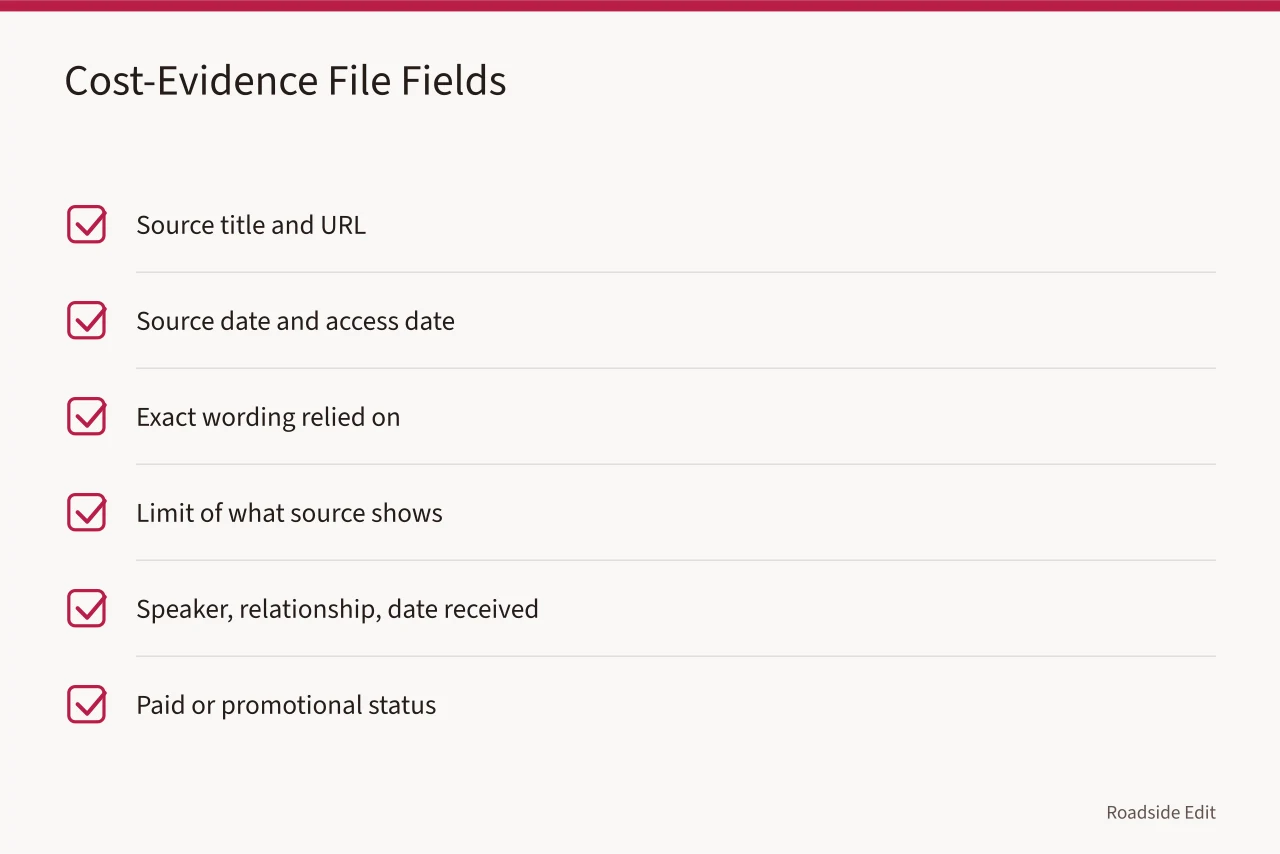
Record the source title and URL, the source date, the access date, the exact wording you are relying on, and the limit of what that source can show.
When an owner or vendor supplies a number, log the speaker, the relationship, the date received, and whether the material is paid or promotional.
| Field | Record it this way | Do not infer |
|---|---|---|
| Amount | Exact figure or range, with currency and date | A current market price |
| Scope | Work, room, phase or report named by the source | Work the source never names |
| Record type | National Register nomination, SHPO survey, Section 106 agreement, invoice | That it covers the full interior |
| Status | Preliminary, historical, billed, supplied or unknown | Finality from an unlabeled number |
| Conditions | Access, known deterioration, code issue or site limit if stated | Conditions nobody documented |
| Source limit | What the source actually covers | A comparable diner or project |
| Disclosure | Paid placement, supplied update or editorial independence | Endorsement or certification |
This file stops one common error: adding unlike figures into a total that persuades and means nothing. A 2018 report may cover documentation. A current operator may describe a maintenance task. A newspaper archive may mention a renovation without saying what it included. Those items can sit side by side. They cannot be summed.
For a vintage diner, the record types include a National Register of Historic Places nomination, a State Historic Preservation Office survey, a Section 106 memorandum of agreement, and local landmark commission minutes.
The Modern Diner in Pawtucket, Rhode Island, and the Miss Worcester Diner in Worcester, Massachusetts, both have National Register listings that describe materials and layout, not a current price. Each record has a date and a stated scope.
Use public cost inputs for the narrow diner fact each publishes
Public tools help a writer test a line item. They cannot produce a diner bid. Cite the fact, then state the limit.
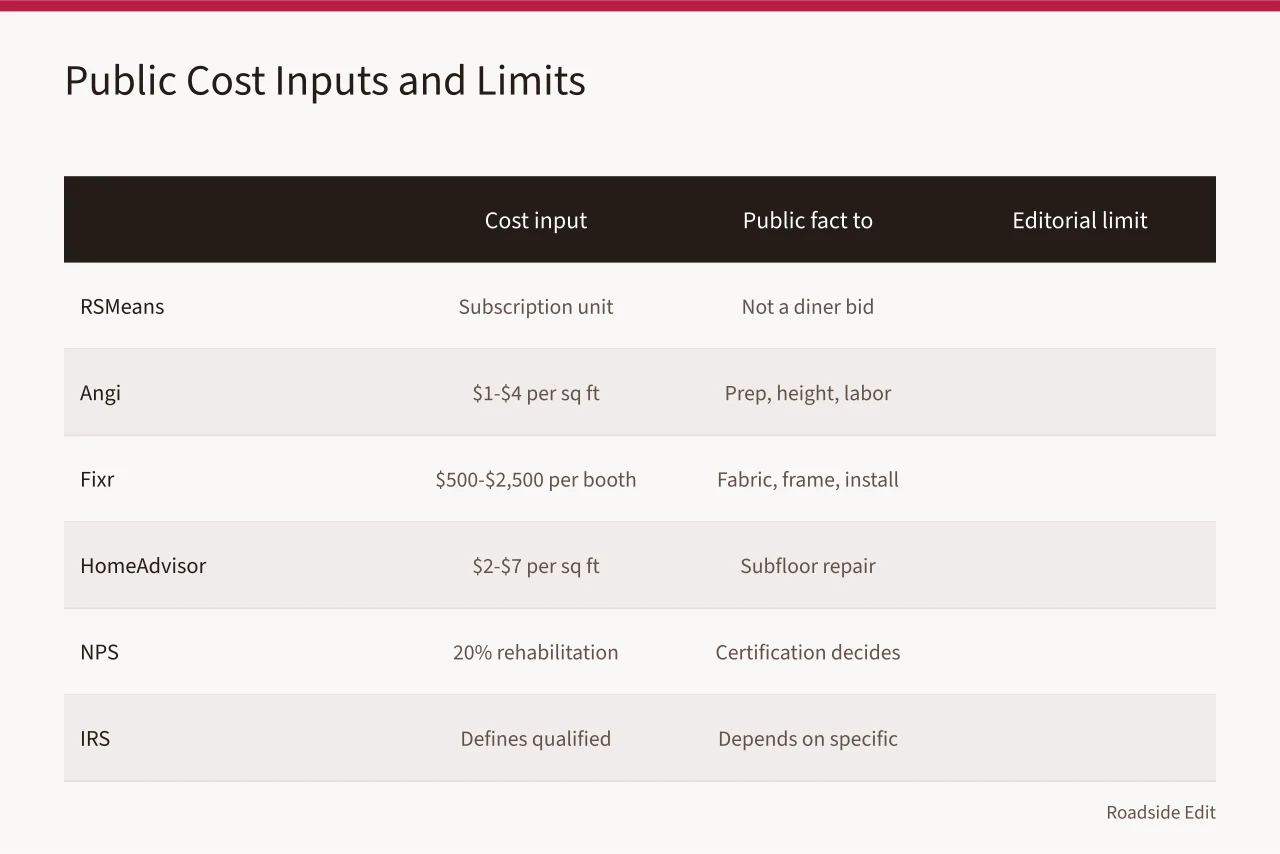
| Cost input | Public fact to cite | Editorial limit |
|---|---|---|
| RSMeans from Gordian | Subscription construction cost data with unit costs and city cost indexes | A national unit cost is not a diner bid |
| Angi | Publishes national average interior painting ranges near $1 to $4 per square foot | Prep, height and local labor move the range |
| Fixr | Lists restaurant booth seating around $500 to $2,500 per booth before installation | Fabric, frame, delivery and electrical work add cost |
| HomeAdvisor | Lists vinyl plank flooring around $2 to $7 per square foot installed | Subfloor repair and removal are separate line items |
| NPS Preservation Briefs and tax credit guidance | Explains the 20% rehabilitation credit for income-producing certified historic structures | Certification and program rules decide eligibility |
| IRS | Defines qualified rehabilitation expenditures for the credit | Tax outcomes depend on specific facts and law |
| FTC | Requires clear disclosure of material connections in endorsements | Disclosure does not verify a price |
RSMeans suits early scope checks, because it prices line items and adjusts by city. It is a subscription product, so a small newsroom may need a library card or a contractor who already pays for it.
Angi and HomeAdvisor suit national range checks. Both are lead-generation sites, and their figures are averages rather than local quotes. Fixr suits fixture planning, but booth cost swings on fabric, frame and delivery.
The NPS and IRS rows answer eligibility questions. The 20% credit is program information, not a promise for a named diner. The FTC row covers sponsored profiles: clear disclosure helps a reader weigh a claim, and does nothing to make the claim true.
Define the diner interior scope before you discuss the number
A reader should know what a figure contains. In a diner interior feature, that might be survey work, documentation, design, cleaning and repair. It might also be equipment, accessibility changes, permits, temporary operations or a single phase.
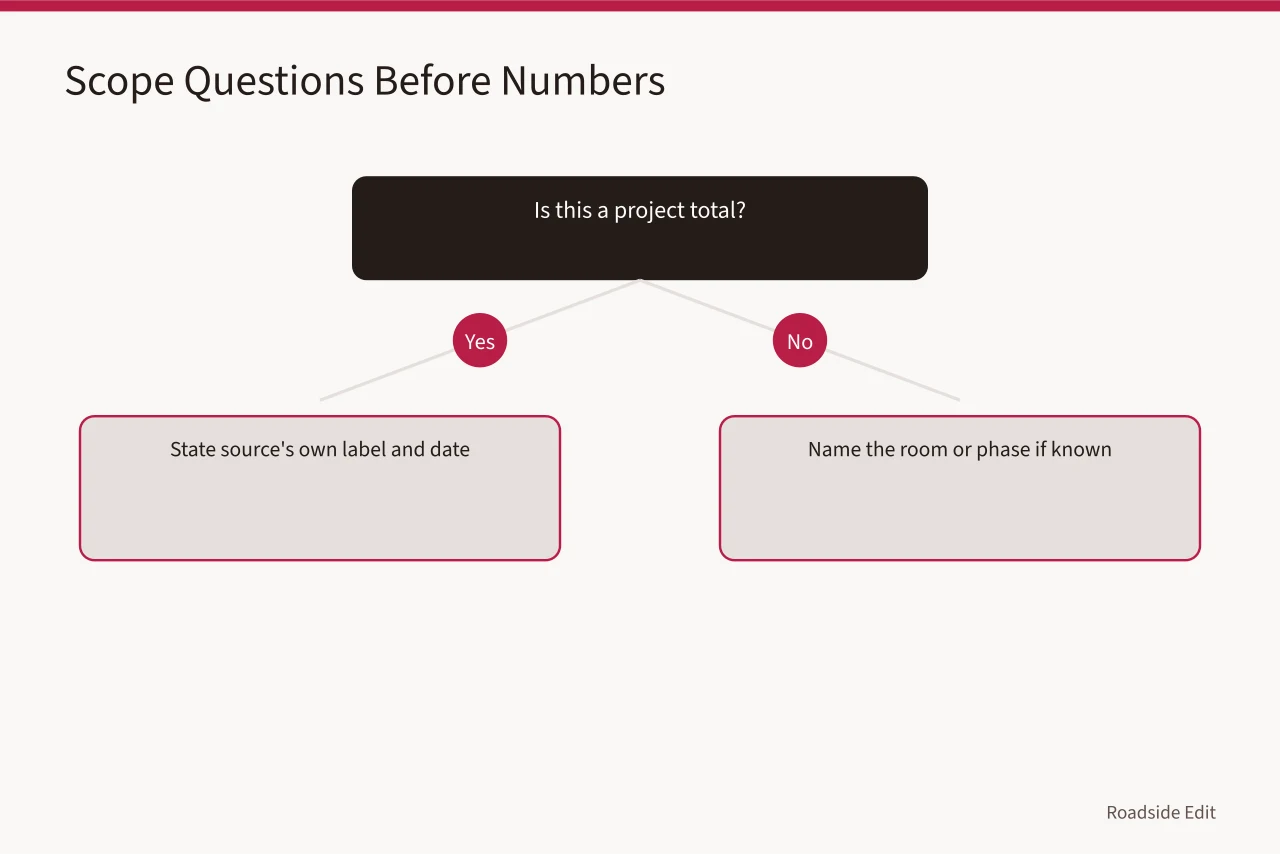
Publish only the categories the record identifies. If the source says interior upgrades, quote that label instead of inventing a list of materials and labor.
Put a scope note directly after the number. The 2024 figure was reported for the documented phase is a complete, honest sentence.
That wording is duller than one confident total. It also tells the reader what is unknown, and it gives the business a fair chance to send a correction.
| Editorial question | Safer move | Avoid |
|---|---|---|
| Is this a project total? | State the source's own label and date | Calling every number a total |
| Does it cover the whole interior? | Name the room or phase if known | Expanding a partial scope |
| Is it current? | Use the stated date and source | Inflating an old figure to 2027 |
| Is it comparable? | Explain differences in conditions and scope | Ranking businesses by unlike amounts |
| Is it advice? | Keep it as context | Calling it an expected price |
Keep the diner restoration alternatives visible
Cost planning goes wrong when the article makes one option look inevitable. A historic finish, a booth, a counter or a ceiling usually has several possible paths, each with its own evidence and constraints.
Describe the alternative the record names. Say what is unknown. Do not decide which option a property should choose.
One source may document a repair approach. Another may discuss replacement materials. A third may carry a current business update. Give each its own paragraph with dates and attribution.
If a source addresses feasibility inside a preservation program, say so. It is not a universal rule for diners outside that program.
The same discipline applies to any list of agencies, firms or suppliers. State published services, locations, credentials or a documented project only where you have support for that item, and disclose the inclusion rule. Paid placement needs a conspicuous label.
Show how dates change what a diner number means
A number without a date can be accurate and still mislead. Materials, labor availability, financing, permit review and business operations all shift between a historic report and a reader's 2027 question.
Do not project a dated number forward. Explain its stated time and scope. If the source gives no date, say so or leave the number out.
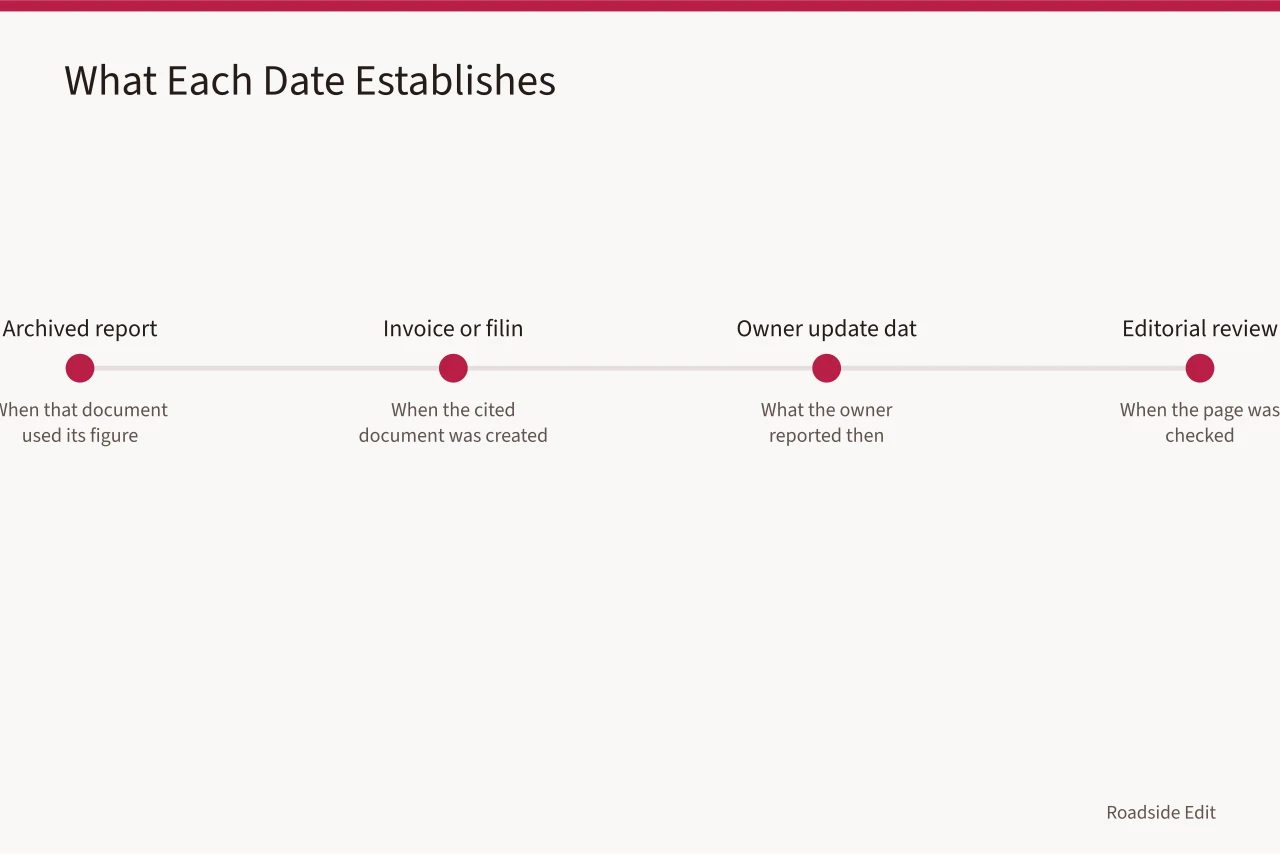
Use a timeline when the record has several moments. It can separate a historical report, a contributor update, an editorial correction and a future publication date. It should not manufacture a trend.
| Date type | What it can establish | What it cannot establish |
|---|---|---|
| Archived report date | When that document used its figure | A current quote |
| Invoice or filing date | When the cited document was created | Scope beyond the document |
| Owner update date | What the owner reported then | Independent verification |
| Editorial review date | When the page was checked | That all facts remain current |
Report diner tax and financing references narrowly
Tax credits, grants and financing carry high stakes. A general feature may state what a program requires. It should not calculate a reader's benefit or tell a business that an expense qualifies.
Eligibility turns on property, use, certification and timing. Ownership, accounting and law matter too, and all of it changes. A 2027 page needs a dated source and a pointer to qualified professionals.
The Internal Revenue Service rehabilitation credit guidance describes the conditions for the federal credit and what counts as a qualified rehabilitation expenditure. That is program information, not a basis for one diner's tax outcome.
The safer question is not how much a project will receive. It is what program requirement the source identified, and which project facts the source says matter.
Write a diner cost preparation list, not a construction scope
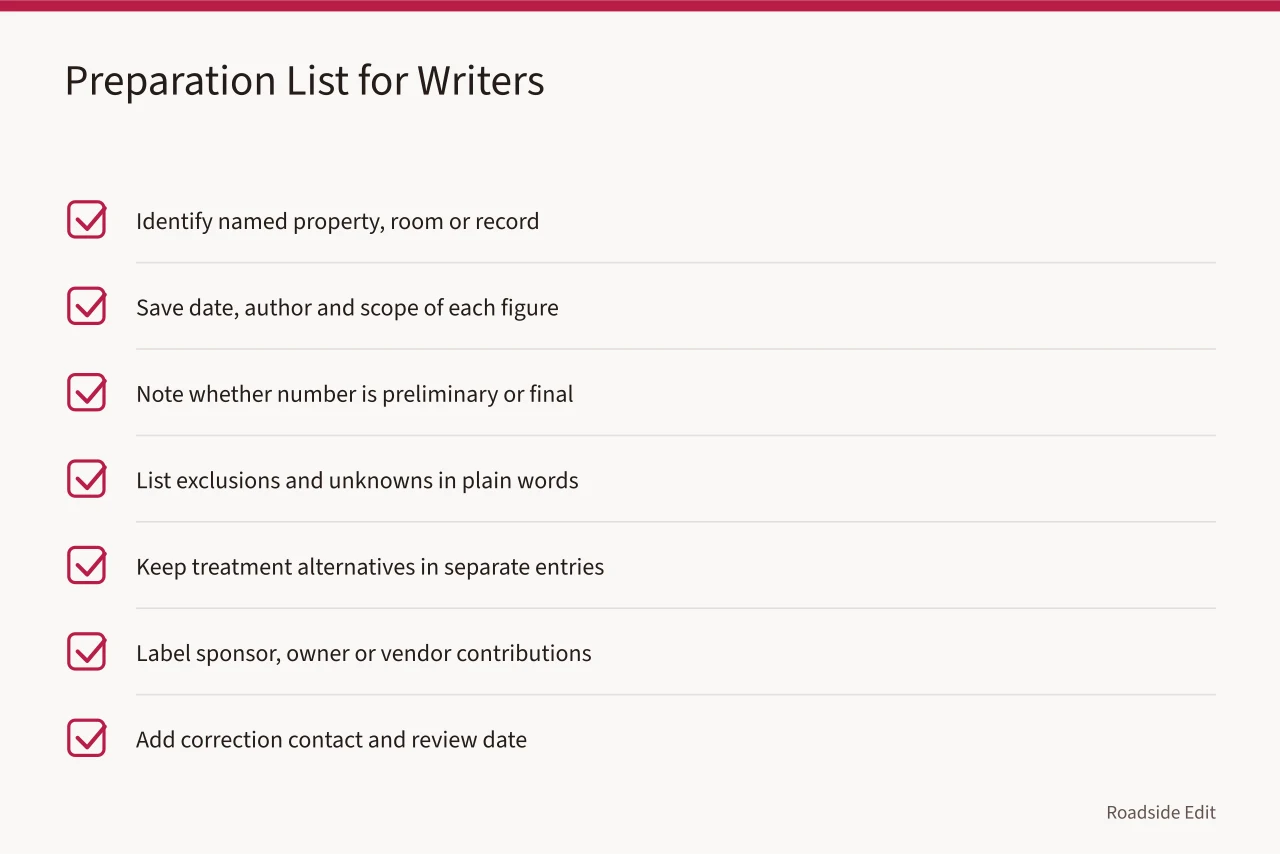
An article can be practical without numbers that overreach. This list helps a reader ask better questions of the relevant professional, agency or business. It is editorial, not a scope of work.
- Identify the named property, room or historic record.
- Find the National Register nomination or State Historic Preservation Office survey for the diner, if one exists.
- Note the date on each record and the work it describes.
- Separate documentation, design, cleaning, repair and equipment in your notes.
- Log any public cost figure with its source, date and scope.
- List the conditions that could change the figure: access, code, materials, season.
- Name the agency or program that published the figure, such as NPS, IRS or a state preservation office.
- Label any supplied or paid material next to the cost claim it affects.
- Write the scope note directly after the number.
- Keep case studies separate from current cost claims.
The list tells a writer what to verify rather than what a physical project should do. It also reuses cleanly across field notes, profiles and case studies without making them read alike.
Give diner businesses a fair correction route
A cost feature with clear rules attracts useful corrections. Publish the process: factual updates need a source, supplied material is attributed, sponsorship is labeled, and editorial acceptance is not guaranteed.
If a business says a historical figure is incomplete, ask what the figure covered, when it applied, and whether a public record supports the change. Do not swap one unverified number for another.
When a correction changes a claim, keep the old and new wording in the editorial file with the decision date. On the page, update the sentence and add a note when the change is material. That beats a vague note that information may change.
The National Archives records-management overview supports the traceability cost reporting needs. Locate the original record and identify the narrow claim it supports.
The Federal Trade Commission's endorsement guidance says material connections that could affect how readers weigh an endorsement must be disclosed clearly and conspicuously. Disclosure gives context. It does not validate a supplier's price.
If your own budget work is still open, the planning checklist and the budget notes carry the same rule into the numbers you keep privately.
Common questions
Can a diner article publish a historical renovation figure?
Yes, when the source, date, scope and limits are stated. It stays historical context, not a current price or a quote for another property.
Should a paid profile include cost information?
Only if it is clearly attributed, dated, scoped and labeled as supplied or paid material. Payment does not verify the claim.
Can a writer add together figures from several sources?
Not unless the sources establish a compatible date, scope and basis for calculation. Reporting the figures separately is clearer and safer.
Does a tax-credit reference mean a diner project qualifies?
No. Eligibility and tax treatment depend on specific facts and current rules. Describe the source narrowly and leave advice to the reader's accountant.
In this guide
- Before you publish vintage diner cost figures, run this scope checklistVintage diner cost planning checklist for 2027: qualify each figure by source, date, scope, comparison limits, disclosure, and publication decision.
- Vintage diner cost planning: questions to ask before you compare figuresA diner cost comparison holds up only when both figures describe the same work, date and status, so ask what each record is before ranking them.
- How to write cost budget notes on vintage diner interiors recordsVintage diner cost budget notes for 2027 show how to annotate historical amounts, tax references, supplied claims, scope limits, and corrections accurately.
- How vintage diner owners should keep cost records straightA diner cost record pairs each published figure with its source, date, scope and disclosure, so an editor can defend the number years later.