Guides
Vintage diner interior care checklist: how to document sources and photo limits
Use this 2027 vintage diner interior care checklist to document sources, observations, photo limits, disclosures, corrections, and review dates clearly.
A vintage diner interior care checklist is most reliable when it is used to organize editorial facts, not to direct work on a building. This 2027 checklist helps a writer document what a source shows, identify what remains unknown, and give a contributor a fair route to request a factual correction.
What to take away
- Treat each observation as a dated record with a stated limit.
- Keep supplied business information separate from independent sources.
- Use a review date and correction note instead of making permanent claims.
- Do not turn a checklist into property-specific repair advice.
Set up the article record
Before publishing, create a compact record for every factual sentence that may matter to a reader. The goal is traceability. An editor should be able to see where the statement came from, when it was reviewed, and whether it describes the past or the present.
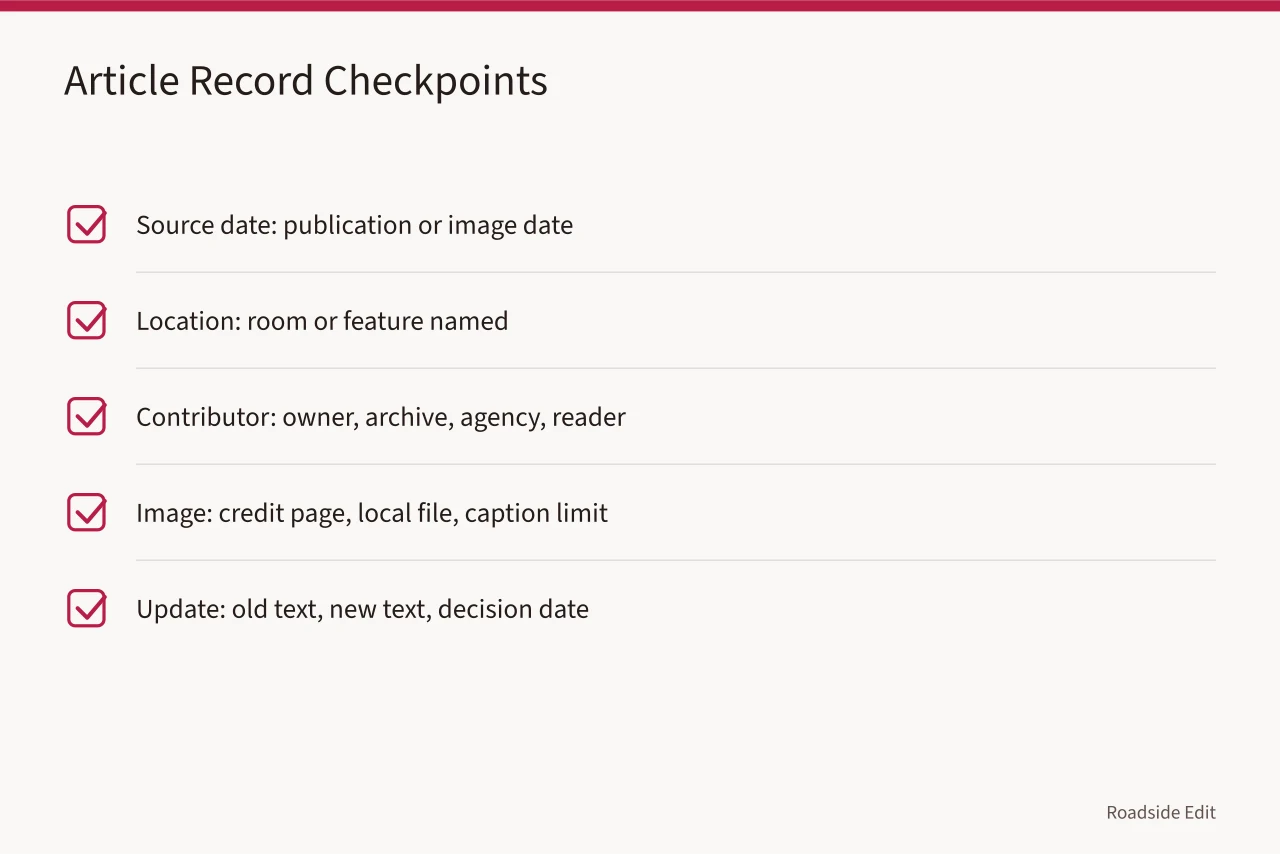
| Checkpoint | Record in the working notes | Leave out of the article |
|---|---|---|
| Source date | Publication or image date | A guess about current conditions |
| Location | The room or feature named by the source | A wider claim about the whole diner |
| Contributor | Owner, archive, agency, or reader relationship | An implied independent endorsement |
| Image | Credit page, local file, and caption limit | A claim the image does not show |
| Update | Old text, new text, and decision date | A silent rewrite of a disputed fact |
The General Services Administration advises keeping final reports and project documentation in historic-preservation work. Its documentation guidance for interior marble supports the narrower editorial point that a usable record needs enough detail for a later reviewer to follow it. It does not tell an editor how to care for a diner surface.
Run the publication checklist
Use these checks before and after a page goes live.
- Confirm that the primary source is a specific page, report, catalog item, or attributable statement.
- Label a historic photograph by its date and do not present it as current evidence.
- State whether a business supplied the information and disclose paid placement when applicable.
- Give every local image a credit link and a caption that describes its limited role.
- Separate a visible observation from any explanation of cause, urgency, or treatment.
- Add a review date and a route for a reader or business to submit a correction.
- Preserve the old wording when a substantive factual correction is made.
Make the checklist useful to contributors
A contributor may know a diner's current operating details, a renovation date, or a photographed feature's identity. That can be valuable material, but the article should name it as an owner update, archive note, or supplied description.
A checklist gives contributors a clear request: send the exact source, relevant date, covered location, and permission to quote or summarize.
The same process is useful for paid listings. A payment can purchase visibility only when the label is conspicuous and the article does not make unsupported comparative claims. The checklist keeps commercial information visible rather than blending it into an apparently independent judgment.
The National Archives records-management overview supports the need to keep a traceable source record behind a published factual claim. That record identifies what was reviewed without turning the article into care instructions for a specific property.
The Library of Congress primary-source analysis guide begins with observation before reflection and investigation. It supports the checklist's distinction between a dated visual observation and a conclusion about current condition or cause.
The Federal Trade Commission's endorsement guidance says material connections that could affect how readers weigh an endorsement should be disclosed clearly and conspicuously. A disclosure provides context; it does not validate a supplied maintenance claim.
Use a simple correction log after publication. Record the page URL, the sentence changed, the evidence received, the person who reviewed it, and the date of the decision. This small record helps preserve an honest distinction between an update that adds detail and a correction that reverses a factual statement.
Common questions
Is a photograph enough to support a current maintenance claim?
No. A photograph supports only what is visible at the stated time. Use current, specific evidence for a present-tense claim.
Can an owner submit a correction?
Yes. Ask for the exact source, date, and relationship to the property, then update only what the evidence supports.
Should a sponsored listing use the same checklist?
Yes. It should also include a clear disclosure and avoid treating advertising copy as independent verification.