Guides
How to keep vintage diner interior care budget notes honest and sourced
A diner budget note records the work phase, the source and the date, so a reported figure never reads as a price for someone else's building.
Vintage diner interior care budget notes are scope records, not estimates. Each line says who reported what, on what date, and for which phase of work. A note never turns one project's number into a price for the next diner. Porcelain-enamel panels, Vitrolite glass, terrazzo floors, Formica booth laminate and chrome trim wear on different schedules.
A cast ornament piece, a laminate counter and a terrazzo floor are three different purchases. Their costs do not trade against each other, and a note that mixes them misleads the next reader.
What to take away
- Record the work phase the source names. "Restoration" and "mechanical upgrade" are different scopes, and their numbers do not compare.
- Keep the reported amount, the date, and the source title together on one line.
- Label a grant, a credit, or a listing fee as what it is, never as total project cost.
- Write down what the figure excludes when the source says. When it does not say, write "not stated."
- Cite the record a reader can request, such as a National Register nomination, a State Historic Preservation Office file, or a preservation commission packet.
- Set a review date so a 2024 number is not read as 2027 pricing.
The phase is the entry that matters
Most bad diner cost notes fail on phase, not arithmetic. One source quotes a figure for porcelain-enamel panel repair. Another quotes booth laminate replacement. A third quotes a full interior rehabilitation. A reader will treat all three as the same job.
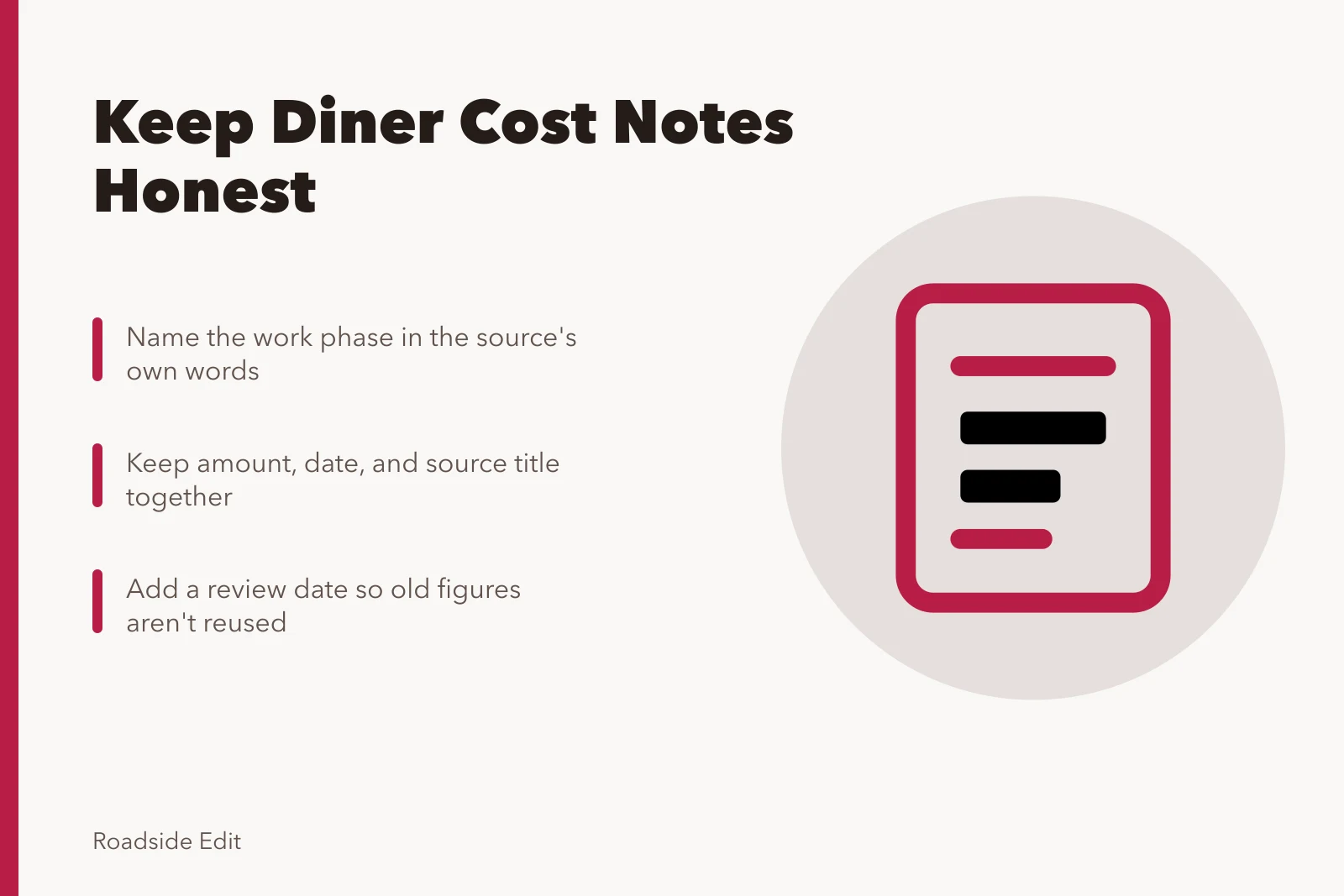
Name the phase in the source's own words. If the source says "planning," the note says planning. If it says "completed 2023," the note says completed 2023. Do not upgrade a proposal into a result.
A National Register of Historic Places nomination separates a physical description from a statement of significance, and the National Park Service keeps those nominations in NPGallery. Pull the phase wording from the document itself, not from someone else's summary of it.
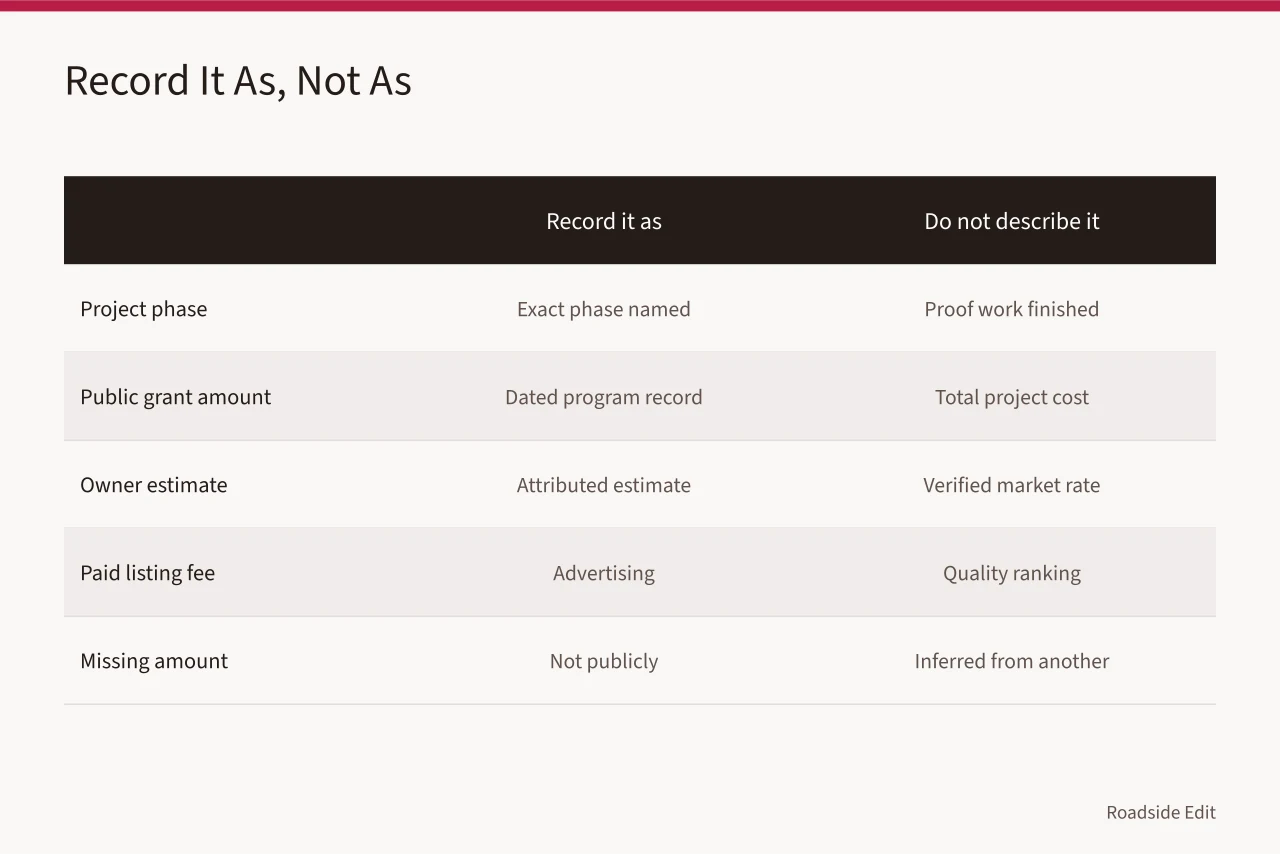
| Entry | Record it as | Do not describe it as |
|---|---|---|
| Project phase | The exact phase named by the source | Proof the work was finished |
| Public grant amount | A dated program record | The total project cost |
| Owner estimate | An attributed estimate | A verified market rate |
| Paid listing fee | Advertising information | A quality ranking |
| Missing amount | Not publicly established | A number inferred from another site |
The National Park Service holds that treatment decisions follow from a property's documented significance and condition. Its guidance on composition ornament shows how far a scope description has to go before two projects can be compared at all. It is not a cost source.
A sequence that keeps a note checkable
- Name the source and the date it was published or supplied.
- State the exact work phase named by the source, quoting its wording.
- Mark the amount as reported, estimated, awarded, or not disclosed.
- Say whether the figure covers a whole project, one feature, or an unknown scope.
- List the exclusions the source states, or write "not stated."
- Disclose any paid placement next to the entry it affects.
- Add a review date.
Seven lines. A reader can check every one against the original record, which is the point. The gas station preservation planning notes use the same sequence on canopy and forecourt work, where phase confusion between soffit repair and full demolition is just as common.
Where a figure comes from, and where it stops
The Government Accountability Office's cost guide for capital projects requires a defined purpose, a technical baseline and documentation before an estimate means anything. Four characteristics make an estimate reliable: comprehensive, well-documented, accurate and credible. A diner note needs the same in miniature: what work, measured how, recorded where.
The Internal Revenue Service describes the historic rehabilitation tax credit as 20 percent of qualified rehabilitation expenditures on a certified historic structure, claimed on Form 3468 and taken at 4 percent a year for five years. A separate 10 percent credit covers non-historic buildings placed in service before 1936.
Whether a given diner qualifies is a question for a tax professional and the State Historic Preservation Office, not for a budget note. Label a credit as a credit.
The Federal Trade Commission's endorsement guidance covers compensation that could sway how a reader weighs a statement. A listing fee is advertising information and belongs in that slot, never in a ranking column.
The Advisory Council on Historic Preservation runs the Section 106 review that a federal license, permit or funding award can trigger. That review produces dated correspondence a budget note can cite.
Worked example: one entry, written two ways
Weak: "Interior restoration at a Route 66 diner ran about $X per booth."
Sourced: "Booth laminate and chrome-edge trim replacement, one 12-stool counter, reported by the owner in a March 2024 preservation commission packet as an estimate. Excludes electrical, plumbing, and permit fees, which the packet does not address. Not verified by this publication."
The second version is longer and worth it. It names the phase, the feature, the source, the date, and the exclusions. It states plainly what nobody checked. A reader who wants the primary record knows which packet to request from the local preservation commission or the State Historic Preservation Office.
When no source exists, write "not publicly established." A typical range, if you publish one, needs units and drivers: per linear foot of counter, per booth, per enamel panel, per square foot of floor. Access, off-site fabrication and whether trim is reused move the number.
Common questions
Can a site publish a historic project cost?
Yes, when the amount carries a date, an attribution, and the phase the source named. A figure without those three is a rumor with a dollar sign.
Should an owner estimate be called a market price?
No. Present it as an attributed estimate and keep it off any page that reads as a rate card for other diners.
Where do I find the source document?
National Register nominations sit in NPGallery. State Historic Preservation Office files, local preservation commission minutes, and Historic American Buildings Survey drawings at the Library of Congress also carry dated scope language.
Can a paid placement appear in a list article?
Yes, when the disclosure sits beside the entry and the entry is not ranked on condition or workmanship. The diner interior budget case notes show how that separation looks in practice.