Guides
Part of Motel exterior fundamentals: how to document what you can see in 2027
Motel exterior basics checklist: how to record what you see in 2027
Motel exterior basics checklist for 2027: create a dated visual record, track water and access questions, describe visible features, and route decisions responsibly.
Before discussing a motel exterior, create a record of what is visible now. A sign, canopy, driveway, room door, planter, roof edge, and parking area can each tell part of the story. None of them alone can explain a building's condition, a maintenance history, or a future project.
This checklist is for owners, editors, photographers, and researchers who need a useful starting record. It is not an inspection, a repair specification, an accessibility determination, or a permit review. Its purpose is simple: keep visible observations, source material, and open questions organized before a larger decision is made.
What to take away
- Record the date, lawful viewpoint, and weather conditions with each exterior observation.
- Describe roofs, walls, openings, ground, and circulation routes as separate visible subjects.
- Treat water clues as observations until the responsible person or qualified review can determine a cause.
- Keep photos, captions, and source pages tied to the exact view they document.
Start with a dated exterior record
The first record should identify the motel, the observation point, the date, and the limits of access. A photograph from a public sidewalk may show a sign and facade but not the rear wall, roof surface, guest circulation, or inside of a room. State that boundary instead of writing around it.
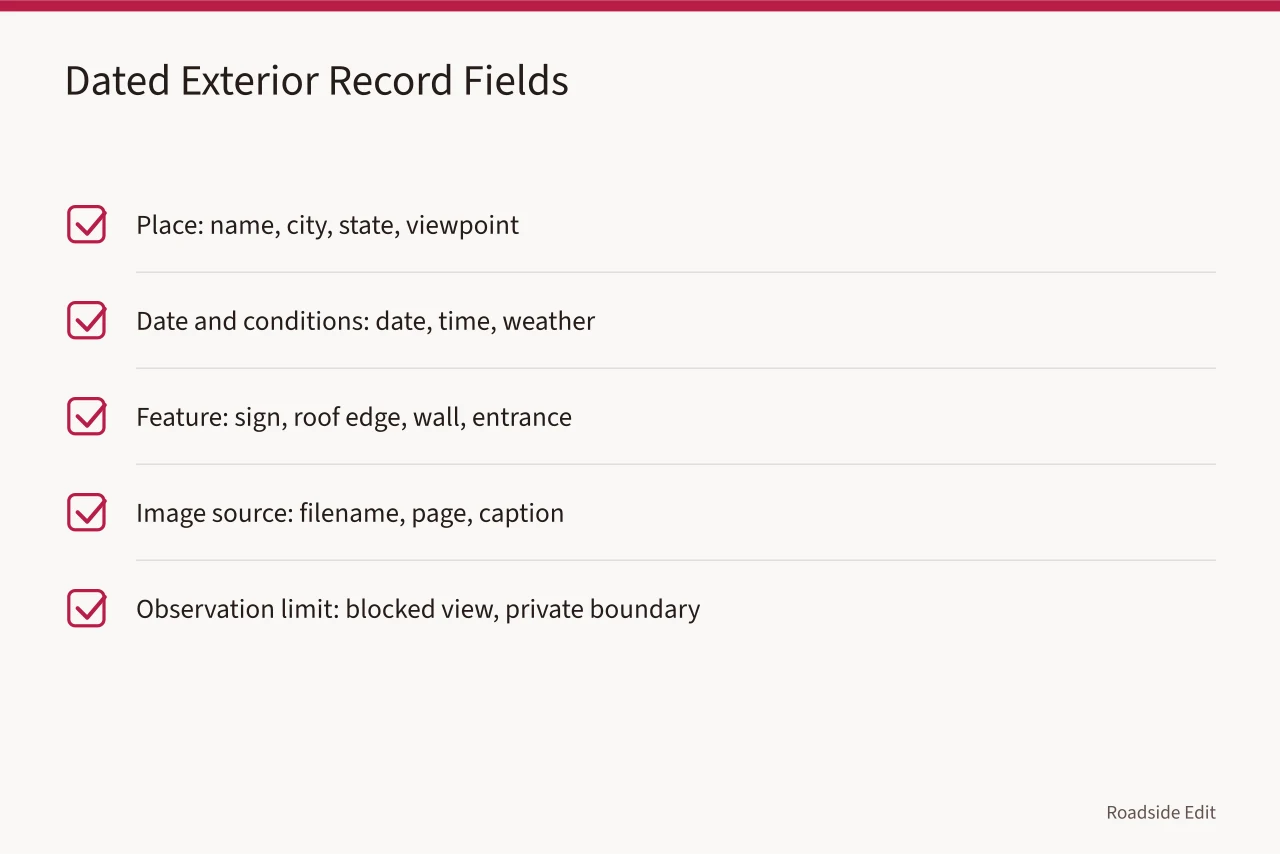
| Record field | What to capture | What it cannot establish |
|---|---|---|
| Place | Name, city, state, and a clear public or authorized viewpoint | Ownership or property-line position |
| Date and conditions | Date, approximate time, weather, and recent precipitation if known | A complete maintenance history |
| Feature | Sign, roof edge, wall finish, entrance, parking surface, or other exact subject | Condition of hidden parts |
| Image source | Local filename, original page, caption, and date shown by source | Permission for new access or use |
| Observation limit | Restricted area, blocked view, poor light, or private-space boundary | A conclusion about what was not seen |
Use repeatable viewpoints where possible. A front-corner photo taken from the same lawful location at different times can help an editor compare a visible change. It still cannot say why the change occurred. Store the original files and explain the view in the caption.
The National Park Service describes regular inspections, monitoring, seasonal care, and written records of completed work as parts of exterior maintenance for historic buildings.
Read NPS Preservation Brief 47. The brief targets historic buildings and does not set a program for every motel. It supports basic recordkeeping: note visible condition and keep a dated trail of work actually done.
Separate the exterior into visible zones
One long note labeled "motel exterior" is hard to use later. Divide the observation into zones so a reader can see what was observed and what remains open. The goal is not to create a diagnosis. It is to prevent one visible clue from becoming a claim about the whole property.
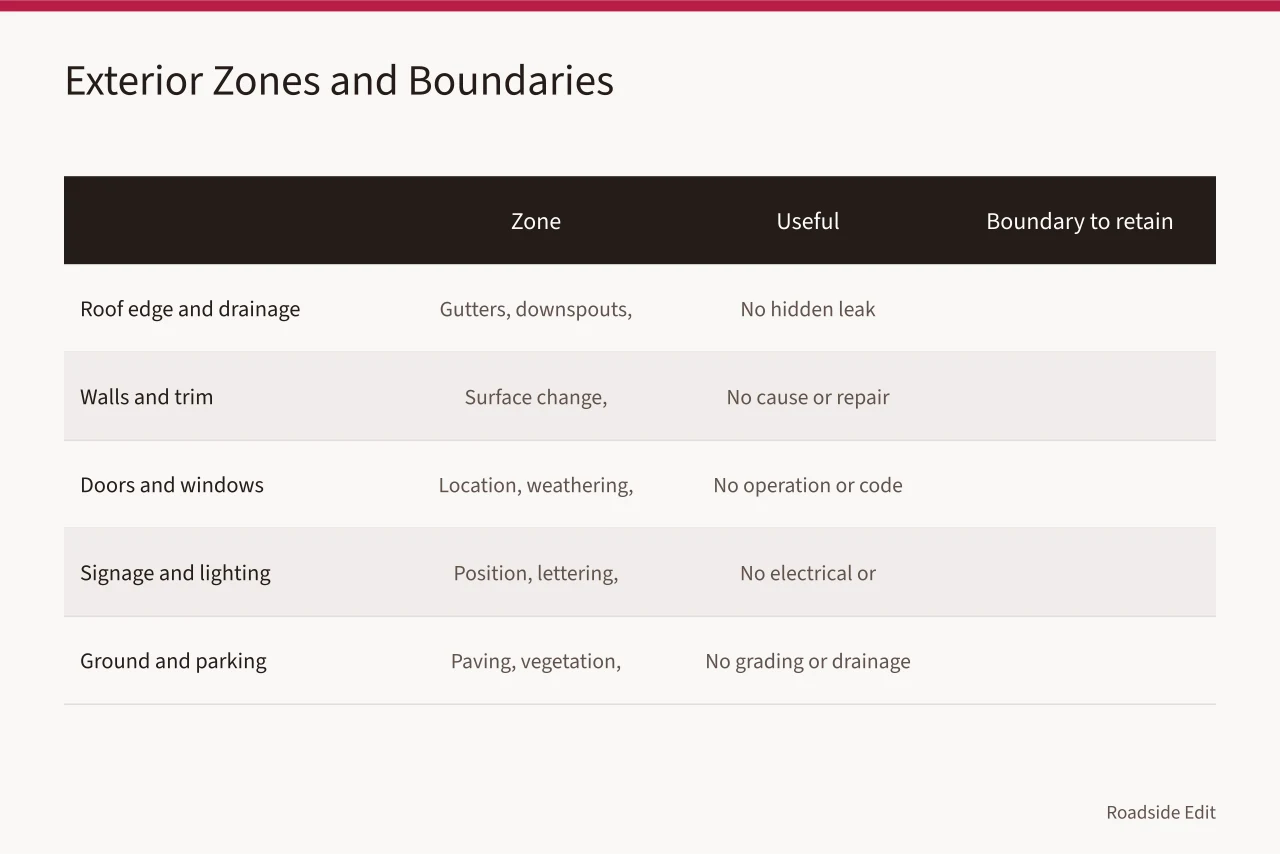
| Zone | Useful observations | Boundary to retain |
|---|---|---|
| Roof edge and drainage | Gutters, downspouts, overflow marks, debris, and visible discharge points | No conclusion about roof layers or hidden leaks |
| Walls and trim | Surface change, open joint, peeling coating, staining, or material transition | No cause or repair method |
| Doors and windows | Location, visible weathering, coverings, screens, and surrounding condition | No statement about operation, security, or code compliance |
| Signage and lighting | Position, visible lettering, fixture condition, and date of the image | No electrical or structural finding |
| Ground and parking | Paving, vegetation contact, standing water, curbs, and visible route changes | No grading or drainage diagnosis |
Use plain location words: "below the east downspout," "at the lower edge of the office wall," or "near the driveway-side entrance." A useful note lets another person find the same feature. Broad language such as "the building has water damage" does not.
Track water observations without naming the cause
Water clues deserve their own row in the record because a visible mark can relate to rain, irrigation, plumbing, condensation, cleaning, a past event, or something else. The observation should say what is visible, where it is, and whether the record shows recent weather or site conditions. It should not leap to a cause.
EPA moisture-control guidance addresses site drainage, foundations, walls, roof and ceiling assemblies, plumbing, and HVAC systems. Review EPA moisture-control guidance. The guidance is for building professionals. It helps a basic exterior record stay organized by reminding the writer that visible moisture questions can involve more than one part of a building.
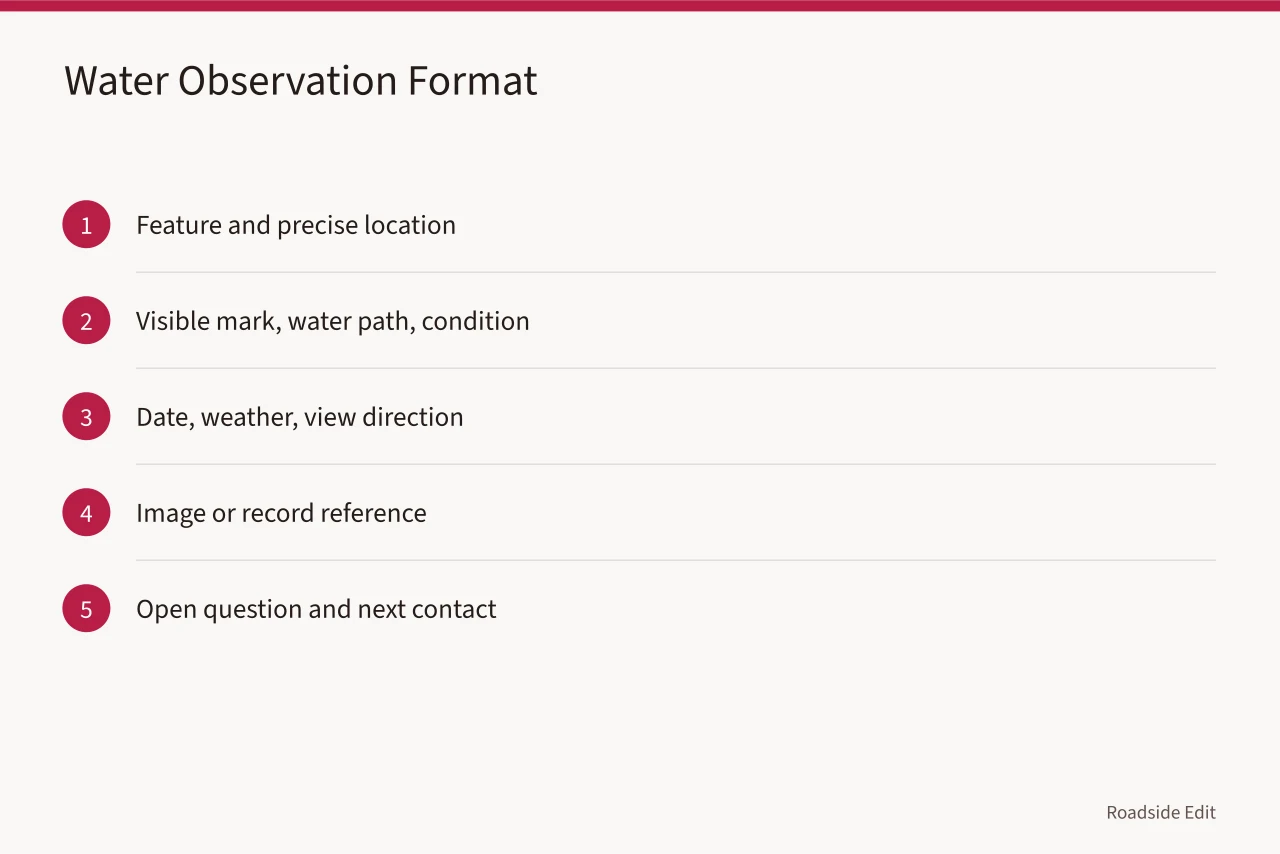
Use this observation format:
- Feature and precise location.
- Visible mark, water path, or condition.
- Date, weather, and view direction.
- Image or record reference.
- Open question and next responsible contact.
For example: "Darkened area visible below the west roof edge in the June 2027 street-view image. The image was taken after reported rain, but the source does not identify a cause. Refer to the property contact." This is much stronger than a sentence that attributes the mark to a roof leak.
The National Park Service's moisture brief discusses roofs, gutters, walls, openings, drainage, and vegetation as parts of recurring moisture maintenance. Read NPS Preservation Brief 39. It does not determine the reason for a condition at a particular motel. Use it to identify the visible area worth recording, then leave cause and treatment to the right project process.
Record entrances and circulation as a separate question
An exterior article can note the visible route from parking or a public sidewalk to an entrance. It should not say the route meets accessibility requirements based on a brief visit or a photo. Measurements, routes, changes in level, door operation, and applicable rules may need more information than the article has.
The U.S. Access Board says accessible routes connect site arrival points to the facilities and elements they serve. Read the Access Board guide to accessible routes. The guide explains ADA standards.
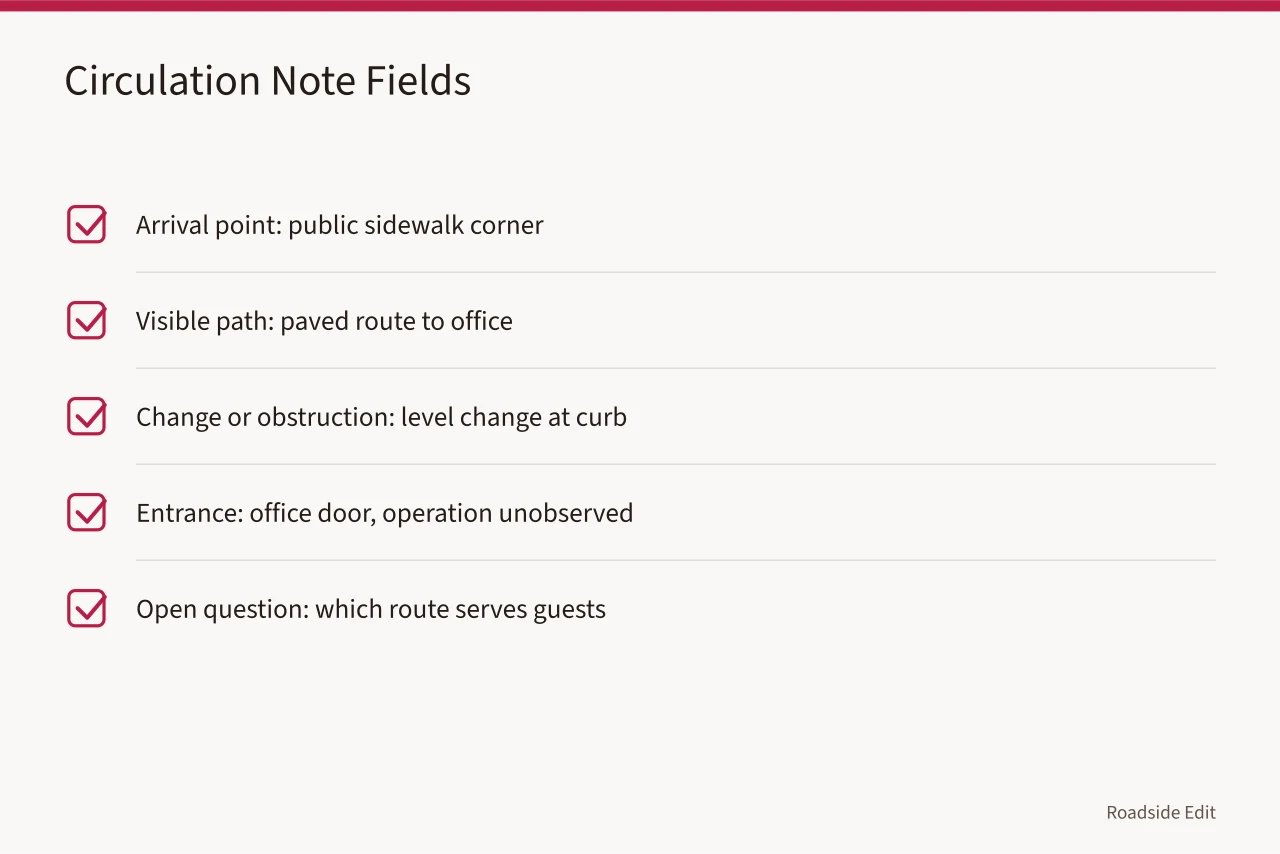
This checklist does not evaluate a motel's compliance. Its narrower use: prompt an observer to label the arrival point, visible circulation path, entrance, and any limit on the view.
| Circulation note | Example |
|---|---|
| Arrival point | "Public sidewalk at the northeast corner" |
| Visible path | "Paved route toward office entrance visible from public viewpoint" |
| Change or obstruction | "Level change visible near curb; exact height not measured" |
| Entrance | "Office door visible; operation and interior route not observed" |
| Open question | "Ask responsible party which route serves guests and what review applies" |
Do not stage a photo by crossing a barrier, entering an occupied area, or asking a guest to move. A complete image is never worth a bad access decision.
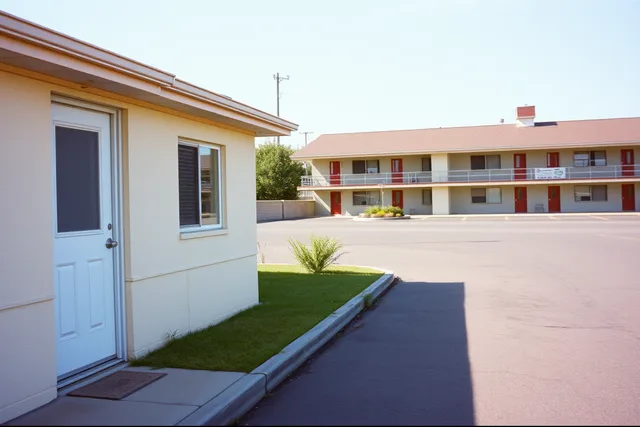
The image is visual context only. It does not establish the current condition, ownership, access, maintenance history, or regulatory status of any separate motel.
Keep signs, lighting, and character descriptions factual
Roadside motels often depend on an exterior sign or distinct facade. That makes those features tempting subjects for sweeping claims. A better article records the lettering, colors, material appearance, placement, date, source, and viewpoint. It does not say the sign is original, safe, permitted, structurally sound, or historically significant without direct evidence.
Use a simple sign record:
- Exact words and visible graphics.
- Position relative to the building or street.
- Image date and source.
- Visible change since a dated reference, if one exists.
- Unconfirmed questions about age, ownership, power, structure, or local approval.
The same rule applies to exterior lights. Note that a fixture appears present or absent from a view. Do not infer that an electrical system works, fails, or meets a requirement.
Turn an observation into the right next step
The exterior record should end with a small decision list. Some items will simply be filed for a later comparison. Others may need a source check, owner question, authorized visit, or qualified review. The record should name the next step without pretending the work is complete.
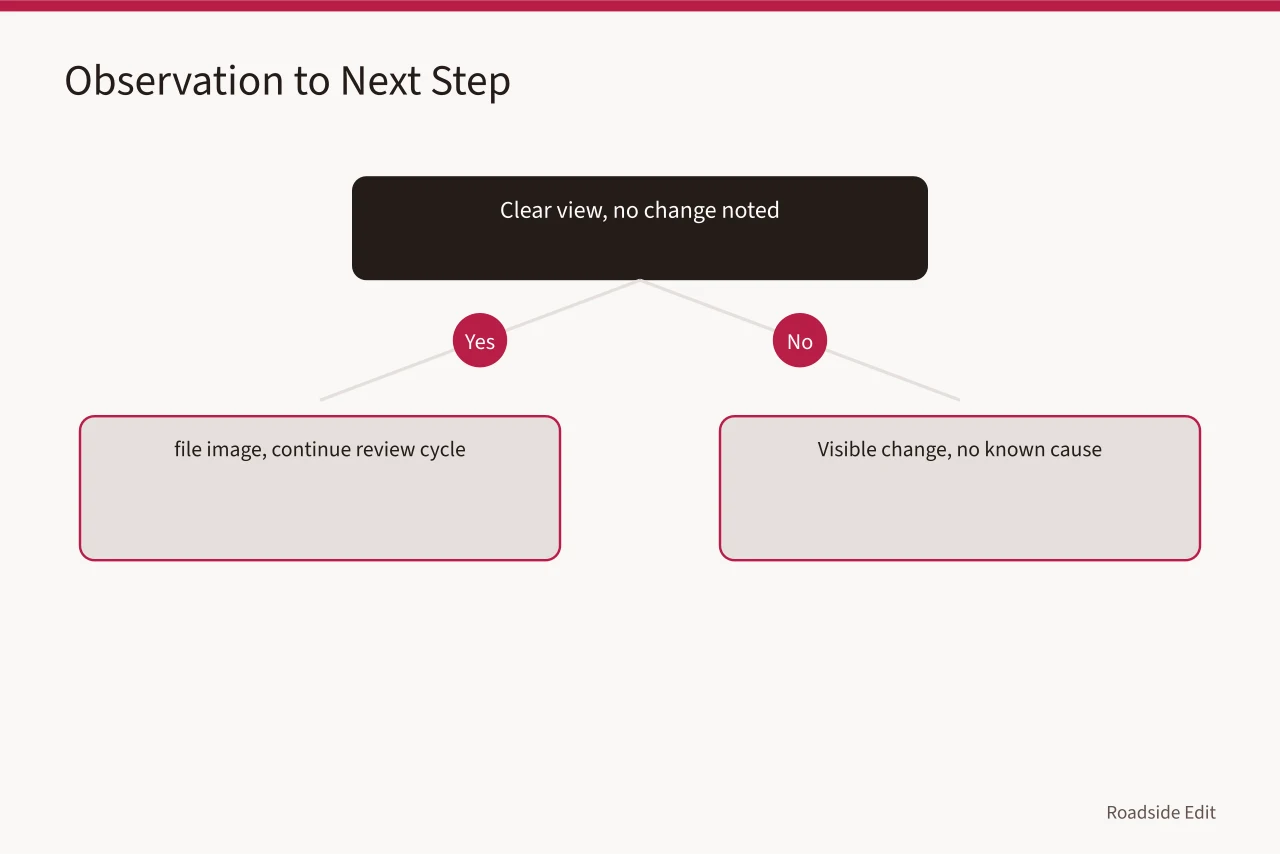
| Record result | Next step |
|---|---|
| View is clear and no change is noted | File image and continue the existing review cycle |
| Visible change has no known cause | Document the view and refer the question to the record owner |
| Claim depends on a historic date or status | Find a specific source before publishing the claim |
| Proposed physical work is mentioned | Open a separate project note with authority and scope |
| Access limit prevents a useful observation | Record the limit and do not guess about hidden conditions |
Before publishing, check that every strong word has support. Replace "unsafe," "abandoned," "accessible," "restored," "damaged," and "approved" unless the exact source supports the word for the motel and date described. A precise, limited record gives readers more than a dramatic guess.
Common questions
Can this checklist identify the source of a leak?
No. It records visible clues and their locations. A cause and response need the appropriate project-specific review.
Does a photo of an entrance prove accessibility compliance?
No. A photo can document a view. It cannot establish whether the applicable requirements are met.
What should happen when a photo has no reliable date?
Label it as undated and do not use it to establish a sequence of exterior changes.