Reviews
Part of Motel exterior fundamentals: how to document what you can see in 2027
Motel exterior fundamentals: comparison questions for a 2027 first record
A 2027 motel exterior record starts with dated views, named features and the questions a photograph can answer before any paint or sign treatment claim.
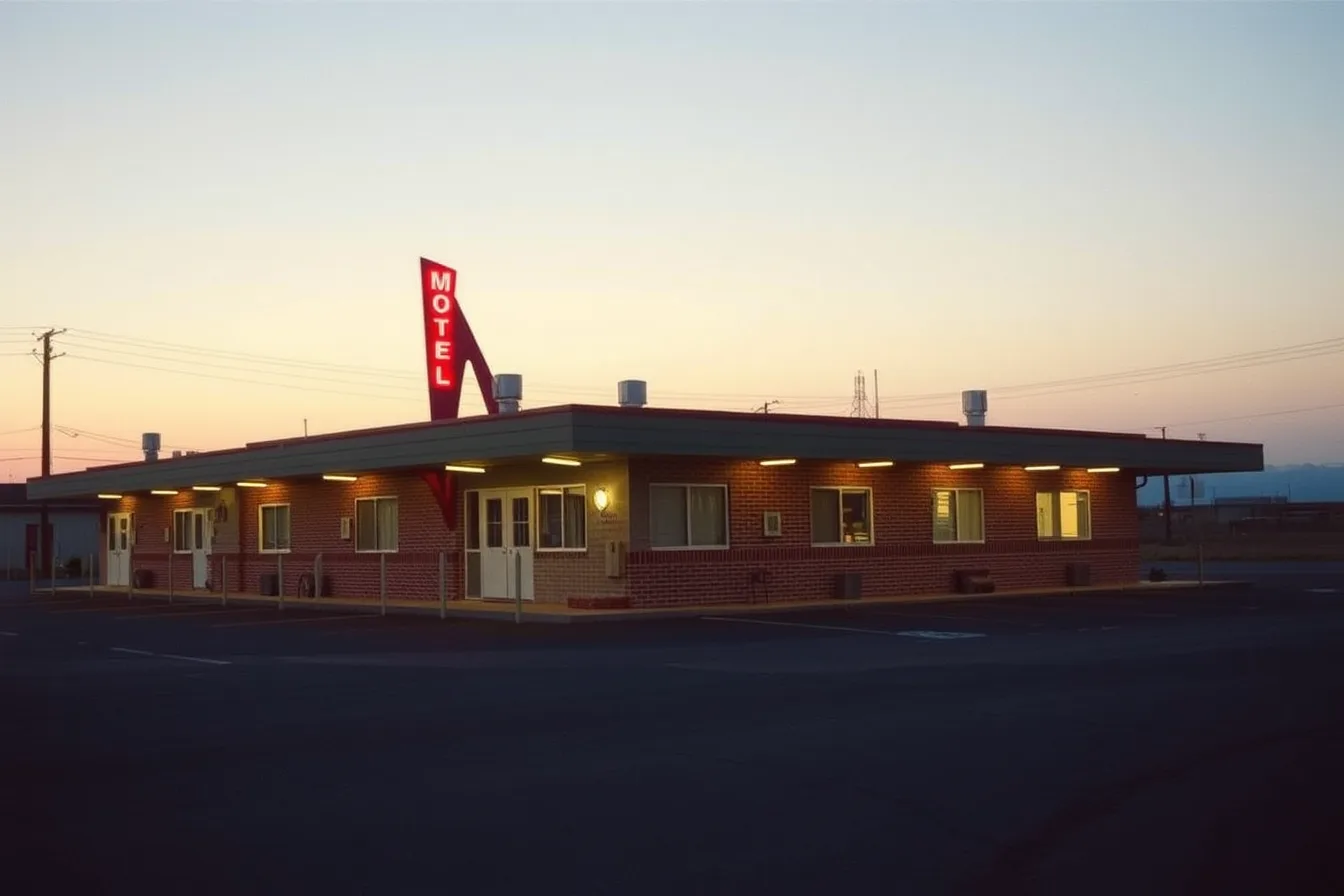
A 1962 motel front can carry a porcelain-enamel sign panel from Ingram-Richardson, a brick veneer wing, and a butterfly roof on one elevation. A 1974 rebuild of the same address may show a plastic-faced box sign, curtain-wall glazing at the office, and a flat canopy soffit.
Those are different buildings. A dated view that names the sign maker, the glazing system, and the roof form is a record. One that says "the motel exterior" is a caption.
This guide sets out the comparison questions that turn a first 2027 view into a usable record, and the ones that belong to a licensed engineer, a State Historic Preservation Office, or the owner instead.
The comparisons below name the products and places that document a feature: YESCO neon tubing, Federal Sign and Signal cabinets, Plexiglas faces, and Kawneer storefronts. Each gives a reader something to check against a dated view.
What to take away
- Name the feature and the decade before comparing two views: enamel versus Plexiglas sign face, brick veneer versus Kawneer-era storefront, butterfly versus flat roof.
- Write what the image shows and where it was taken from. A front elevation cannot speak for the rear wall or the drainage path.
- Keep water, openings, surfaces, and site access as four separate questions with four separate answers.
- Route condition, structural, electrical, and hazardous-materials findings to a licensed engineer, electrician, or environmental authority. Permit questions go to the local Authority Having Jurisdiction.
- Record the source page, the date accessed, and the limit of the view, so a later survey can correct the entry instead of deleting it.
- Name the source in the ledger. A Library of Congress HABS sheet, a Margolies archive frame, or a dated Mapillary capture beats an unattributed image.
Reading a dated exterior by decade: enamel, Plexiglas, and Kawneer framing
Roadside documentation sorts motels by construction era because the era predicts the material. A 1950s court usually shows masonry piers, a projecting canopy, and a pole sign with an exposed neon tube. The Society for Commercial Archeology, formed in 1977, publishes field work on that dating method.
Sorting by era is a first pass, not a finding. It tells you which features to look for and which questions to ask next.
A 1960s property often shows a flat canopy soffit, a box sign with an acrylic face, and a pool set behind the office.
A 1970s exterior may show curtain-wall glazing at the lobby and a mansard fascia.
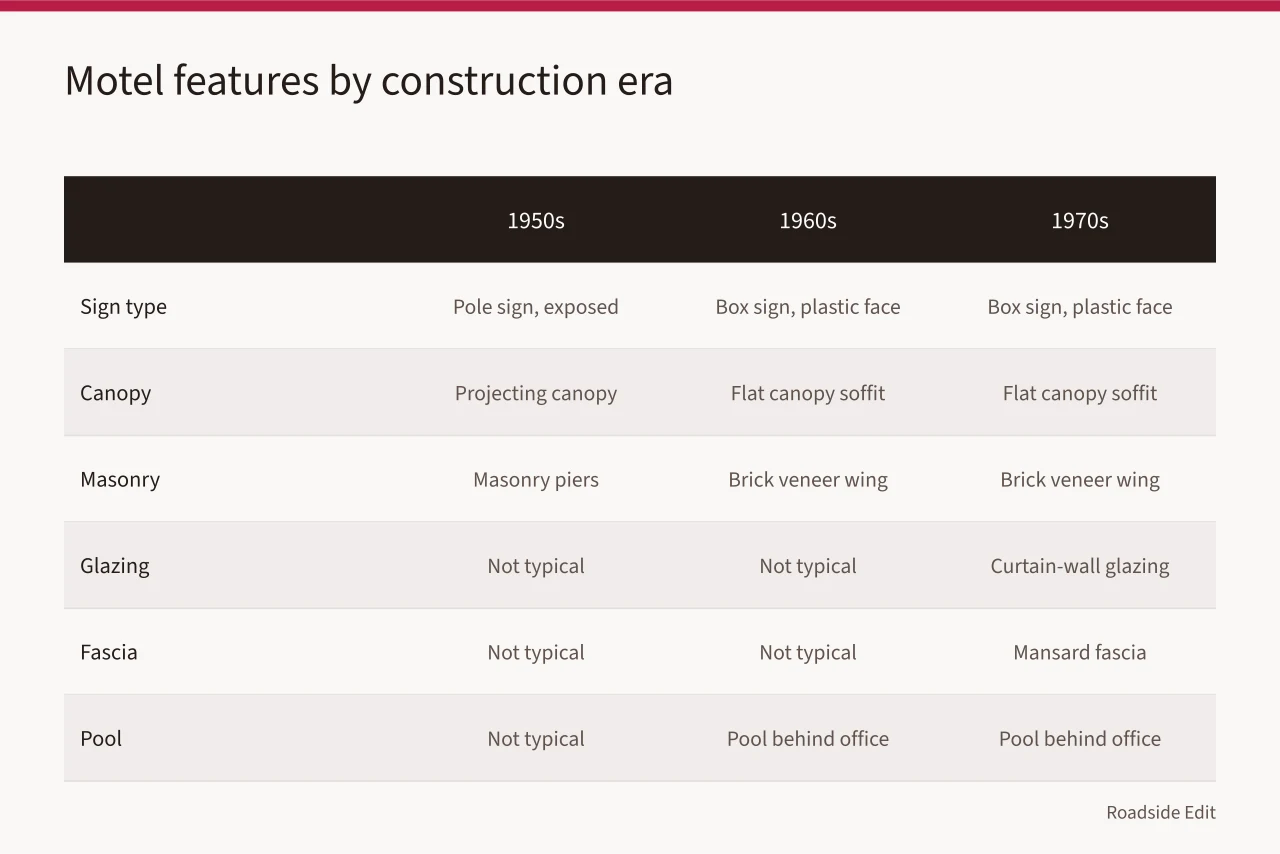
The comparison below is the one this article is built on. Each row pairs a feature with the decade it usually signals, a named maker or product where one is documented, and the check that separates a real match from a lookalike.
| Feature | Common era | What to check before comparing |
|---|---|---|
| Porcelain-enamel sign panel (Ingram-Richardson, Beaver Falls, Pa.) | 1930s to 1950s | Enamel chips at the mounting bolts; repaint over original enamel is a provenance loss |
| Plastic-faced box sign (Federal Sign and Signal and similar cabinets) | 1960s onward | Face material, cabinet depth, whether the original neon was replaced with LED |
| Exposed neon tube (YESCO fabrication) | 1950s to 1960s | Tube diameter (12 mm and 15 mm are common), transformer location, and who is licensed to open the raceway |
| Brick veneer wing | 1950s to 1960s | Veneer ties and weep holes are a structural question, not a visual one |
| Curtain-wall glazing at the office (Kawneer and similar aluminum systems) | 1960s to 1970s | Whether the frame is original to the stated date or a later refit |
| Butterfly roof | 1950s to early 1960s | Valley drainage path, which no single photograph resolves |
| Flat canopy soffit | 1960s onward | Soffit vent pattern and whether the canopy is original to the wing |
| Formica booth laminate and chrome-edge trim | 1950s to 1960s | Whether trim is original stock or a later replacement |
| Back-lit acrylic sign face (Plexiglas, trademarked by Rohm and Haas in 1933) | 1940s onward | Whether the sheet is original acrylic or a later cast replacement |
| Vitrolite solid-color structural glass | 1920s to 1950s | Whether the panel is opaque structural glass or painted back-up glass |
| Owens-Illinois glass block | 1930s to 1950s | Mortar joints, and whether the block is original or a later repair |
| Insulated glass unit (Thermopane, a Libbey-Owens-Ford brand) | 1950s onward | Whether the unit is original or a replacement, which the glass stamp can show |
A link hung on a random noun in a list does not describe where it goes. The same is true of a feature list: name the sign face, the glazing, the roof form, and the trim, then say what each one lets you compare.
Public records tie these features to real properties. The Blue Swallow Motel in Tucumcari, New Mexico, opened in 1939 on Route 66 and keeps a restored neon sign. El Vado Motel in Albuquerque, built in 1937, reopened in 2018 with its motor court intact.
The Wigwam Motel in Holbrook, Arizona, is listed on the National Register. The Coral Court Motel in St. Louis, built in 1941 and 1942, was demolished in 1995, which leaves dated photographs as the main record of its glass block front.
The opening questions that keep a record honest
Before any comparison, answer six questions about the source itself. They are the difference between a record and a claim.
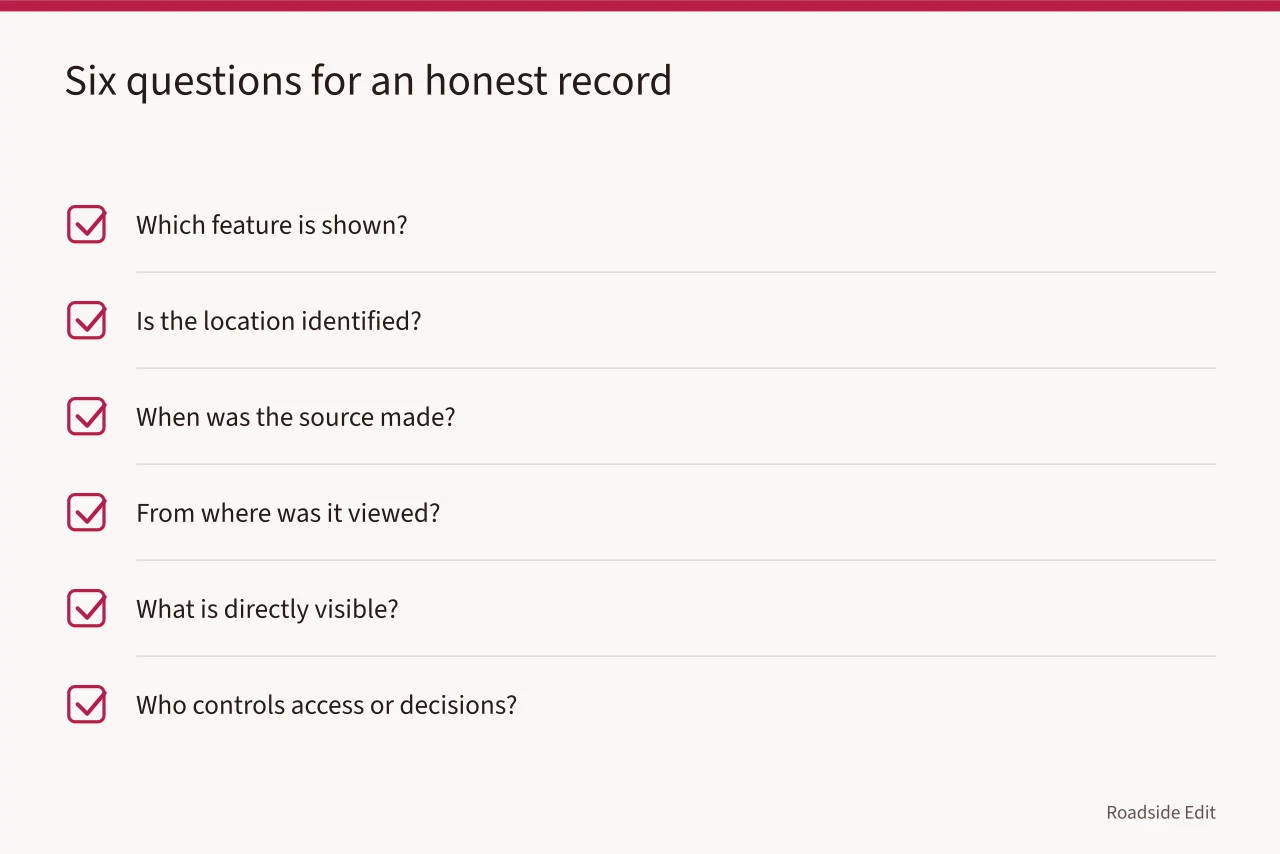
| Record question | Why it matters |
|---|---|
| Which feature is shown? | Stops a general view from becoming a statement about every wing. |
| Is the location identified? | Keeps two similar courts on the same highway from being merged. |
| When was the source made? | Gives the observation a time boundary. |
| From where was it viewed? | Explains what the source cannot show. |
| What is directly visible? | Separates observation from a condition finding. |
| Who controls access or decisions? | Names the next responsible contact. |
For example, "a dark stain is visible below the upper walkway in this 2026 street-view image" is an observation. "The walkway has a leak" is a diagnosis that needs a project-specific review. The first sentence gives a reader something to check, and the second creates a claim the image cannot carry.
If a view has no clear date or location, label it undated. Do not use it to prove a sequence.
Water, weather, and the five-step observation card
Water is the most common exterior question and the easiest to overstate. A photograph can show a roof edge, a flashing line, a gutter, or a downspout.
It can also show a grade change or a paved drain. It cannot show the path water took or when it started.
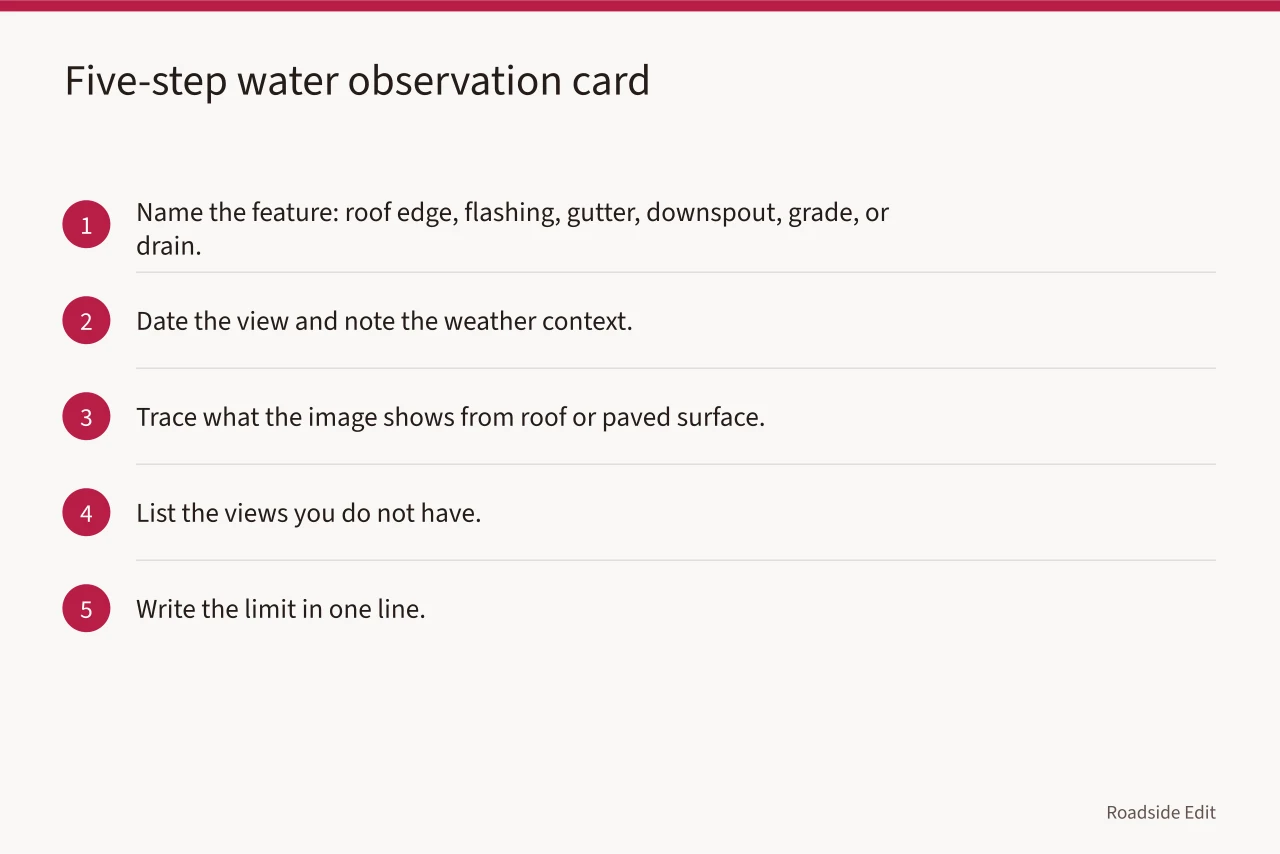
Use this card for each view. It is an observation record, not a repair plan.
- Name the feature: roof edge, flashing, gutter, downspout, or grade. A paved drain counts too.
- Date the view and note the weather context if the source states it.
- Trace what the image shows from the roof or paved surface toward the visible area.
- List the views you do not have: rear wall, valley, below-grade, or interior side.
- Write the limit in one line: "This view does not establish the source or timing of the stain."
The National Park Service advises that exterior maintenance of a historic building begins with a clear understanding of the building and its materials, and that deterioration should get prompt attention. Read Preservation Brief 47 on exterior maintenance.
That brief is not a repair specification for any motel. It supports one careful question: what evidence is needed before choosing a response?
The U.S. Department of Energy notes that windows, doors, and skylights affect a building's energy performance and publishes general efficiency information. Review the Department of Energy window and door guidance.
The National Park Service recommends starting weatherization decisions with an energy audit and tailoring the plan to the building, site, climate, and occupancy. See the NPS weatherization guidance.
Both sources describe the general case. Neither decides a specific motel's scope, code obligations, or treatment choice.
What openings and glazing can and cannot tell you
Doors, windows, louvers, screens, and curtain-wall bays shape the visual character of a motel. They also touch comfort, security, accessibility, and ventilation, and a public image settles none of those.
Under the 2010 ADA Standards for Accessible Design, accessible routes, parking, and entry thresholds at places of lodging carry dimensional requirements. Those numbers live in the Standards and in the adopted local code, not in a photograph. Confirm any accessibility question with the Authority Having Jurisdiction.
Frame and glass stamps date a replacement better than a paint color does. A Thermopane stamp points to Libbey-Owens-Ford production, and a frame tag reading Kawneer points to that maker's aluminum storefront line.
Ask whether the opening matches the image's stated date, whether a storm panel or screen is visible, and whether the wing repeats one unit pattern. Do not call a replaced window a loss or an improvement without a dated source and project context.
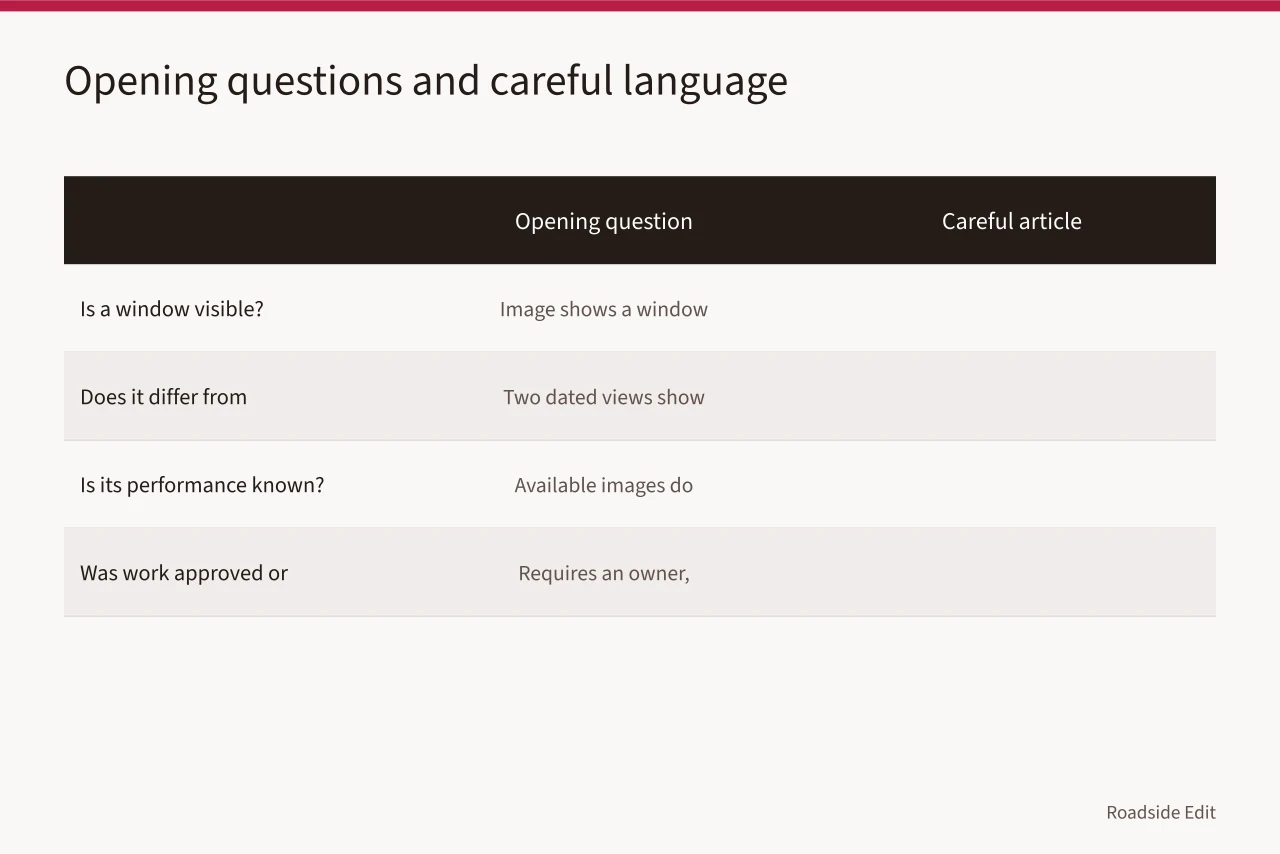
| Opening question | Careful article language |
|---|---|
| Is a window visible? | "The image shows a window with a metal frame." |
| Does it differ from another source? | "The two dated views show different visible frames." |
| Is its performance known? | "The available images do not establish performance." |
| Was work approved or completed? | "That requires an owner, permit, or project record." |
| Which product is named on the frame or glass? | "The frame tag read Kawneer and the glass stamp read Thermopane." |
Surfaces, finishes, and the limits of a photograph
Paint, masonry, stucco, and wood are tempting subjects for a quick conclusion. Metal panel and sign face are tempting too. Color shifts with light and image processing. A crack may be cosmetic or may need a closer look. Missing paint is visible, but the substrate and the treatment are not.
Materials carry their own dates. Plexiglas acrylic sheet, trademarked by Rohm and Haas in 1933, replaced glass in sign faces from the 1940s on.
Formica laminate, in production since 1913, covered diner booths and counter tops. Vitrolite, an opaque structural glass, faced storefronts and motel fronts from the 1920s into the 1950s.
Over-painting original porcelain enamel is a documented loss in roadside preservation, because the enamel surface and its chipped edges are part of what dates the sign. Ingram-Richardson panels show that chipped edge as a fired coat over steel.
Replacing neon with LED changes the tube diameter and the transformer load. It also removes the evidence a later survey would use. Both decisions belong to the owner and the project team, not to a caption.
Start with the narrowest description: location, feature, date, visible pattern. Then state what the next answer needs: closer photographs, owner-authorized access, a material record, or a review matched to the scope.
Age alone does not establish National Register eligibility, Section 106 review, or any protection. Those determinations belong to the State Historic Preservation Office, the tribal historic preservation officer, or the local landmarks commission, working from the adopted ordinance and the primary record.
The site around the building
The exterior extends to the arrival path. A driveway, parking surface, curb, and sidewalk shape how a visitor reaches the property. A retaining edge, pump-island footprint, forecourt drain, and roadside setback shape how a visitor sees it. They also raise questions appearance cannot answer: access rights, traffic exposure, drainage, and flood hazard.
FEMA's National Flood Hazard Layer is the federal tool for viewing flood hazard information. Check FEMA's National Flood Hazard Layer information.
It does not decide whether a motel is safe, insurable, damaged, or subject to a project requirement. It gives a reader a specific starting point instead of inferring hazard from a low-looking lot or one storm image.
Sanborn fire insurance maps and NETR Historic Aerials show footprints and parking layouts at dates a single photograph cannot. Sanborn coverage runs from the 1880s into the 1950s in thousands of towns, and Historic Aerials sells dated aerial sets, often from the mid-20th century forward.
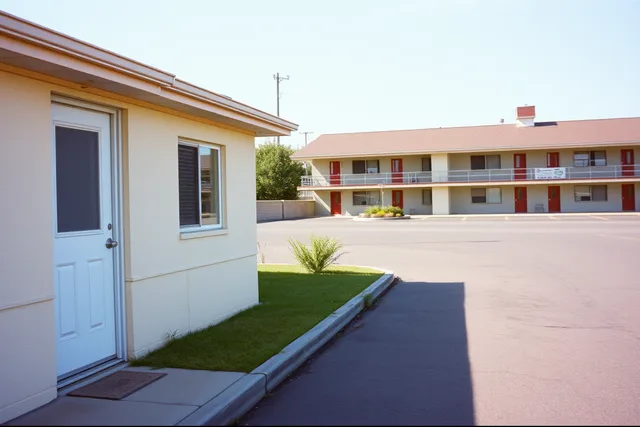
The site is shown next to a paved road in this image. Do not write "the site has adequate access." Access rights, easements, and cross-border import duties on salvaged parts are questions for an attorney, an accountant, or a customs broker. The current figures are published by the agency that sets them.
Keeping the record useful
Build a short exterior ledger so the article does not repeat a statement after its source changes or disappears. For each item, keep the source page and the date accessed. Also keep the creator if known and the location the source states. Also keep the exact observation and an uncertainty note.
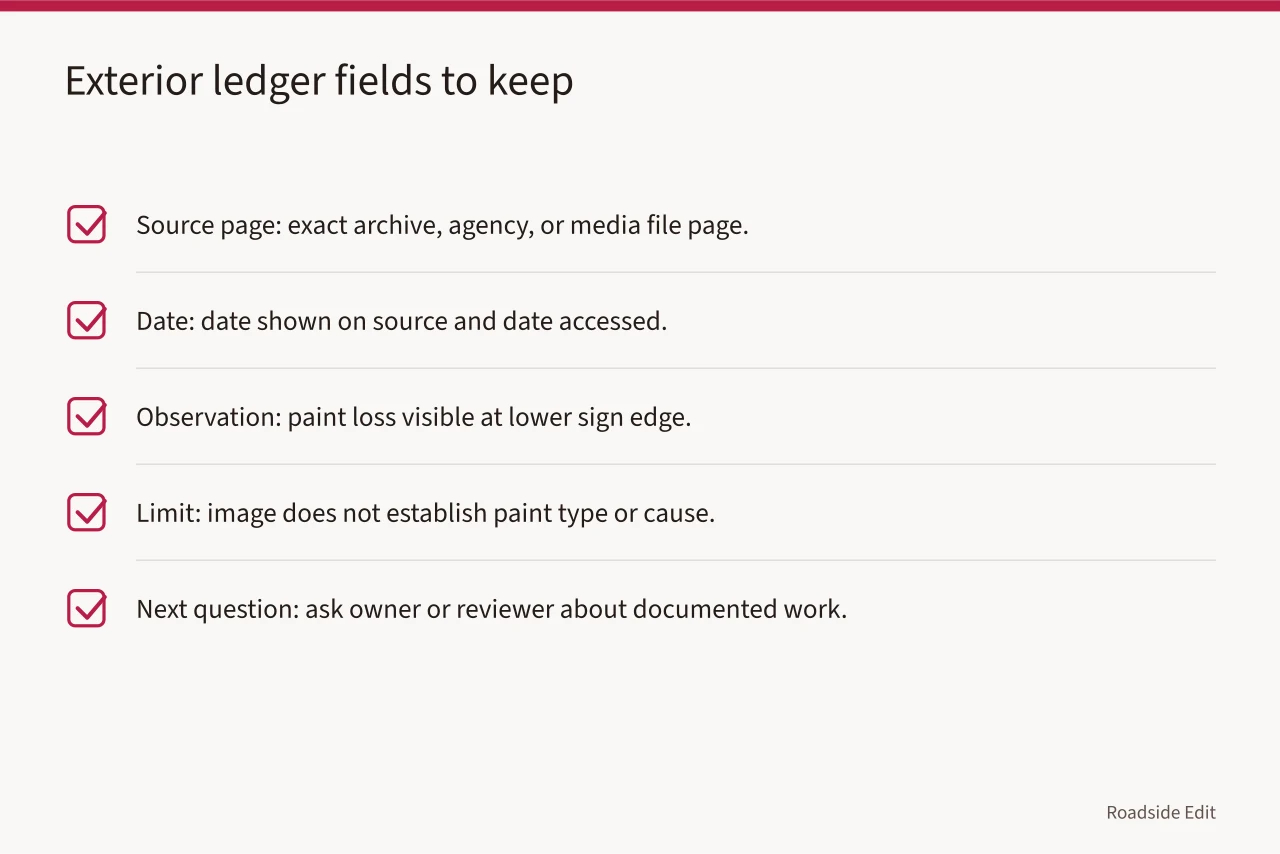
| Keep | Example |
|---|---|
| Source page | The exact archive, agency, or media file page. |
| Date | Date shown on the source and date accessed. |
| Observation | "Paint loss is visible at the lower sign edge." |
| Limit | "Image does not establish paint type or cause." |
| Next question | "Ask the owner or responsible reviewer about documented work." |
Citable pages come from named collections. The Historic American Buildings Survey, begun in 1933, files measured drawings and large-format photographs. The John Margolies Roadside America Photograph Archive at the Library of Congress holds thousands of digitized roadside images. NPGallery carries National Register records.
If an owner, operator, or contractor supplies information, attribute it. Do not present a submitted description as an independent inspection result. If a listing is paid, disclose it.
The image is illustrative. It does not establish the current condition, ownership, safety, or project status of any property discussed here.
A worked example: comparing a 1968 postcard with a 2026 street view
Take a 2026 street-view capture and a 1968 postcard of the same address. The postcard shows a pole sign with exposed neon and a projecting canopy. The street view shows a box sign with a plastic face and a flat soffit.
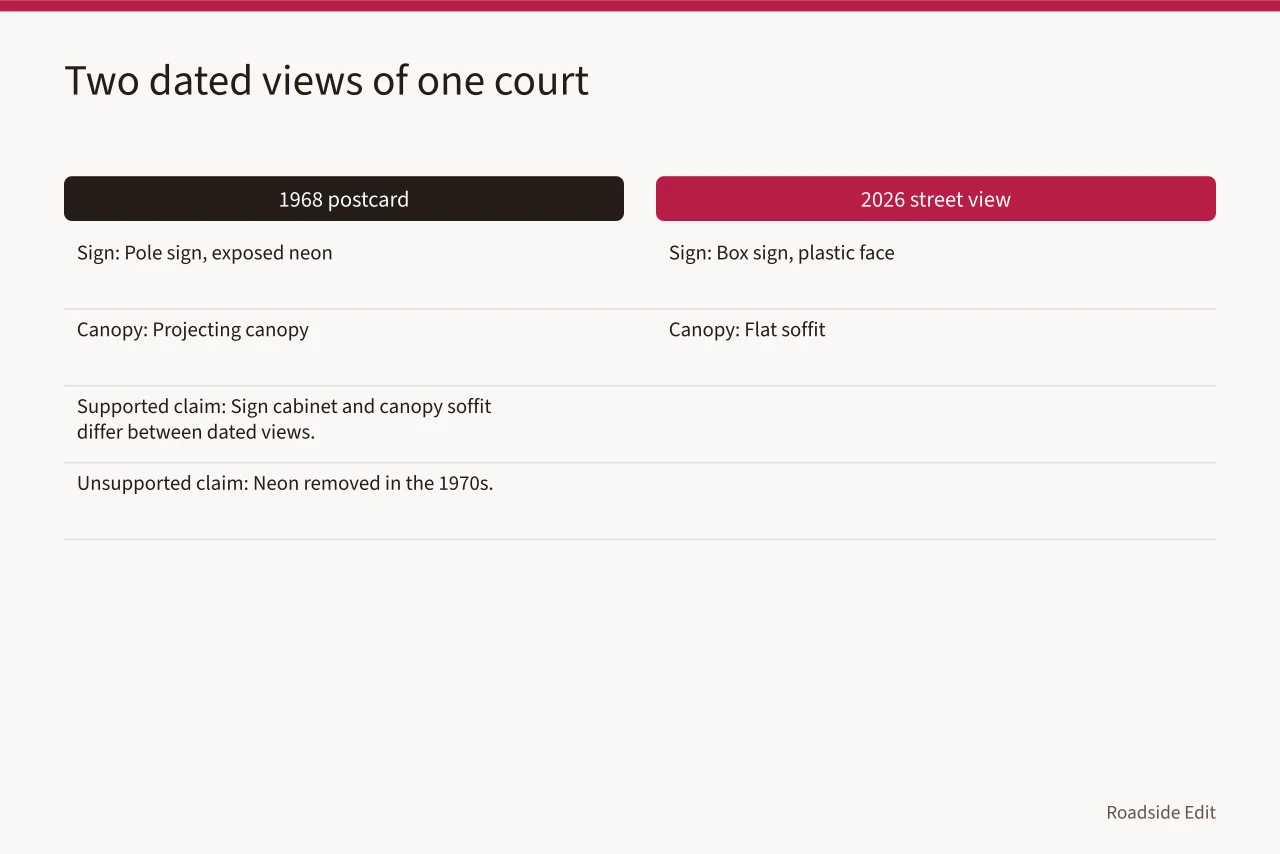
The comparison supports one sentence: the sign cabinet and the canopy soffit differ between the two dated views. It does not support "the neon was removed in the 1970s," because no record in hand gives that date.
The next step is a survey day at the property with owner permission, or a search of the local newspaper archive and the State Historic Preservation Office file for a dated alteration record.
Cost structures for that work split into survey days, travel, and fabrication if parts are needed. Shops quote per project rather than per article. Quotes typically break into a day rate plus travel, a per-tube charge for custom neon bends, and a per-square-foot charge for a replacement acrylic face.
For the wider treatment sequence, motel exterior fundamentals for a 2027 record covers the feature-by-feature baseline this comparison assumes. When the record grows past one building, fold it into a roadside architecture maintenance plan so the next survey inherits the dates and limits instead of starting over.
Common questions
Can two public photos prove that a repair happened?
No. They may show a visible difference between two dated views. Cause, date, and scope need an owner record or a permit file. A survey answers the rest.
Should an article rank exterior treatment options?
Only with comparable criteria and support for the claim. Otherwise describe the visible differences and state what a project-specific decision would require.
Does a visible crack prove a structural problem?
No. A photograph documents the visible feature. A licensed engineer makes the condition finding, and the Authority Having Jurisdiction sets what the adopted code requires.
Where do the dated views come from?
Library of Congress collections such as the John Margolies archive, HABS, and HAER supply dated views. Sanborn maps, local newspaper archives, and dated street-level imagery on Google Street View or Mapillary fill gaps. Each source carries its own limits.
What if a key detail is missing?
State the gap and name the owner, record, authority, or qualified reviewer who can address the next question. An incomplete record that says so is more useful than a confident caption.