Guides
Part of Motel exterior fundamentals: how to document what you can see in 2027
How to keep a motel exterior records guide that holds up in 2027
A motel exterior records guide holds up in 2027 when every claim, image, correction and inspection photo keeps its own dated source note file.
A folder of photos named "motel new" and "motel final" answers nothing. It cannot say when a frame was shot, from where, or what it was meant to show. A working record gives every observation a dated home and keeps the evidence beside the claim it supports.
This guide covers editorial records only: image fields, alt text, observation logs, and the correction trail behind published motel exterior articles. It is not a permit file, a nomination, or a condition assessment. For the wider project record, start with planning a motel exterior project.
What to take away
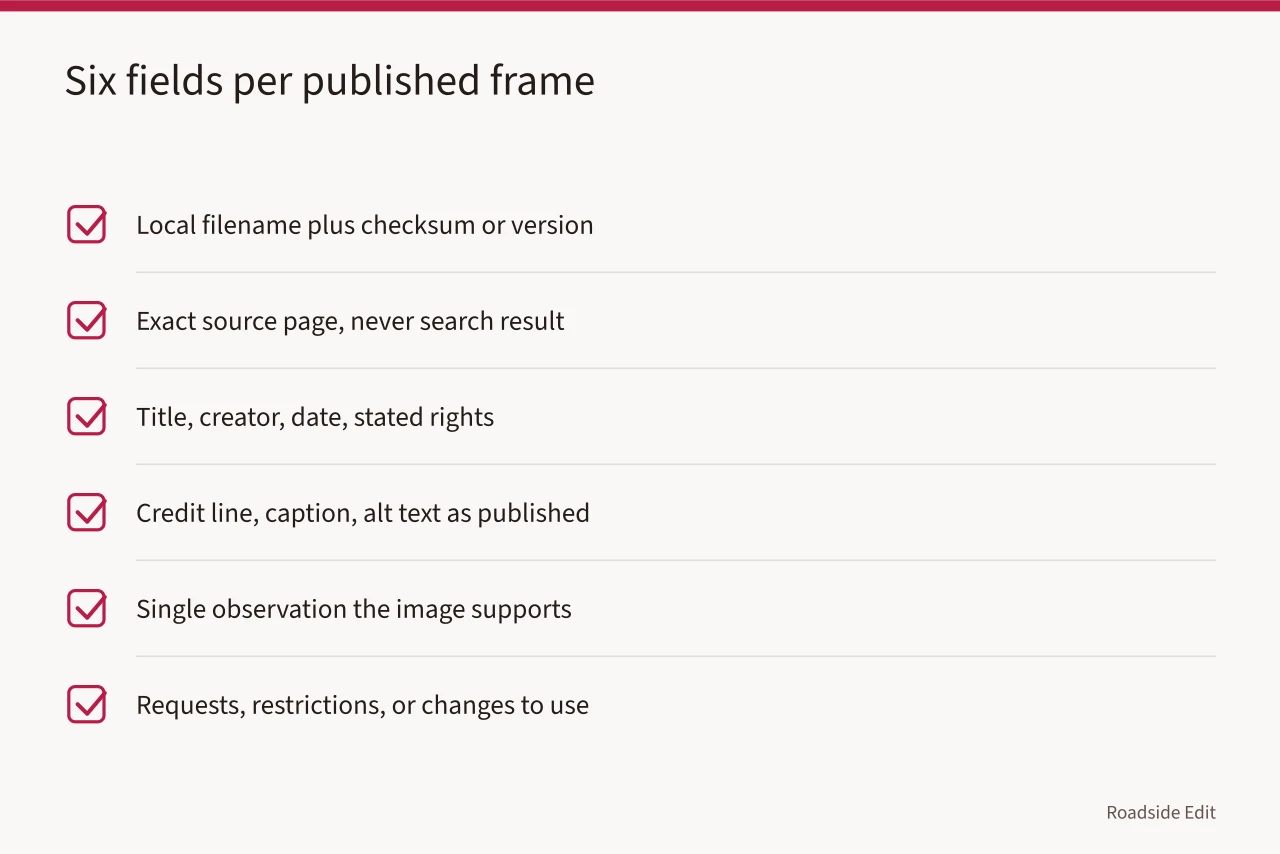
- Give each image six fields: file, source page, credit, caption, alt text, and the one thing it may support.
- Write alt text for what the image contributes, not for the claim you wish it proved.
- Log observations with a viewpoint and a date, and record "not observed" rather than writing around missing access.
- Keep the original claim, the new evidence, and the decision together when you correct a published line.
- Reopen the ledger before any update, so a current business note never overwrites a dated historical statement.
The image record is the part most guides skip
A photo of a motel exterior carries four separate facts: the file, the source page, the credit, and the reason you published it. One cannot stand in for another. A creator name on a source page does not grant reuse, and a caption does not prove condition.
Section508.gov defines alternative text as the meaning of an image in digital content, written for its purpose in that context. Read the federal guidance on alternative text. Write alt text for what the frame contributes to this article. Do not use it to assert a condition the frame cannot show.
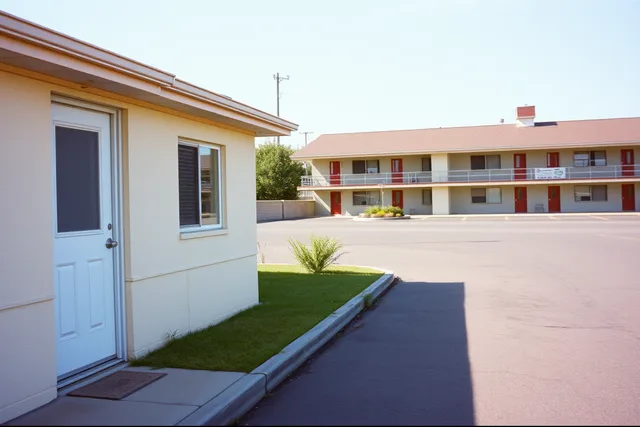
The Rialto frame is visual context. It says nothing about the current condition, ownership, or operating status of any other motel you write about.
Alt text that describes the frame, not the argument
Alt text fails in two directions. It either repeats the caption word for word, or it smuggles in a conclusion. "Cracked stucco shows deferred maintenance" is a diagnosis. "Stucco wall below the office window, hairline crack running to the sill" is what a sighted reader sees.
Keep alt text under about 125 characters where the frame allows it. Name the building element, its position in the frame, and the light if it matters. Skip "image of" and skip the motel's marketing name unless the sign is the subject.
The caption does different work. It says why the frame is here and what it cannot show. A caption reading "Canopy soffit, east bay, photographed from the public sidewalk" tells a later editor the viewpoint without a phone call.
The observation log holds what a person saw
An observation log records what was visible from a stated place on a stated date. It never turns a stain into a repair finding or a lit sign into proof of trading. Add a "not observed" field instead of writing around a locked gate.
| Observation field | Example entry |
|---|---|
| Date and time | "May 2027, late afternoon" |
| Viewpoint | "Public sidewalk, north side of the road" |
| Visible feature | "Roof edge above office entry" |
| Visible condition | "Darkened area below gutter line" |
| Limit | "Roof surface and rear wall not observed" |
| Next action | "Keep dated image; open question to record owner" |
Keep guest information, vehicle plates, access codes, and private contact details out of any public record. Retain only what research, correction, or publication genuinely needs, and route anything sensitive through the publisher's privacy process.
A correction log beats a silent edit
Corrections are ordinary publication work. The log exists to stop two opposite failures: an error left standing because nobody remembers why the sentence was written, and a quiet deletion that leaves readers unable to see what changed.
National Archives information-quality guidance corrects errors after publication, issues a correction notice, and tracks the change. Read NARA's information-quality guidelines. That policy governs NARA products. A publisher can run a simpler version: original claim, new evidence, action, date.
| Correction field | What to record |
|---|---|
| Reported issue | The exact sentence or caption questioned |
| Source received | Page, document, or message reviewed |
| Review result | Confirmed, corrected, clarified, or not changed |
| Article action | Text revised, image removed, note added, or no update |
| Date and reviewer | Decision date and responsible editor |
If the evidence is thin, do not manufacture a correction. Narrow the sentence or mark it unresolved and keep researching. A correction should raise accuracy, not introduce a fresh unsupported claim.
Where the record lives, and why it stays together
One folder or workspace per subject: a single motel, a single sign, a single exterior project. Label it with a property name and city, an internal project number, or another stable identifier. A broad place name fails once two motels on the same strip share it.
The main file holds the current article and a short index. Supporting material sits in subfolders, and the index points to each one. The aim is not a grand archive. It is to stop source pages, original images, submitted text, and update notes from drifting away from the article they explain.
National Archives guidance holds records about a particular project, transaction, study, or subject together so their context survives. Read NARA's recordkeeping requirements. That rule covers federal records, not a motel article, but the habit travels: a later editor should find the article, its sources, and its history in one place.
Submitted material stays labelled
Owners and publicists send current descriptions, opening dates, and photographs. Those can refresh a listing. They should never slide into the editorial record as though an independent source confirmed them.
Mark each item as submitted. Store who sent it and the date. Store the exact supplied wording or asset. Store any paid-placement or affiliate relationship. Store what the article attributes to the submitter. Store what a separate source confirmed. A business statement can then be revised or withdrawn without disturbing unrelated research.
Review before you republish
Open the image records and the observation log before touching the article. Check whether the claim is time-sensitive, whether the source page still supports the wording, and whether a replacement image has a complete source path.
This pause stops a current business update from overwriting a dated historical statement, and stops a general exterior frame being used as proof of a specific condition.
For the maintenance side of the same file, the motel exterior care checklist covers seasonal work and written records of completed work. National Park Service Preservation Brief 47 treats regular inspection, monitoring, and written records as part of exterior maintenance on historic buildings.
Read NPS Preservation Brief 47. It sets no recordkeeping rule for your motel, but it draws the line this guide draws: record a completed activity only when evidence says it happened, and keep observation separate from work history.
Run this check before every update, and again when a new editor takes over:
- Title, date, and meta description still match the article's scope.
- Every changed claim has a rechecked exact source.
- A replaced image has a full local and external record.
- Submitted text is still labelled as submitted.
- The correction log carries every material change.
- Superseded evidence stays in the working file unless retention rules say otherwise.
The same discipline applies to interior records, where the diner interior safety checklist sets out the fields a booth or counter survey should carry.
Common questions
Should the record hold every page opened during research?
No. Keep the specific pages that support material claims, plus notes on conflicts and limits. An unfiltered list makes verification slower, not faster.
What must an image record prove?
It identifies the local file, the exact source page, stated credit details, and the published caption. It also identifies the alt text and the one purpose the image serves in the article.
When is a correction worth logging?
Whenever a published claim, caption, or credit changes. Log the original wording, the evidence, the action, and the date, even when the outcome is no change.
How often should the whole file be reviewed?
Time-sensitive claims and images get checked before any update or republish. The full file gets a pass when a new editor or project owner takes responsibility.