Guides
Part of How to run a motel exterior case study method with clear sourcing
How to keep motel exterior case study records clean before 2027 handoffs
A motel exterior case study packet pairs each claim with its source, status word, and photo limit so the next editor can retrace the story alone.
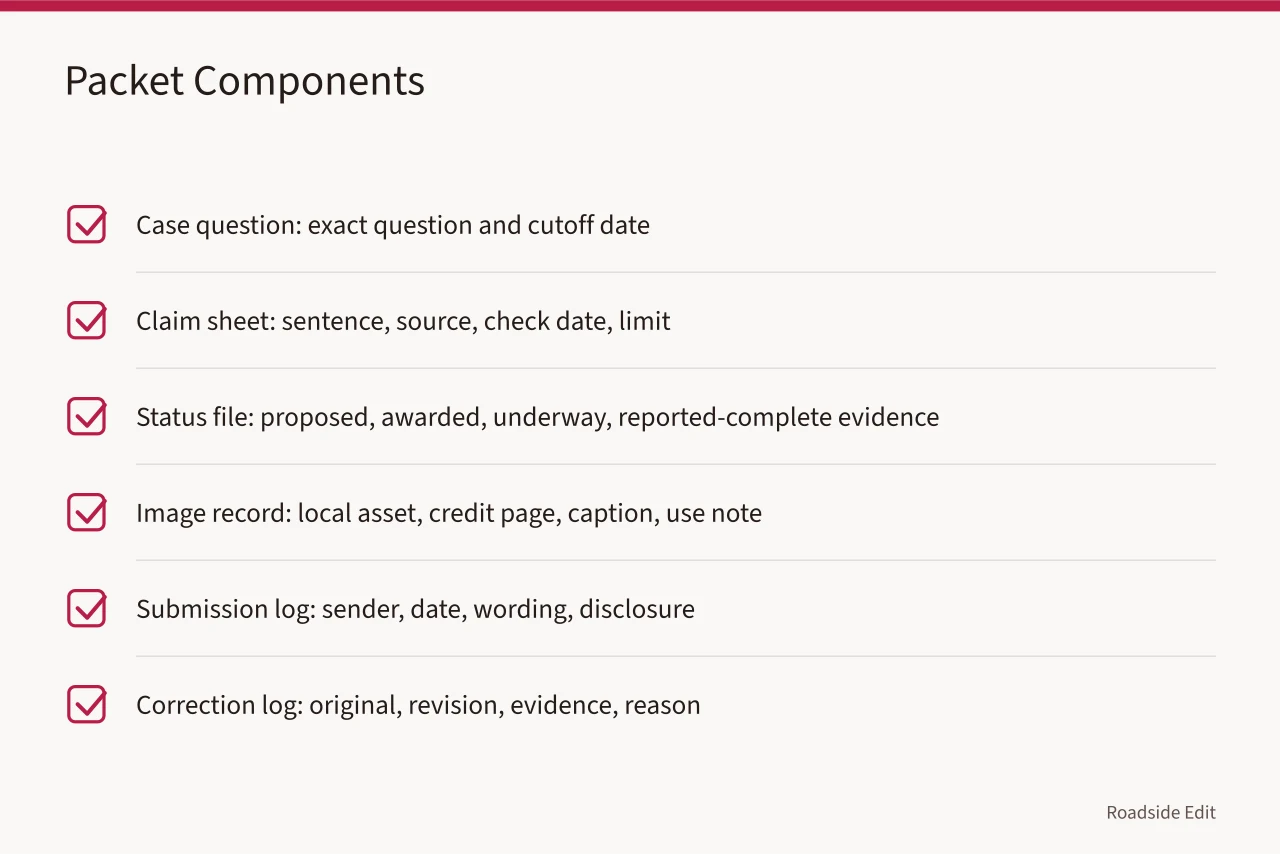
A case study record should let a second editor retrace the story without the first writer's memory. A folder of links will not do it.
Every source needs a role: historical context, project-stage evidence, attributed update, image credit, or correction. Without roles, an award becomes a completion claim and a 1950s sign photo becomes a statement about the building today.
This is a working method for case-study evidence. It does not judge a building's condition, decide whether work is appropriate, or assign legal or technical responsibility for a property.
What to take away
- Open one packet per case question, with a cutoff date, not a folder for all Route 66 material.
- Keep the status source beside the exact status word it supports.
- Label owner and vendor updates as attributed submissions until an independent source confirms them.
- Hold image credit, caption, and source page in one record.
- Log a correction as a new dated event, never as a silent edit.
Open a packet for one bounded question
Write the question so it can be answered from records: "What did available records say about the announced sign project as of July 2027?" That closes the story at a date instead of guessing an outcome.
The National Park Service's Route 66 roadside architecture perspective covers how history, setting, and public interpretation shape a roadside property's story. Treat it as background, not as a condition report. In the packet, mark such a source as historical context so nobody reads it as evidence of present ownership or finished work.
Give each status word its own record
An announcement, a grant award, a quoted plan, a construction update, and a completion report are five different records. Keep the source next to the exact status word the article uses.
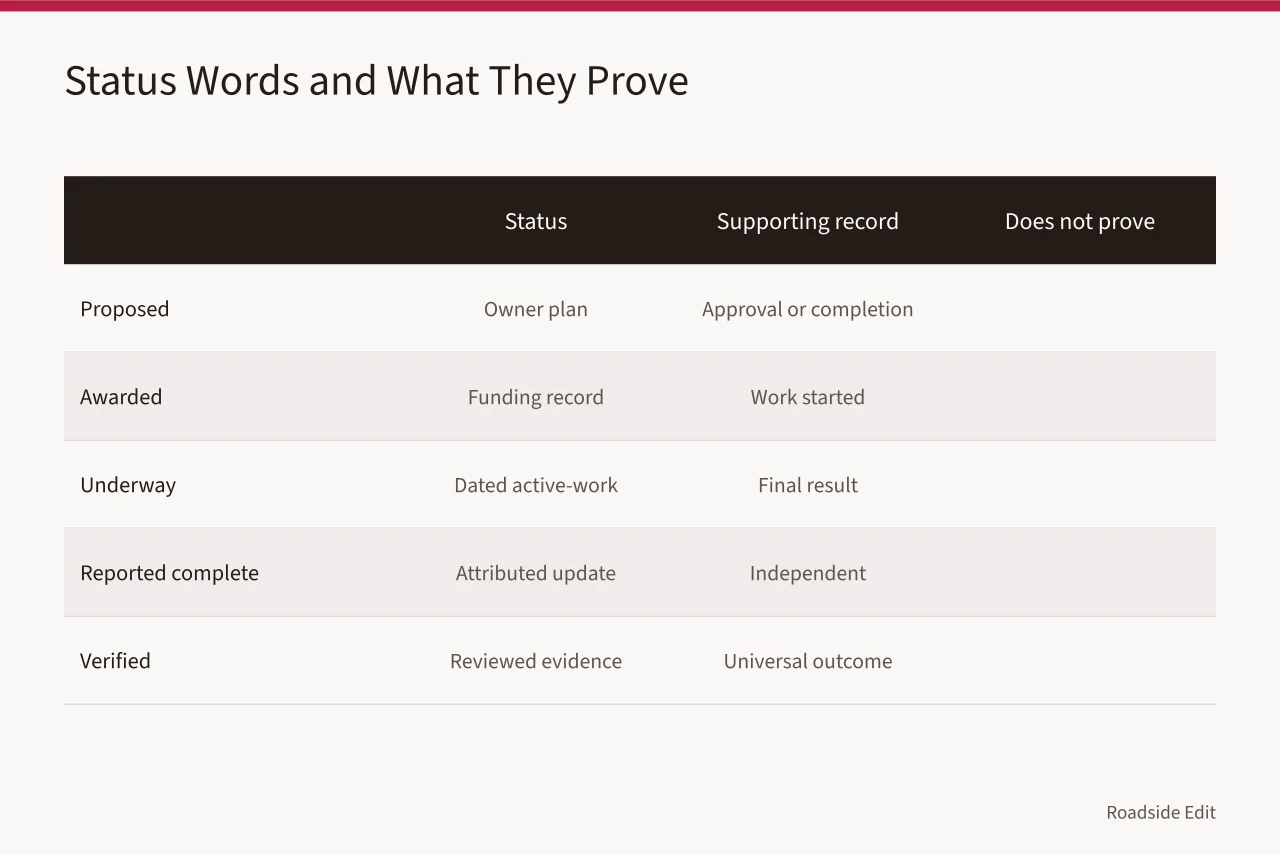
The National Park Service's documentation standards and guidelines ask for reliable sources and stated limits so a record can be checked. Write no status word the source cannot carry, and say where the evidence stops.
Preserve the source page with a claim note
A deep link beats a homepage, but it still needs a note. Record the organization, page title, page date if shown, and check date. Also record the fact it supports and the limit.
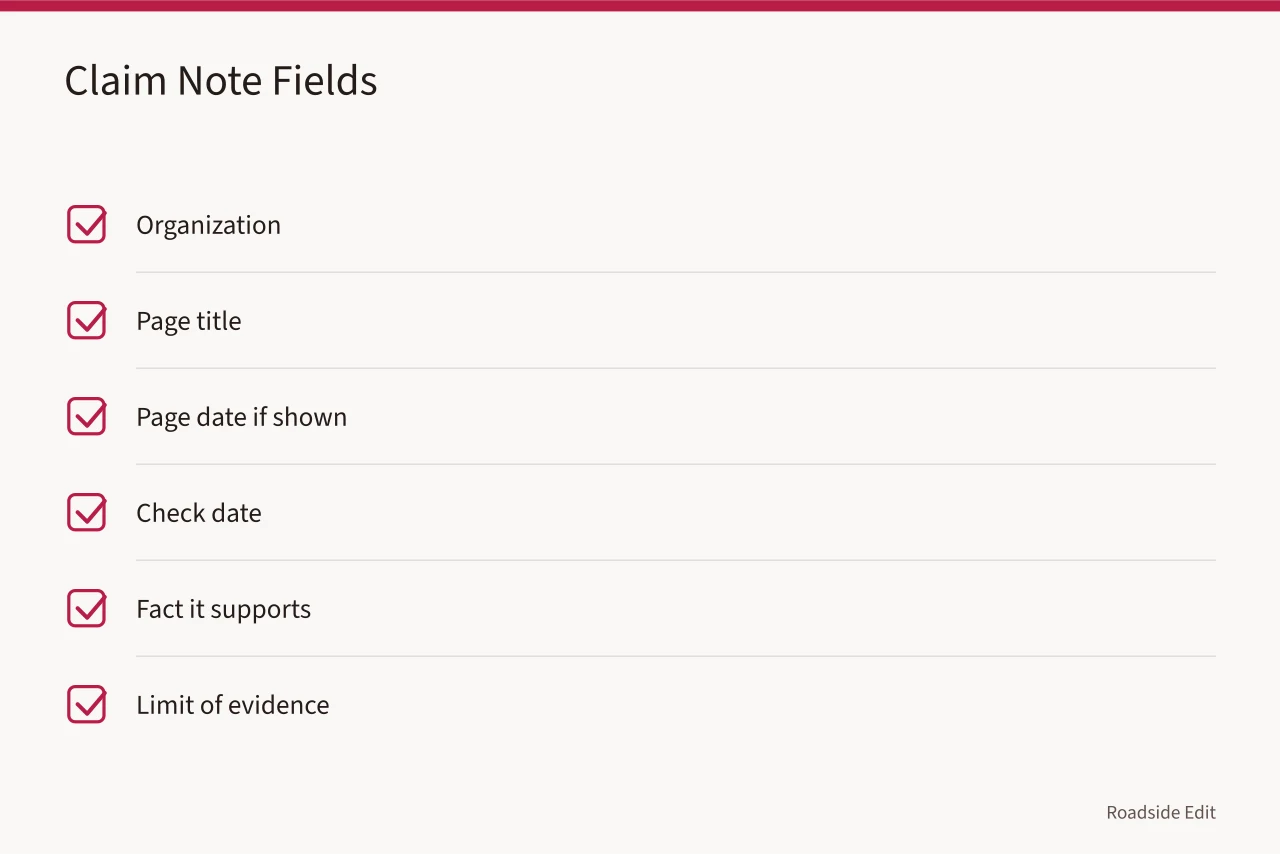
A claim note reads: "The page announces funding for a named project. It does not state that work finished." One sentence like that stops a later editor from writing an overbroad update.
The National Archives holds records about the same project or subject together so the connection supplies context. Read the National Archives recordkeeping requirements. Those rules bind federal agencies, not a private publisher. The parallel is to keep question, claim note, source, and correction in one story record.
Control image provenance and captions
An image record holds the local filename, the source page, the credit line, the known date or period, and the caption. Add one line on why the image belongs in this case study.
A period sign photograph shows the visual culture of roadside motels. It cannot establish the condition or ownership of a different property, and it is not proof of a project result.
A loose credit or a search result will not do. The credit must lead to the page that identifies that exact image. Before publication, check that the caption matches the source page and adds no interpretation the source does not support.
File submitted updates in their own lane
Owners, managers, vendors, and local groups send updates after publication. Keep the original message, the sender's role, the date, the requested wording, and any relationship to the publisher. Label the update as submitted until an independent source confirms the factual claim.
If a person paid for a listing or received a free service, record that with the submission. The Federal Trade Commission says advertising that looks like independent content must be recognizable as advertising. Read the FTC native-advertising guide.
This method does not judge whether a project claim is true; it keeps commercial material in its own file with its disclosure attached.
Correct the story without deleting the trail
When new evidence contradicts a claim, update the article and open a correction card. The card carries the original wording, the publication date, the revised wording, the source that forced the change, and the reason.
Never write "updated" alone. A specific correction keeps later writers from repeating the error, and it stops the case study from reading as more certain than the evidence was on the day it ran.
Prepare an editor handoff
Before a writer or editor leaves, build a handoff page. List the case question, current status, packet location, and the published claims that depend on each source.
Add outstanding evidence requests, attributed submissions, image credits, and the next review date. Leave private contact details and security-sensitive property information out of the public case-study file.
The handoff is done when a new editor can sort the file four ways: what is documented, what is reported, what is historical context, and what is still unknown. If those lines blur, the case study needs another evidence pass.
Common questions
Can an owner update change a project's status in the article?
It can support an attributed line such as "the owner reported." Use a verified status only when the responsible evidence review backs it.
Why keep a historical image record in a case-study packet?
It fixes the image's source, caption, and permitted context. It also stops the photo from resurfacing later as evidence of a current building condition.
What belongs in the correction log?
Keep the original claim, the revised wording, the date, and the source behind the change. Add the reason and the responsible editor so a reviewer can see exactly what moved.