Guides
Part of How to run a motel exterior case study method with clear sourcing
Motel exterior case study checklist: 8 checks before you publish
Motel exterior case study checklist for 2027 helps U.S. publishers verify a narrow question, project status, source limits, captions, and disclosures.
A motel exterior case study should answer one documented question, not turn photos and announcements into a success story. The reader needs to know what happened, which source supports each part, what stage the work reached, and what the evidence does not establish.
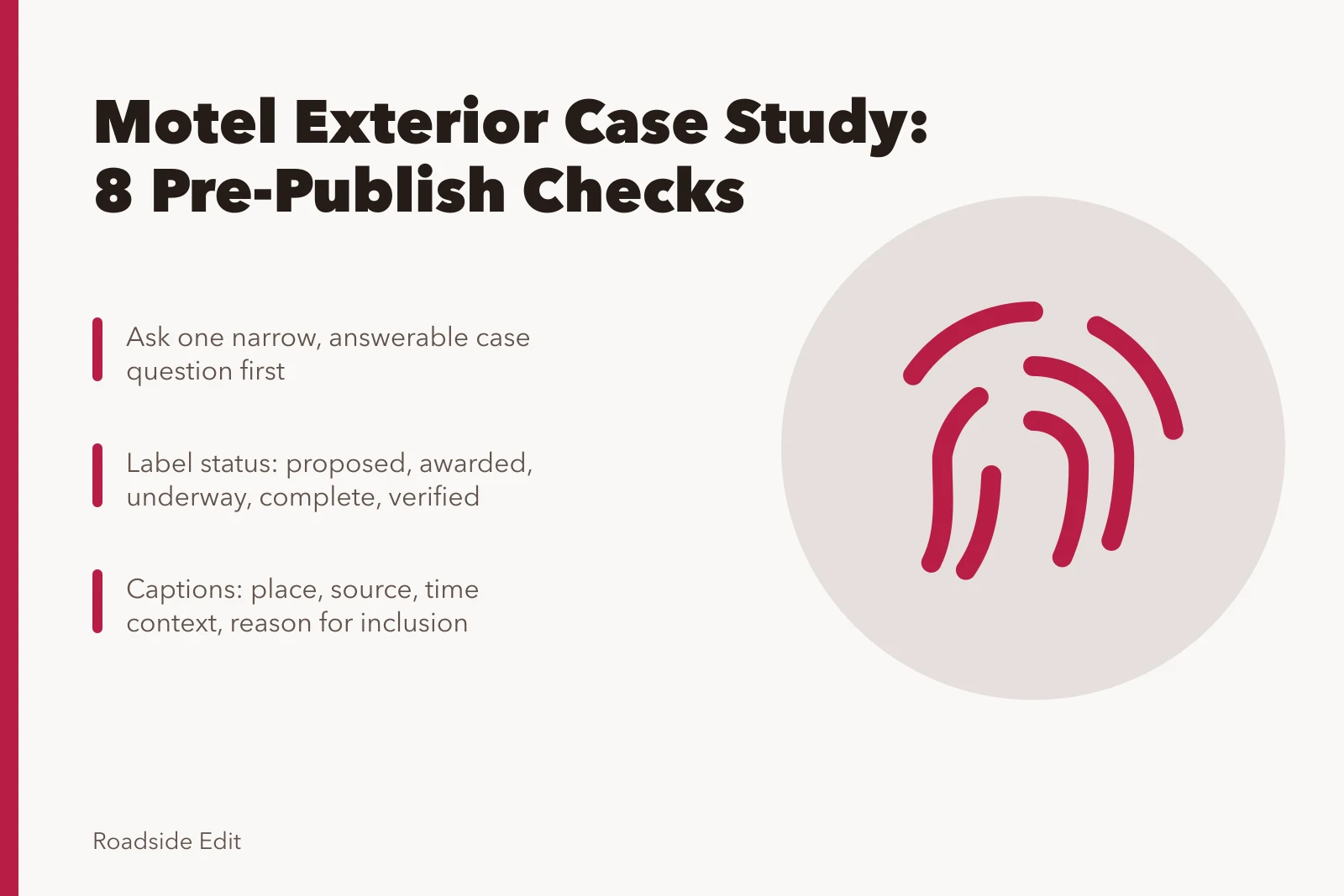
This checklist gives a writer or owner a disciplined way to build that story. It runs eight checks, in order, from the case question to the final publication review.
It does not verify a property's current condition, decide whether a project met a standard, or provide a repair recommendation. Where evidence is incomplete, the case study should say so and name the next responsible question.
The 8 checks before you publish
- Define one answerable case question. Write it at the top of the working file, with an evidence cutoff date, before you collect material.
- Build a project-status timeline. Keep proposed, awarded, underway, reported complete, and verified stages on separate lines, each with its own source.
- Match every claim to a source and its limit. Record the sentence, source page, source date, status, scope, and limit in a claim table.
- Write captions that carry no borrowed authority. Include the place or catalog title, the source, the time context, and the reason the image is there.
- Attribute owner and provider material, and disclose commercial ties. Label supplied material and keep the disclosure record with the source file.
- Test the outcome paragraph. Ask whether a source after the project event describes the result rather than the plan.
- Log corrections. Keep a correction card with the original statement, new wording, new source, and reason.
- Run the final publication check. Confirm the question answered is the question asked, credits are right, stage words are supported, and relationships are disclosed.
What to take away
- Build the story around one answerable question.
- Label each project fact as proposed, awarded, underway, reported complete, or independently verified.
- Keep original sources, captions, and editorial conclusions separate.
- Use historical images as context, not proof of the current property.
- Correct a case study when its supporting record changes or is contradicted.
Check 1: Define a case question before collecting material
Start with a question narrow enough that sources can answer it. "What did this grant announcement say it would support?" is answerable. "Did the project save the motel?" is not, unless the evidence directly addresses that outcome. A focused question keeps a writer from filling gaps with assumption.
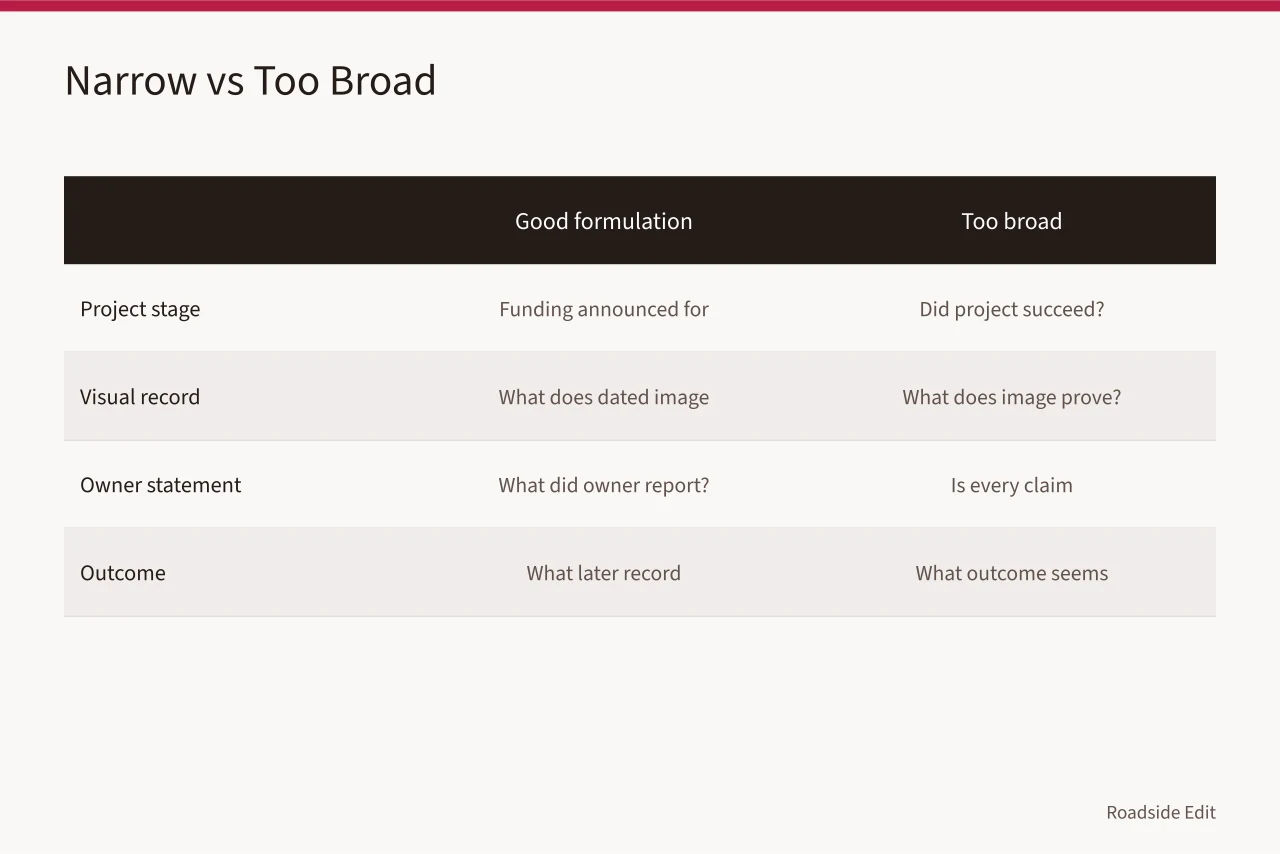
| Case element | Good formulation | Too broad |
|---|---|---|
| Project stage | Was funding announced for the stated scope? | Did the project succeed? |
| Visual record | What does this dated image show? | What does this image prove about building condition? |
| Owner statement | What did the owner report on a named date? | Is every claim in the statement independently confirmed? |
| Outcome | What later record documents? | What outcome seems likely? |
| Grant scope | What did the named award announcement list? | Did the funded work get built? |
Write the question at the top of the working file, along with the cutoff date for evidence. This keeps a later press release or social post from quietly changing the scope of an earlier case study.
Check 2: Build a project-status timeline
Project status is often where case studies go wrong. An award, an announcement, a permit, a contract, and a completion note are distinct events. Do not use a source for one event to claim another occurred.
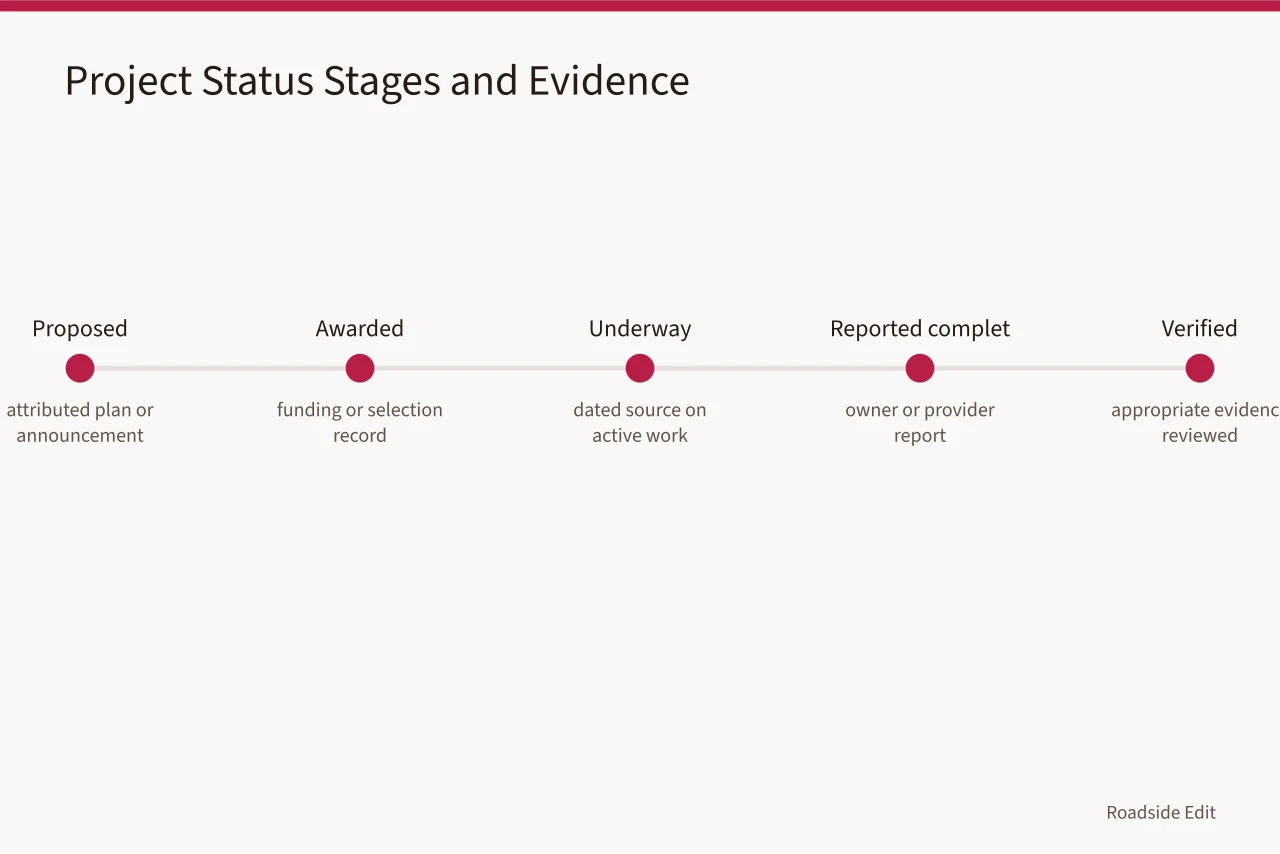
| Status | Evidence needed | Safe wording |
|---|---|---|
| Proposed | Attributed plan or announcement | "The plan described..." |
| Awarded | Funding or selection record | "The award announcement listed..." |
| Permitted | Dated local permit record | "The permit record lists the stated scope." |
| Underway | Dated source describing active work | "A dated report said work was underway." |
| Reported complete | Owner or provider completion report | "The owner reported completion." |
| Verified | Appropriate evidence reviewed | "The record confirms..." |
The National Park Service's 2023 Route 66 cost-share award announcement lists grant-supported projects and their stated work, including motel projects. It supports the limited facts in that announcement.
It does not by itself prove a later construction result, current ownership, or the present condition of a property.
Check 3: Match every claim to a source and limit
Create a claim table before drafting. Include the sentence, source page, source date, status, geographic or property scope, and the limit. One source can support several distinct facts. It should not become a blanket citation for a paragraph that goes beyond it.
The National Park Service's documentation standards and guidelines call for reliable sources and clear limitations that permit independent checking. They concern historic-property documentation rather than every motel story.
The editorial rule is the same: state exactly what a source supports, and do not turn a broad or historical reference into a current property finding.
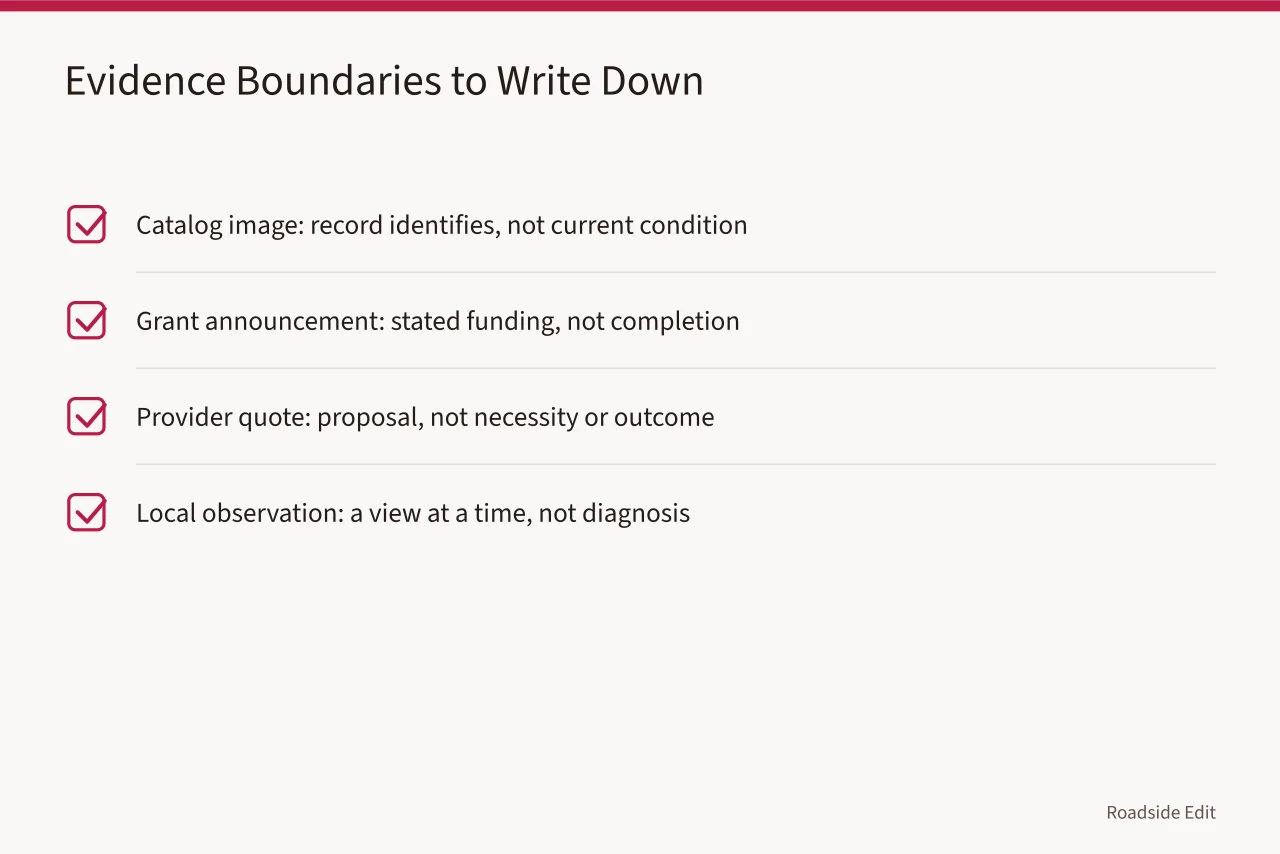
Evidence boundaries to write down
- A catalog image establishes what its record identifies, not current condition.
- A grant announcement establishes stated funding context, not completion.
- A provider quote establishes what the provider proposed, not necessity or outcome.
- A local observation establishes a view at a time, not a technical diagnosis.
Check 4: Make image captions do their real job
A caption should help a reader understand the image without borrowing authority it does not have. Include the place or catalog title, source, time context if the record provides it, and reason for inclusion. Keep project claims in the text where they can be cited accurately.
Avoid words such as "restored," "unsafe," "abandoned," or "original" unless the cited image record or a nearby source supports the exact term. A historical photo of one motel may illustrate roadside design, but it is not evidence about another motel or a later date.
Check 5: Handle owner and provider material honestly
Case studies can include an owner or provider perspective. Attribute it, date it, and identify whether it is supplied material. Do not delete uncertainty from a quote or rewrite it as independent confirmation. When the site receives payment, a donated service, or another material connection, keep the disclosure record with the source file.
The Federal Trade Commission says that advertising made to resemble independent content should be recognizable as advertising. Read the FTC native-advertising guide.
The guide does not decide the truth of a motel project claim. It supports a clear label and a separate record for sponsored or provider-supplied material so readers can interpret it correctly.
Check 6: Test the outcome paragraph hardest
The ending of a case study is where unsupported claims tend to appear. Before publishing an outcome, ask four questions.
Does a source after the project event describe the result, not only the plan? Is it an attributed report or independent documentation? Does it contradict an earlier statement?
If the answer is no, write the open status. A case study can conclude, "The available records establish the award and stated scope; this review did not locate a later source confirming completion." That statement is informative and does not pretend to know more than the record shows.
Check 7: Log corrections as part of the case study
New evidence may reveal a wrong date, project status, image label, or attribution. Correct the public article promptly, but preserve an internal correction card with the original statement, changed wording, new source, and reason. This protects the history and improves the next update.
The National Archives' information-quality guidelines describe procedures for identifying information at issue and documenting a correction response. Those rules apply to agency information.
Their practical lesson remains valuable for editorial work: show what changed and why instead of making an unsupported statement disappear.
Check 8: Run the final publication check
Before publication, verify that the case question is still the question the article answers. Confirm every source is a specific page, every caption has the correct credit, every project-stage word is supported, and every commercial relationship is disclosed. Remove claims that cannot pass those checks.
The case study is ready when the reader can distinguish documented fact, attributed report, historical context, and unanswered question without guessing.
Common questions
Can a grant award serve as proof that work was completed?
No. It supports the award and stated scope. A completion claim needs a later source that actually documents completion.
What makes a case study different from a property profile?
A case study follows one documented question through evidence and status. A profile may give broader background, but it should still avoid unsupported claims about condition or outcome.
How should a case study handle conflicting sources?
Identify the conflict, cite each relevant source where it supports its own statement, and correct any claim contradicted by stronger evidence. Do not hide the inconsistency.