Costs
Part of How to compare motel exterior options for 2027 without a score
Motel exterior options comparison: how to read budget notes before you treat a figure as a quote
Motel exterior options budget notes for 2027 help U.S. readers compare scope, assumptions, exclusions, and changes without treating a planning figure as a quote.
Budget notes help readers compare options without converting a general article into a project quote. The note should show what each figure describes, what it assumes, and which missing facts could change it.
What to take away
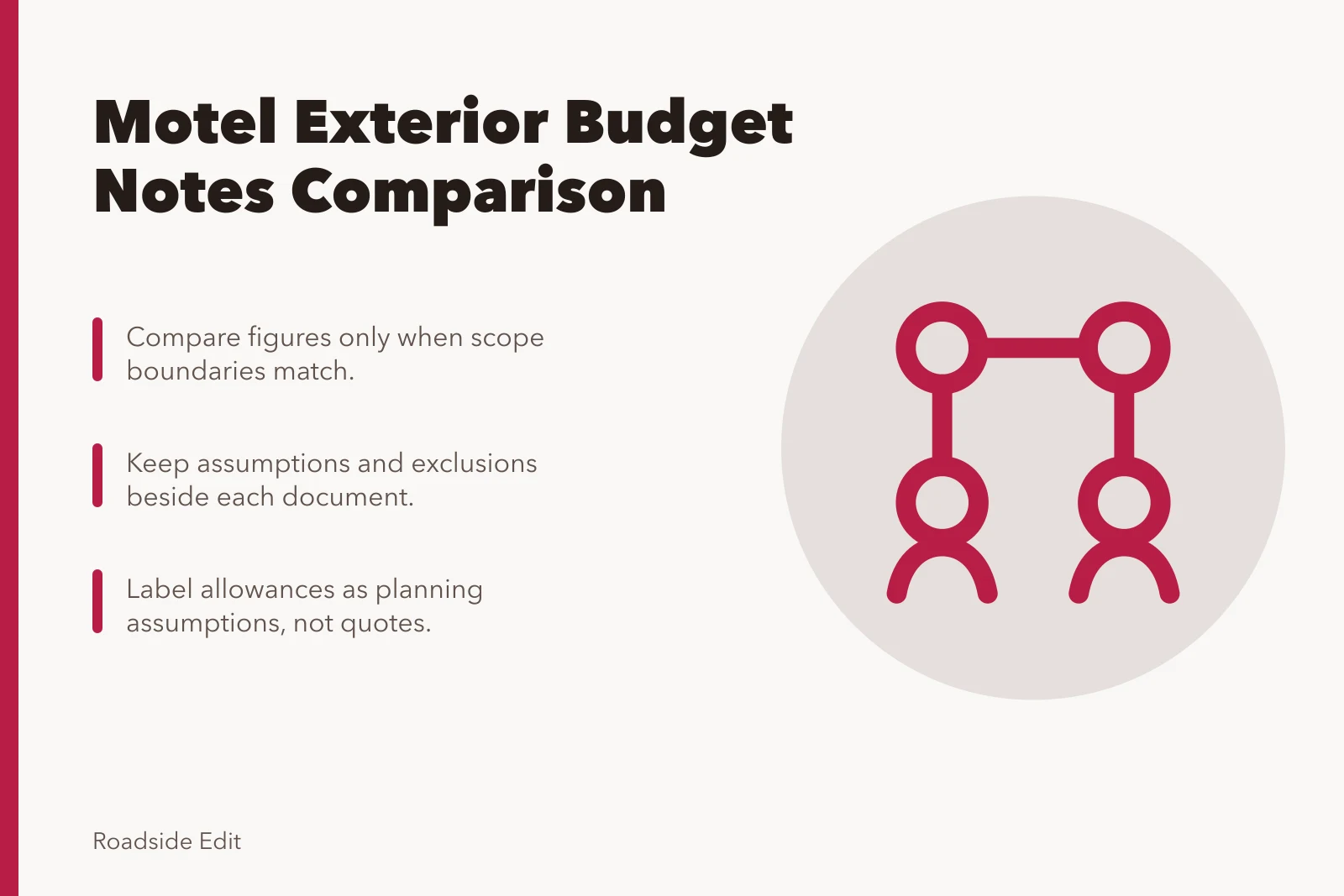
- Compare figures only when the options have matching scope boundaries.
- Keep assumptions and exclusions beside each submitted document.
- Label an allowance as a planning assumption, not a confirmed cost.
- Add a dated revision when an option or its evidence changes.
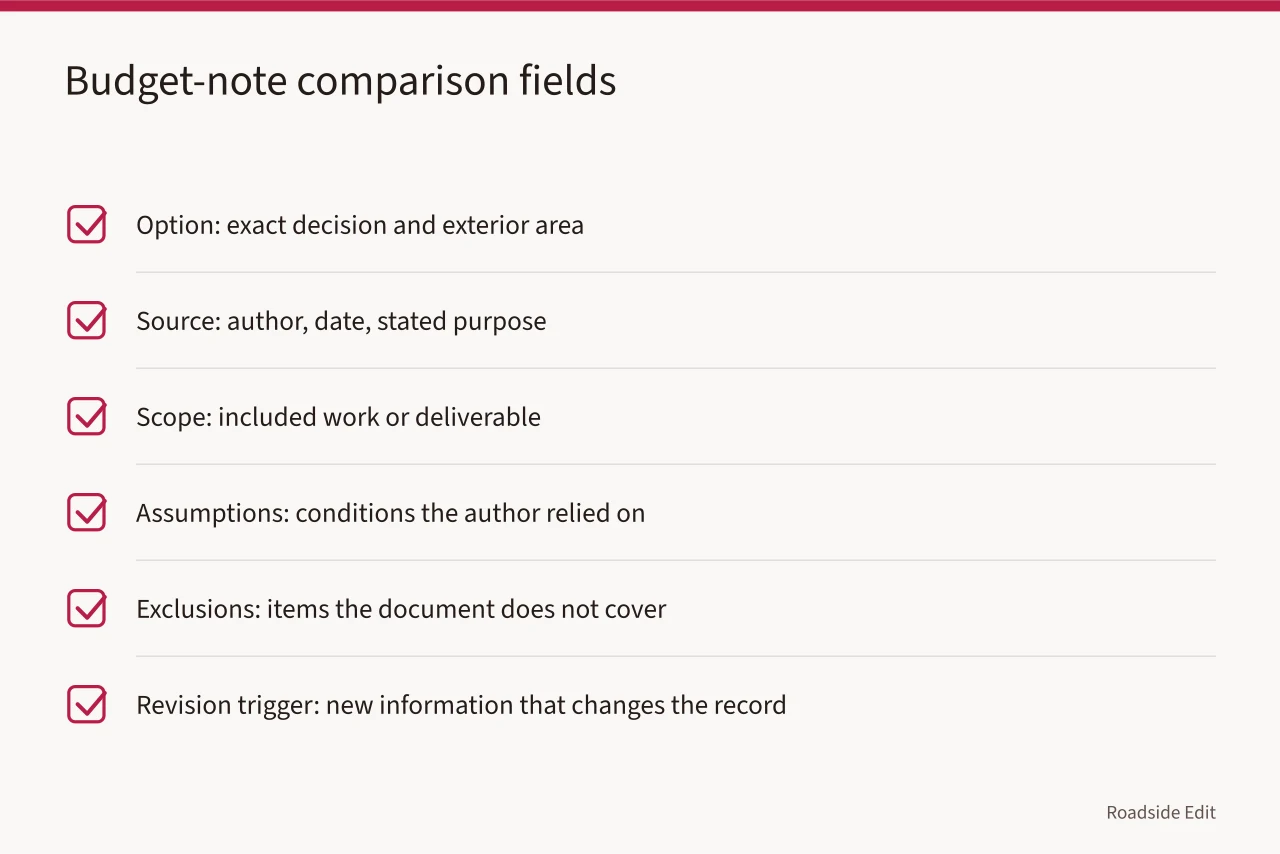
Budget-note comparison fields
| Field | What to retain |
|---|---|
| Option | The exact decision and exterior area. |
| Source | Document author, date, and stated purpose. |
| Scope | Included work, deliverable, or item. |
| Assumptions | Conditions the author relied on. |
| Exclusions | Items that the document does not cover. |
| Revision trigger | New information that would change the record. |
NPS construction-document deliverables include a contract price schedule based on a cost estimate and identification of resolutions to project issues. Read the NPS construction-document deliverables. It is a federal workflow, not a private-motel estimating template. Its useful point is that price information needs to remain connected to the underlying project record and its changes.
Avoid false precision
A number from a submitted document can help planning. It is not proof of final cost, quality, suitability, or approval. Do not compare totals until scope, source date, assumptions, and exclusions can be read together.
If one option depends on unconfirmed access or a condition, record the unknown. Do not make it a hidden contingency.
The GAO Cost Estimating and Assessment Guide explains that estimates need a purpose, scope, technical basis, assumptions, data, methods, and updates. It is not a motel-project pricing system. It supports a clear comparison rule: options should not be ranked until the work and evidence behind their figures can be checked.
Compare options by decision stage
An exterior article may discuss documentation, limited protection, repair and retain, a different use, or replacement. Those are different decisions. They need separate evidence cards before a cost table makes sense.
| Option | First question | Cost status to publish |
|---|---|---|
| Document and defer | What should be recorded now? | Scope research, not construction cost |
| Protect temporarily | What limited task can be defined? | Dated allowance or proposal only |
| Repair and retain | Which exterior features are included? | Estimate only when scope is stated |
| Adapt for reuse | What access and operating questions remain? | Unpriced until defined review |
| Replace | What existing feature and new work are described? | Separate record from repair option |
The National Park Service Standards for the Treatment of Historic Properties distinguish preservation, rehabilitation, restoration, and reconstruction. The page does not select an exterior treatment or price a motel project. It supports keeping an option's treatment goal separate from a claim that its cost or approval is known.
An option with no figure can still be useful. State the question it answers and the next work needed to create a defensible scope. Do not add a placeholder number just so a comparison table has every cell filled.
Keep commercial information separate
A provider may submit a description, price range, or paid placement. Label it as submitted material and disclose the relationship. It should not become an independent editorial claim about a property or a future outcome.
The FTC's endorsement guidance says material connections should be disclosed when they could affect how readers evaluate an endorsement. Attribute a provider's range, date, and scope. A paid statement may inform readers, but it is not independent proof that an option is cheaper or better.
Make an options revision log
When a selected direction changes, preserve the earlier source and add a new record. State the prior option, new option, date, reason supported by the record, and effect on any figure. Do not silently swap a repair amount for a replacement amount or combine planning spending with later construction pricing.
Before publishing, verify that every option has a defined boundary, a source status, an exclusion note, and a next decision. Explain why an option is unpriced when the evidence is incomplete. This keeps readers from treating a design conversation as a finished market comparison.
Revise visibly
When a source, scope, or decision changes, add a short dated entry. Say what changed, why it changed, and what it affects. That preserves the difference between a current planning note and an unsupported promise.
Common questions
Is an allowance a final cost?
No. It is a stated planning assumption that may change with scope or evidence.
Can an article publish an exact project budget?
Not without a specific, current source and clear context. A general guide should not create a quote.
What should trigger a budget-note revision?
A changed scope, corrected record, new access information, or clarified document assumption should trigger one.