Guides
How to compare motel exterior options for 2027 without a score
Motel exterior options compared for 2027 helps U.S. readers compare evidence, scope, authority, assumptions, and next steps without endorsing a project outcome.
An exterior option is not ready to compare because it has a name, a color, a provider, or a price. It becomes comparable when it answers the same project question with the same boundary, evidence standard, assumptions, and next decision. Without those basics, an article can make one incomplete idea look stronger simply because it is described more vividly.
This guide helps U.S. readers set up a fair early comparison for a motel exterior. It does not choose a treatment, diagnose conditions, determine permit requirements, approve work, or recommend a business.
What to take away
- Compare options only after defining one decision and one location boundary.
- Keep current observations, historic context, proposals, and approvals separate.
- Give every option the same evidence, unknowns, decision owner, and next action fields.
- Do not rank a provider submission as editorial proof.
- Use a change log when new information changes the basis of comparison.
Start with one decision question
"Improve the exterior" is not a comparison question. It can include a facade, sign, lighting, paving, accessibility, landscaping, drainage, security, or a wholly new addition. Each option must answer the same immediate decision or the comparison has no stable basis.
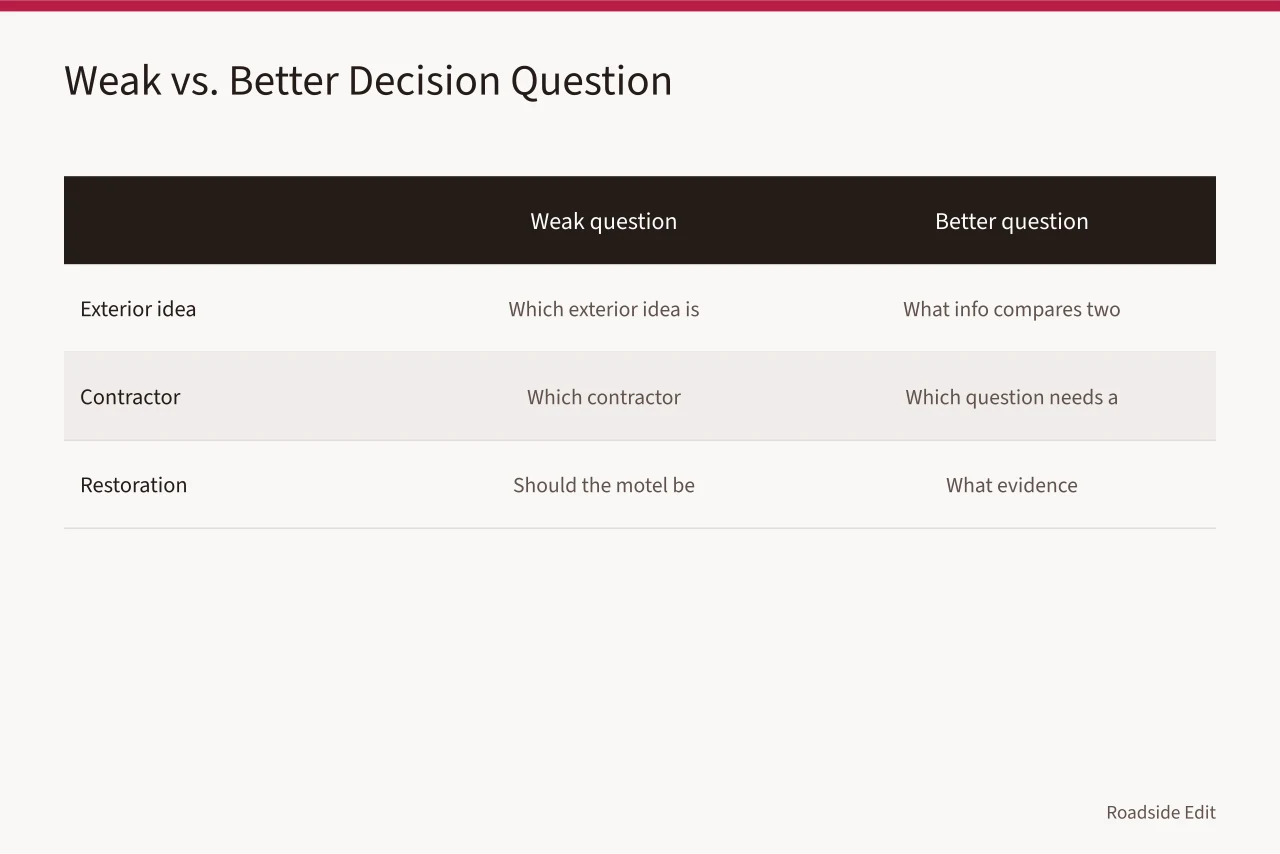
Write the question in one sentence. It might ask what information is needed to compare approaches for a visible sign, what existing records should be assembled before a facade concept is discussed, or which next study can clarify a site-access question. Include the relevant feature or area and what falls outside the comparison.
| Weak question | Better question |
|---|---|
| Which exterior idea is best? | What information is needed to compare two documented concepts for the street-facing sign? |
| Which contractor should I use? | Which project question needs a defined scope before any submitted estimate can be reviewed? |
| Should the motel be restored? | What evidence identifies the current visible feature and the responsible review path? |
Build the same evidence file for every option
Options should begin with an existing-conditions record, not a conclusion. A dated image can show a visible view, feature, or setting. It cannot establish hidden material conditions, structural performance, property access, code compliance, or a suitable repair. State those limits in the record.
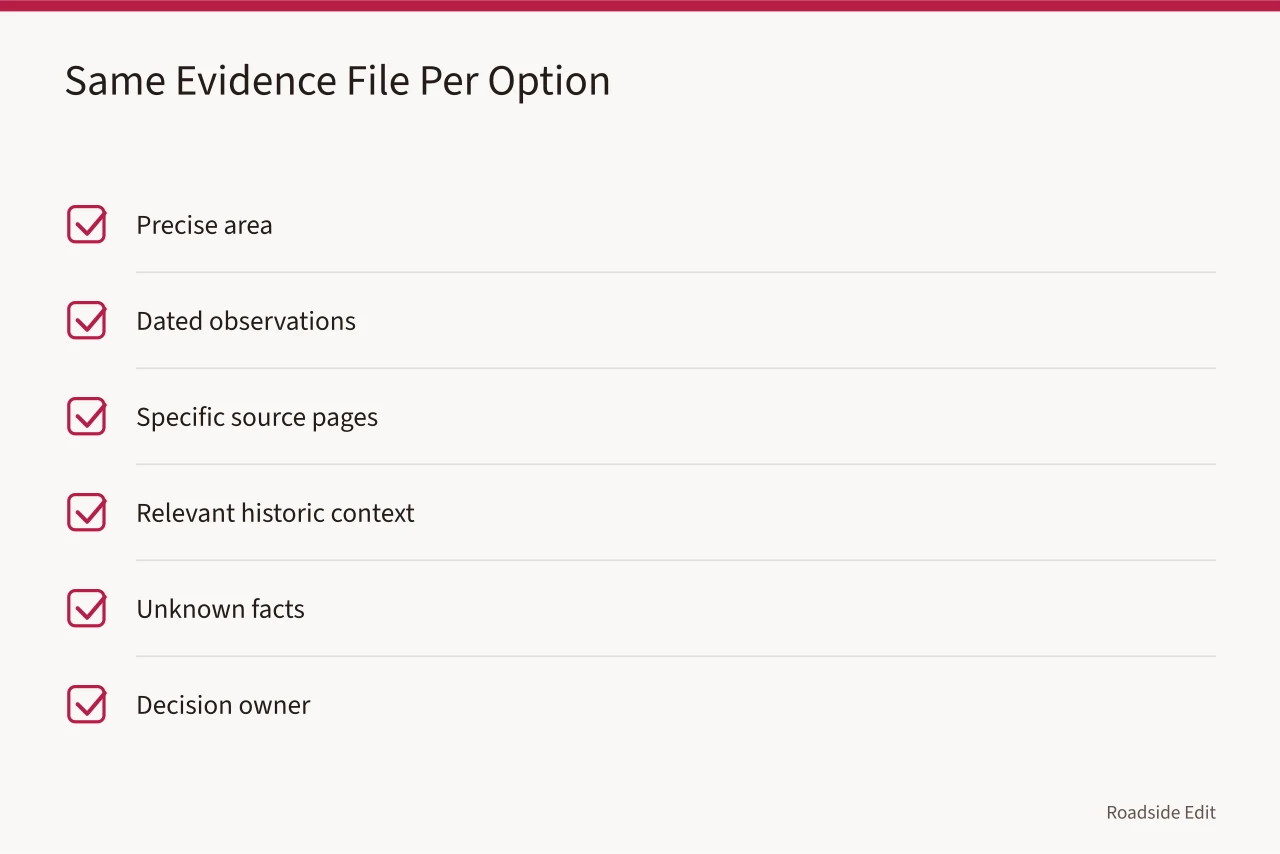
For every option, retain the same kinds of information: the precise area, dated observations, specific source pages, relevant historic context, unknown facts, and the person or body that controls the next decision. If one option has a drawing and the other has only an idea, do not use a numeric score to disguise the imbalance. Call it an evidence gap.
Use an option card
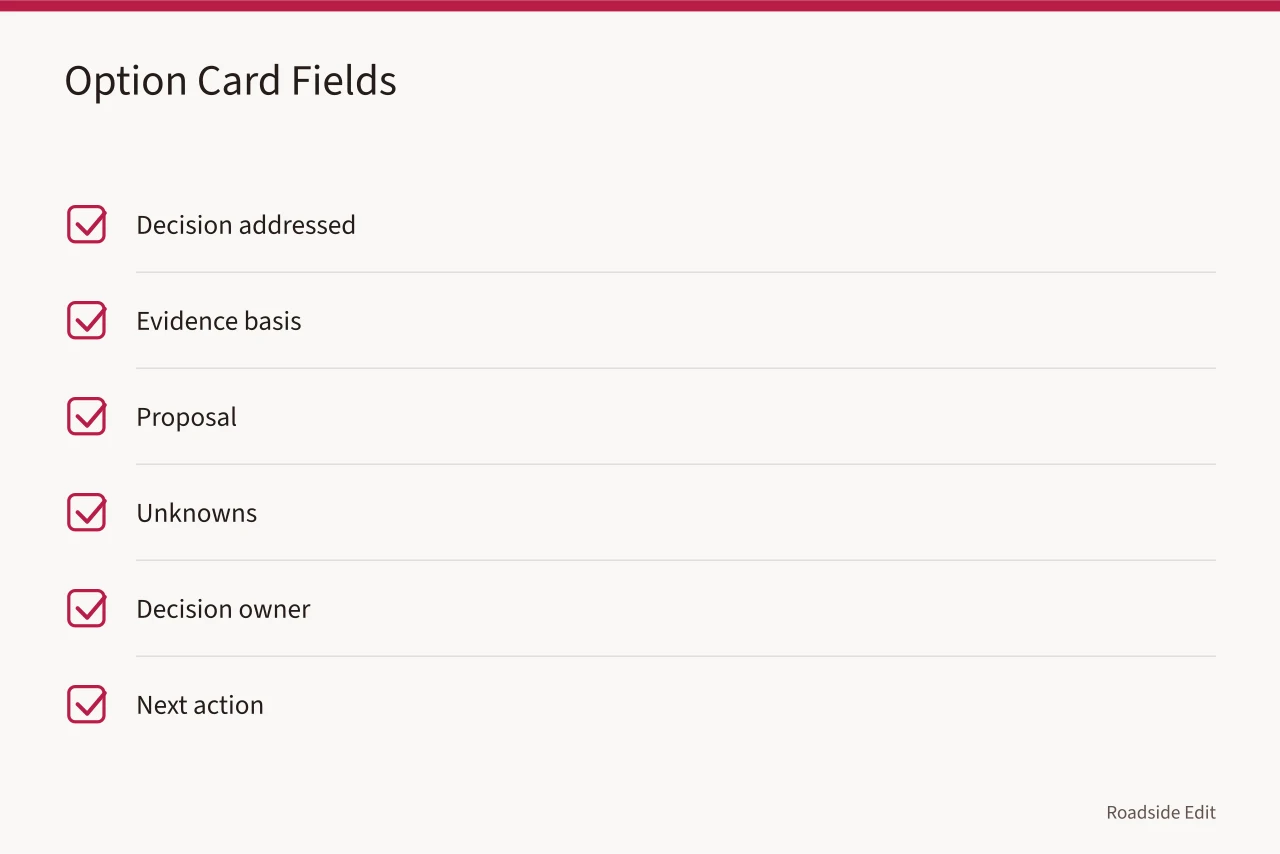
An option card keeps different concepts on the same footing. It also helps an editor identify what may be factual, what is submitted, and what remains a proposal.
| Field | What to record |
|---|---|
| Decision addressed | The exact question this option answers. |
| Evidence basis | Dated image, specific record, or attributed statement. |
| Proposal | A narrowly described concept, not an approval. |
| Unknowns | Facts needing access, local authority, or qualified review. |
| Decision owner | Person, organization, or public office responsible for the next step. |
| Next action | The smallest defensible task before comparison continues. |
NPS design-deliverable guidance calls for schematic design alternatives, a completed contextual analysis or project program, and an existing-conditions plan. Review the NPS schematic-design alternative guidance. It applies to federal projects, not every motel exterior. Its useful planning principle is that alternatives should be developed against a known context and documented existing conditions.
The National Park Service's drafting quality-assurance guidance addresses documenting amendments through identifiable procedures. See the NPS drafting QA checklist. This is not a private-motel requirement. It supports keeping each option revision visible instead of silently replacing an earlier version.
Compare the questions before the concepts
Before comparing visual appearance, ask whether each option answers the same question. One may address a sign's placement while another addresses an electrical system. One may concern a visible facade finish while another assumes a structural condition that has not been evaluated. Those are separate planning tracks, not competing options.
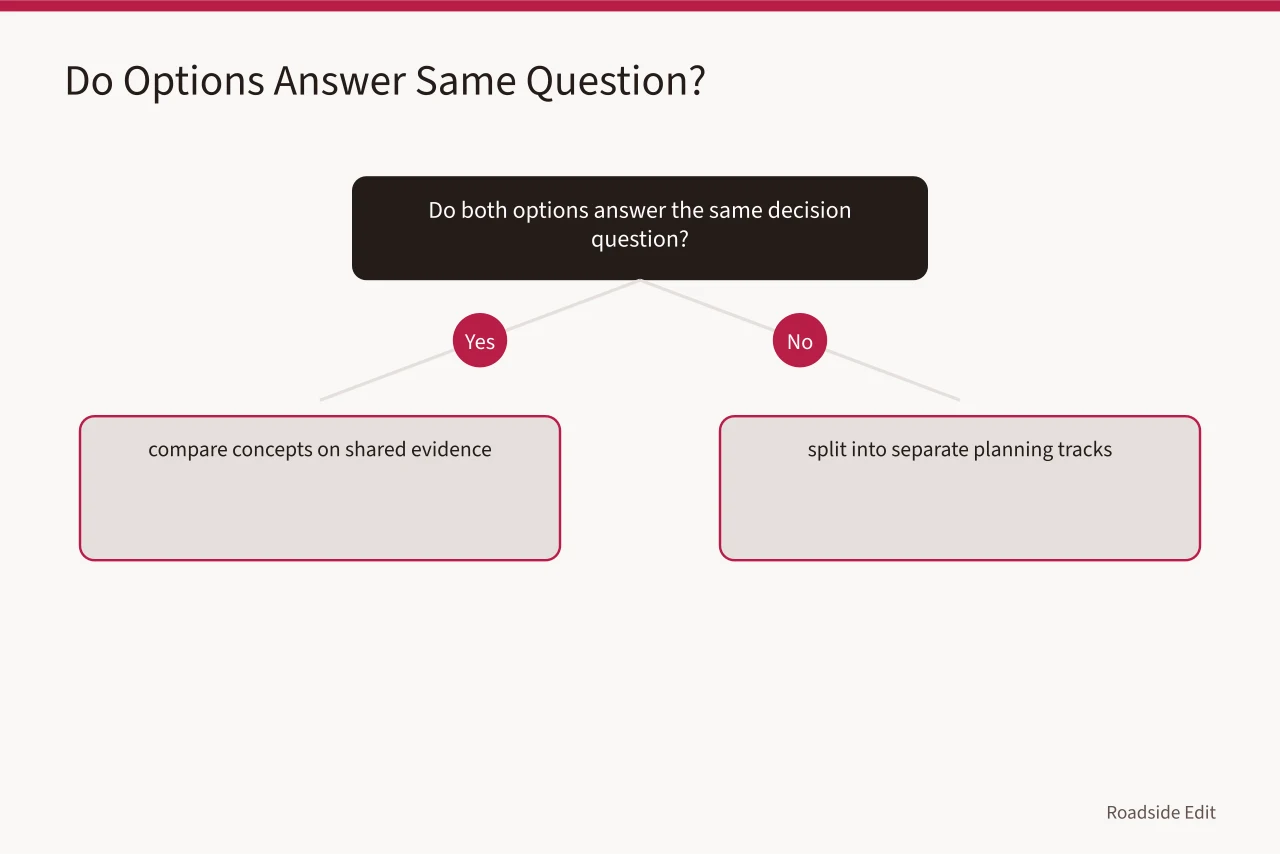
Use plain labels such as "requires an existing-condition record," "requires access authorization," "requires local-office confirmation," or "requires a qualified assessment." This is more useful than pretending an editorial article can decide a project-specific technical question.
FEMA's National Flood Hazard Layer provides federal flood hazard information for mapped areas. Check FEMA's National Flood Hazard Layer information. It does not decide whether a particular motel is safe, damaged, insurable, or subject to a project requirement. It gives the comparison a defined source when an option depends on mapped flood information.
Do not use a score to hide a judgment
Scores can look neutral while concealing unequal evidence. If a score is used at all, publish the criteria and the source basis for every entry. A score cannot turn missing permission, missing condition information, or an unclear scope into a favorable result.
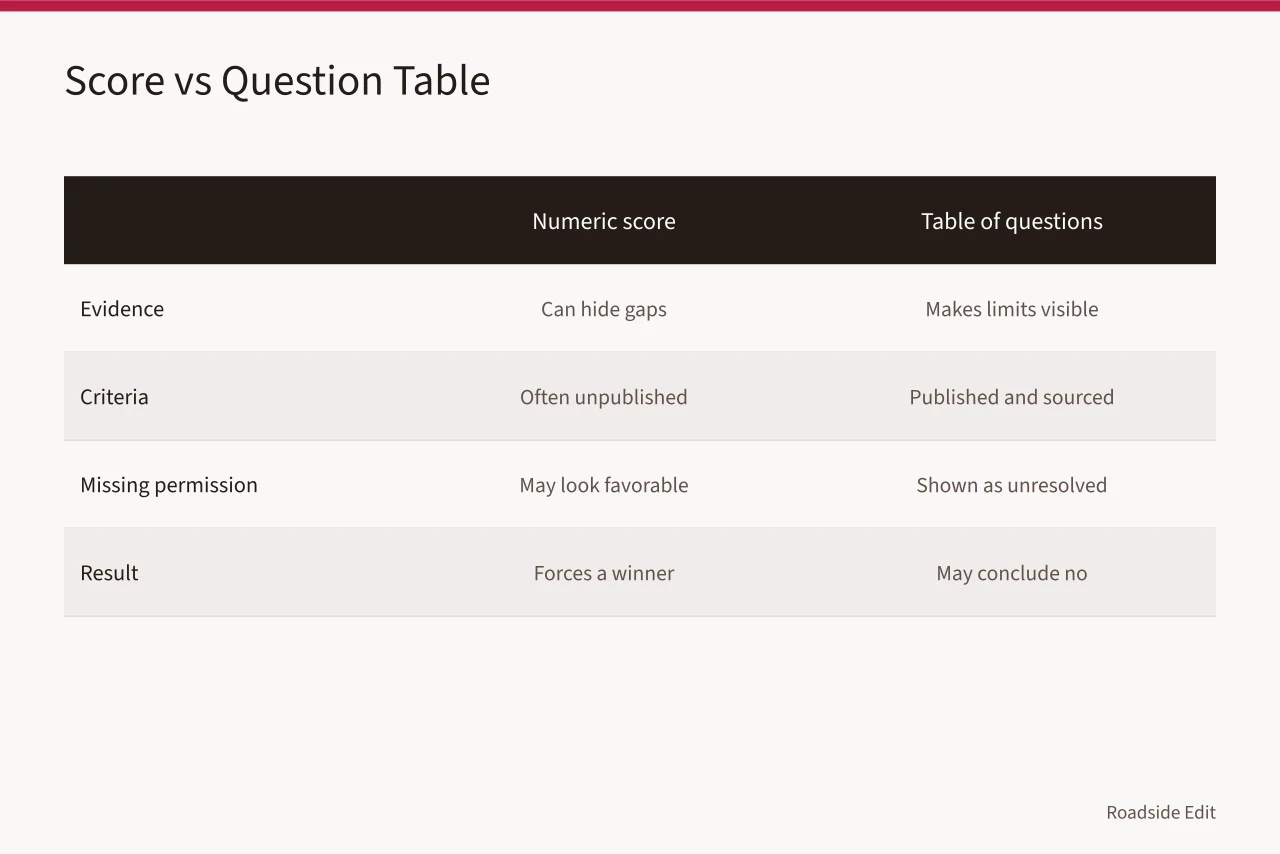
For most early comparisons, a table of questions works better. It makes the limits visible and shows readers what must happen next. A fair comparison may conclude that no option can yet be selected. That is a useful result when the record is incomplete.
A visible entry, walkway, curb, or ramp should not be labeled compliant from a photograph. The ADA Standards for Accessible Design are technical standards for covered facilities. Consult the ADA Standards for Accessible Design. They do not determine conditions or duties at a specific motel. They show why compliance questions belong with the appropriate authority or qualified reviewer.
Keep commercial material separate
Businesses may eventually seek paid placements, reviews, or directory entries. Their submitted descriptions can be useful, but they are not independent confirmation of a property's condition, suitability, quality, or outcome. Label the relationship near the material and retain the original submission and date.
For a future listicle, publish the selection method. It might be a geographic boundary, disclosed paid inclusion, public documentation, or independently described editorial criteria. Avoid superlatives, implied inspections, or approval language unless the site can prove the exact basis for each claim.
Record changes rather than rewriting history
New information can change the comparison. An older image may be corrected, a local authority may identify a different path, a decision owner may clarify access, or a proposal may change. Add a dated change-log entry with the new source, what changed, and the effect on the option card.
This protects readers from stale information and helps preserve a credible editorial record. It also stops a later paid submission from being mistaken for the source of an earlier conclusion.
Practical comparison routine
- Name the decision and location boundary.
- Build a dated existing-condition record.
- Give each option an identical card.
- Identify unknowns before weighing benefits.
- Ask the responsible owner or authority about project-specific decisions.
- Separate commercial submissions from independently sourced claims.
- Record revisions with dates and source pages.
How to prepare a comparison meeting
Bring the decision question, option cards, source record, and change log to the meeting. Open with the boundary: which feature is being discussed, what information has been verified, and which questions have not been answered. Then review each option against the same fields instead of giving the first proposal more attention because it arrived with more visual material.
Write meeting notes as records, not verdicts. A useful note lists participant, date, source or document considered, question raised, and next action.
Never say someone approved a treatment unless they had authority and the record states the decision clearly. If an authority or property owner was absent, note that confirmation is pending.
When the comparison should pause
Pause when options depend on unconfirmed access, an undocumented current condition, a missing property record, an unclear local path, or evidence that cannot support a technical conclusion. Pausing shields readers from a polished but unsupported recommendation.
The next task may be small. Get a dated photo from an authorized source, find a property-specific record, or ask the responsible office which question it can answer.
A note on visual appeal
Visual appeal may be one criterion, but it should not replace evidence. State whose point of view is represented and why the criterion matters to the decision. Do not present a design preference as a factual requirement or claim that a concept will improve safety, compliance, revenue, or historic status without a source that supports that claim for the property.
After the meeting, assign one owner to the next record request and set a review date. That modest follow-through keeps the comparison from becoming a decorative exercise and gives later editors a clear trail of evidence, limits, and decisions.
It also makes later corrections straightforward when new documentation or evidence arrives.
Common mistakes
Comparing different scopes
An option to clean a surface is not directly comparable with an option to redesign a facade. Split the work into separate decisions before asking which one is preferable.
Treating an image as a complete condition assessment
Images are useful records of visible views. Do not use them to claim what is behind a surface or what work is required.
Assuming an older property has a specific status
Age or style alone does not establish designation, eligibility, review requirements, or funding. Verify a property-specific status with the responsible source.
Allowing a provider's language to choose the criteria
Commercial language should be attributed and disclosed. Editorial comparison criteria should be set independently and applied consistently.
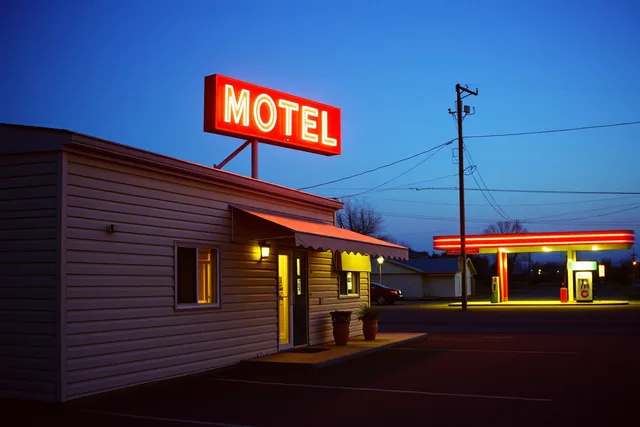
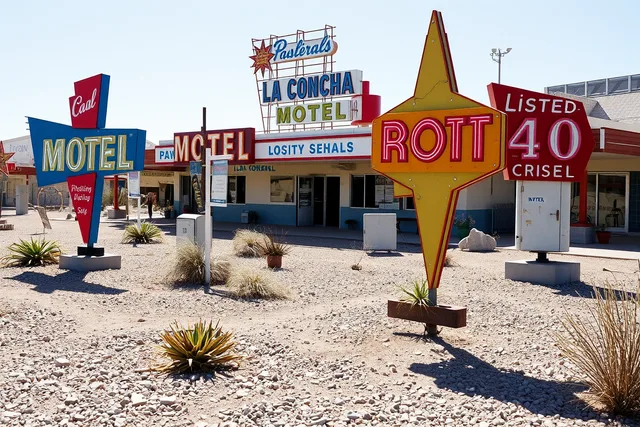
The image is illustrative. It does not establish a motel's current condition, cost, ownership, safety, or project outcome.
Common questions
Can an article select the best exterior option?
No. It can provide a fair comparison method, but a project-specific decision belongs to the responsible parties using appropriate evidence.
What if one option has more detail than another?
Treat that as an evidence difference, not proof that the detailed option is better.
Should a paid listing appear in an options article?
Only with clear disclosure and without presenting submitted claims as independent editorial evidence.
In this guide
- Motel exterior options checklist: how to compare paths before you chooseCompare motel exterior paths on one evidence packet, one decision owner, and one stop point, so a record, study, or project request is judged fairly.
- Motel exterior options: 7 real choices and questions to settle before 2027Seven motel exterior options, from HardiePlank siding to McElroy standing seam metal, with the key question each option forces before 2027 renovation planning.
- Motel exterior options comparison: how to read budget notes before you treat a figure as a quoteMotel exterior options budget notes for 2027 help U.S. readers compare scope, assumptions, exclusions, and changes without treating a planning figure as a quote.
- How to keep motel exterior options records clear before a 2027 decisionMotel exterior options records for 2027: retain comparable option cards, source notes, disclosure decisions, revisions, and correction history in one clear file.