Reviews
Part of How to compare motel exterior options for 2027 without a score
Motel exterior options: 7 real choices and questions to settle before 2027
Seven motel exterior options, from HardiePlank siding to McElroy standing seam metal, with the key question each option forces before 2027 renovation planning.
Seven exterior choices sit in front of most 2027 motel capital plans, and each one forces a question that costs more to answer late than early. What follows is a comparison frame, not design advice, a permit review, or an endorsement of any provider.
What to take away
- Fiber cement, coating, signage, awning, lighting and metal roof options are compared on scope, evidence, and who owns the decision, not on looks.
- James Hardie and Nichiha both publish Class A fire ratings for many fiber cement products; confirm acceptance with your local code office.
- Tnemec, Gemini, Marygrove, RAB and McElroy all price by quote, so ask for a written scope before comparing cost.
- Flood mapping and accessibility questions route to FEMA and the ADA Standards, not to a product card.
- Keep revisions identifiable so a sketch never gets read as an approved plan.
Seven motel exterior options to compare
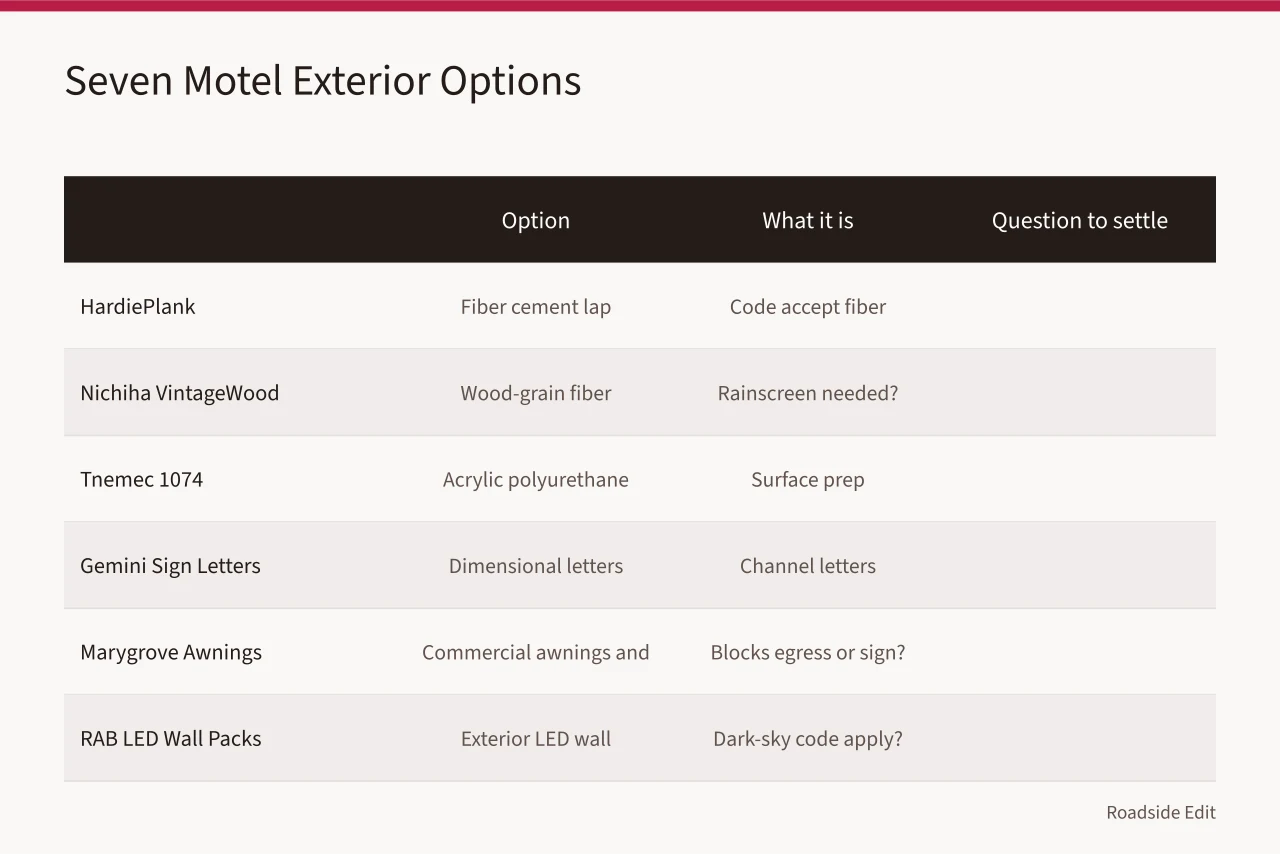
| Option | What it is | Public fact to use | Question to settle |
|---|---|---|---|
| James Hardie HardiePlank lap siding | Fiber cement lap siding | Sold primed or prefinished; James Hardie publishes a 30-year limited warranty on many siding products | Does local code accept fiber cement at this wall? |
| Nichiha VintageWood fiber cement siding | Fiber cement panels with wood-grain texture | Nichiha lists Class A fire ratings for some fiber cement panels | Does the wall need a rainscreen or drainage plane? |
| Tnemec Series 1074 Endura-Shield | Acrylic polyurethane coating for exterior steel and concrete | Tnemec publishes system guides and dry-film thickness ranges | What surface preparation is specified? |
| Gemini Sign Letters | Dimensional letters and logos in metal, acrylic, or foam | Quote-based pricing by size, material, and finish | Does local sign code allow channel letters? |
| Marygrove Awnings | Commercial awnings and canopies | Custom sizes, quote-based pricing | Does the awning block egress or sign visibility? |
| RAB Lighting LED wall packs | Exterior LED wall packs for parking and walkways | RAB lists wattage, lumen output, and a 5-year limited warranty on many fixtures | Does dark-sky or sign lighting code apply? |
| McElroy Metal standing seam roof | Standing seam metal roof panels | McElroy lists 24-gauge steel panels and finish warranty options | Is the substructure rated for the load? |
Ask each provider for a written scope before you compare cost. A quote that names material, finish, and installation separately is comparable; a single lump sum is not.
On a mid-century roadside building, the sign and the wall are one decision. A Gemini channel letter set hung on new HardiePlank reads as a remodel, while the same letters on original porcelain-enamel panels read as the building.
If the plan touches the sign, start with motel exterior options compared so the letter choice and the wall choice are made together.
Do the options have comparable evidence?
An option resting on a dated photograph is not equivalent to one resting on authorized site information. Neither is automatically better; they answer different levels of question. Write the source type beside every option so the comparison shows why it may be incomplete.
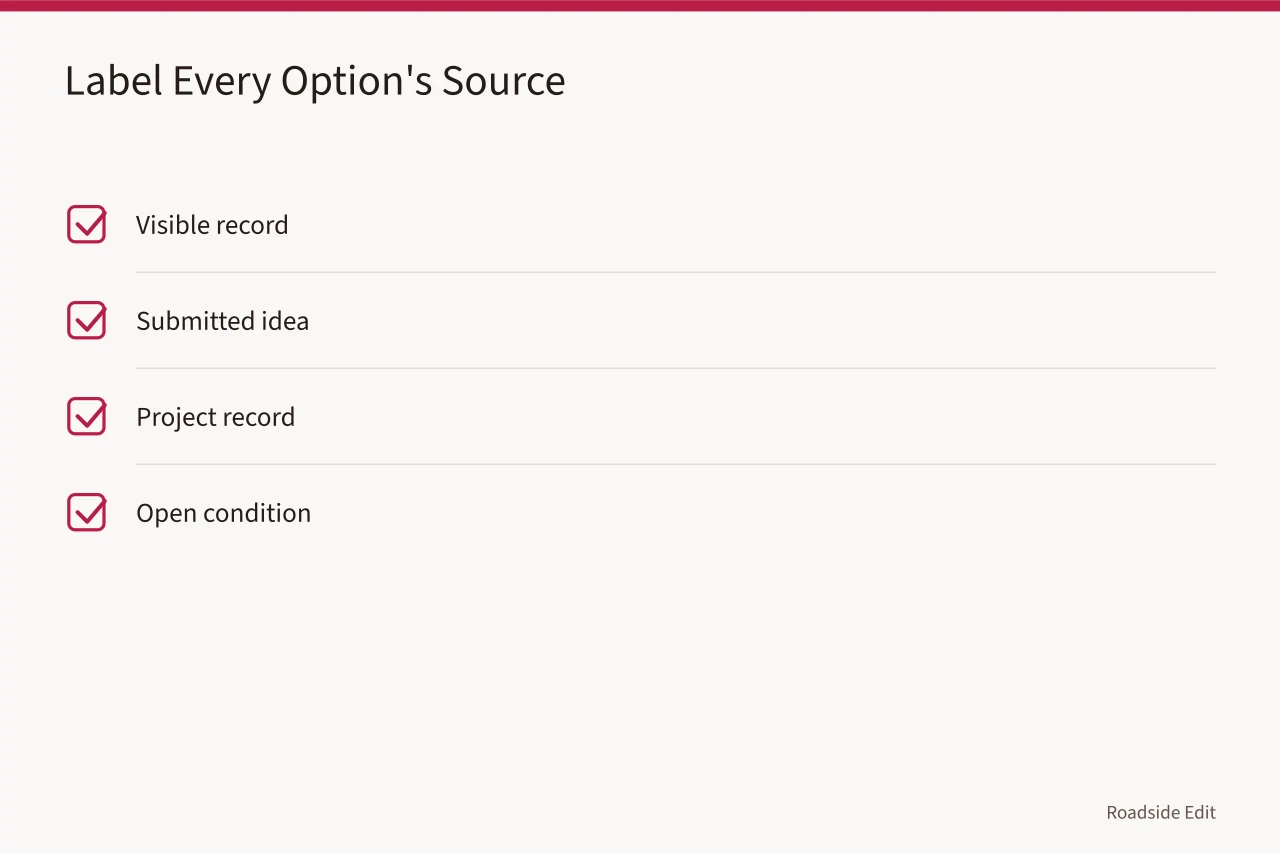
Label each source as a visible record, submitted idea, project record, or open condition.
The National Park Service defines existing conditions as the current condition of a site, and treats research, observation, and images as documentation tools. Read the NPS existing-conditions definition. That guidance addresses NPS work, not every motel, but the lesson travels: a record of what exists stays distinct from a proposal for what might change.
For siding, ask what the image does not show, such as hidden substrate or approval status.
Which criteria can every option meet?
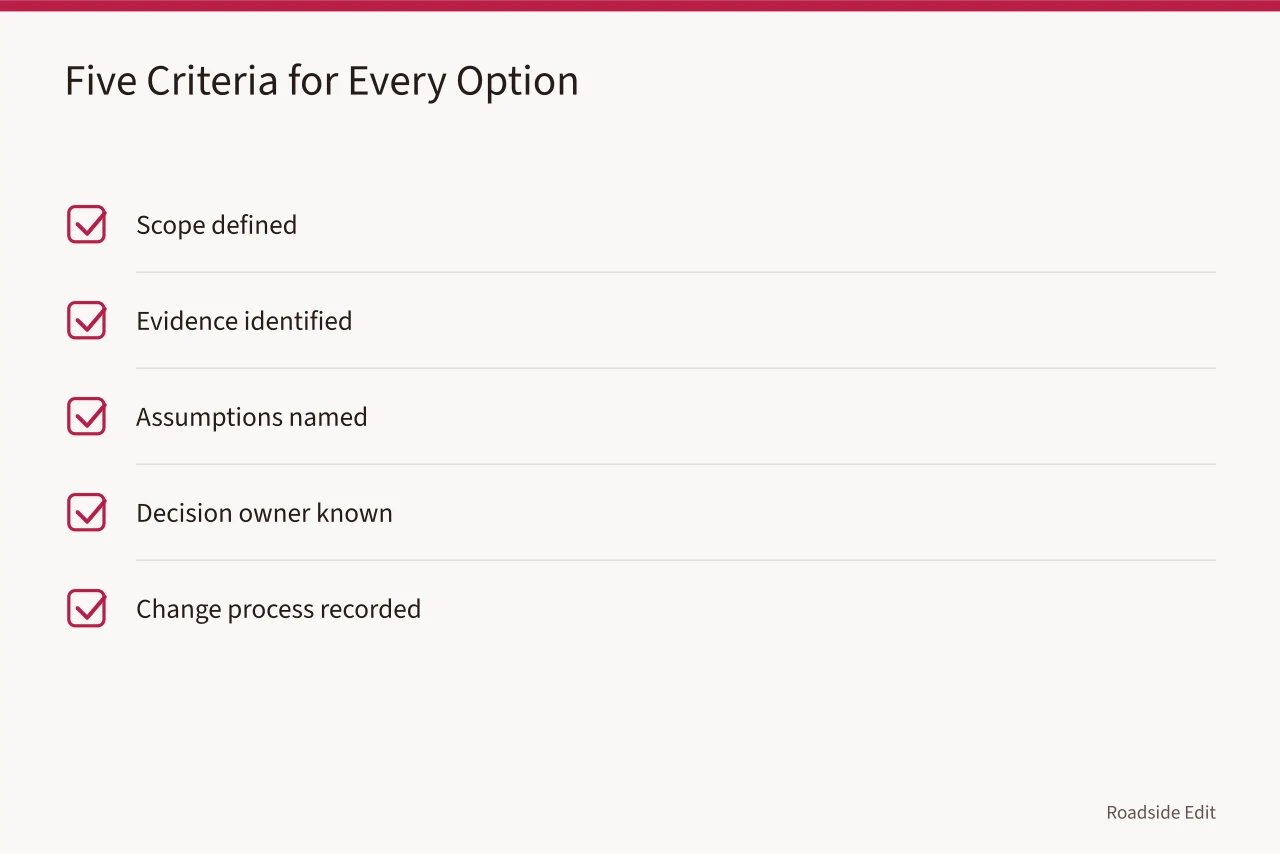
The National Park Service drafting quality-assurance guidance manages drawing amendments through identifiable procedures. Review the NPS drafting QA checklist. It supports one recordkeeping habit: revisions carry a visible identity.
What questions belong with a local authority?
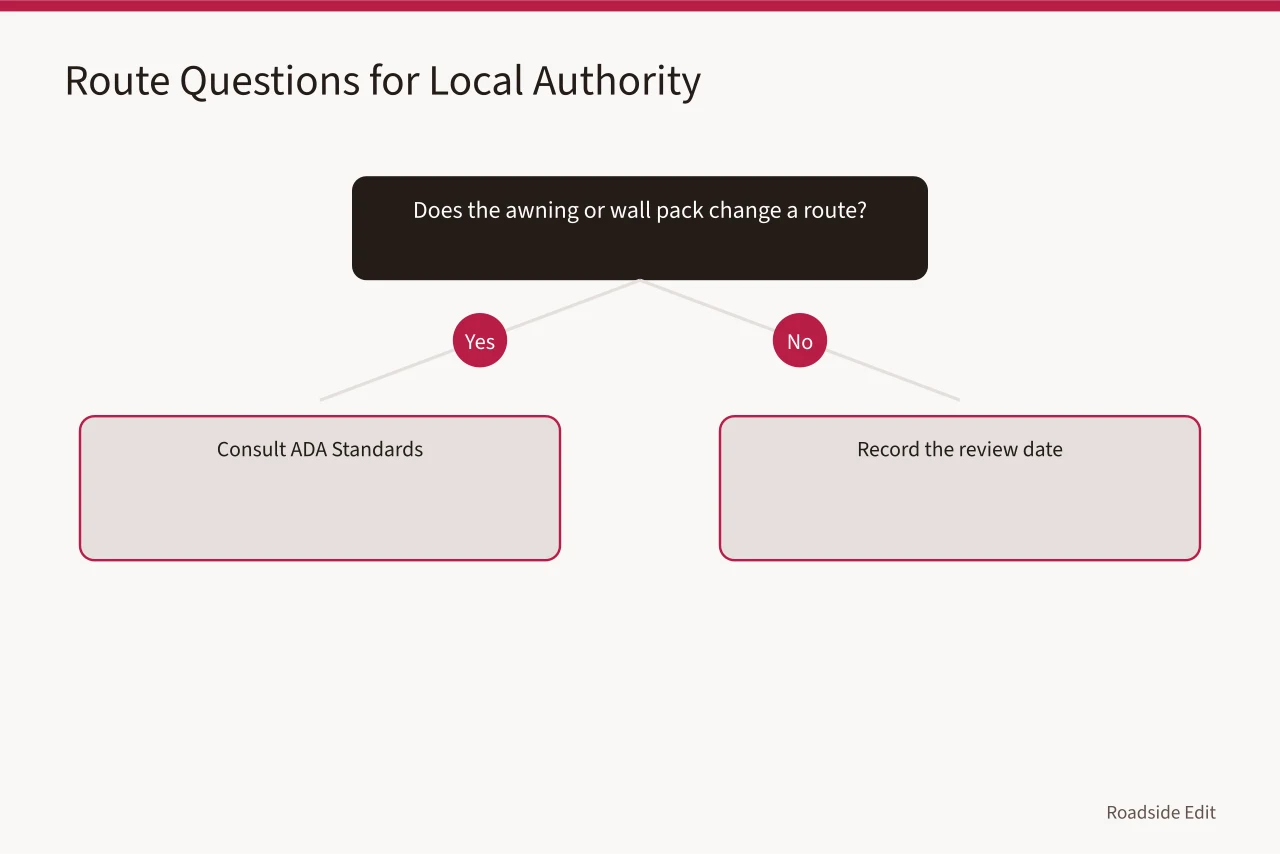
An exterior concept can raise permit, use, access, flood, or technical questions. An editorial comparison cannot answer them from appearance. Identify the office or qualified reviewer who owns the question and record the date of any response.
FEMA's National Flood Hazard Layer provides federal flood hazard information for mapped areas. Check FEMA's National Flood Hazard Layer information.
It does not decide whether a particular motel is safe, damaged, insurable, or subject to a project requirement. It gives a planning record a specific source to consult when mapped flood information may bear on a coating or metal panel choice.
An arrival route needs the same care. A photo may show a curb, ramp, walkway, or entrance, but it cannot establish accessibility compliance.
The ADA Standards for Accessible Design are technical standards for covered facilities. Consult the ADA Standards for Accessible Design.
A Marygrove awning or a RAB wall pack can change a route or a light level, and that question belongs with the reviewing authority.
How should visual preference be used?
Preference is real, but it should be labeled. An owner may prefer a color, sign treatment, planting change, or lighting look. Readers may prefer a historic appearance or a contemporary one. Those are opinions, not findings about code, cost, safety, or approval. They are also not findings about building condition.
Give preference its own row. Do not let it hide missing facts. A concept can be visually right and still need property information, a responsible review, or authorization.
How should provider and paid material be handled?
A business may submit an image, a scope description, or paid placement. Attribute the statement to the business and mark sponsored visibility. A submitted description is not independent proof of performance, price, approval, or outcome.
Publish the comparison basis. If sources are uneven, say which option needs more evidence. A visible gap beats a ranking the record cannot support.
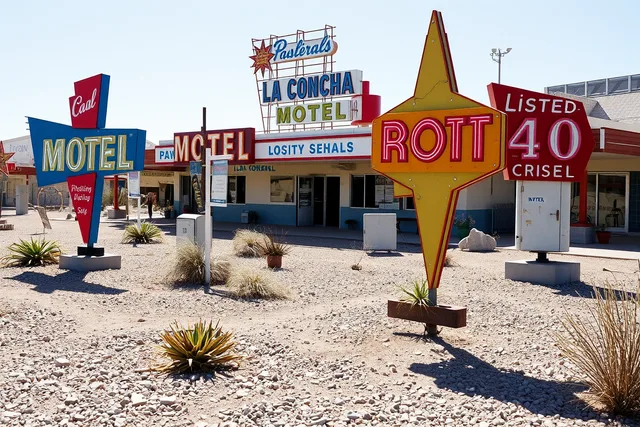
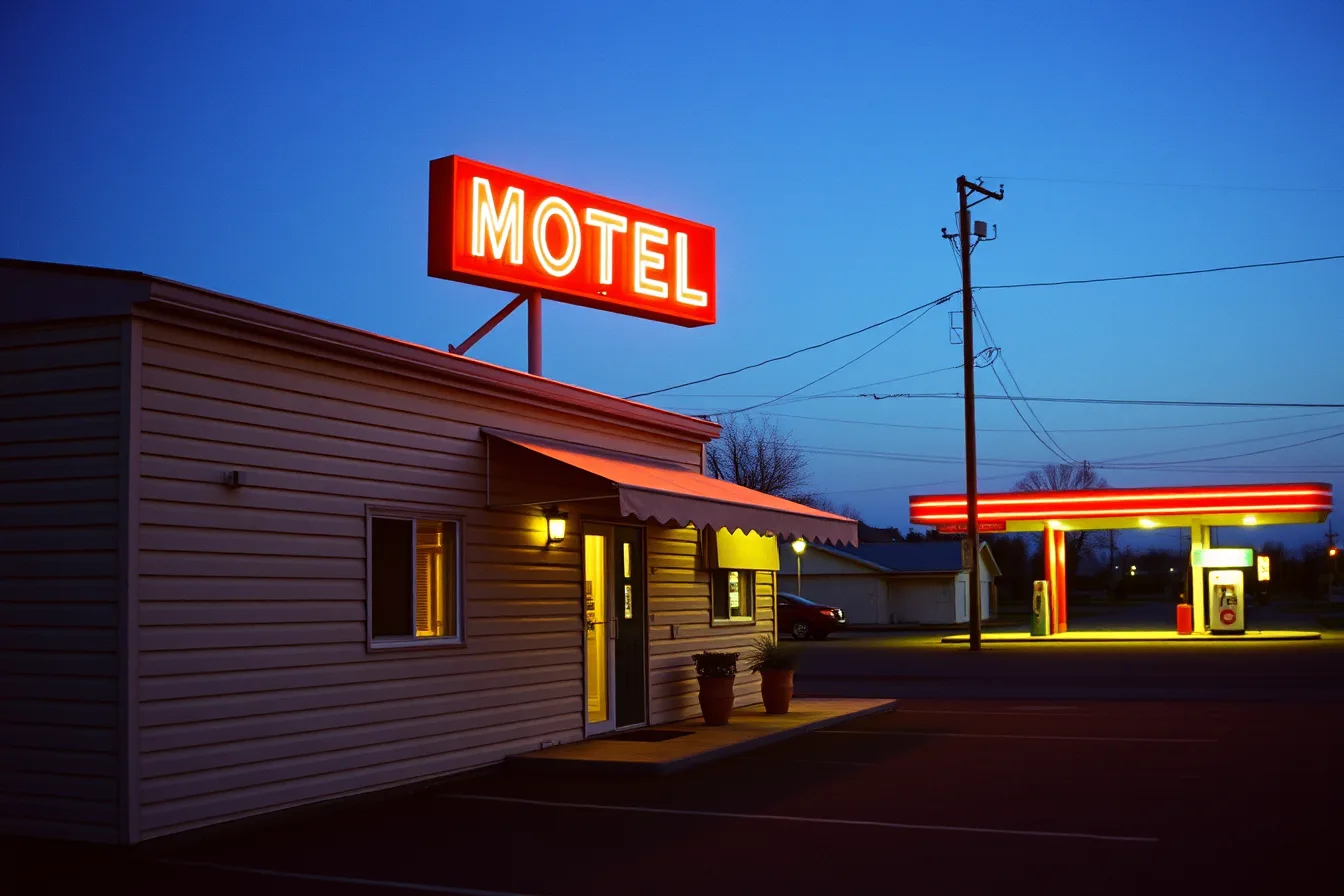
The image is illustrative. It does not establish a specific motel's condition, cost, ownership, safety, or project status.
A short option-review meeting
Read the option cards together. Confirm the question, evidence, assumptions, decision owner, and change record for each. Then decide whether the next action is research, a records request, an authorized review, a revised concept, or a project decision.
Pause when the scope is vague, the record conflicts, access is unresolved, or a claimed benefit has no source. A pause keeps a preliminary idea from hardening into an unsupported statement.
When the meeting ends, the plan either has a named owner and a date or it does not. If the sign or the wall is still open, planning motel exterior work is the next read.
Common questions
Can visual preference be a comparison criterion?
Yes, if it is labeled as preference and does not stand in for factual or project-specific evidence. Give it a row so it cannot quietly replace a missing fact.
What if two options answer different questions?
Split them into separate planning tracks instead of ranking them against each other. A coating decision and a sign-code decision rarely share a decision owner.
Who can answer an approval question?
The responsible owner, the public authority, or the appropriate project reviewer, depending on the issue. Record who answered and when.
Is a sketch an approved design?
No. It is a proposal or a communication tool unless a responsible record states otherwise. Keep revisions identifiable so no one mistakes one for the other.