Guides
Part of How to compare motel exterior options for 2027 without a score
Motel exterior options checklist: how to compare paths before you choose
Compare motel exterior paths on one evidence packet, one decision owner, and one stop point, so a record, study, or project request is judged fairly.
An exterior option is a possible next path, not a promise. A motel owner may weigh a record-only path, targeted research, a concept study, a maintenance review, or a project request.
Each path takes different inputs and ends at a different decision maker. Comparing them fairly means writing down those differences before anyone treats a drawing or a proposal as a final answer.
This checklist sets up that comparison. It does not pick a treatment, approve work, judge a building's condition, or say what permits apply. It organizes evidence, limits, and the next question.
What to take away
- Name the one decision each path must serve, and the exterior feature it covers.
- Keep dated observation, future concept, and source-backed history in separate fields.
- Treat missing evidence or missing authority as a reason to pause, never as a low score.
- Log who can authorize access, records, or review, and the date you checked.
- Record why a path advanced, changed, or stopped, so the old reasoning is not reused.
Five paths, five different jobs
A record-only path preserves what exists now: dated photographs, source pages, open questions. It answers nothing about physical work.
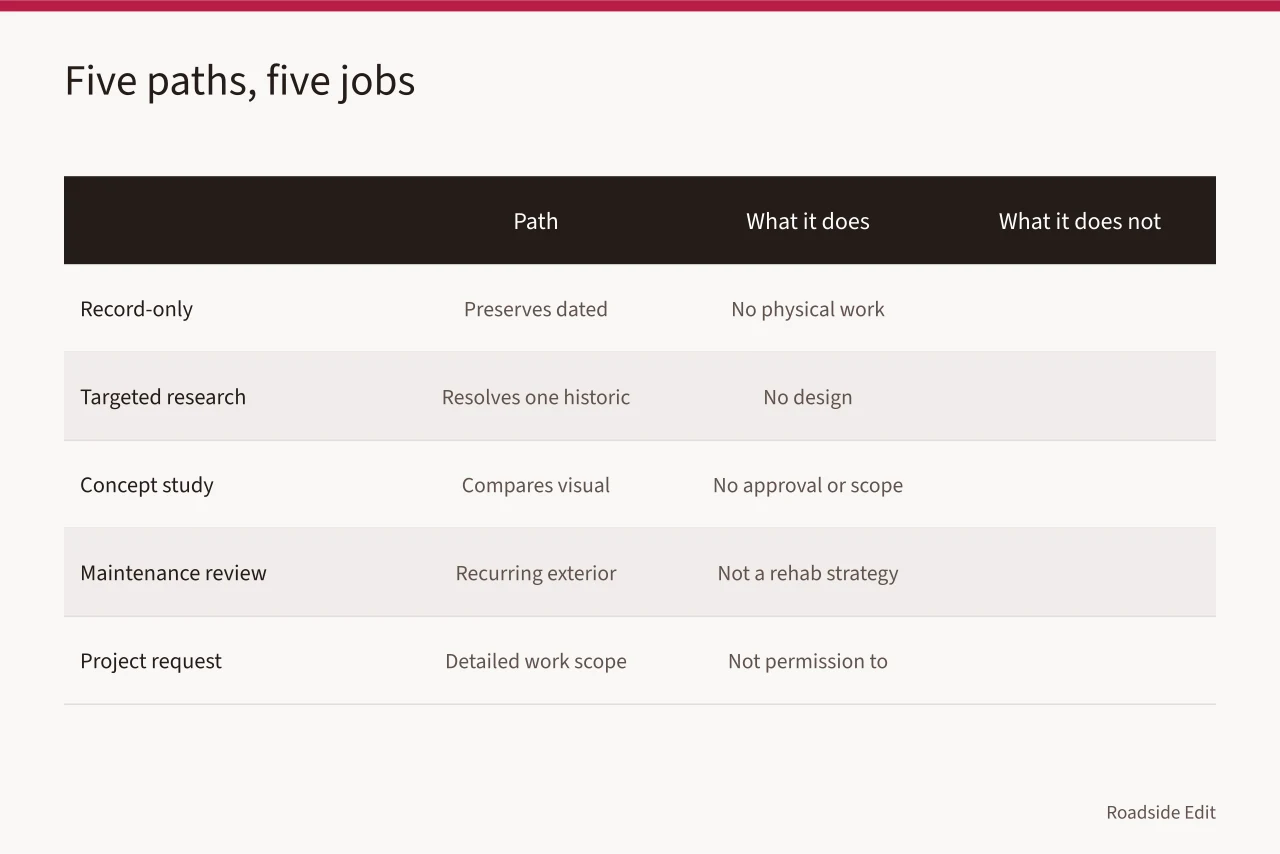
Targeted research resolves one historic or ownership question, such as the date a porcelain-enamel sign was installed or which supplier made the canopy's neon tubing. It does not produce a design.
A concept study compares visual directions against a defined brief. It does not approve anything or set construction scope.
A maintenance review covers recurring exterior care, such as canopy soffit and dry-stand pipe inspection or forecourt drainage. It is not a rehabilitation strategy.
A project request prepares a detailed work scope for a decision owner. It is not permission to start.
The National Park Service's preservation-planning guidance asks teams to define issues, goals, and priorities and to match scope to available resources. Read the NPS preservation-planning guidelines. The lesson for a motel card: write a decision someone can actually investigate before you compare solutions.
Do not let a preferred look become the question. A mood board can open a design conversation. It should not decide which evidence the team gathers.
One evidence packet for every path
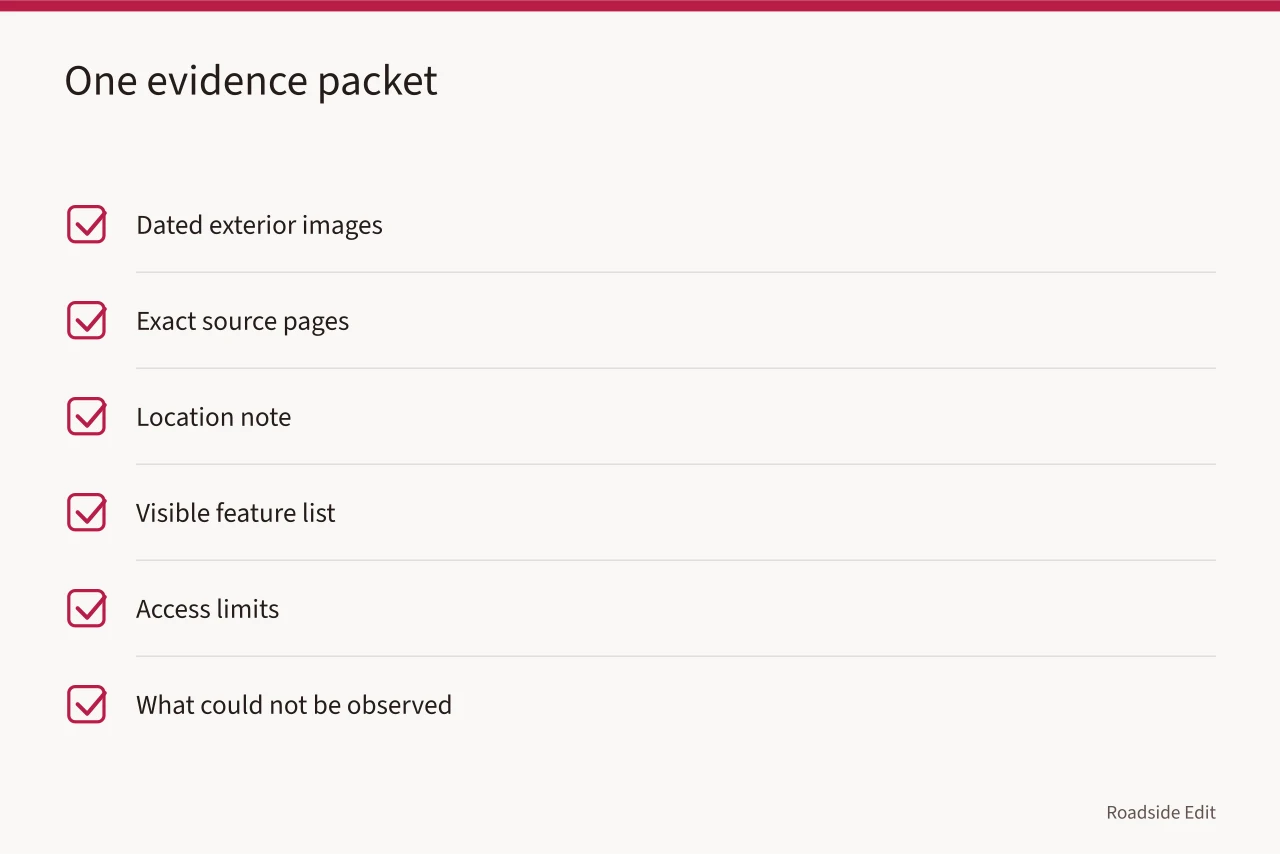
Every path starts from the same current record: dated exterior images, exact source pages, a location note, a visible feature list, and access limits. Write down what could not be observed. Do not hand the favorite path a richer packet.
NPS documentation requirements for rehabilitation applications use photographs to record existing appearance and condition, with captions tied to each view. Review the NPS photo-documentation requirements. That program has its own formal standards. The transferable habit is to label every image by subject, date, view, and purpose.
| Evidence item | Supports | Does not support |
|---|---|---|
| Dated photo | A visible view at a stated time | Hidden condition or project approval |
| Owner statement | The owner's stated preference | A final scope or technical conclusion |
| Historic record | The specific fact in that record | Current operation or future work |
| Concept image | A possible visual direction | Cost, permit path, or final outcome |
Each card cites the exact evidence it uses. If a source does not carry a claim, move the claim to the open-question field instead of arguing harder for it.
Describe each path by purpose and boundary
A record-only path and a physical-project path solve different problems, so the cards should not look alike. The differences are the decision.
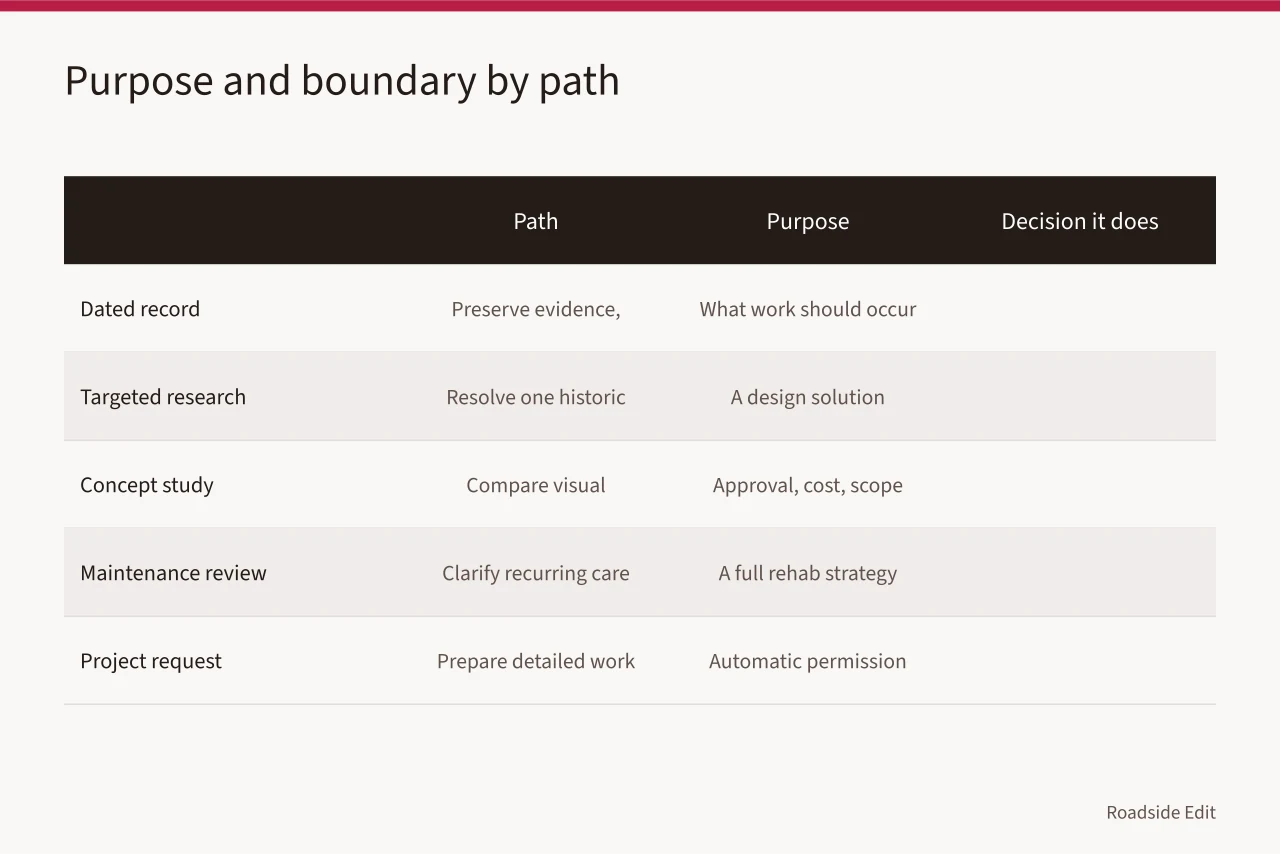
| Path | Purpose | Required input | Decision it does not make |
|---|---|---|---|
| Dated record | Preserve current evidence and open questions | Lawful viewpoints and source notes | What physical work should occur |
| Targeted research | Resolve a historic, ownership, or authority question | Specific records or a responsible contact | A design solution |
| Concept study | Compare visual directions | Defined brief and current evidence | Approval, cost, or construction scope |
| Maintenance review | Clarify a recurring exterior-care question | Access, scope boundary, suitable reviewer | A full rehabilitation strategy |
| Project request | Prepare a more detailed work scope | Decision owner, requirements, source record | Automatic permission to begin |
The Secretary of the Interior's Standards describe rehabilitation as retaining historic character while allowing alterations for a compatible contemporary use. Read the rehabilitation treatment standards. Those standards govern the NPS program, not every motel. They show why a card should separate the current property, the proposed alteration, and the purpose of the change.
Skip labels like "best option" until the record shows what is being compared. A concept can look strong and still lack the access, authority, or evidence the next decision needs.
Log authority and access questions
Some paths need an owner's direction, a public record, authorized site access, a local review, or a specialist. Name the exact question and the likely decision maker. Do not write the answer you hope for.
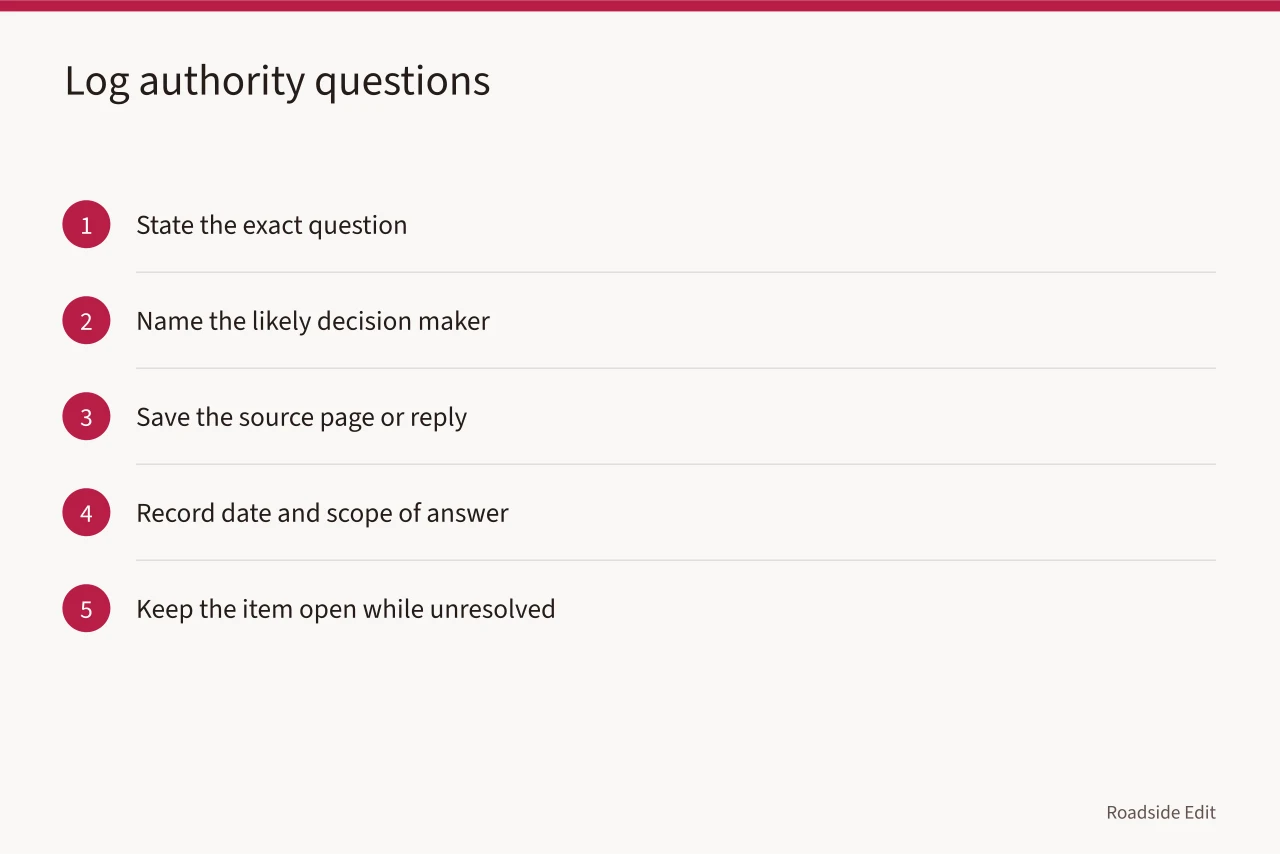
NPS permitting guidance asks teams to analyze jurisdictions, separate what is and is not part of a project, and document how unknowns get resolved. Read the NPS permitting checklist. It is a federal project tool. For a motel card it supports one step: put authority questions in their own log before treating an assumption as permission.
- State the question, such as "Who can authorize a measured exterior record?"
- Name the likely owner, office, or entity.
- Save the source page or written response you checked.
- Record the date and scope of the answer.
- Keep the item open while it is unresolved.
Do not contact agencies or owners just to fill the log. The task is to identify the responsible source for a question that changes the path.
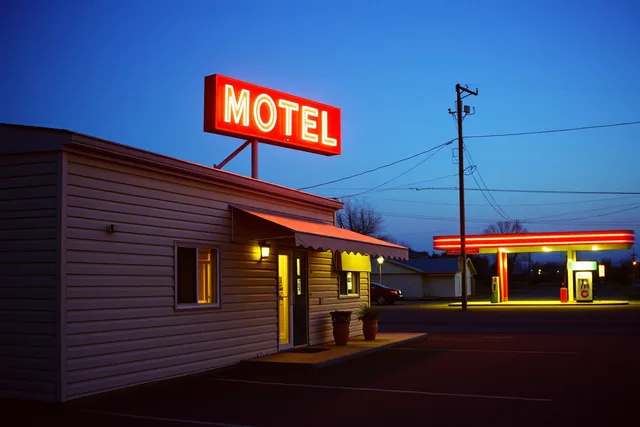
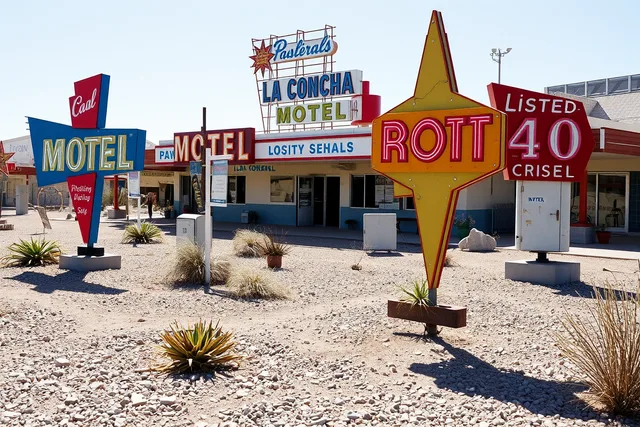
The image is visual context only. It does not establish current condition, ownership, access, or approval. It does not establish cost or whether any path suits another motel.
Decide from a table, not a score
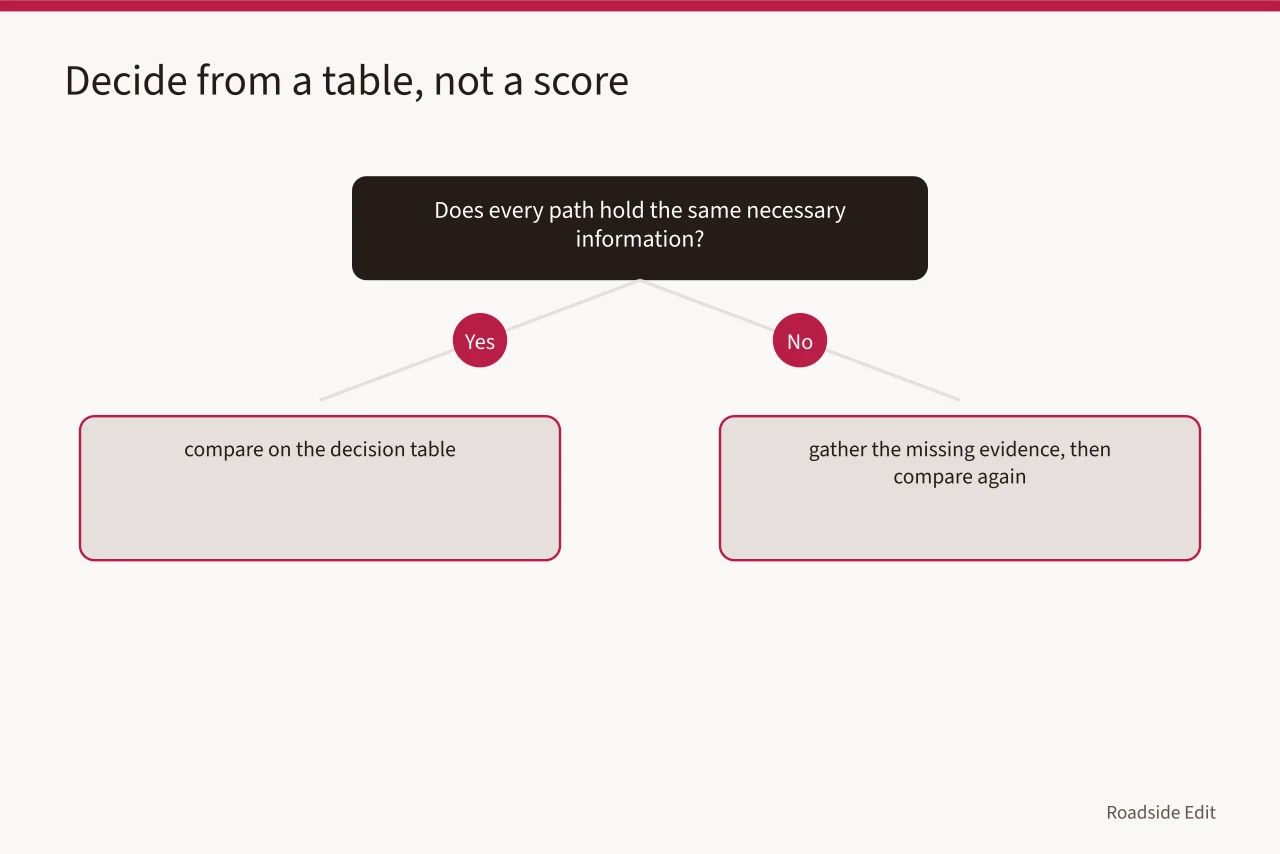
Scoring early hides the fact that a path has no decision owner or no reliable evidence. Use a decision table first. Score only if the owner has a documented method and every path holds the same necessary information.
| Review question | What to record |
|---|---|
| What problem does this path address? | Exact decision question |
| What evidence supports it? | Dated source and visible limit |
| What is missing? | Access, record, authority, or condition question |
| Who decides the next step? | Named role or responsible body |
| What changes if it proceeds? | New scope, request, or research task |
| What is the stop point? | Condition that blocks a valid next decision |
An incomplete path is not a bad path. It may be the only one that surfaces an unanswered question. The correct result can be "gather this evidence, then compare again."
Keep the option history
Cards change when a source is corrected, an owner changes the question, or access proves unavailable. Note the change instead of quietly rewriting the card.
| Change type | Example note |
|---|---|
| New source | "July 2027 photo added; second public view of the sign." |
| Access limit | "Interior documentation removed; access was not authorized." |
| Decision update | "Owner chose a record phase before any concept study." |
| Correction | "Source date revised after the original archive record was checked." |
Store submitted or paid material apart from the option evidence. A provider's proposal describes an offered approach. It does not prove the motel's condition, approval, or expected result. Label any commercial relationship where a reader might mistake it for neutral editorial judgment.
Two internal paths sit behind this one. The motel exterior options compared piece sets paths side by side on the same criteria. The planning the motel exterior piece covers the record that comparison depends on.
Common questions
Is an options checklist a project scope?
No. It builds a comparison record. A project scope needs its own deliverables, requirements, authority, and review process.
What if one path has less evidence than the others?
State the gap and name the next research or review task. Do not bury the gap under a score.
Can a public image establish permission to alter a motel?
No. Image rights and property permission are separate questions. Ask the owner and, where the work touches a regulated feature, the local landmarks commission or State Historic Preservation Office.