Guides
How to plan a roadside design studio workflow before you pick options
Plan a roadside design studio in 2027 with a clear scope, evidence inventory, participant strategy, options log, decision record, and revision cycle.
A roadside design studio needs a workflow before it needs a rendering. The workflow keeps a useful idea tied to the question, evidence, people, and decision that gave it meaning.
Without it, a meeting can produce attractive material that cannot explain why one option was discussed, what it leaves unresolved, or who owns the next step.
This is an editorial planning method for a U.S. roadside place. It can help organize a discussion around a corridor, commercial frontage, historic roadside building, parking area, sidewalk, entry, sign, or public-facing outdoor space. It is not a permit process, professional assessment, construction plan, accessibility determination, boundary opinion, or agency approval.
What to take away
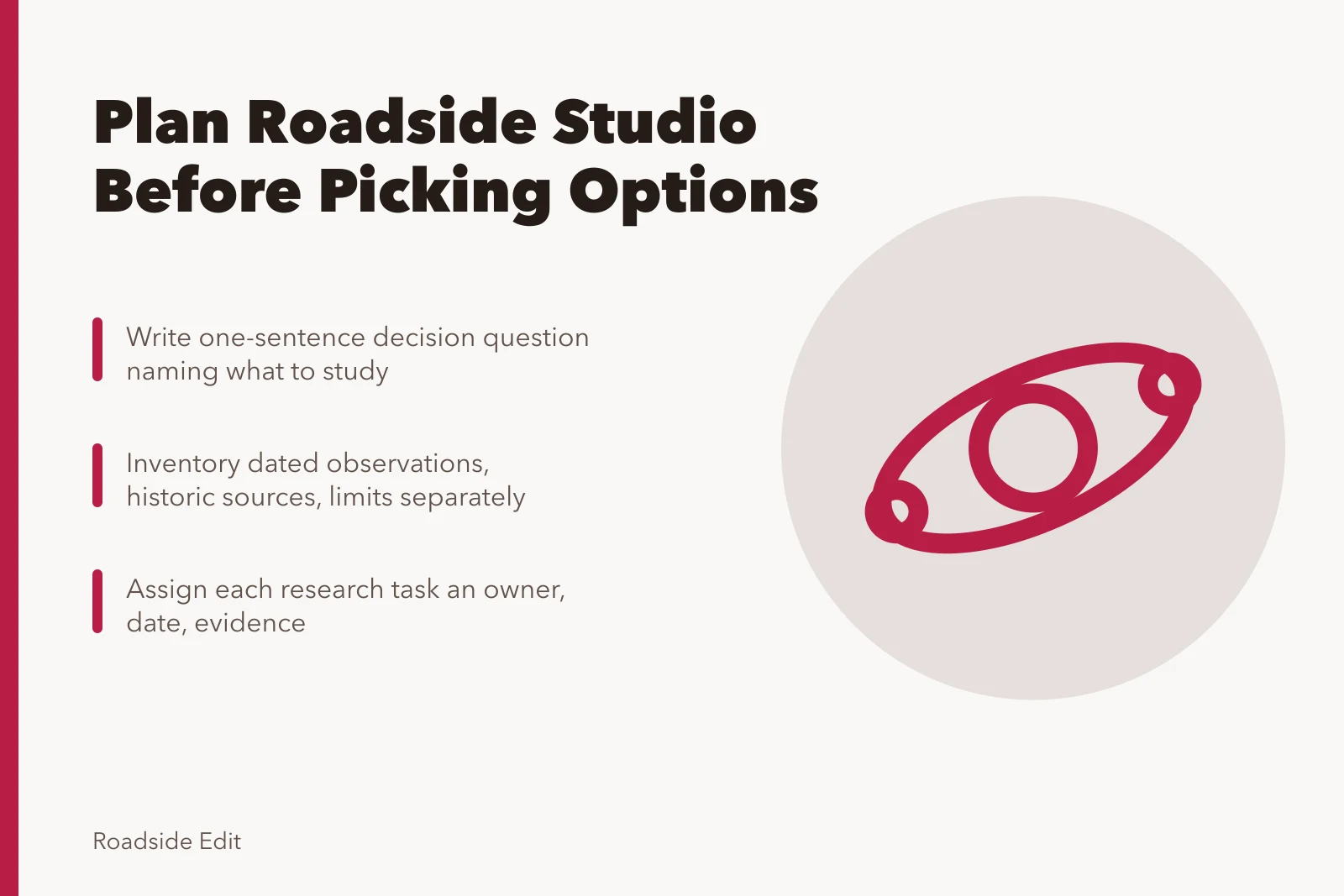
- Define the decision, the place, and the limits before collecting ideas.
- Inventory conditions and sources separately from participant views.
- Use values and constraints to frame alternatives, not to select a favorite prematurely.
- Assign each research task to an owner with a date and expected evidence.
- Keep a revision record when new information changes an earlier assumption.
Begin with a decision boundary
Write a one-sentence decision question. It should identify what the studio will help a responsible party understand, not what it must approve.
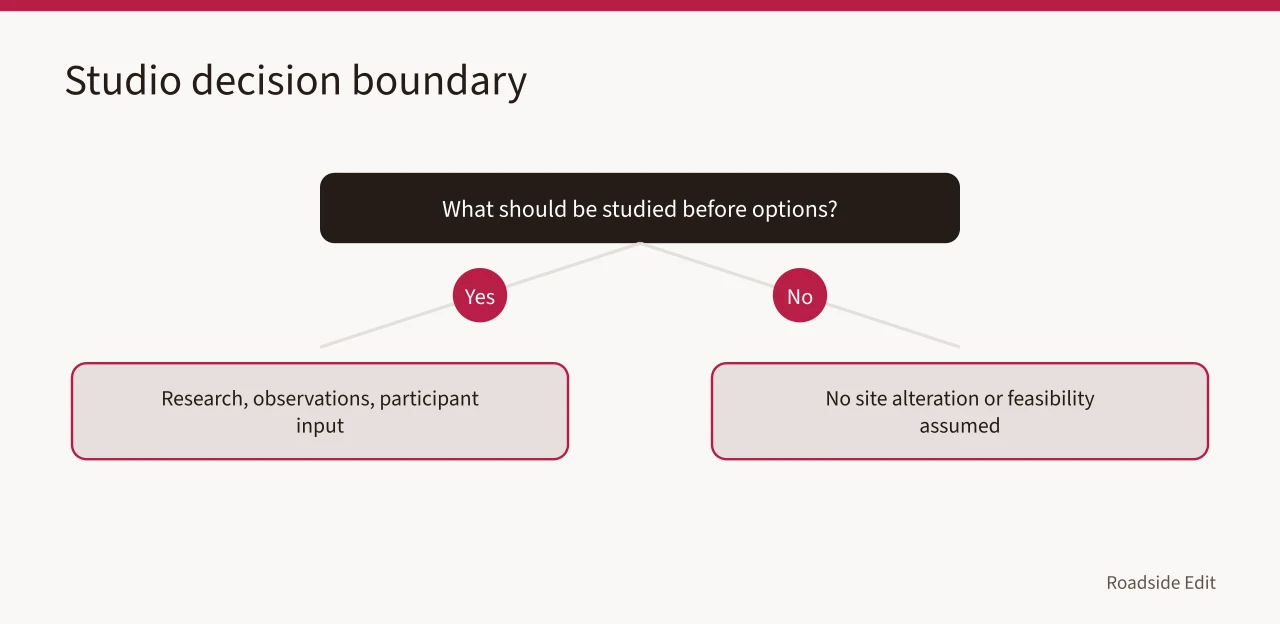
For example: "Which documented arrival and frontage issues should be studied before the owner evaluates concept options?" That question allows research, observations, and participant input. It does not assume a site will be altered or any particular option is feasible.
Next, state the physical and time boundary. Name the frontage, parcel area, corridor segment, or building edge the session covers. Record the source date for historic material and the observation date for present conditions.
A historic view may be relevant to a place's story, but it does not prove current condition. A current photograph may show a visible obstruction, but it does not establish ownership or an unseen construction issue.
Finally, write exclusions. A studio can identify questions for later code, engineering, preservation, environmental, legal, or accessibility review. It should not make those findings by implication. This short scope note prevents a later article from describing a concept as though it answered every project question.
Build a conditions inventory
The inventory is a concise, dated record of the information available at the start. It does not need to be exhaustive. It needs to be legible enough that a new participant can see what is known and what is missing.
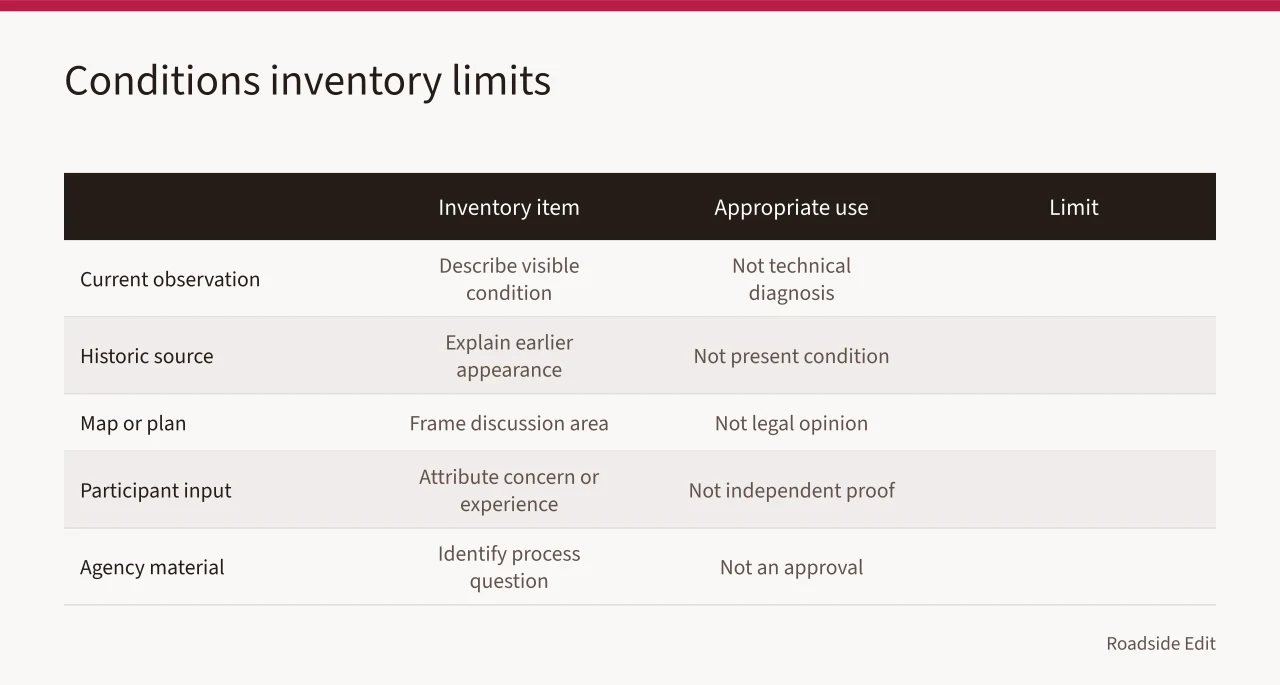
| Inventory item | Record to capture | Appropriate use | Limit |
|---|---|---|---|
| Current observation | Date, viewpoint, and observer | Describe a visible condition | Not a technical diagnosis |
| Historic source | Publisher, date, and feature shown | Explain earlier appearance or use | Not present condition |
| Map or plan | Publisher and date | Frame the area of discussion | Not a legal opinion |
| Participant input | Role, date, and topic | Attribute a concern or experience | Not independent proof |
| Agency material | Specific page and scope | Identify a process question | Not an approval |
Add a limitation note to each item. This one habit makes the workflow safer and easier to audit. It tells a writer not to enlarge the record beyond what it can show. It also keeps an early idea from becoming a misleading promise once the project reaches a different stage.
Identify values before selecting options
Values are reasons the question matters: a site's historic character, a business's public entry, a pedestrian route, a view, and a relationship to adjacent buildings. They also include a place's economic role or an area's environmental setting.
Constraints are conditions that limit choices. They include unknown ownership, a documented access concern, a limited work area, an unverified utility condition, and a required process that has not yet occurred.
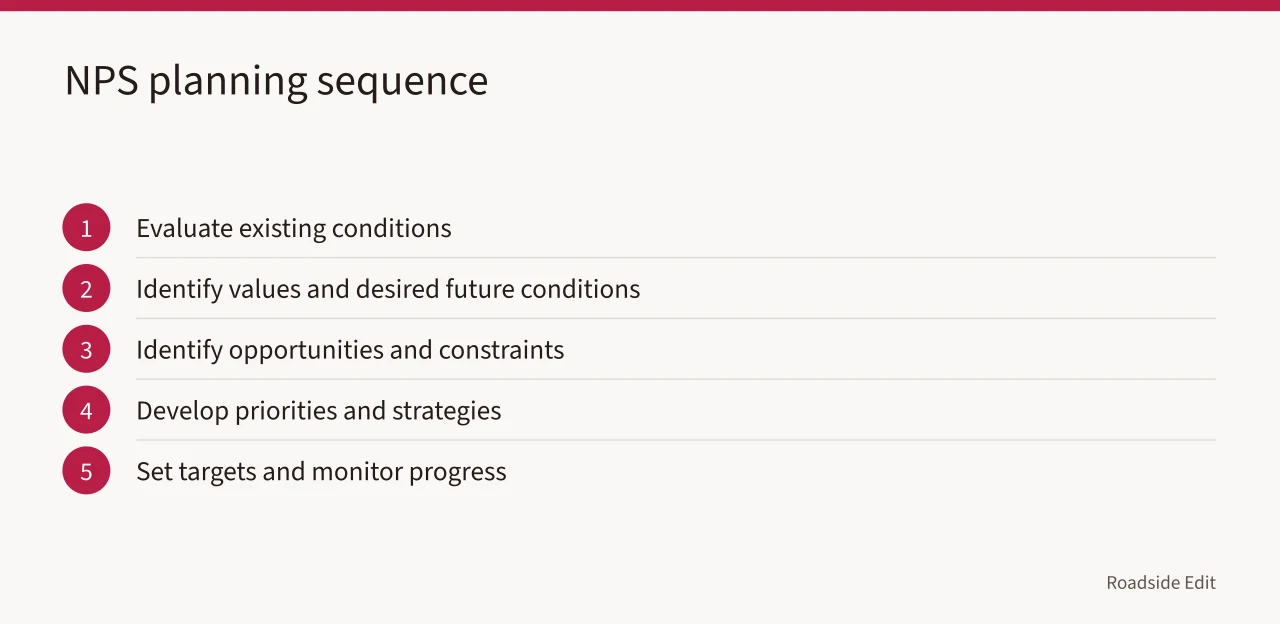
The National Park Service's planning tips outline a workflow: evaluate existing conditions; identify values and desired future conditions; identify opportunities and constraints; develop priorities and strategies; then set targets and monitor progress. Read the NPS planning tips.
That sequence uses values and constraints as planning inputs. It does not dictate a project's values or final strategy.
Do not label a preference as a value without explaining whose preference it is and why it is relevant. Do not label a difficult issue as a constraint if it is merely an assumption that has not been checked. A careful studio allows both categories to change as new information appears.
Plan participation around useful questions
Participation works best when people know what they are asked to help with. An operator may know deliveries and daily patterns. A neighbor may know a recurring conflict. A historian may find a source.
A public employee may describe the local process. A person who uses a route may point to a gap in the studio's understanding. Record each contribution as the kind of input it is.
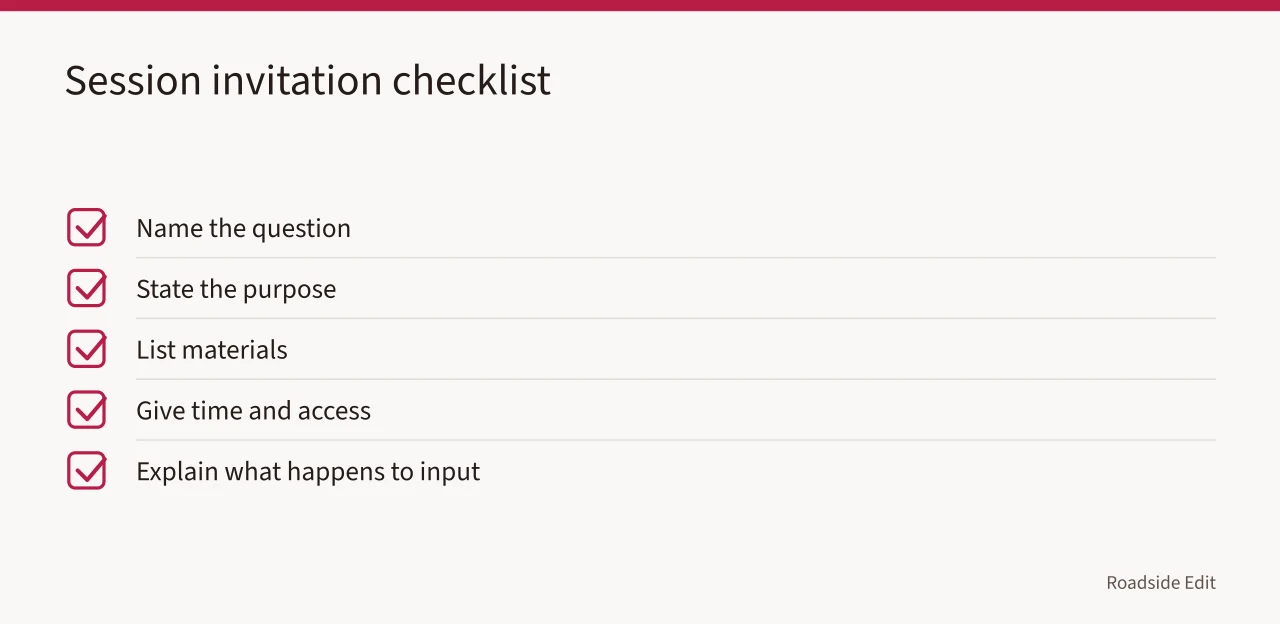
The session invitation should name the question, purpose, materials, time, and access information. It should state what happens to input afterward.
Do not promise a comment will be adopted, a vote will decide a project, or an informal session replaces required notice or review. If the studio is part of a public process, use the responsible body's actual rules and records.
During the session, keep a separate log for questions, views, and facts. If someone makes a claim about a date, condition, cost, or requirement, add it to the research queue unless a cited record is already available. This gives participant knowledge proper respect without asking it to carry more authority than it has.
Develop alternatives with explicit assumptions
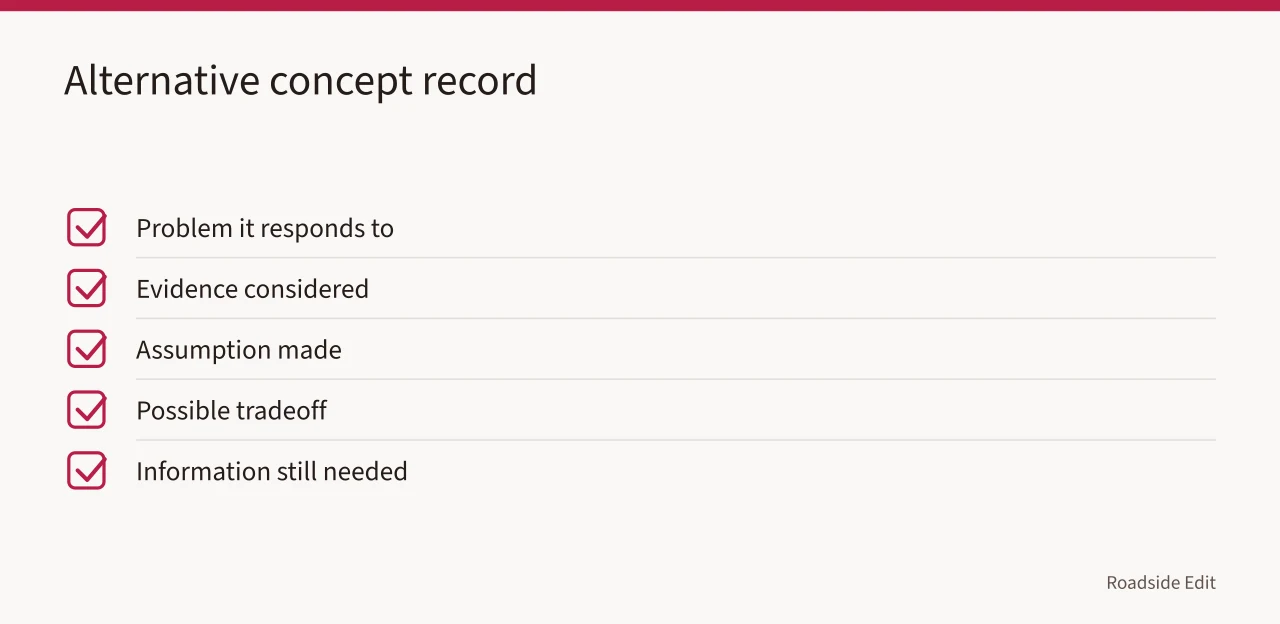
Alternatives work best when they address the same defined question. For each one, state the problem it responds to, the evidence considered, the assumption made, the possible tradeoff, and the information still needed. A concept can test a different arrival sequence, signage relationship, frontage organization, or public-space use. It should be labeled as a concept throughout.
Avoid inflated phrases such as "best option," "proven solution," or "guaranteed improvement." A studio is not a contest between images; it shows how different ideas respond to documented concerns.
If an option depends on an unverified detail, say so, and if later research is needed to compare it, write that down instead of assigning a false ranking.
Create an action register
Every meeting should end with an action register, not a vague promise to follow up. The register can be small:
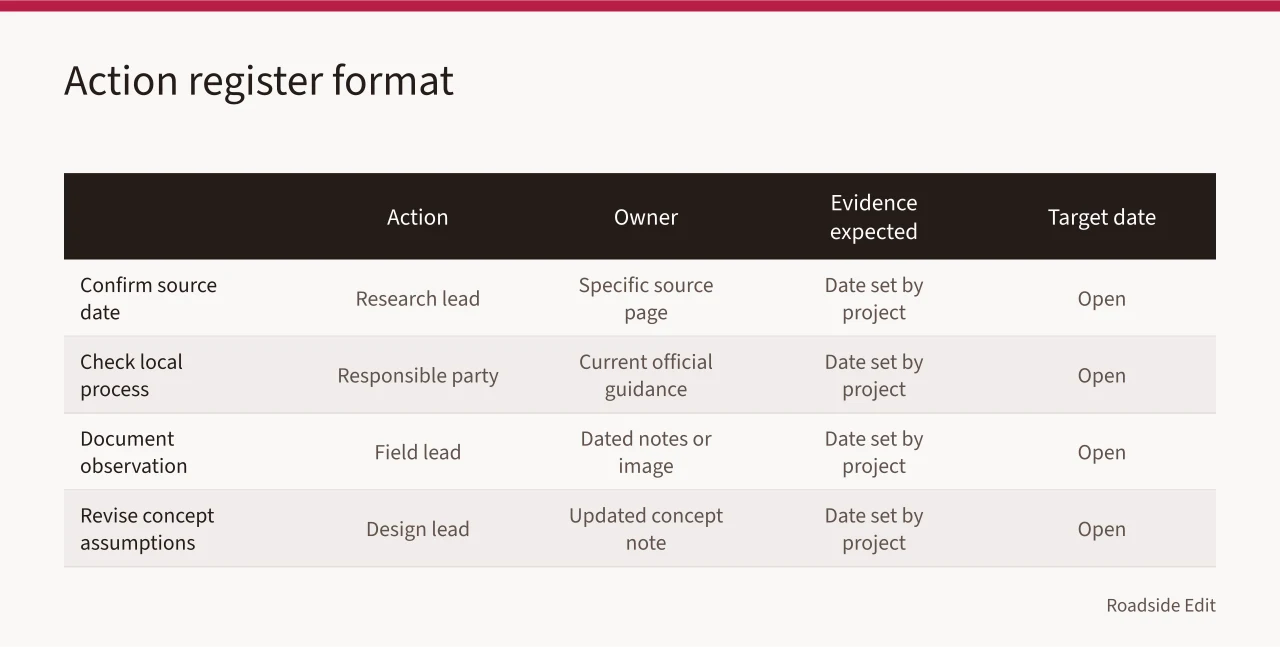
Do not assign a responsibility to "the group." Name the role or organization that can act. If the owner is unknown, record that as a gap. This makes the plan honest and prevents a later recap from making it appear that a task was completed when no one was responsible for it.
Keep a decision and revision record
A planning workflow changes when the evidence changes. Preserve that change. A decision record should state the date, decision owner, source or input considered, result, and any condition attached to the result. A revision note should state what assumption changed and why. Neither needs to be long. Both help distinguish an early concept from a later direction.
When an article summarizes the workflow, use careful verbs. A group discussed, identified, requested, observed, deferred, or selected a next action. A source describes, reports, depicts, or records. An agency approves only when a specific source says it did. These distinctions turn process reporting into something readers can trust.
Close with a review cycle
Set a date to review inventory, values, constraints, options, and action register, the review where the workflow catches itself.
New evidence may narrow a concept, make a question irrelevant, reveal a missing participant, or require a different professional review.
Updating a plan is not a failure of the original session; it is the point of keeping a documented process.
Before publishing, check that every statement is either a source-backed fact, an attributed participant view, a limited observation, or a clearly identified editorial lesson. If not, find support, narrow the sentence, or remove it. A good planning workflow makes a roadside discussion more transparent. It does not create certainty that the evidence has not earned.
The Federal Highway Administration public-involvement guide supports planning for meaningful public involvement. The National Archives records-management basics support a dated decision trail. The EPA smart-growth reuse guide provides a planning context for reuse discussion, not a site-specific decision.
Common questions
Is a studio plan a final project plan?
No. It is a record of questions, evidence, concepts, and next actions. Later review may change every one of those items.
What should happen when a participant raises a new issue?
Add it to the action register, identify what evidence is needed, and avoid treating it as a settled fact until it is checked.
Why preserve earlier concepts?
They explain which assumptions changed and help prevent a later article from describing a preliminary idea as a final result.
In this guide
- Roadside design studio planning questions to settle before the next roundRoadside design studio planning questions for 2027 clarify the decision, evidence needs, participation methods, alternatives, local process, and open project issues.