Guides
Part of How to plan a roadside design studio workflow before you pick options
Roadside design studio planning questions to settle before the next round
Roadside design studio planning questions for 2027 clarify the decision, evidence needs, participation methods, alternatives, local process, and open project issues.
Planning questions make a design studio useful when the evidence is incomplete. They identify what a project needs to learn before it compares concepts, requests a review, or assigns work. A workshop does not become an approval, measurement, or technical assessment because people discuss it.
What to take away
- Ask what decision needs evidence next.
- Separate input-gathering, historic-research, technical, and local-process questions.
- Choose a participation method that fits the people and purpose.
- Preserve unanswered questions as assigned actions rather than smoothing them out of the recap.
What decision comes first?
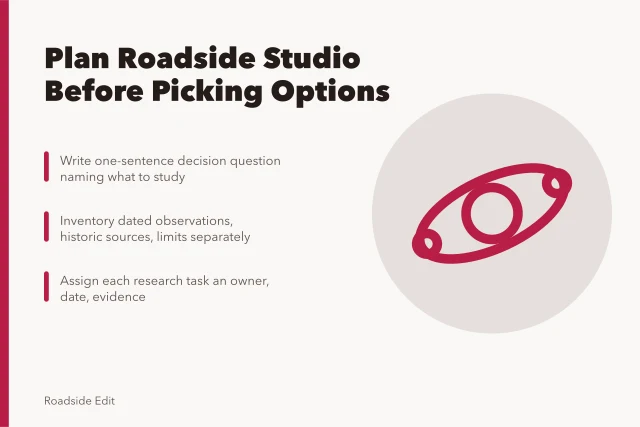
Start with the boundary. What place is included? What issue is visible or reported? What date does each record describe? Then identify the decision: Who will decide the next step? What evidence do they need? What issue should not be decided at this session?
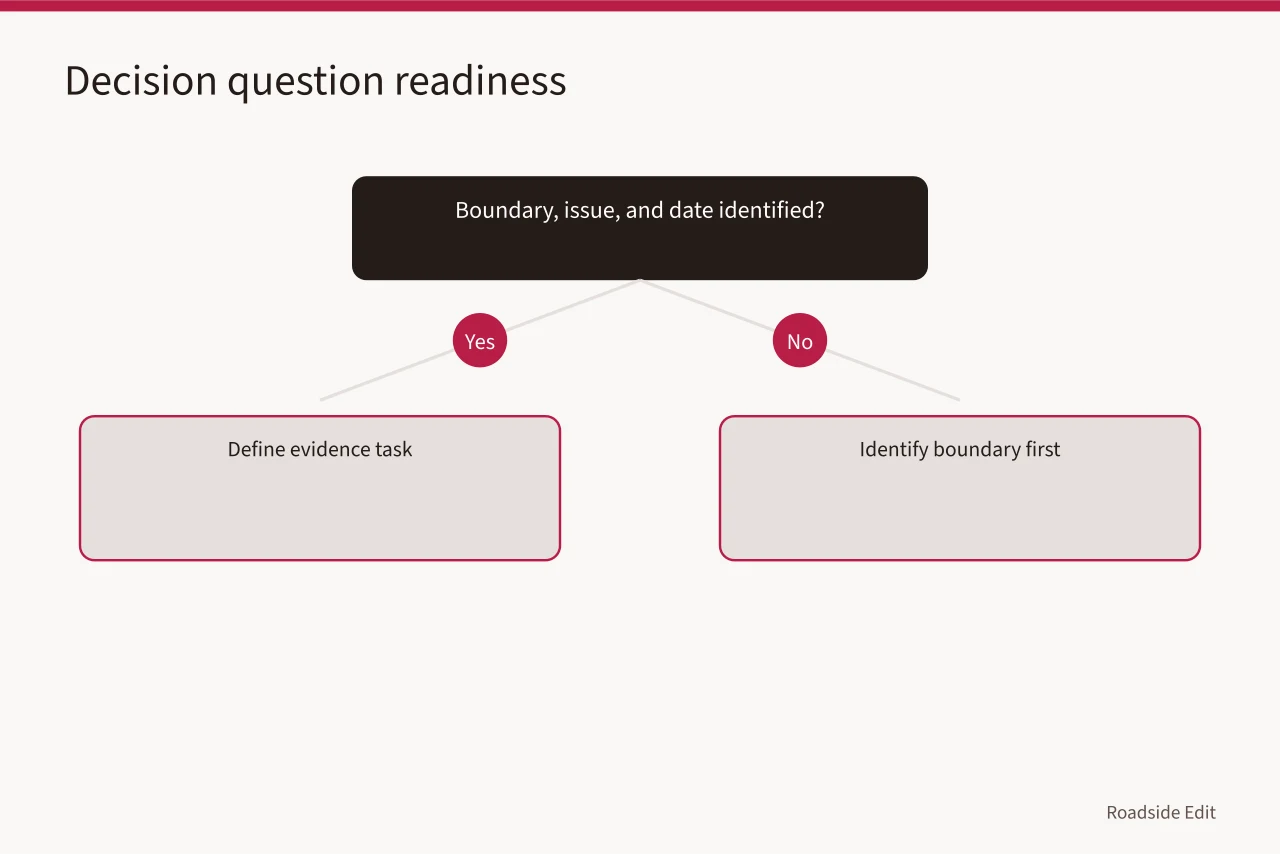
Write the planning question as a decision question. "Where should the new sign go?" is too early if the studio has not identified the property boundary, responsible decision maker, or sign purpose.
"What information is needed before the responsible party chooses a sign location?" gives the group an evidence task. It also makes room for a conclusion that the required information is not yet available.
Define the output before the meeting starts. It may be a question register, a list of alternatives for further study, a source request, a participation summary, or a handoff memo. It should not be presented as a selected plan unless the responsible decision process actually selected one.
FHWA describes virtual public-involvement methods that include online meetings, pop-up outreach, story maps, videos, crowdsourcing, survey tools, polling, and visualization. That is a useful prompt to consider different information-sharing and input methods. It does not establish that any method provides required notice or adequate representation in a particular process.
Who needs to be heard, and how?
Ask what kind of input the planning question needs. A local business owner, visitor, resident, employee, property manager, or public agency may know different things. One participant's view can be a valuable statement, but it cannot stand in for every user group or make a technical finding. Record the role, date, question posed, and the limit of the input.
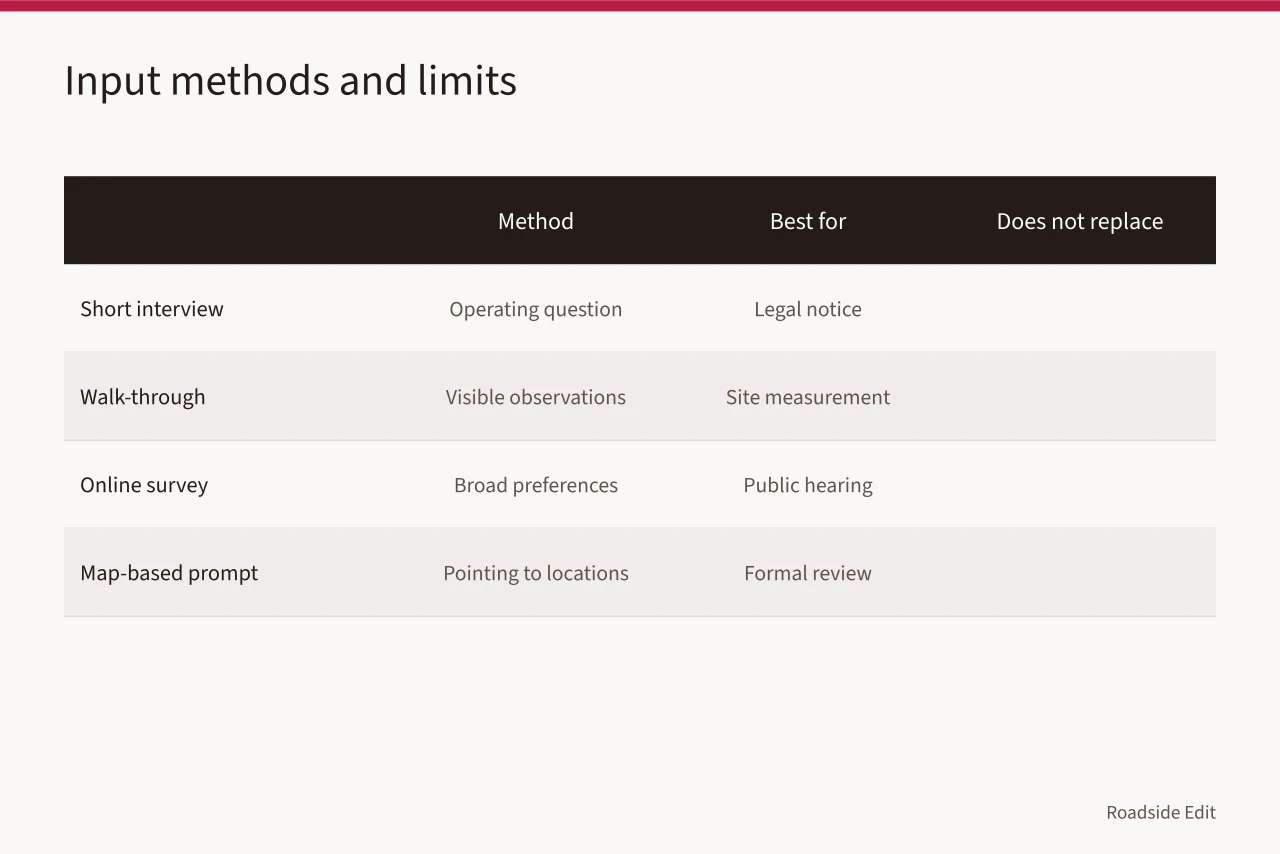
Match the format to the purpose. A short interview can clarify a specific operating question. A walk-through can identify visible observations. An online survey can gather broad preferences. A map-based prompt can help participants point to locations. None of these automatically replaces a legal notice, required public hearing, site measurement, or formal review.
The Federal Highway Administration's virtual public-involvement examples support a deliberate choice among different ways to share information and collect input. Review FHWA's virtual involvement page. It does not establish that a particular method meets the requirements of an individual project. Use it to frame a participation question, not to claim that a planning process is complete.
What historic evidence is needed?
Historic context often gives a planning group useful questions, not ready-made answers. Ask what source shows the prior appearance, date, use, or physical change, and record the creator, date, and what is visible versus inferred.
A historic photo can show an earlier feature. It cannot establish that the feature remains, that reconstruction is appropriate, or that the current property has the same use.
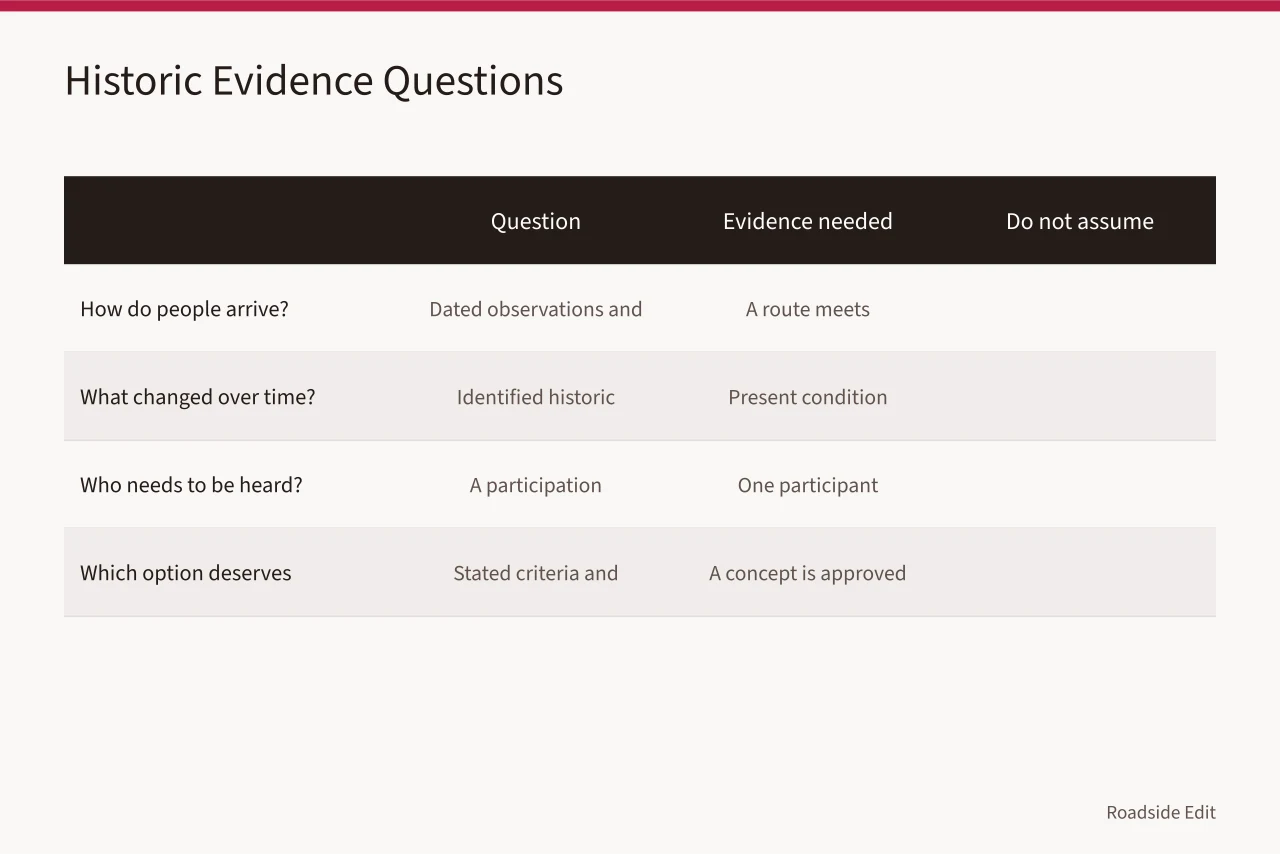
| Question | Evidence needed | Do not assume |
|---|---|---|
| How do people arrive? | Dated observations and input | A route meets requirements |
| What changed over time? | Identified historic records | Present condition |
| Who needs to be heard? | A participation strategy | One participant represents all |
| Which option deserves study? | Stated criteria and limits | A concept is approved |
The National Archives explains that primary sources are created by witnesses or participants and may provide direct evidence about past events. Review the National Archives explanation of primary sources. It does not transform a historic record into a present condition report. It supports a planning-file practice of saving provenance, date, and a limitation beside every historical reference.
Which alternatives deserve another round of study?
Alternatives should be compared against stated criteria. Ask what the alternative changes, who it affects, what it assumes, what evidence supports it, and which questions still need a responsible answer. The comparison can be qualitative. It does not need to create a score that pretends to be a final decision.
EPA's This Is Smart Growth publication describes examples and techniques that connect community visions and values with later actions. Read the EPA publication page. The publication does not adopt a plan for a particular roadside property. It supports keeping a stated vision separate from the actions, reviews, and decisions needed to carry an idea forward.
Use a table that shows both reasons and limits. An option might improve a stated arrival sequence but still lack a current access review. Another may preserve a visible feature but require an ownership or operations answer. The point is not to eliminate uncertainty. It is to identify the uncertainty that matters to the next decision.
Which questions require a local process?
Some questions cannot be settled in a studio. Permits, code application, property rights, final public access, and certain funding decisions belong with the responsible local or project-specific process. The planning record should say who needs to answer the question, what source is needed, and when the request was made.
FEMA describes building codes and consensus standards as risk-reduction tools and notes that adoption is tracked at state and local levels. Read FEMA's building-codes overview. It does not identify the code that applies to a particular design-studio idea. It supports routing code questions to the relevant jurisdiction rather than inferring an answer from broad national information.
How should open issues be carried forward?
An unresolved question is useful when it is dated, assigned, and tied to a next action. It tells readers where the studio stopped and protects a later article from treating a preliminary concept as settled fact. Use a simple open-issues record with the question, evidence already gathered, source still needed, responsible recipient, and next review date.
Group related questions under one evidence request when appropriate. A route observation may answer several arrival questions at once, while a local-process question may need a separate official source. This keeps the follow-up list manageable and makes it easier to see whether an answer is actually supported.
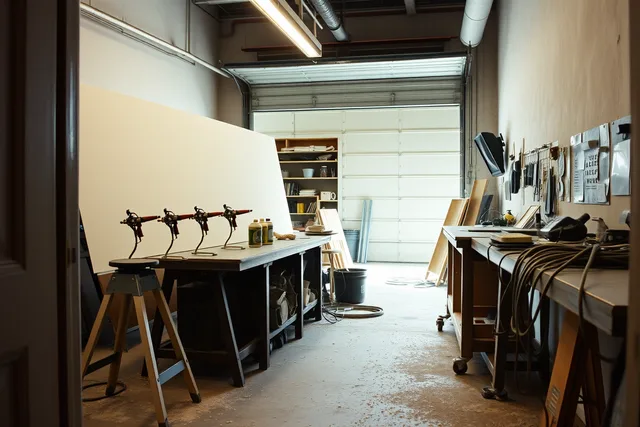
The image is illustrative only. It does not establish a project's boundary, condition, public input, approval, or route status.
A planning-questions checklist
- Is the decision and studio output stated clearly?
- Does each evidence request identify the source needed?
- Is participant input attributed and limited to what it represents?
- Are historic records labeled by date and provenance?
- Are alternatives described as study options, not approvals?
- Does every local-process question have a responsible next recipient?
Common questions
Can an online survey decide a project question?
It can gather input. Its role in a decision depends on the responsible process and the limits of the survey.
What question should be asked first?
Ask what decision the studio is meant to inform and what evidence would make that decision more responsible.
Should unanswered questions be removed from a recap?
No. Keep them visible with an owner and next action.